One of the earliest countries to embrace the habitat diorama form of natural history exhibition was Sweden. The Biologiska museet, which opened in 1893 in Stockholm, was created by Gustaf Kolthoff (1845 – 1913), a hunter naturalist, zoological conservator and nature writer. He designed the innovative museum as an illusionistic 360 degree panorama in which to display the richness and diversity of Nordic wildlife and nature. Thousands of preserved and mounted animals and birds were arranged in facsimiles of their coastal, mountain and forest habitats. Artist Bruno Liljefors (1860 – 1939), assisted by Gustaf Fjæstad, painted the huge background landscape for the museum, giving the scenery a magical sense of atmospheric space and distance. It was a grand visual spectacle of the concept of ecology long before it had been articulated in the biological sciences.
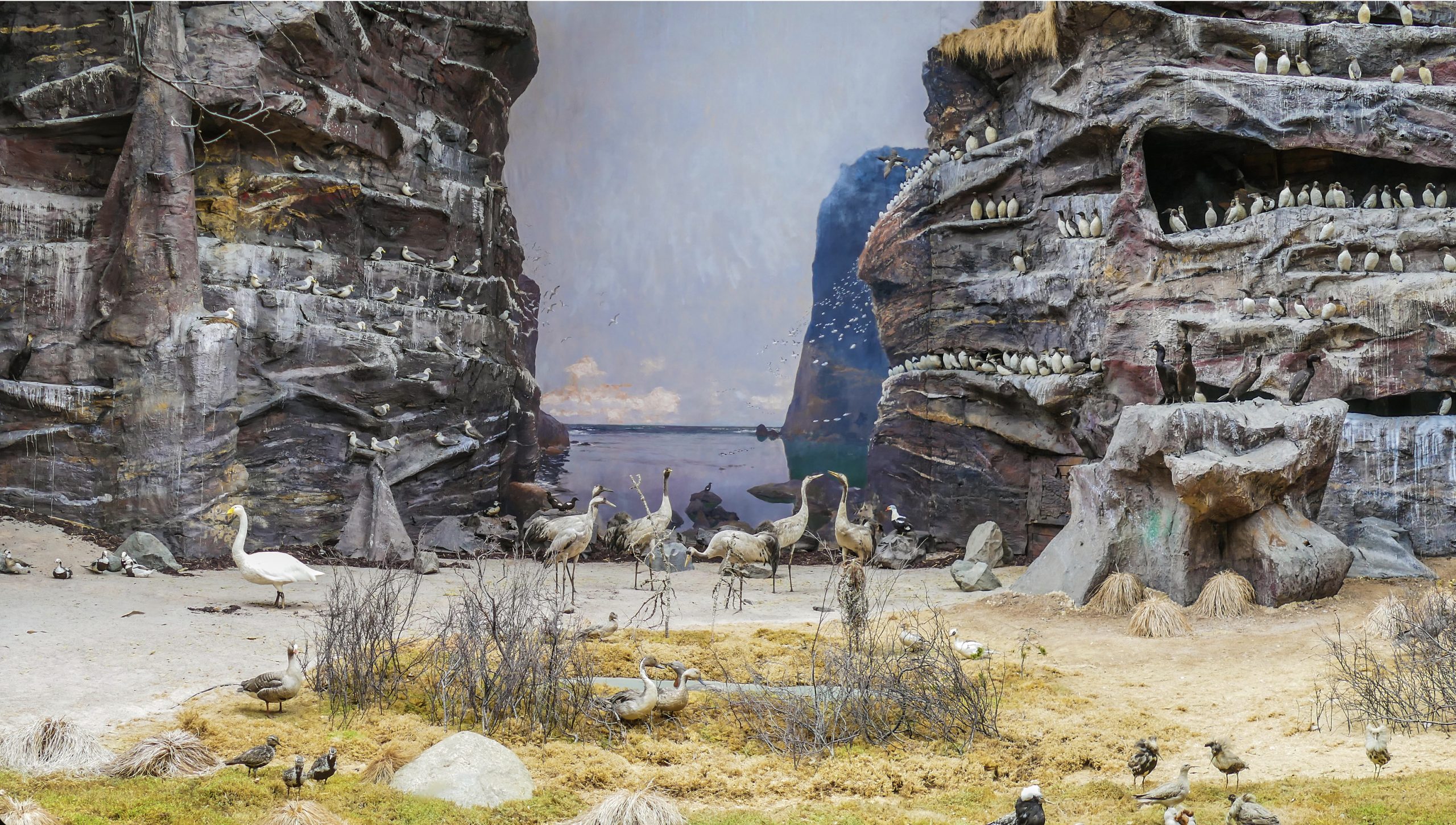
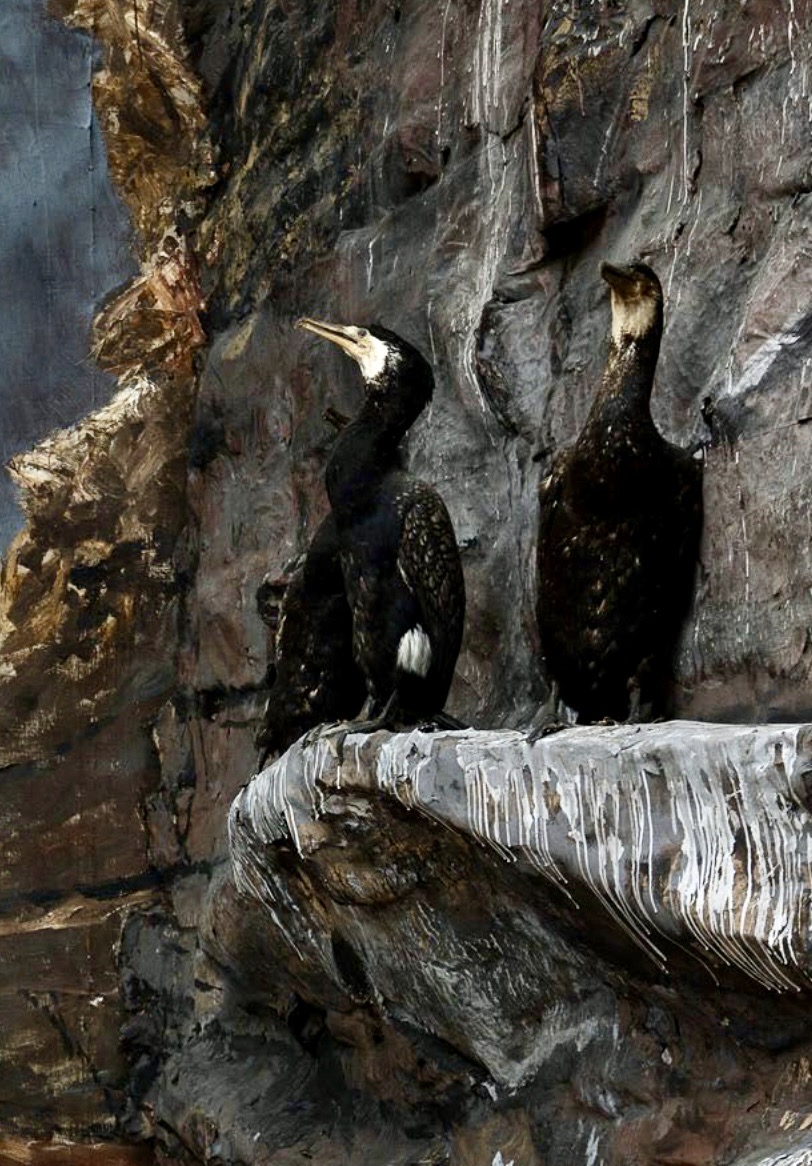
The Biologiska museet’s coastal archipelago scene features multiple ecological niches of cliffs, shoreline and wetlands. Dominating the scene are the vertical limestone stacks of a seabird breeding colony. Two iconic auk species are represented: the Guillemot or Murre (Uria aalge), and Razorbill (Alca torda). By 1880 due to hunting and egg collecting, there were few guillemots remaining in Sweden and by 1900 both species were close to extinction in Europe. Sitting on one quano covered rocky ledge are two large and stately black birds, a species known as the Great Cormorant (Phalacrocorax carbo). Viewed as pests that competed with humans for the consumption of fish, cormorants were heavily persecuted in Europe and had been almost eradicated from Sweden by the time the Biologiska museet was built in 1893.
Kolthoff understood that the most immediate way to communicate the concept of “levnadssätt” (way of living) in animal biology was to capture the viewer’s imagination. The concept falls within the Linnaean tradition of the “economy of nature” with its focus on how an animal’s physiology and behaviour are shaped by its environment. In 19th century Sweden, it was part of the field study of natural history with an emphasis on the hunter’s understanding of natural selection and ecological adaptation. While Kolthoff aimed to instill a love for Nordic nature in visitors to the Biologiska museet, his guidebook did not refer to the endangered status of many of the species on display as a result of hunting whether for food, sport or museum collecting. He had himself killed thousands of animals for scientific purposes as was common during the era when large natural history collections and museums were being established.
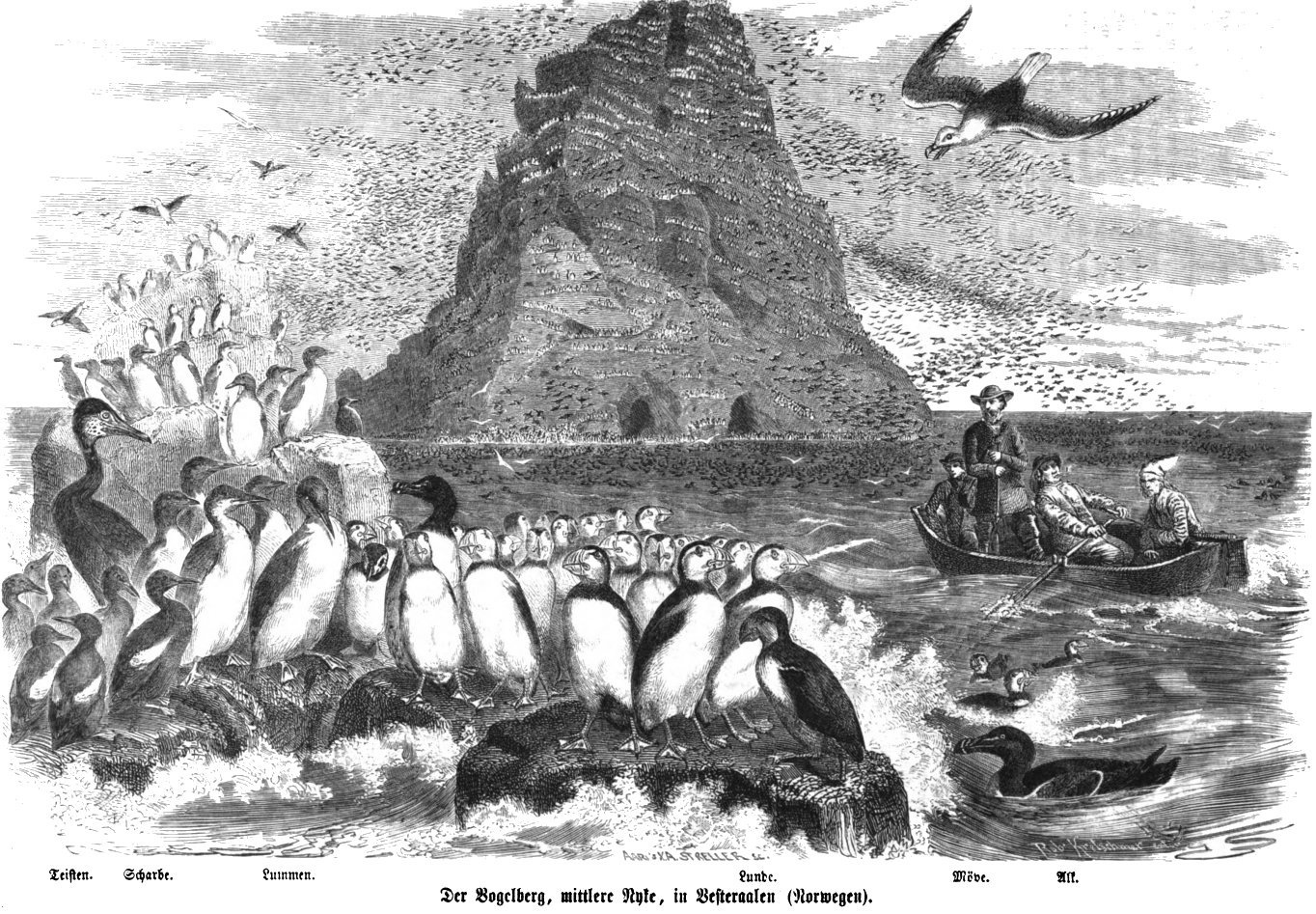
While the taxidermic tableaux of Kolthoff’s “Fågelberg” was the first of its kind, an illustration of a bird breeding rock in Norway appeared in an article by German zoologist Alfred Brehm describing his expedition to collect scientific specimens. Published in 1861, in the popular magazine “Die Gartenlaube,” it was certain to have been seen by Swedish readers as the forerunner to the groundbreaking illustrated encyclopedia of animals Brehms Tierleben. Seen in the labeled engraving are colonies of puffins (Lunde), guillemots (Lummen), and auks (Alken) nesting in burrows and rock crevices. Brehm described how the cliffs were densely perforated with nests, eggs, and a vast multitude of birds in constant motion. He also noted how the local people were harvesting eggs and capturing the birds for food and made no reference to his own collecting and hunting efforts. Yet already by 1852 the Great Auk (Pinguinus impennis) had become extinct due to such relentless human persecution.
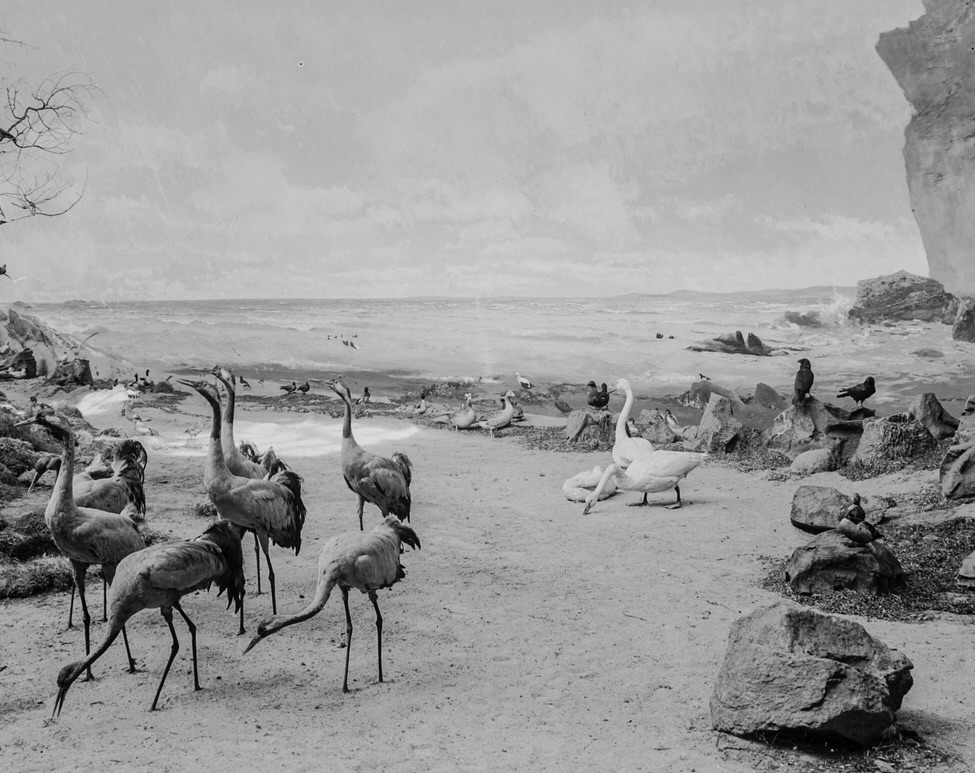
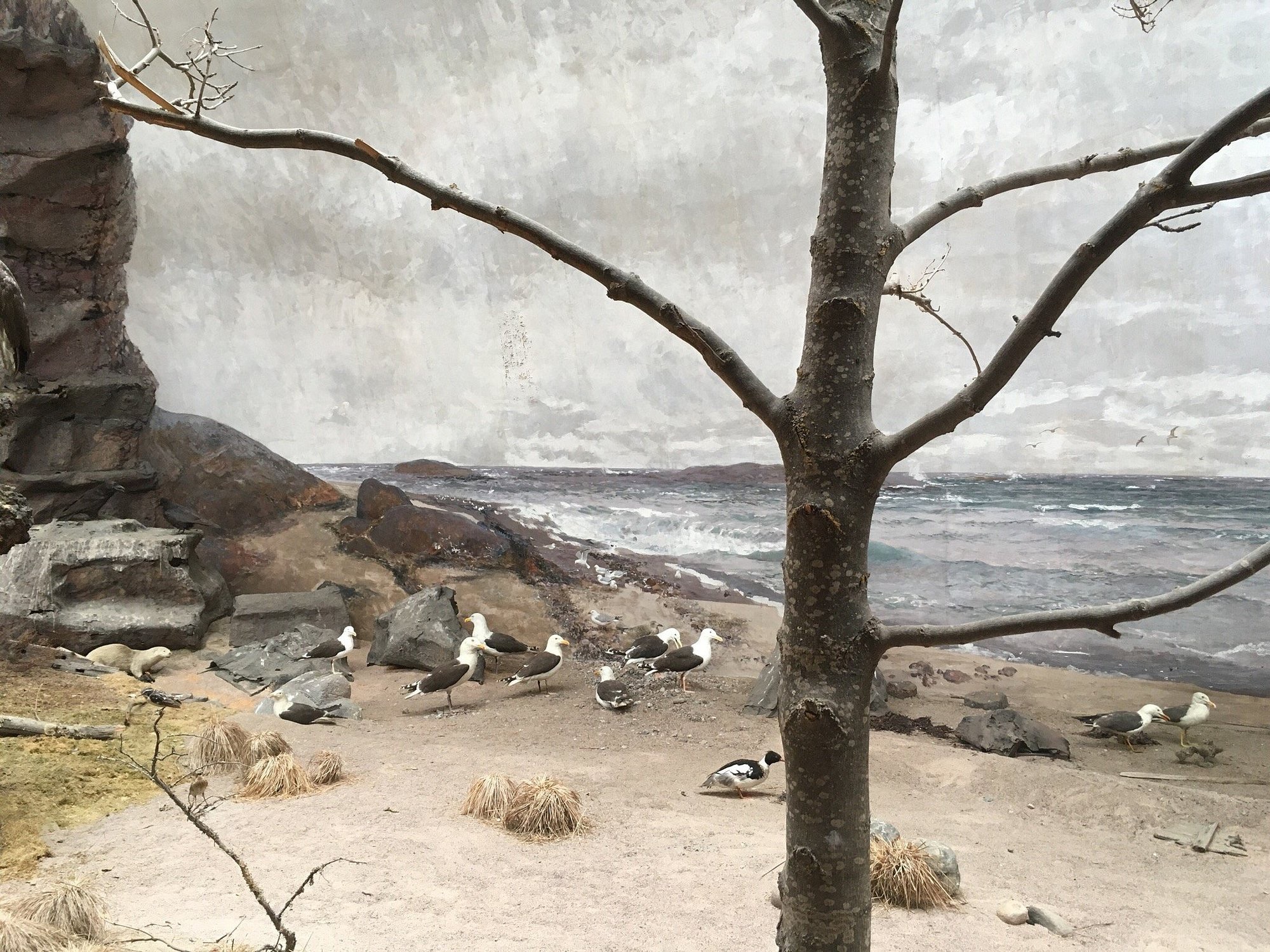
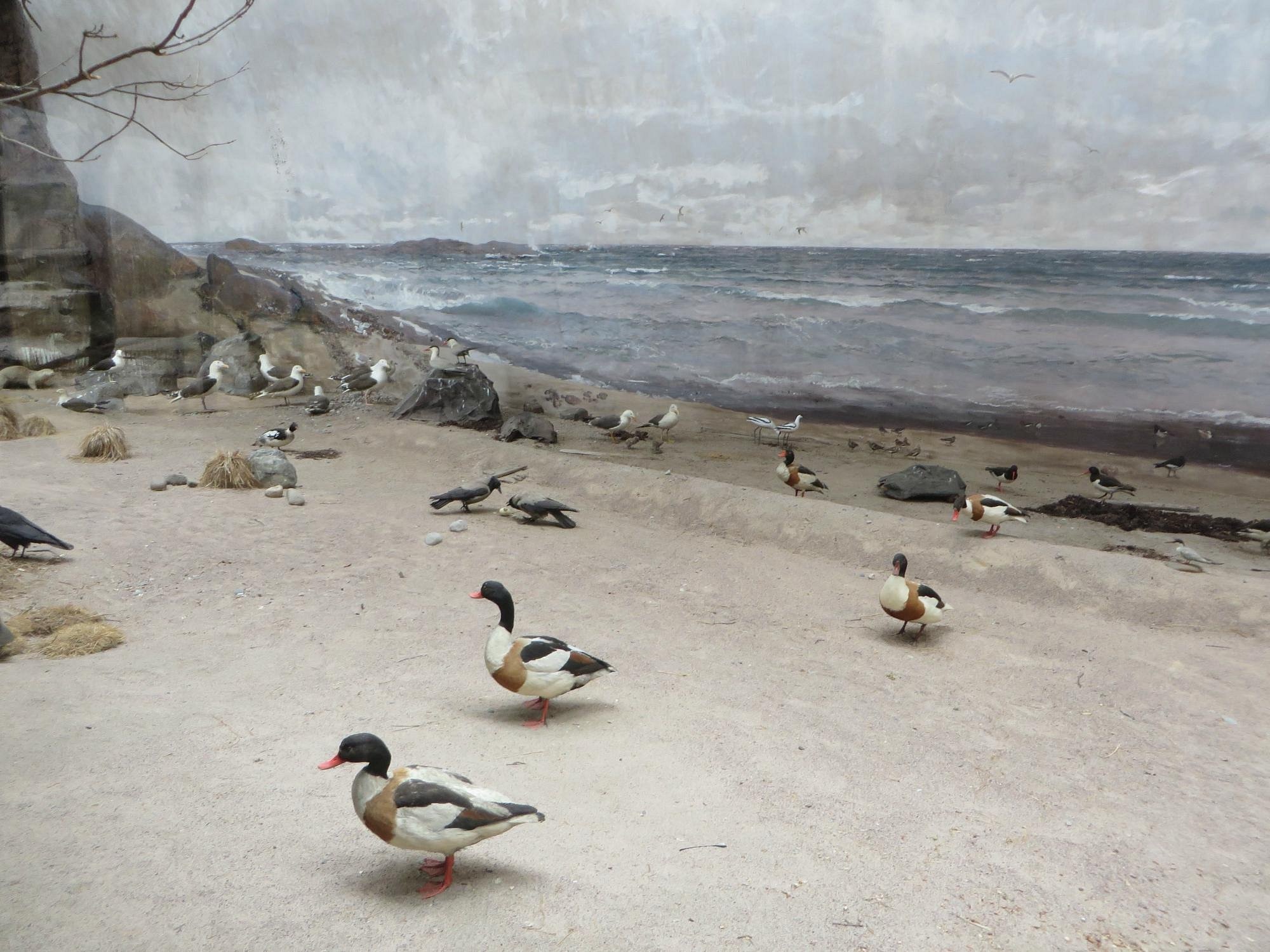
A photo taken in 1900 of the foreshore scene next to the bird cliffs in the Biologiska museet includes a group of tall elegant Common Cranes (Grus grus) as well as two foraging white Whooper Swans (Cygnus cygnus). Cranes were dramatically reduced in Europe in the 19th century due to hunting and habitat degradation, especially the draining of wetlands. Although it held a special place in Swedish culture, symbolizing the return of light in late March, the species faced potential extirpation in Sweden at the same time that these seven cranes for were shot and mounted by Kolthoff as museum specimens.
Whooper swans were also in a state of near extinction in Sweden due to over hunting by humans; by the early 1900s only about 20 pairs remained. Known popularly as the “Wild Swan,” the species was migratory and bred in the remote northern bogs and tundra. Kolthoff made no reference to the endangered status of the Whooper Swan, nor did his hunting partner and museum collaborator, Bruno Liljefors, who frequently portrayed the iconic species in his paintings.
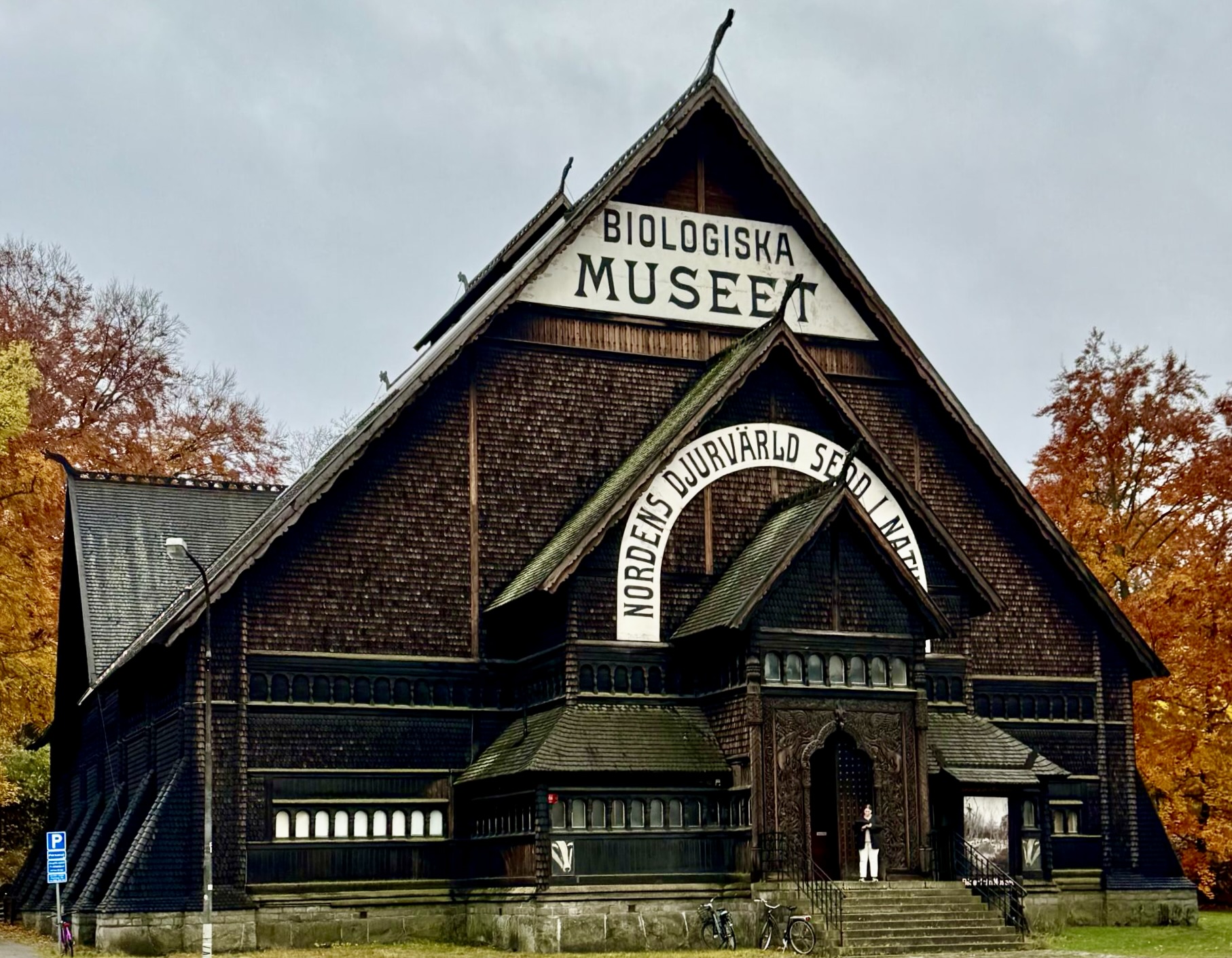
On the outside, the traditional wooden design of the Biologiska museet and its intricate dragon head carvings reflected the National Romanticism movement at the turn of the century. But the discrete roof top glass panels incorporated into the structure to illuminate the inside display with natural light was a modernist initiative to create a proto cinematic and immersive virtual reality experience for the viewer. Many international visitors will have seen the groundbreaking new museum when it was included in the 1897 World’s Fair in Stockholm which showcased Swedish identity and history.
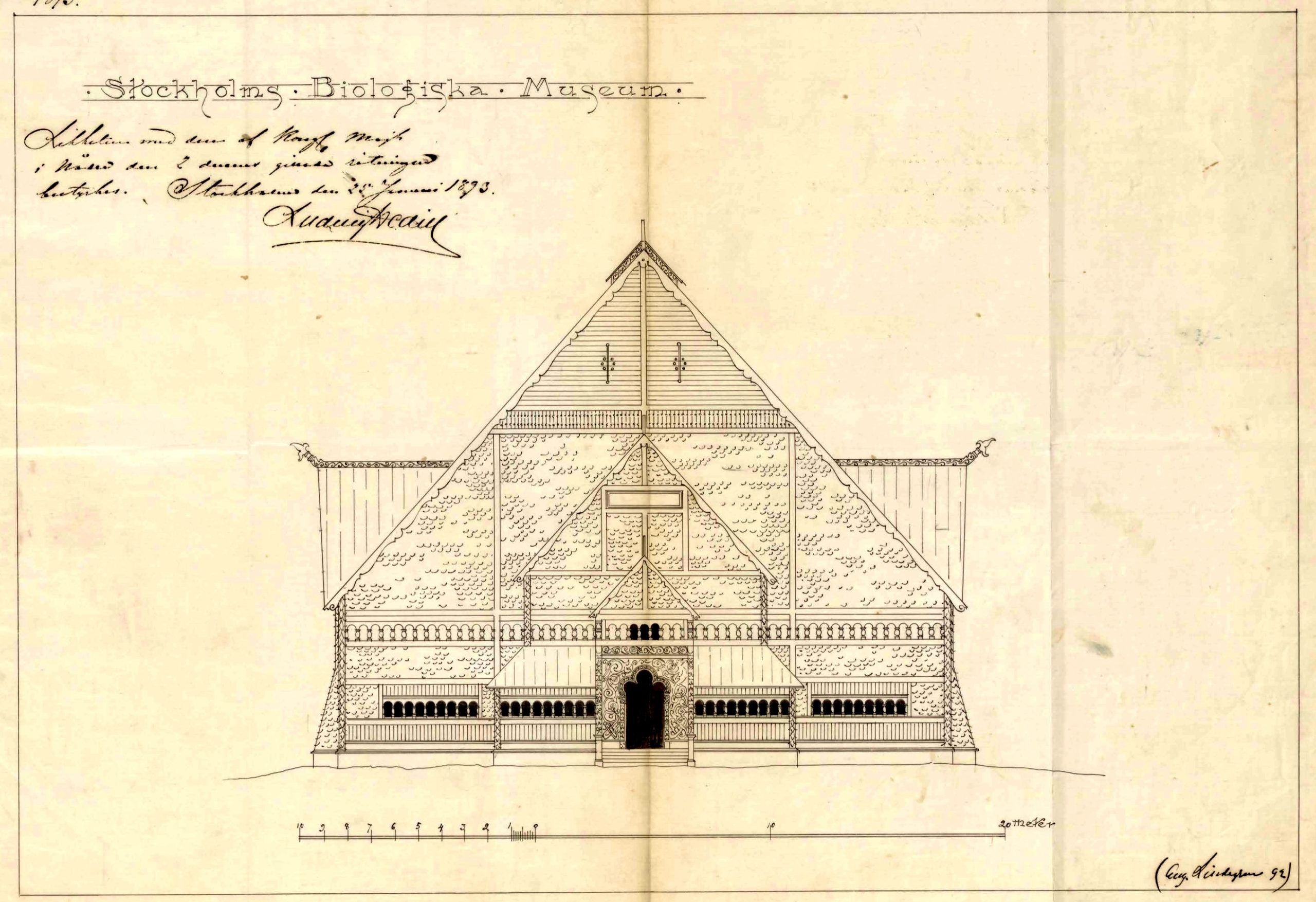
The Swedish Biologiska museet was built next to Skansen and the Nordiska museet, both founded by Artur Hazelius in the late 19th century on Djurgården, an island park in the center of Stockholm, as public monuments dedicated to preserving Swedish cultural history and traditions. Architect Agi Lindegren drew the plans for Kolthoff’s museum, which was modelled after a medieval Norwegian stave church. The first banner over its entrance pronounced it to be a “Panorama of Animal Life” which was “Without Equal Anywhere in the World.” A later banner stated: “Norden’s Wildlife Seen in Nature.” In addition to its pedagogical purpose the museum had a nationalistic goal to promote the appreciation of Swedish landscapes.
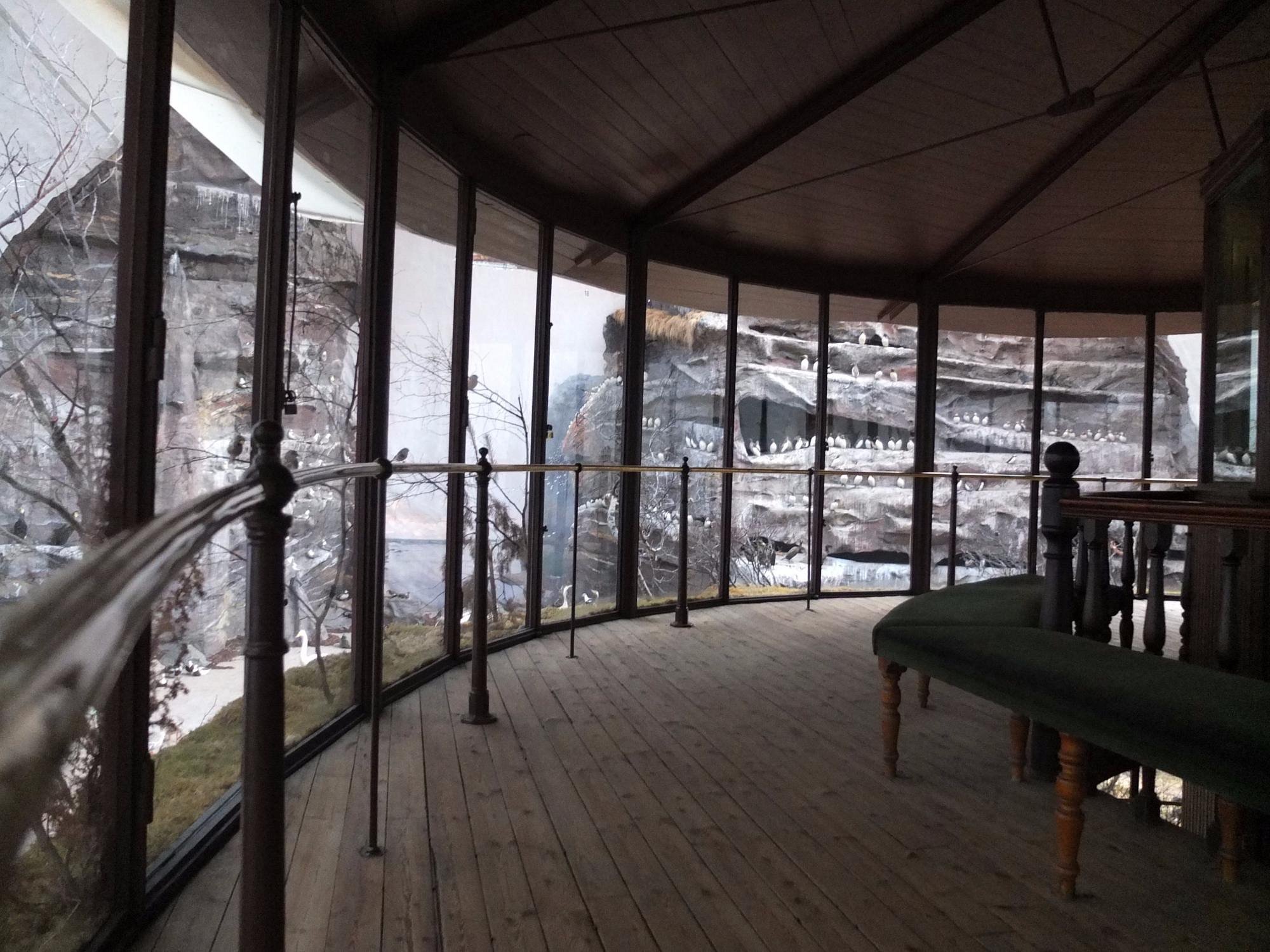
On entering the BIologiska museet, visitors encounter a dark enclosed vestibule from which a double spiralled staircase takes one into a circular observation tower centrally located inside the exhibition area. The sudden exposure to the bright illumination behind the display windows is designed to be disorientating to the visual perception of the viewer and increase the illusion of atmospheric space. Gazing out on the bird breeding cliffs, the sensation is one of overwhelming intimacy to see so many birds closeup and at the same time experience the vastness of the busy avian scene.
By enticing the viewer to perceive its scenery as a substitute for the real world, the BIologiska museet continues a tradition in the imitation of nature practiced by artists for almost 500 years. It is neither an illustrative medium for science nor an aesthetic expression but a recreation of the living landscape with its non human inhabitants.
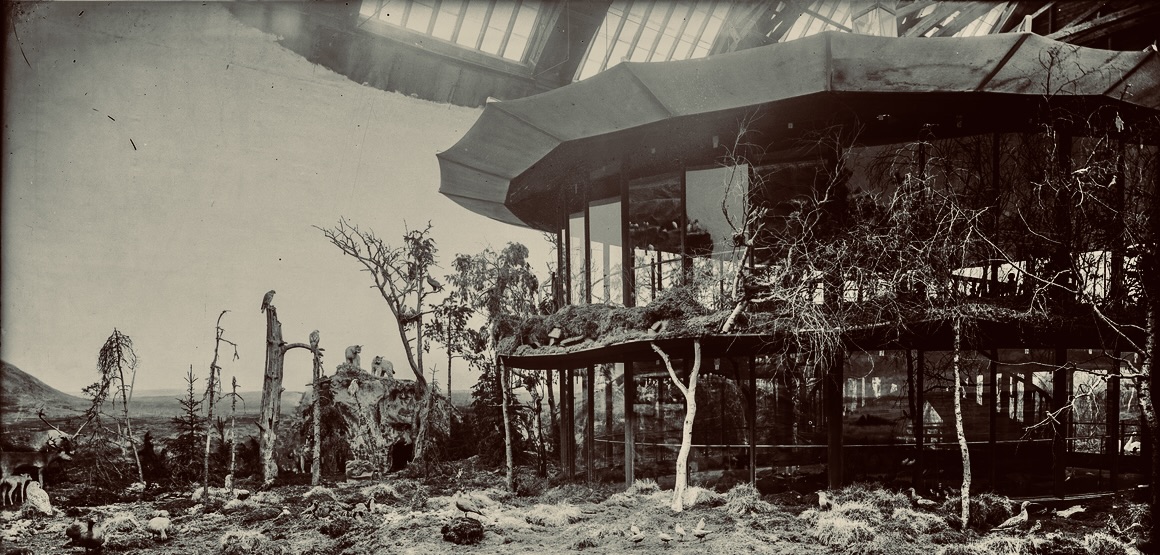
The optical devices adopted by the BIologiska museet were already established by 19th century panoramas. A photo was taken in 1900 from inside the display with its foreground of mounted animals amidst trees, earth, plants and rocks. It shows the two level observational rotunda with an awning over the top to prevent the viewer from looking up. On the ceiling, obscured from the viewer, are skylights which provide the natural illumination for the display. Wrapped around the walls is an enormous canvas on which Liljefors painted the background landscape, skillfully tying it together the three dimensional foreground and creating the illusion of distance.
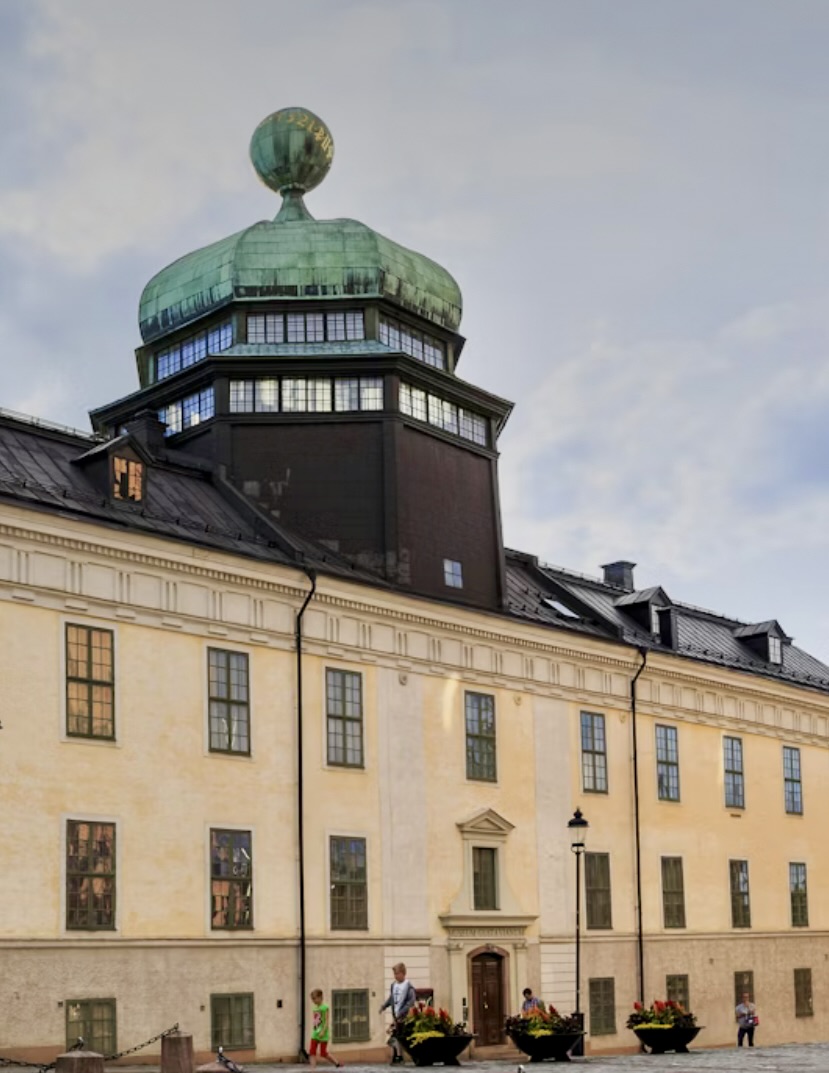
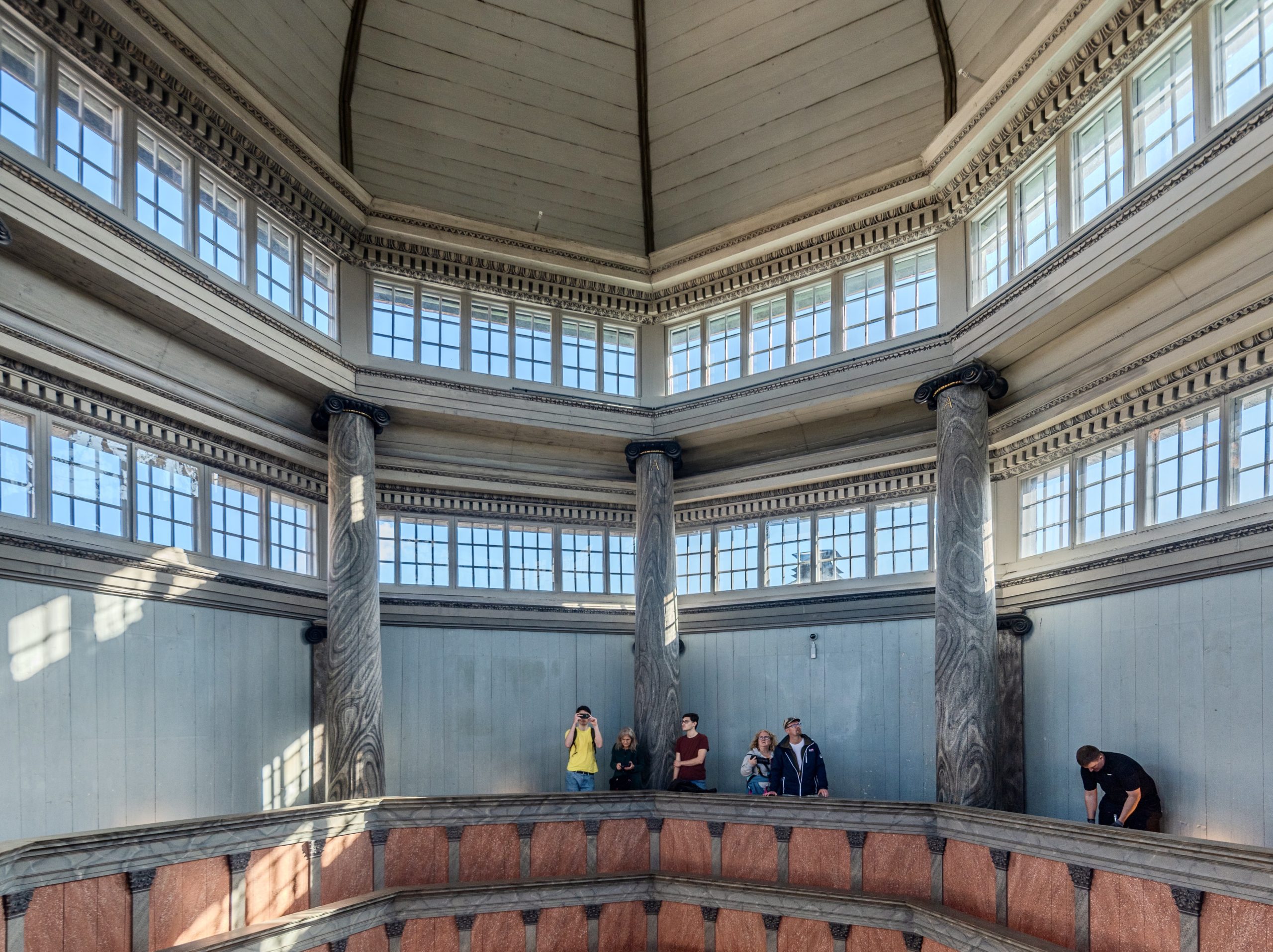
The concept for the BIologiska museet in Stockholm came from a similar display Kolthoff created in Uppsala, in the anatomical theatre of the historic Gustavianum. Kolthoff had been invited to take a position as a conservator (taxidermist) in the department of zoology at Uppsala University in 1878, which was then located in the Gustavianum. Because the anatomical theatre was not being used, Kolthoff was permitted to arrange his ornithological specimens in biological groups so as to show their habitats. This meant using the light filled cupola to create an illusionistic spectacle by situating the viewer in a darkened central observation platform from which the birds could be seen.
Already when he moved to Uppsala, Kolthoff was well known as an accomplished taxidermist who had been trained in the German tradition of “dermoplastik.” From the time he was a young man, he had hunted and mounted birds for his own natural history collection. First in Källviken and later in Kalmar, he had set up prototypes for the BIologiska museet. In Uppsala, Kolthoff founded a taxidermy business in 1890 that sold specimens to museums in Scandinavia and Europe and gained a reputation for the exceptional quality of his work.
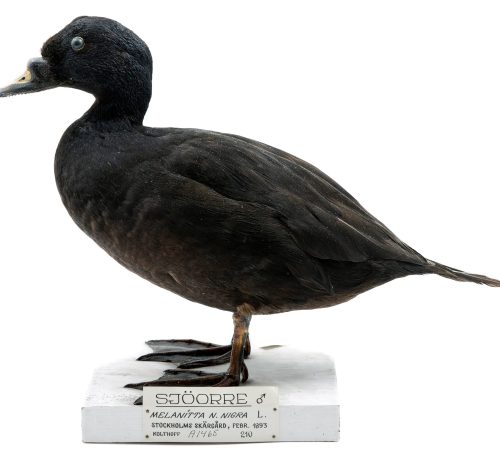
Typical of the many specimens found in Swedish natural history collections that had been prepared and mounted by Kolthoff is the migratory black feathered sea duck “Sjöorre,” or Common Scoter, a game bird found in Sweden’s mountain regions and along the northern coast. The taxidermic label gives its Swedish name and sex (male); its scientific name (Melanitta nigra Linnaeus); where it was collected (Stockholm’s skärgård); the date when it was shot (February 1893) and the name of the preparator (Kolthoff).
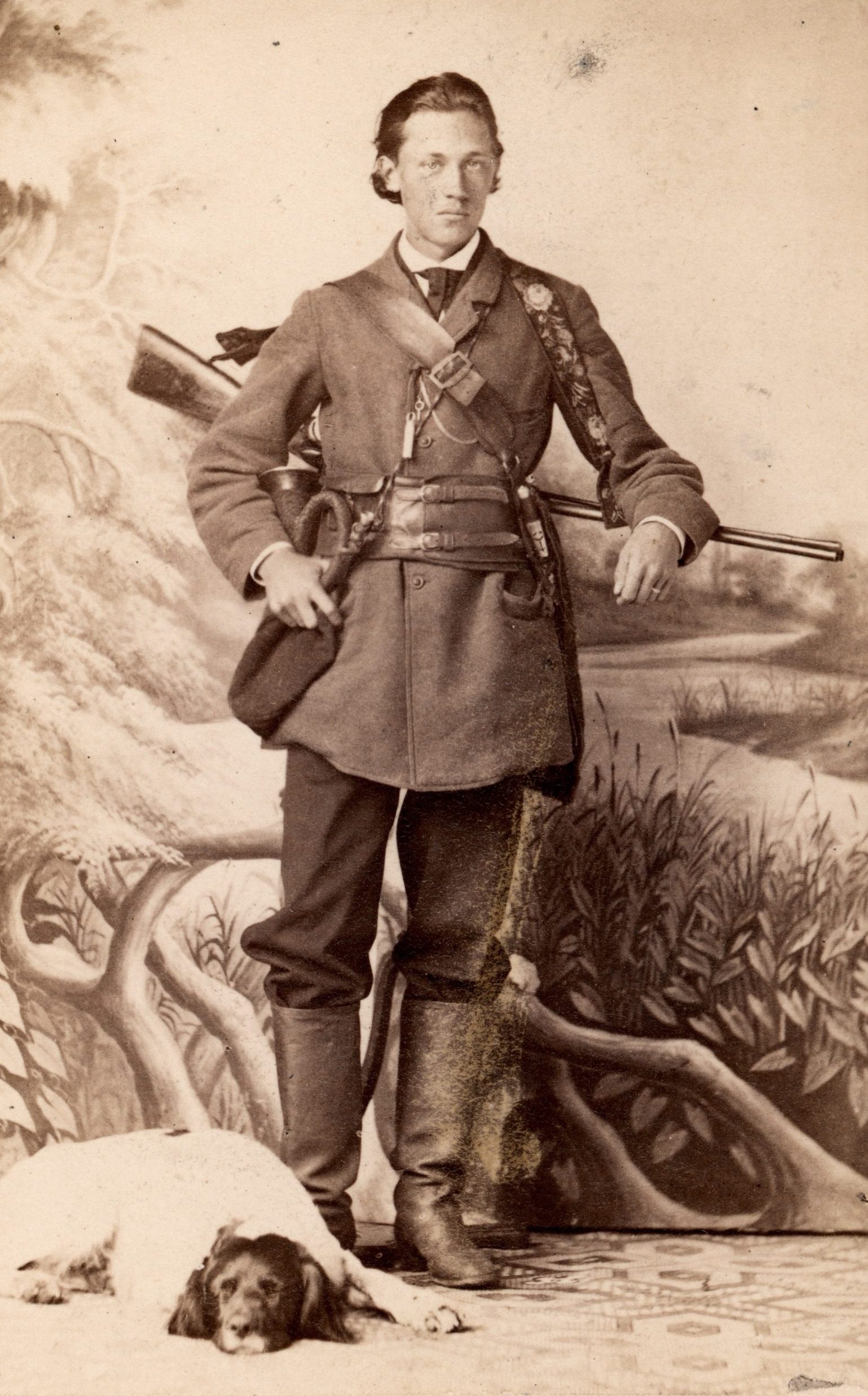
Gustaf Kolthoff was the subject of a studio portrait by Caroline von Knorring, one of Sweden’s first female photographers, in 1866. Posed in front of a picturesque and idealized landscape backdrop, Kolthoff is portrayed as a skillful marksman and competent field naturalist wearing high boots, a fitted coat with a wide belt for cartridges and tools, his game bag and rifle strapped behind his back, his hand resting on his hunting horn and a retriever dog at his feet. The portrait was a Carte de Visite, a calling card for Kolthoff’s social standing as a professional collector of natural history specimens.
Kolthoff’s avid pursuit of hunting gave him an intimate knowledge of the appearance and behaviour of animals in the wild which he used to bring the appearance of life to his taxidermic work. Today, while thousands of zoological specimens mounted by Kolthoff remain in museums throughout Sweden, he is perhaps best remembered for as a nature writer whose articulate field observations were described in stories about his hunting adventures and collecting trips. A member of the Svenska Jägareförbundet (Swedish Hunters’ Association), some of his earliest writings were published in its journal. Some of these were included in his classic book on Swedish game Vårt villebråd (1896), which included 39 illustrations by Bruno Liljefors as well as photos of scenes in Stockholm’s Biologiska museet. Also illustrated by Liljefors was Kolthoff’s book Minnen från mina vandringar I naturen (1897) describing his “wanderings in nature.”
As part of his work as a zoological conservator and collector, Kolthoff took part in a number of scientific research expediitons; to Iceland and the Faroe Islands (1872), to Greenland (1883), to the Arctic coast of Norway (1893), and to Svalbard (1898). In 1900, he led a hunting expedition back to Greenland and Svalbard with the aim of collecting specimens for a new museum that would illustrate the biology of the wildlife of the Arctic regions. This was never realized but Kolthoff set up two habitat groups in the basement of the Biologiska museet that featured scenes from Greenland and Spitsbergen.
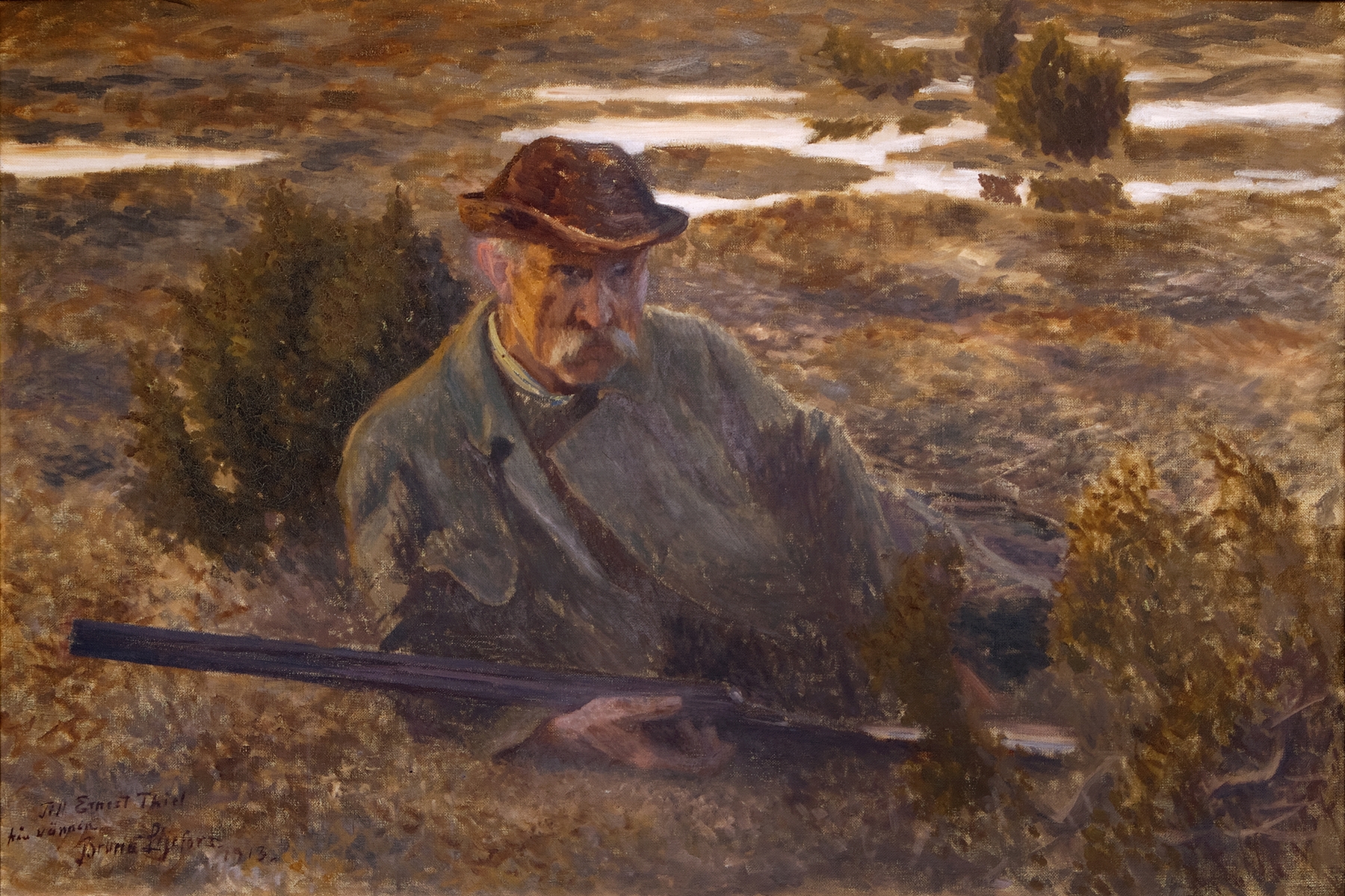
Bruno Liljefors published his self portrait as a hunter from 1913 as the frontispiece to his book Det vildas rike (The Kingdom of the Wild). Published in 1934, a few years before his death, the book was a collection of written sketches about the animals he depicted in his art. Like Kolthoff, whom he much admired for his hunting skill, Liljefors identified as a hunter naturalist and was intent on observing the characteristics of animals in their native habitats, especially predators and game species. How the behaviour and struggle for survival of wild animals was related to their appearance and surroundings was a fundamental theme that Liljefors explored in his art throughout his life. His self portrait reveals how he used painterly and impressionistic brushstrokes and colour to depict both the way that light in nature is perceived and the way that the human hunter, like the hunted animal, blends into his surroundings.
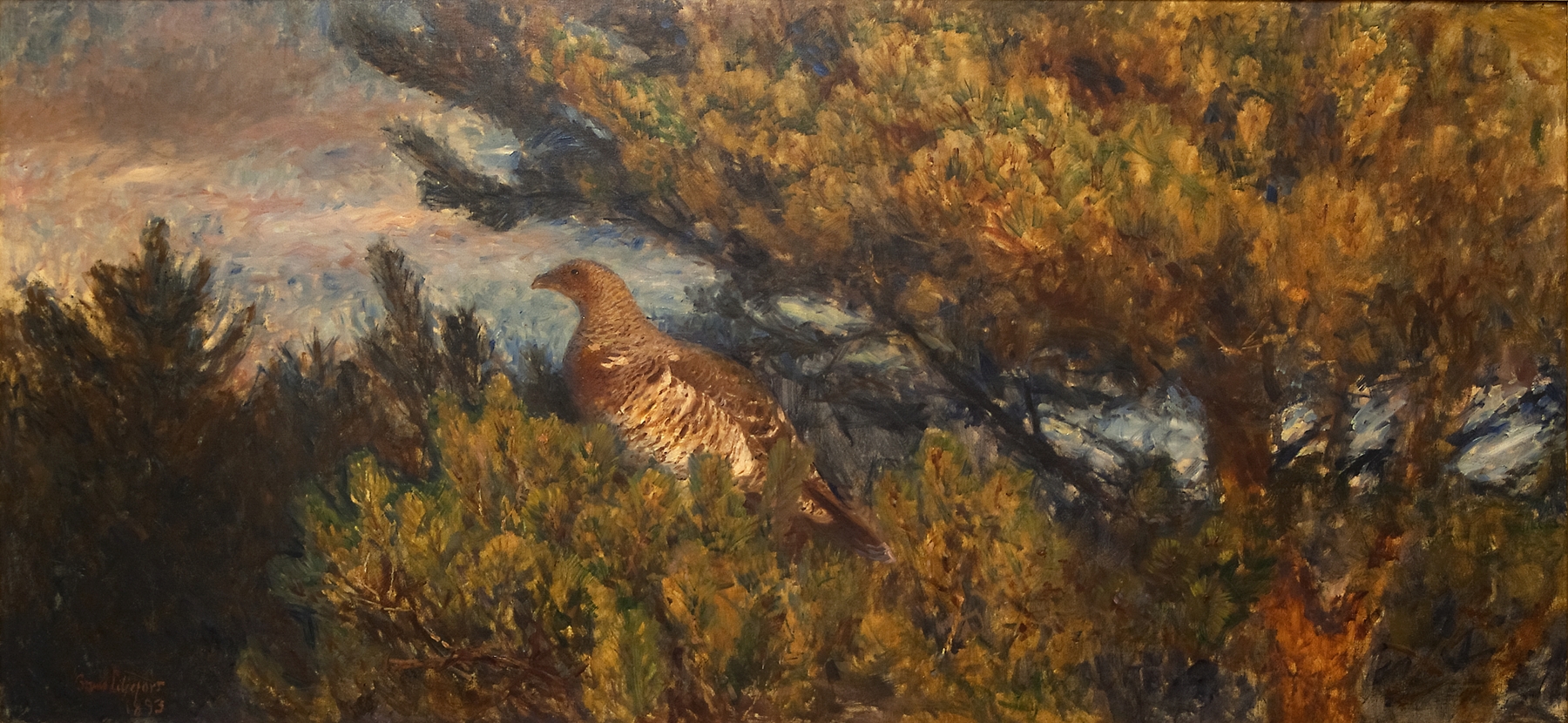
“Tjäderhöna” was painted by Liljefors in the same year that the BIologiska museet opened. It portrays a grouse or Western Capercaillie (Tetrao urogallus) hen perched within the branches of a spruce tree. The species was highly regarded as a noble game species, due in part to the spectacular courtship displays of the male birds. Liljefors observed the birds in nature while hunting them and often portrayed them in his art. His depiction of the nesting female Capercaillie reveals his intimate understanding of camouflage as both a visual and biological function. It was this principle that lay behind the creation of the Biologiska museet.
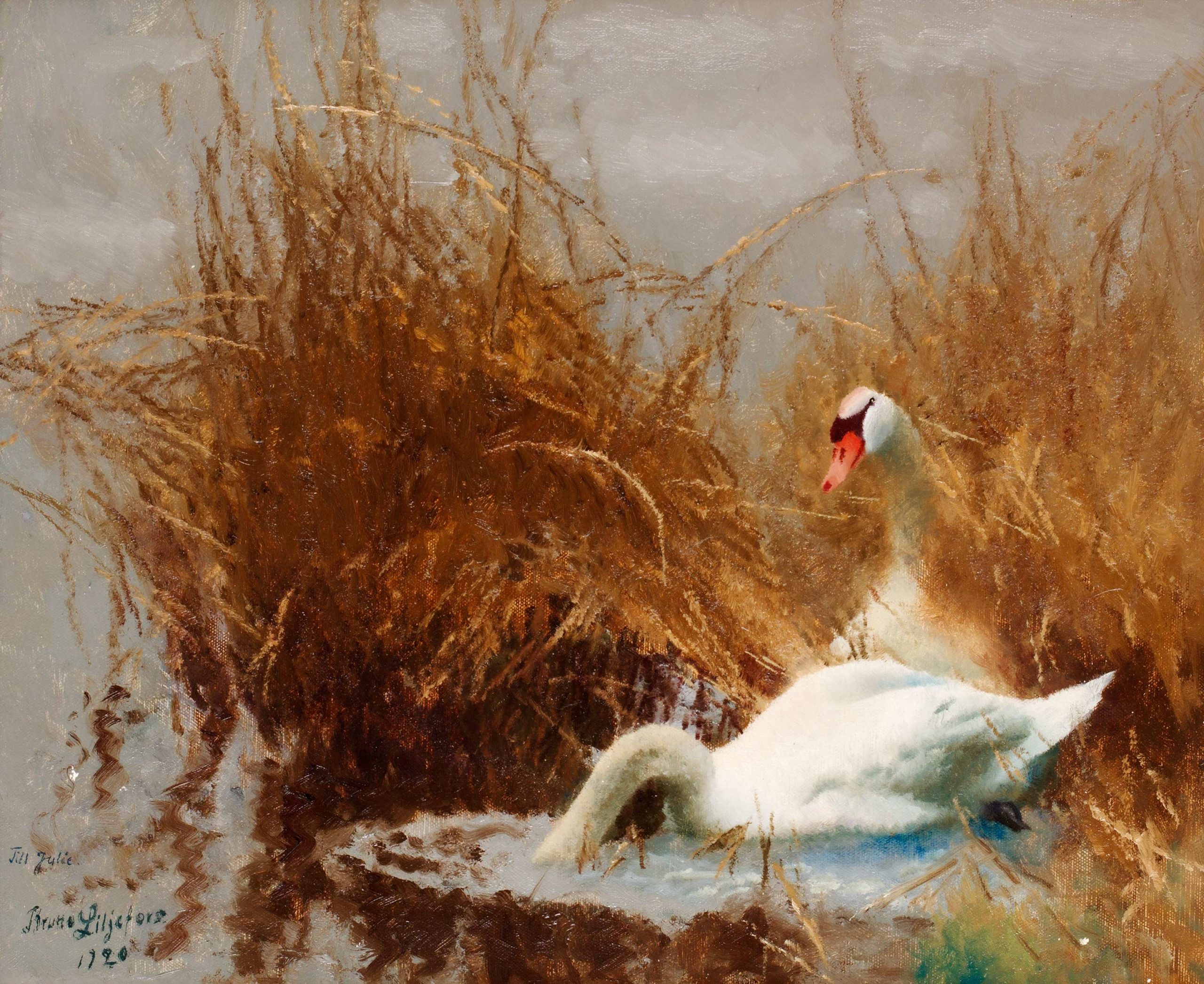
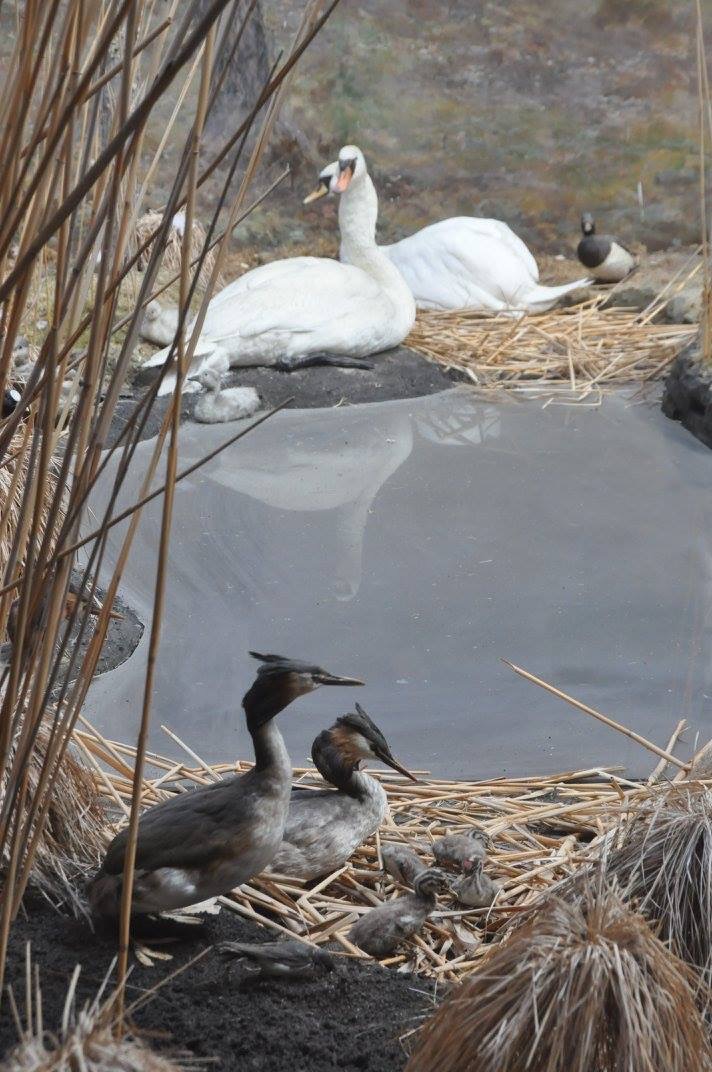
When Liljefors painted the Sångsvan, or Whooper swan, in 1920, only about 20 pairs remained in northern Sweden, driven to extinction by heavy hunting for their meat and feathers and by egg collecting for human consumption. It was not until 1927 that a hunting ban came into force. Two whooper swans are displayed in the Biologiska museet at the edge of a pond and in close proximity are a pair of Great Crested Grebes (Podiceps cristatus) and four fledglings, another species that had been hunted almost to extinction in Europe by 1900 for the plume trade. Kolthoff’s guidebook to the museum, written in 1893 for its opening, takes the viewer on a tour of the different biotopes that were recreated behind the glass and identifies the animals that inhabit them but does not mention the endangered status that threatened many species at the turn of the century.
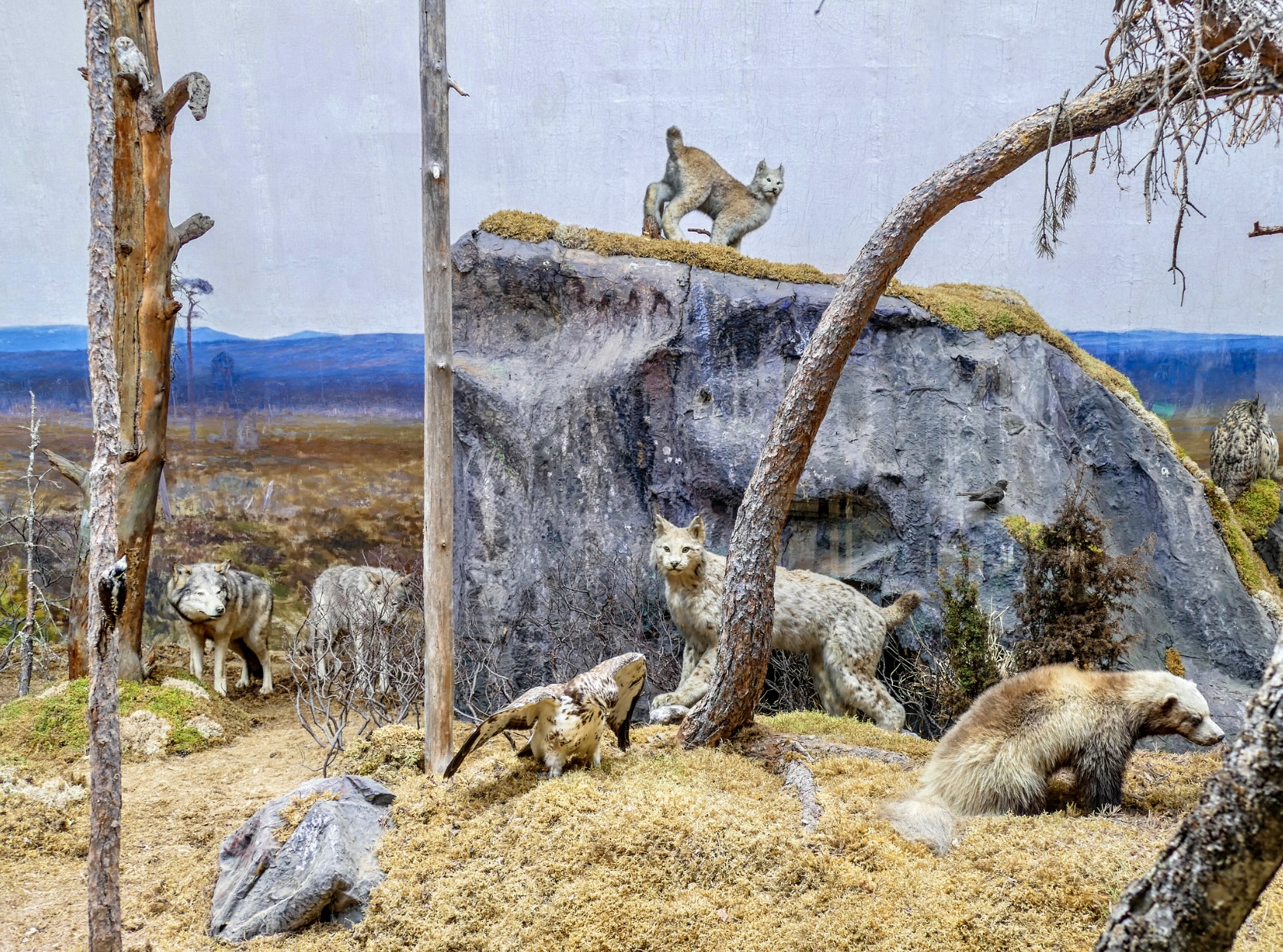
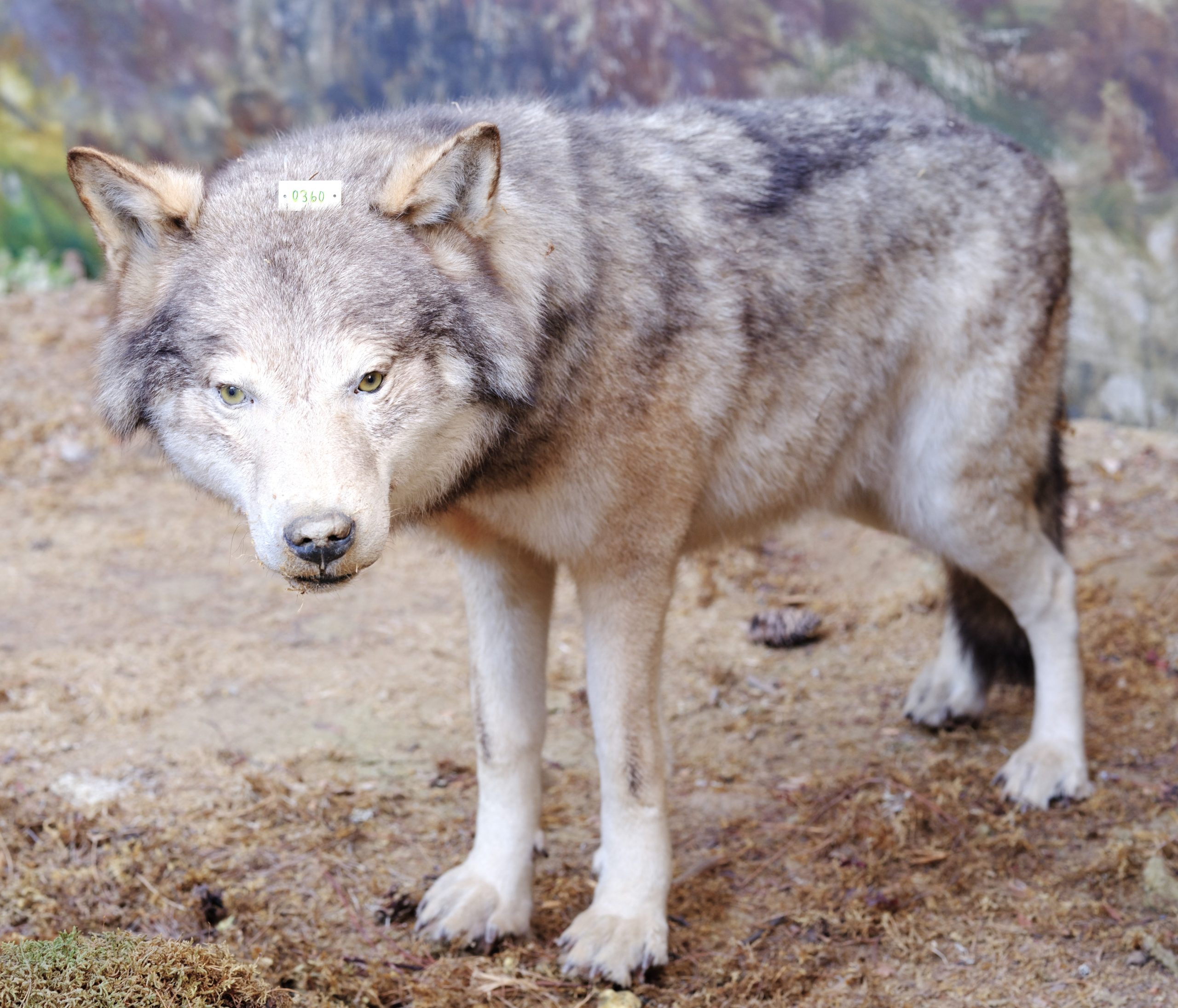
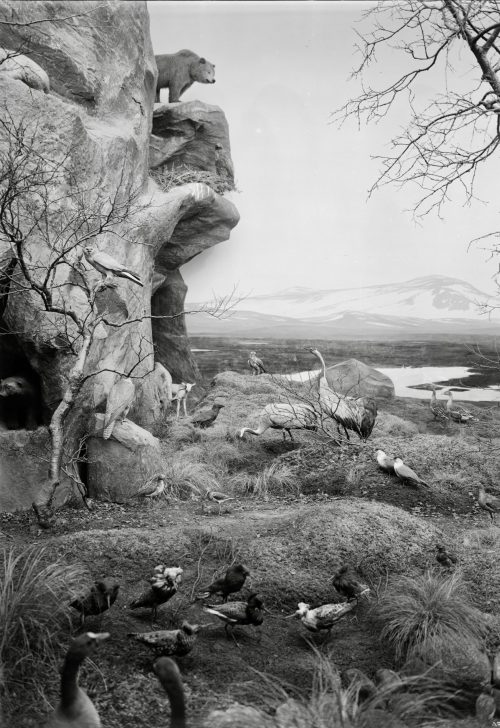
In the tundra biotope of the Biologiska museet, a group of predator species is arranged around a large rock which includes the Wolverine (Gulo gulo); the Gray Wolf (Canis lupus); the Lynx (Lynx lynx); and the Rough-legged Buzzard (Buteo lagopus). All were heavily persecuted species in Sweden with bounties paid for their killing. By the time the Biologiska museet ws created in 1893, all had been hunted to near extinction. Viewed as dangerous “pests” that were harmful to humans, none were portrayed by Liljefors in his art. The bounty on wolves began in 1647 and did not end until the last known individual was shot in 1966.
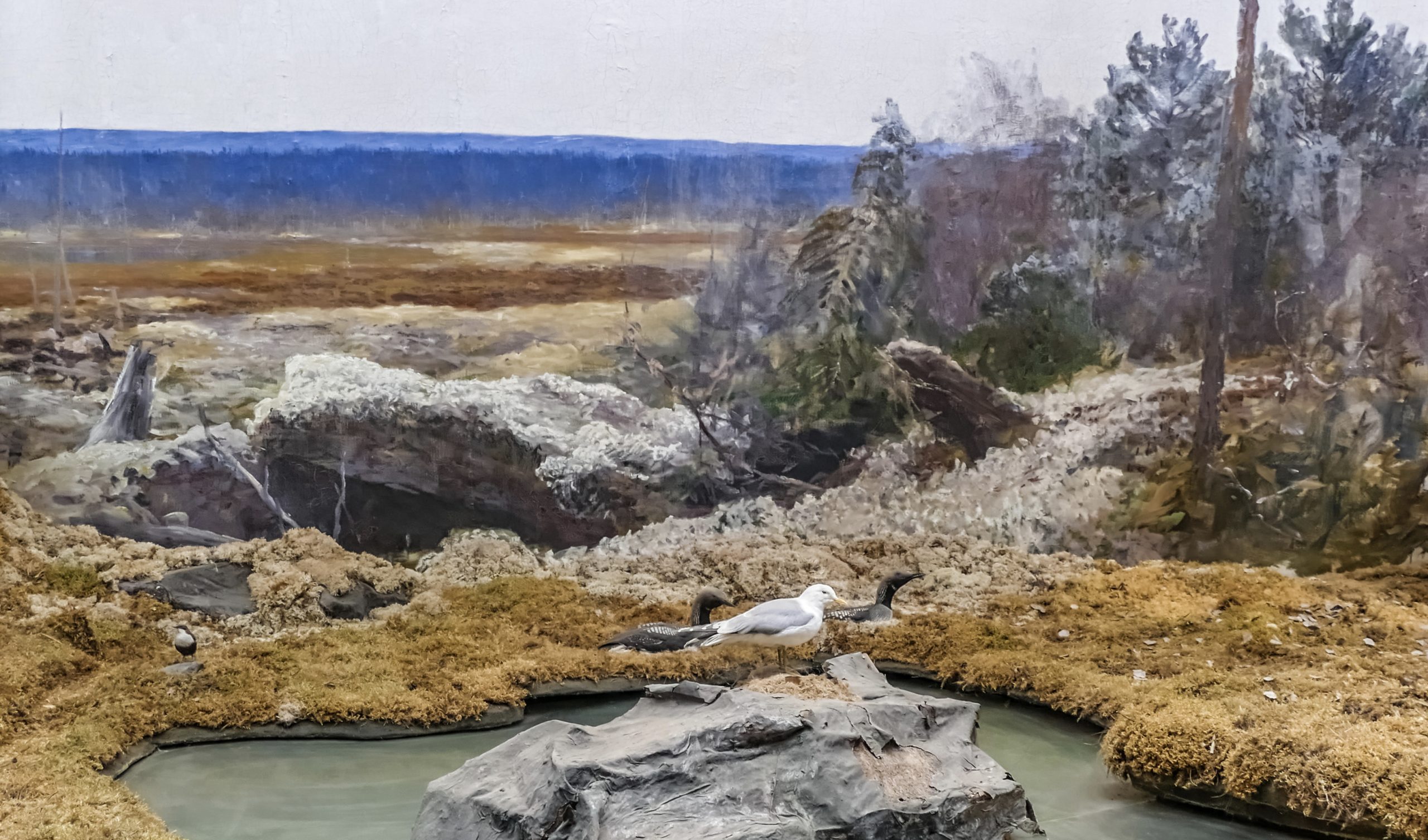
The skill of Liljefors in painting the illusionistic background of the taxidermic tableaux is seen in a closeup of the tundra biotope, where a broad band of blue haze on the distant horizon gives the scene an impression of atmospheric space. In the foreground one can see two Black throated Loons (Gavia arctica) and a Common Gull (Larus canus) and behind them the moss covered rocks and barren landscape that dissolves imperceptibly into the distance.
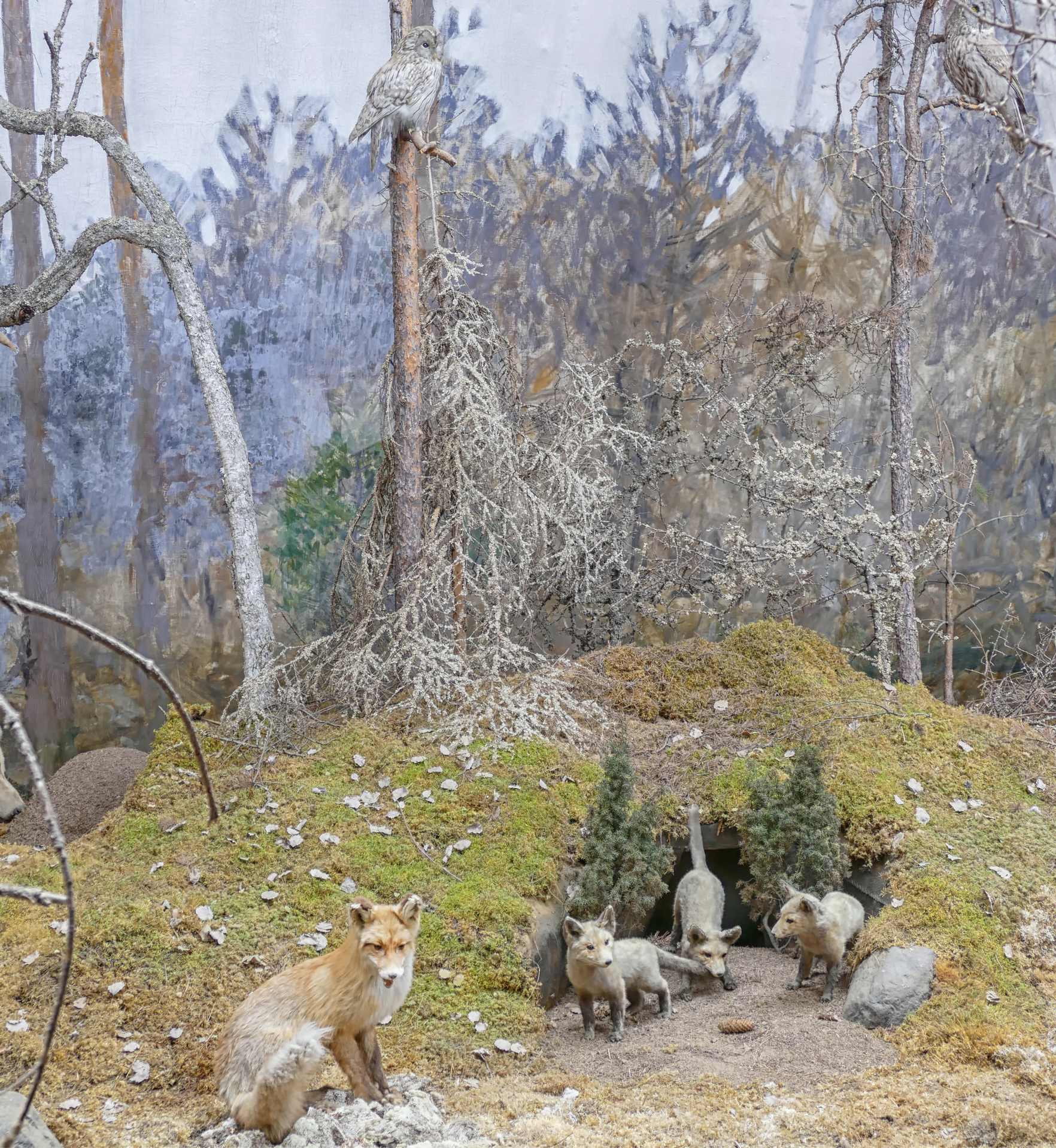
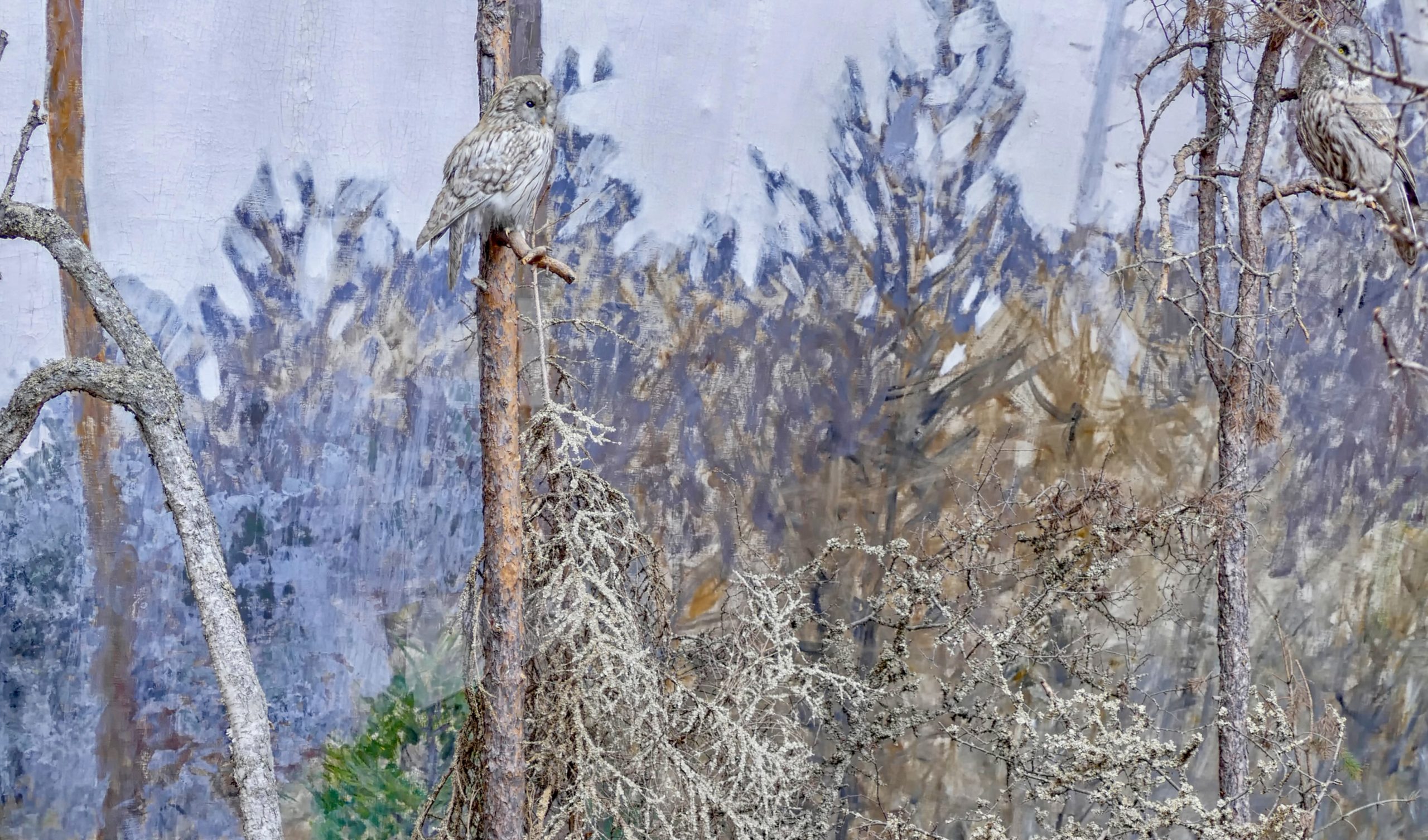
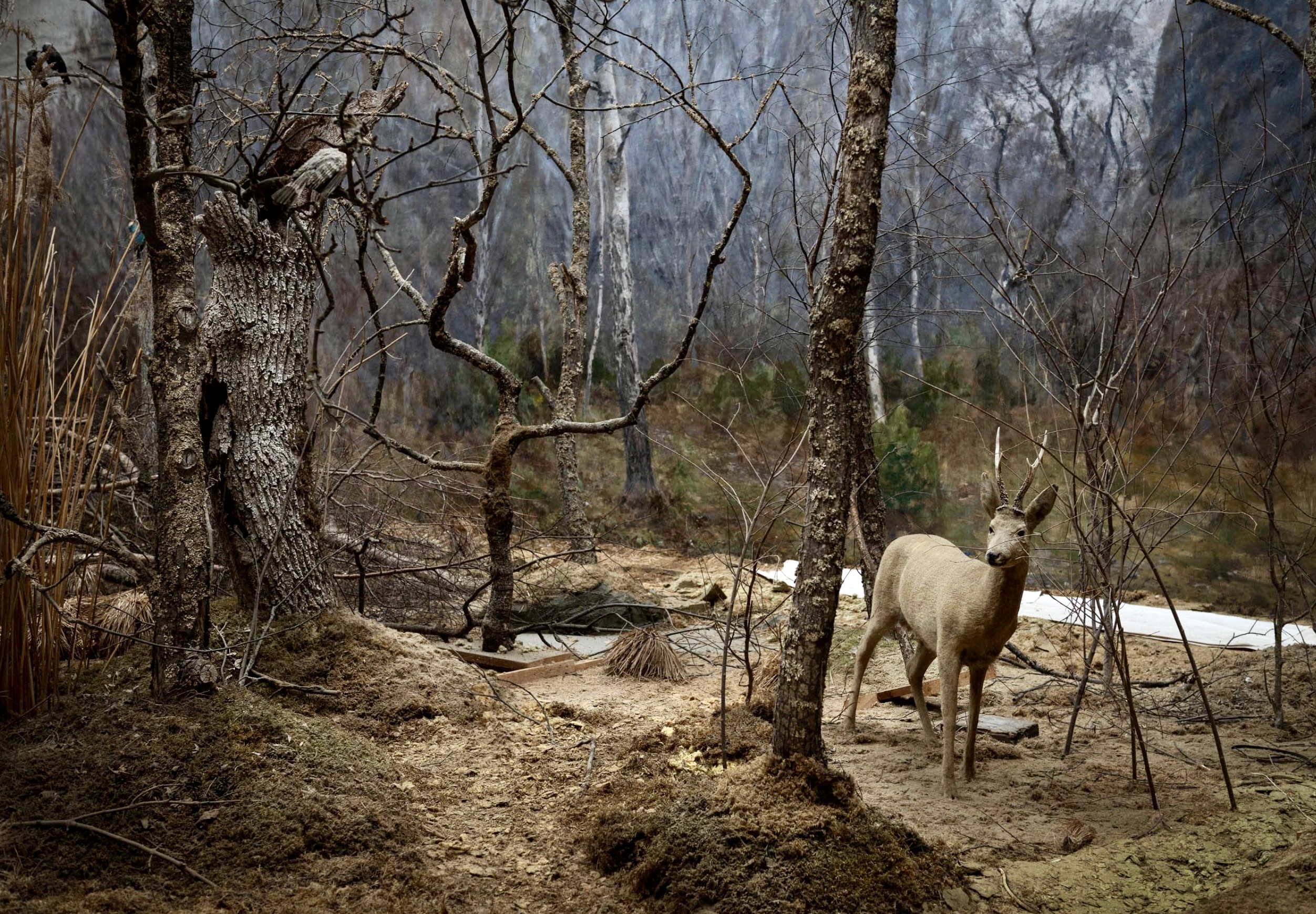
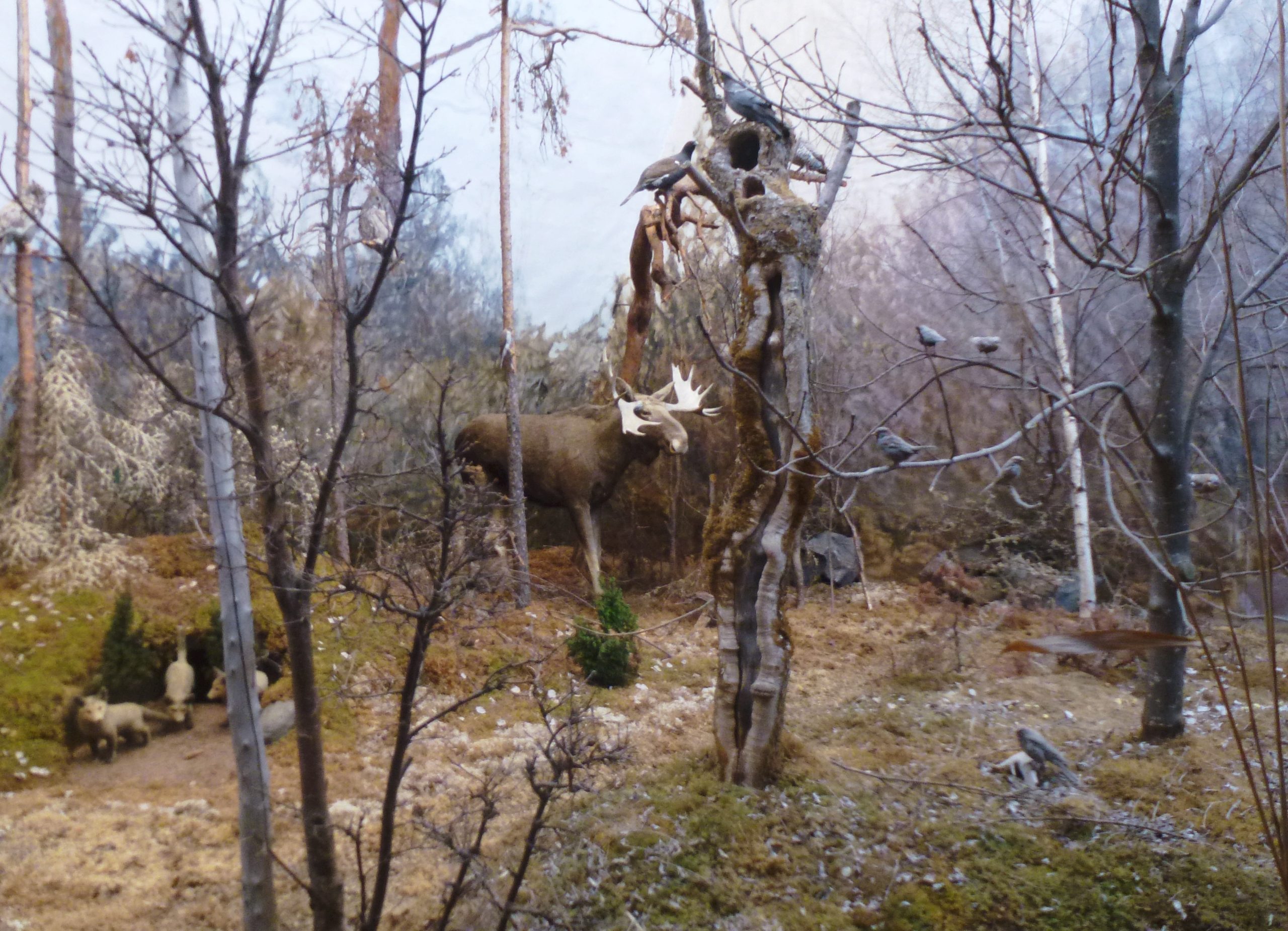
A forest scene in the Biologiska museet shows a fox family outside their den and a pair of Slaguggla or Ural Owls (Strix uralensis) sitting high above them in the trees, almost invisible due to the camouflage effect of their plumage against the surrounding foliage. A close up photo of the background by Liljefors shows how the artist’s rough brushstrokes and impressionistic style succeed in tying the foreground habitat to the illusion of deep space.
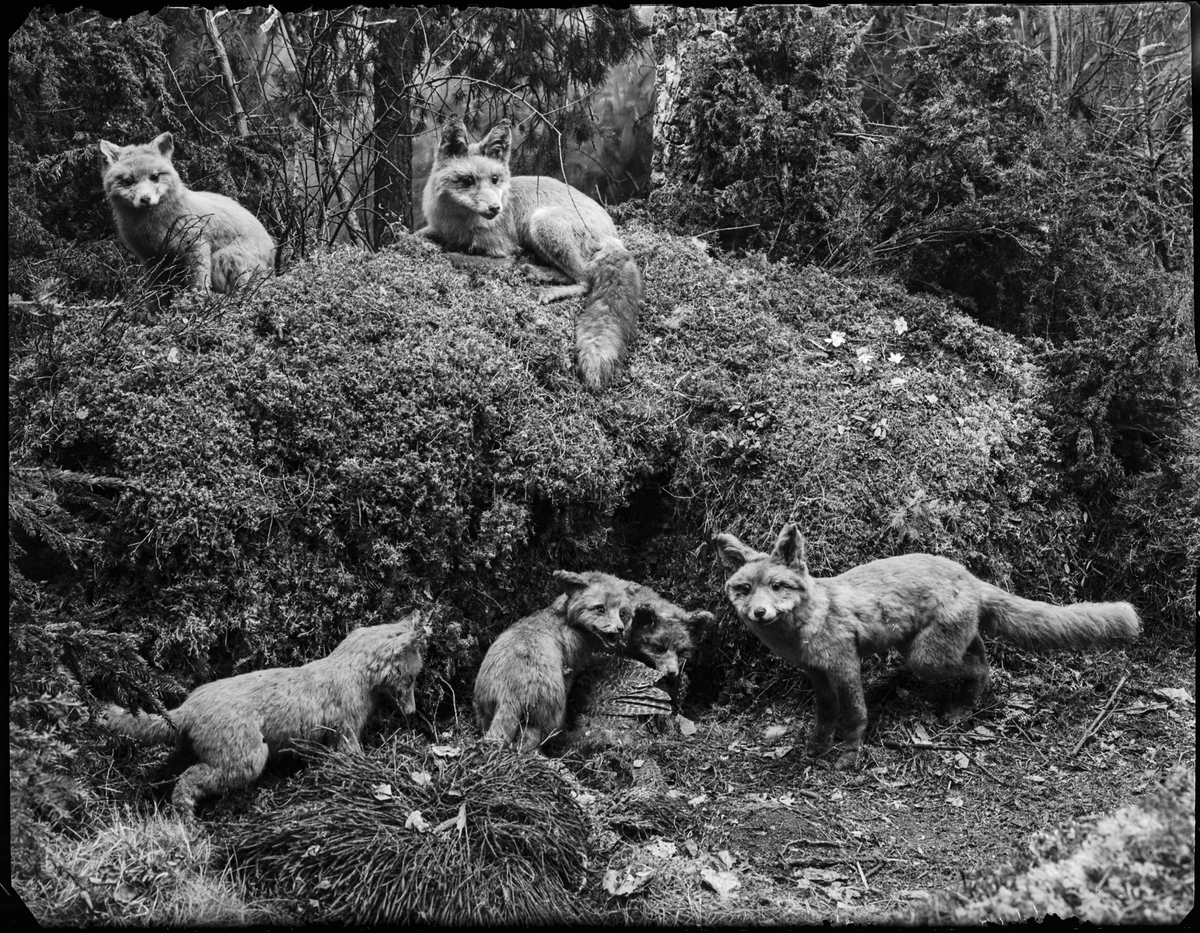
The Red Fox (Canis vulpes) was widespread in Sweden despite being persecuted as pests since a 1734 bounty was enacted. Valued for its fur, the fox was intensely trapped and hunted. A photo taken in 1900 of a fox family in the Biologiska museet shows two adults and several cubs, two of whom are devouring a freshly killed bird outside their den. Kolthoff’s taxidermic skill gives the group an animated and naturalistic appearance. Foxes were respected in Swedish culture for being intelligent and cunning and they were frequently the subject of paintings by Liljefors.
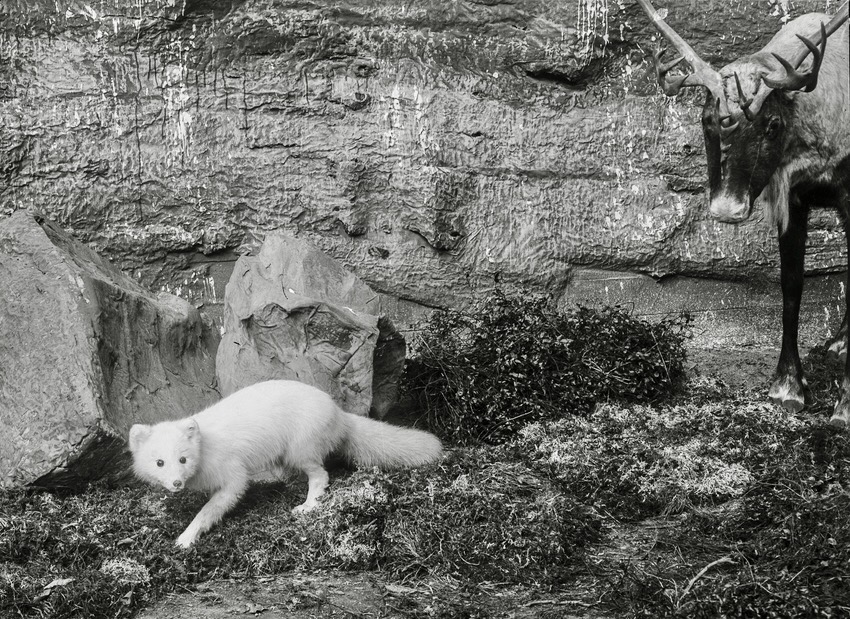
A photo taken in 1900 of the Biologiska museet shows a white Arctic Fox (Vulpes lagopus) in its northern mountainous habitat. Its Swedish name is Fjällräven, well known today as an outdoor company. Already by the turn of the century, the species had been driven to near extinction due to overhunting for its fur. Protection in Sweden was not enacted until 1928 and today its recovery remains uncertain. The photo also shows part of a “Ren,” or Mountain Reindeer (Rangifer tarandus), an ungulate species that shares the high tundra habitat of the Arctic Fox. Only the front part of the horned undulate can be seen in the photo. Wild reindeer have been extinct in Sweden for centuries, having been replaced by semi domesticated herds as part of the state’s colonization of the Sámi people. Kolthoff will have been aware of the endangered status of both animals but his aim was to present a composite picture of all Nordic fauna. Over the years, both these specimens have disappeared from the Biologiska museet.
Despite the enormous number of animals shot by Kolthoff over the years, for natural history collections, he increasingly expressed concern over the depletion and disappearance of Sweden’s rich animal life during an age of when agricultural and natural landscapes were increasingly being lost to meet the needs of an industrial society. In 1896, he wrote: “In ancient times, large stretches of our country lay uninhabited and the animals ruled there almost without encroachment. Gradually the country became more and more populated, forests were cut down, swamps were drained and cultivated, lakes were sunk, and animals had to give way to man. . . It should therefore be the duty of every person to do what he can to try to preserve and protect these animal species that we mistreat.”
One of the most noble animals, according to Kolthoff, was the Moose (Alces alces), incorrectly called “elk” (älg) in Sweden. By the early 18th century, the species was near extinction due to severe overhunting that had resulted after land use rights shifted in 1789 and hunting was no longer reserved for royalty and nobility. The Swedish Association for Hunting (Svenska Jägareförbundet) was founded in 1830 in large part to save the moose from eradication by promoting strict hunting regulations.
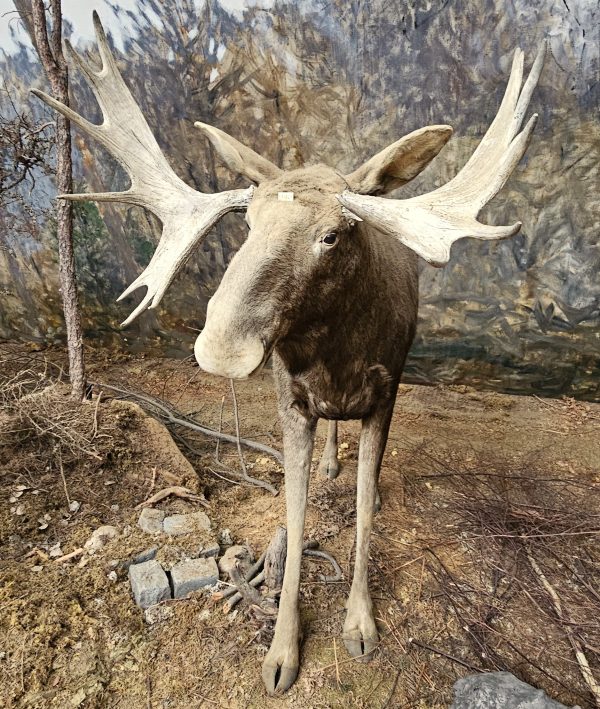
A closeup photo of the tagged moose specimen standing in the forest biotope of the Biologiska museet shows the area between the foreground and the background painting by Bruno Liljefors. The painterly expression of his brush strokes disappear when seen from the right distance in the viewing platform and create an effective illusion of distance.
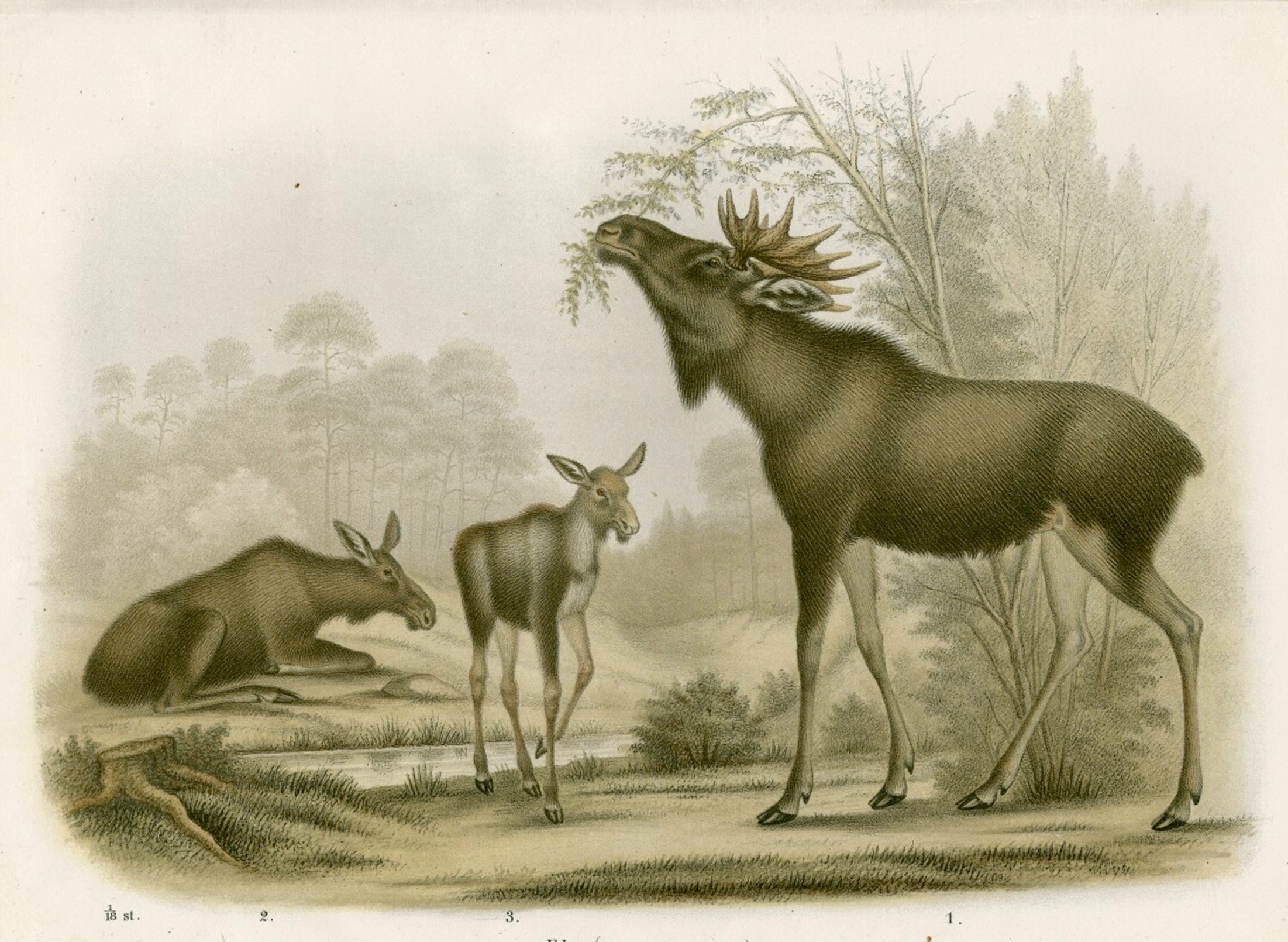
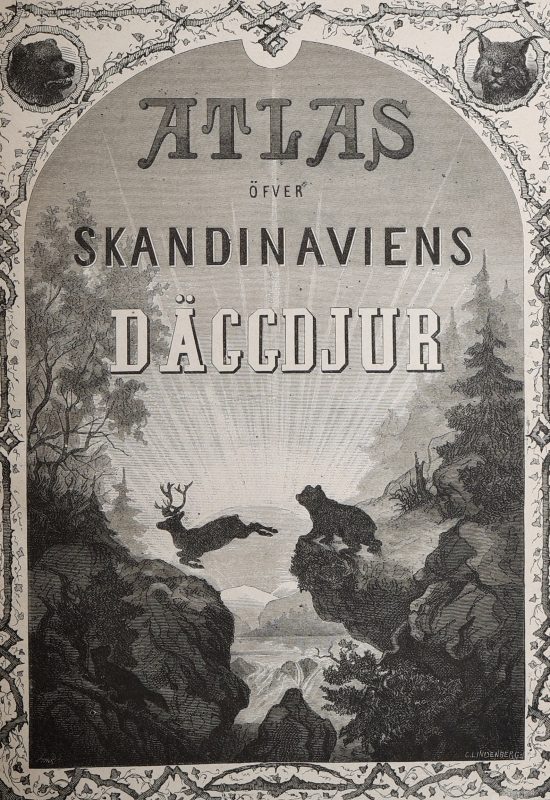
Liljefors rarely painted the moose and in these instances it was the either as a dead hunting trophy or being pursued by a hunter. The species was not often depicted in the genre of animal art due in part to the rarity of the animal. Most representations of the moose were scientific illustrations such as the one in the Atlas öfver Skandinaviens Däggdjur (Atlas of Scandinavian Mammals), published in 1873. Written by zoologist A. E. Holmgren, it included 132 figures and 22 plates produced under the direction of Wilhelm Meves, the German conservator at the National Museum of Natural History. Kolthoff had studied “Dermoplastik” under Meves and may have been inspired by his effort to depict all of the mammals of Scandinavia. Although the native species appear in stylized and picturesque landscapes, the book was a forerunner of Kolthoff’s museum concept to present all of Norden’s wildlife in replicas of their natural habitats in nature.
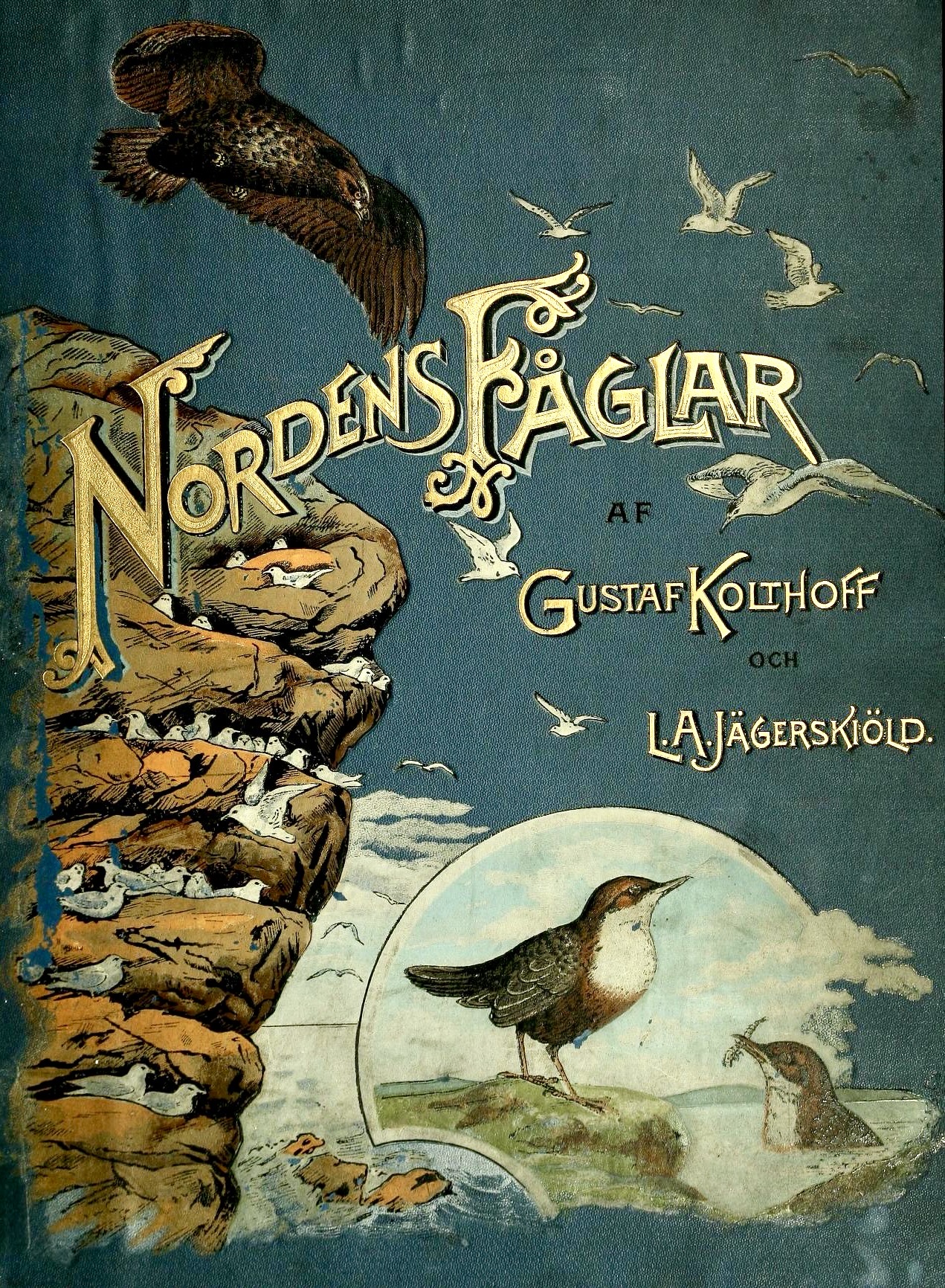
A classic zoological book that described 238 species of Swedish birds was C. J. Sundevall’s Svenska Foglarna (1857), illustrated by Peter Åkerlund. Kolthoff was asked to publish a new expanded edition of this book in collaboration with the ornithologist L. A. Jägerskiöld. Research for the book, was done at the Zoological Museum at Uppsala University and included detailed observations by Kolthoff on the occurrence, breeding and lifestyle of the birds of Sweden, Norway, Finland, Denmark, Iceland, Spitsbergen and Greenland. The book, titled Nordens Fåglar (1898), was highly regarded as a seminal work that mirrored the National Romanticism and nature conservation movements in Sweden at the turn of the 20th century. The term “Norden” was later expanded from its biological context to a political and cultural identity.
The cover of Kolthoff’s book featured two birds species seen in their natural habitats in the wild: one was the White throated Dipper (Cinclus cinclus), an aquatic passerine song bird deeply ingrained in Nordic culture as a symbol of pristine nature known for its amazing ability to dive and swim in flowing water. The other species on the cover is the Herring Gull (Larus argentatus), seen nesting in a bird colony on the steep rocky, coastal shore that is typical of the biotope of Stora Karlsö. Kolthoff had represented both biotopes in his Biologiska museet in Stockholm along with their animal inhabitants. A second, updated edition of Nordens Fåglar was published in 1926 – 1930. The earlier book had included the illustrations published in Sundevall’s 1857 book; conventional chromolithography plates that depicted related species on the same page, posed singularly and stiffly as in conventional taxonomic museum displays.
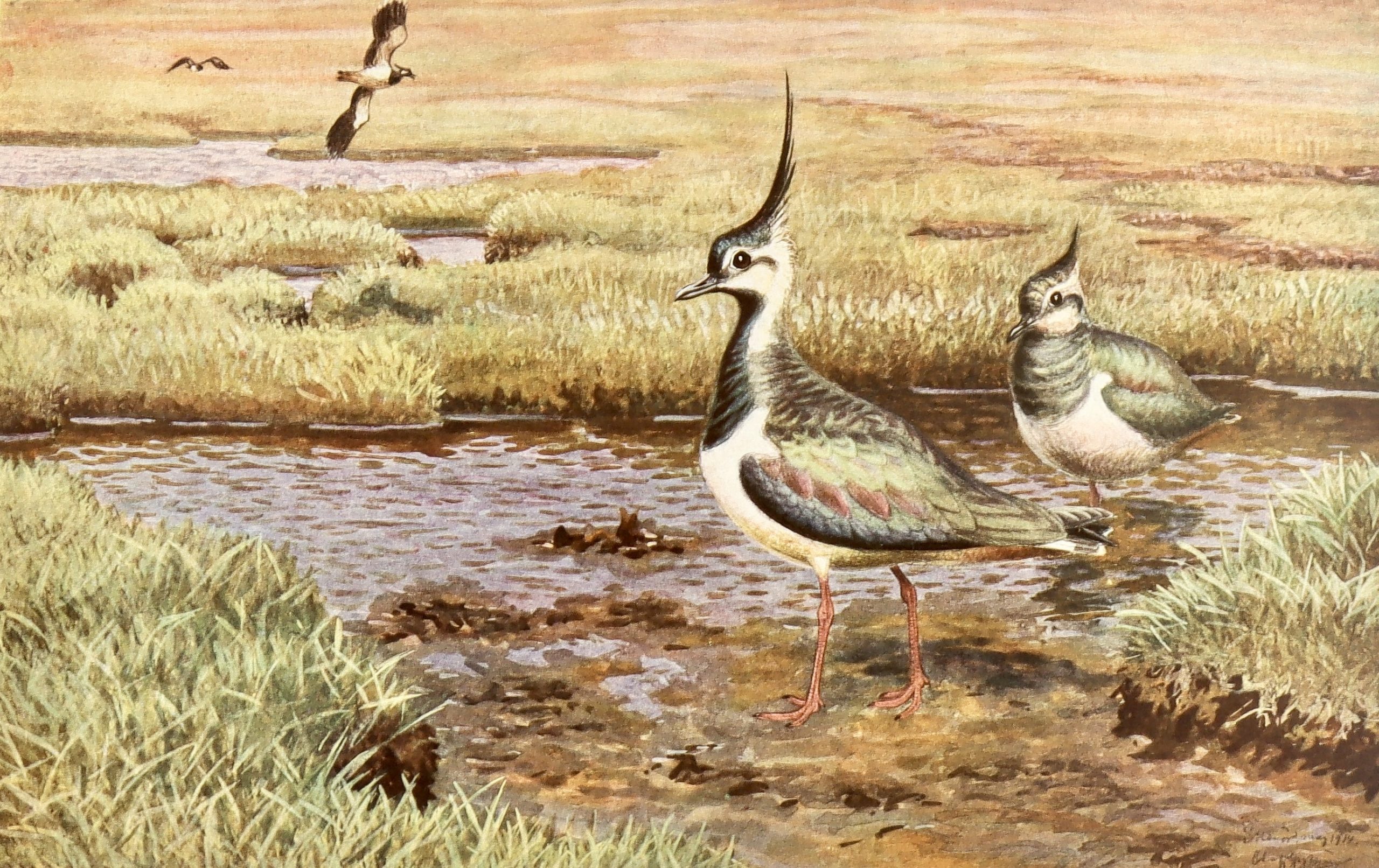
The new edition of Nordens Fåglar included 170 colour plates by Carl Olof Gylling (1870 – 1929), a multi talented zoological conservator, museum curator and artist. An example of one of Gylling’s illustrations is the Tofsvipor or Northern Lapwing (Vanellus vanellus). The landscape is given equal attention as the birds that inhabit it and the style is painterly rather than illustrative. The title notes the location of the pictured shorebird as the beach at Falsterbo in Skåne, at the southern tip of Sweden, a famous bird migration area known as Måkläppen. This biotope was the subject of two dioramas that Gylling created, the first at the Malmö Museum in 1902, the same year that Måkläppen became Sweden’s first protected bird habitat. The second diorama opened to the public in 1923 at Göteborg’s Naturhistoriska museet, where the influential director, L. A. Jägerskiöld, had supported Gylling’s unique and exceptional displays.
“Måkläppen utanför Falsterbo, Juni 1920” was one of five dioramas created by Gylling at the museum in Göteborg, all of which featured a biotope that was or had been under threat before protection. The landscape motif of each diorama was an exact recreation of a particular place in nature at a specific time of year. Gylling did extensive and painstaking research in the field, making sketches and taking photographs of the scene. Birds were featured in two of the dioramas but not in the others. Gylling’s ambition was to replicate the visual experience of being in nature and to combine his knowledge as a naturalist with his artistic abilities to communicate to the viewer an aesthetic appreciation for the biological richness and beauty of nature. The Göteborg dioramas were carefully designed by Gylling to produce an effective visual illusion. Much like Kolthoff’s biological display in the Gustavianum, he made use of the round tower of the museum with its overhead natural illumination and in the middle he designed a constricted viewing platform.
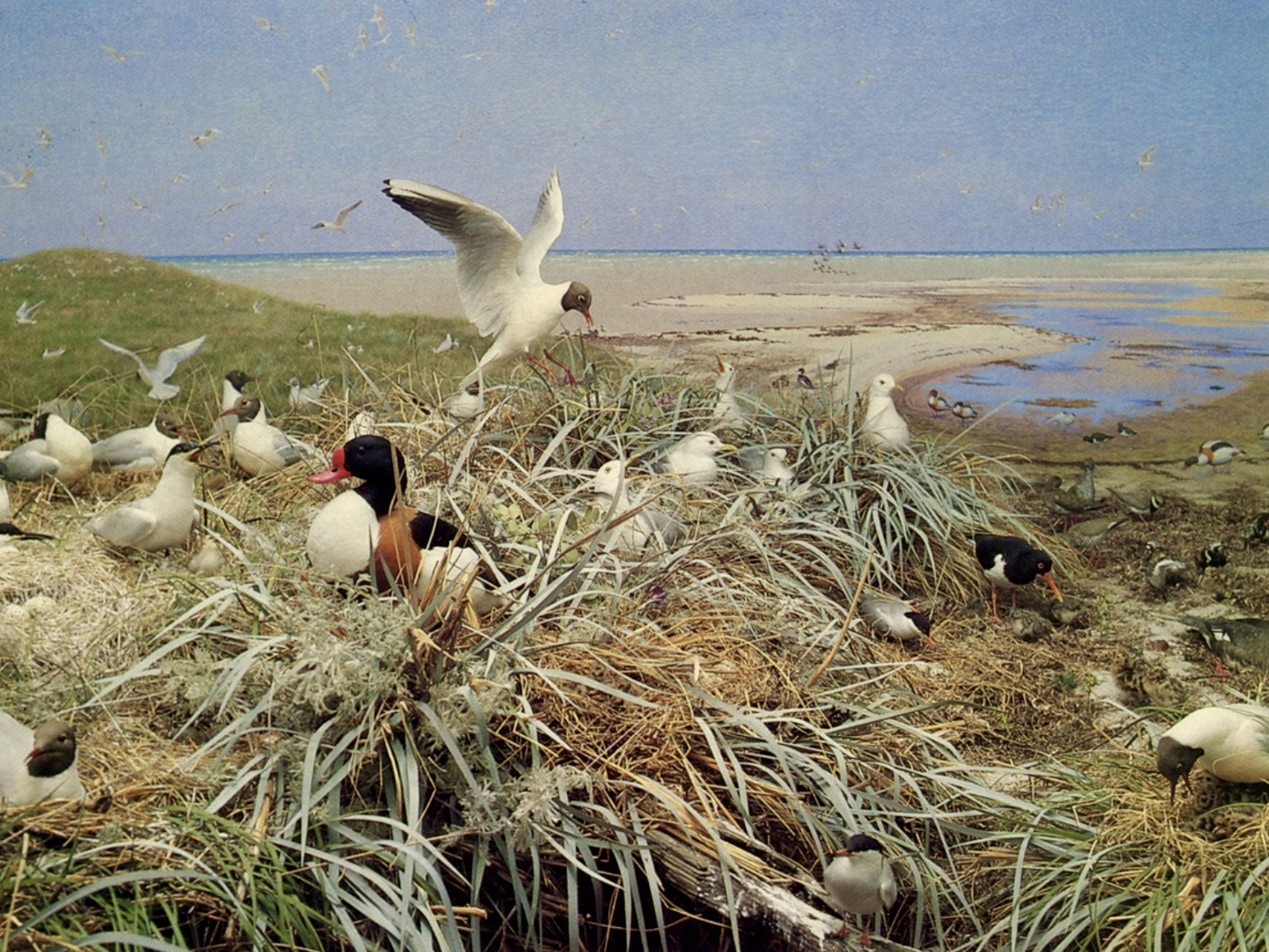
The five bird species in the Måkläppen diorama were all named by Linnaeus in 1758: Arctic Tern (Sterna paradisaea), Common Tern (Sterna hirundo), Sandwich Tern (Thalasseus sandvicensis), Black headed Gull (Chroicocephalus ridibundus), and Common Shelduck (Tadorna tadorna).
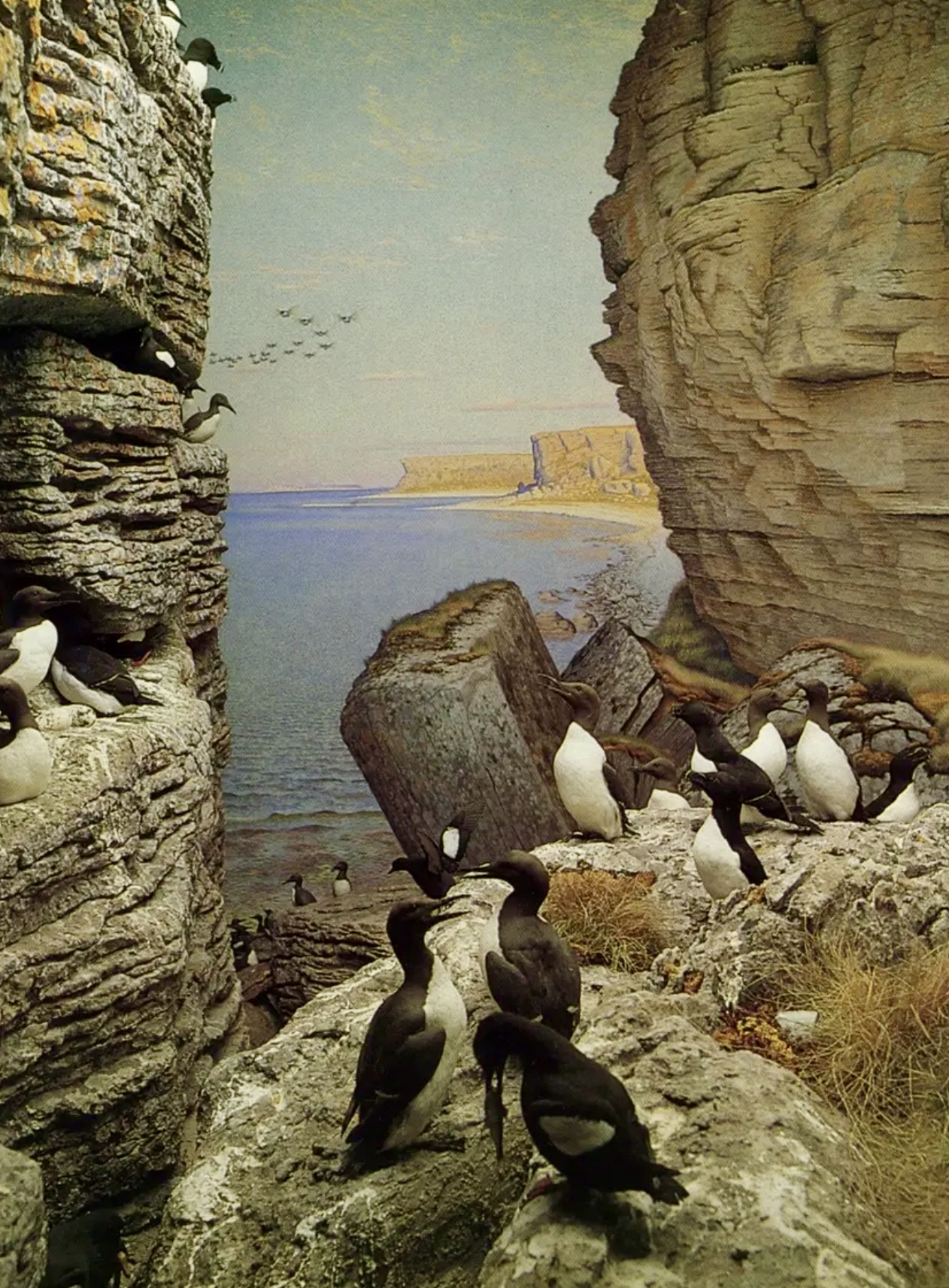
A second diorama by Gylling featuring a prolific bird breeding habitat was “Stora Karlsö utanför Gotland.” The exact location was Spangände, on the eastern side of the small island off Gotland, famous for its steep limestone cliffs and large colonies of Common Guillemots (Uria aalge) and Razorbills (Alca torda). Gylling was recognized for his exceptional skill in mounting bird specimens such as those in the foreground, but he was also an accomplished artist whose background landscape gives the taxidermic tableau the impression of a real scene in nature.
The naturalist Linnaeus visited Stora Karlsö and, in his 1741 travelogue, described the intensive harvesting of guillemot eggs by local residents. While he admired the birdlife, his utilitarian view focused on the economic and dietary benefits of birds as a natural resource. A century later, in the 1840s, Stora Karlsö became the site of a major guano harvesting industry. By 1880, intensive hunting had reduced the common guillemot colony to only some 20 to 30 individuals.
The same pressures, compounded by scientific collecting, had already driven the closely related Great Auk (Pinguinus impennis) to extinction in 1844. In the 1880s, Stora Karlsö was protected from further exploitation, helping to save its seabird colonies and establishing it as one of the world’s oldest protected natural areas, after Yellowstone National Park.
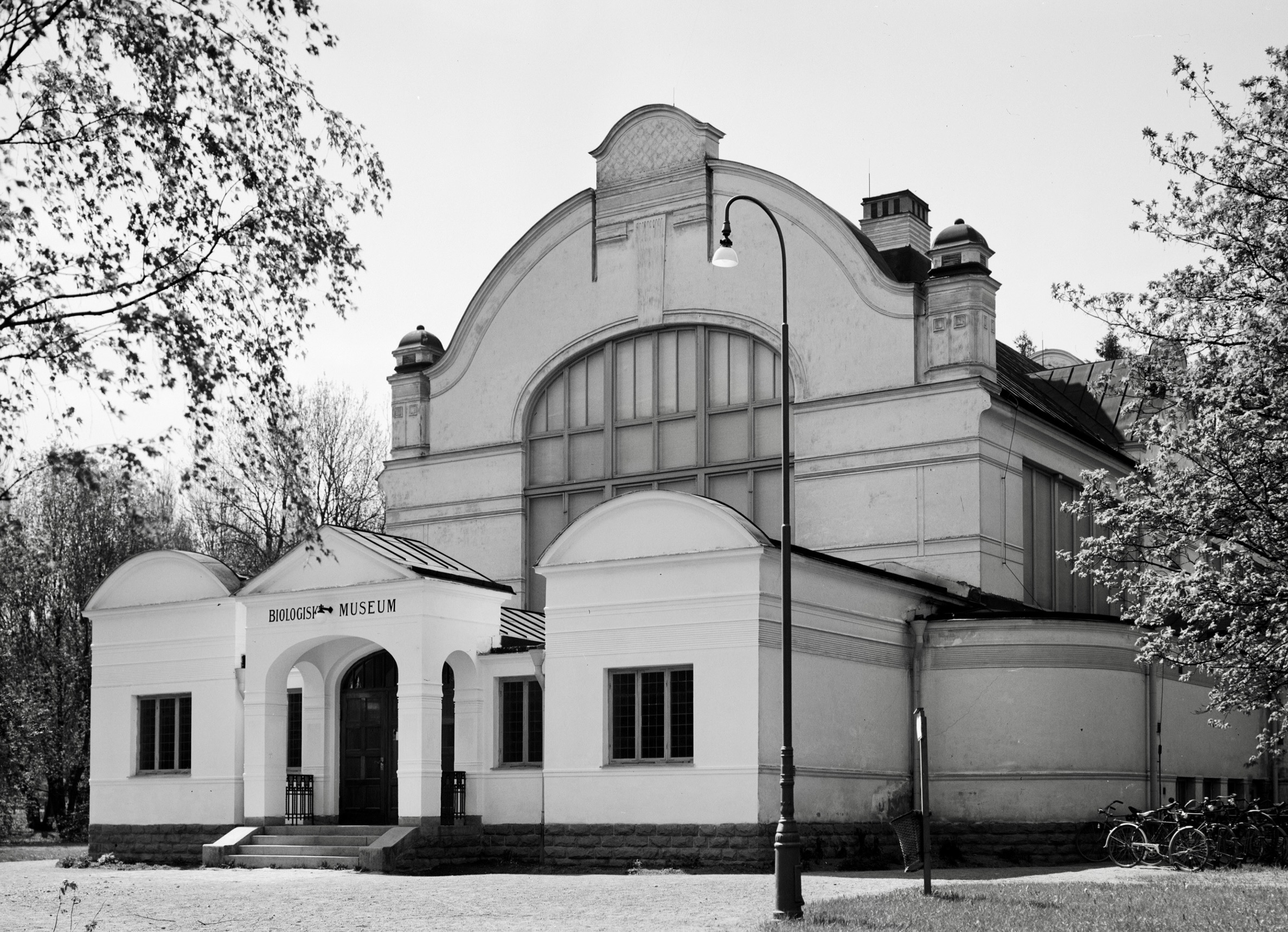
Following the opening of the Biologiska museet in Stockholm in 1893, Gustaf Kolthoff created three other biological museums: in Turku, Finland (1907); Uppsala (1910); and Södertälje (1913). These museums were closely associated with secondary schools and their pedagogical curriculum based on the use of natural history collections for teaching purposes. Part of the Linnaean tradition of nature study that originated in the early 18th century, the subject was later defined as “biology,” or the study of organisms and their relationship to one another and their surroundings. The museum in Uppsala was designed by architects Justus Hellsten and Hjalmar Cederström.
When the Biological Museum in Turku was built in 1907, Finland was part of the Russian Empire as the autonomous Grand Duchy of Finland and remained so for another decade. The architect, Alex Nyström, designed it in the style of Stockholm’s Biologiska museet, a direct homage to the National Romantic architecture that expressed Nordic national identity in Finland as a counterweight to Russian influence.
The museum was designed to provide a number of alcoves in which to display mounted zoological specimens in ten illusionistic scenes that showcased Finish biotopes such as: a marshy meadow near an ocean beach; a moss covered mixed forest; rock formations on the mainland; and a coniferous forest in the winter. A founding principle was to exhibit as many species as possible to acquaint the urban public with all of the native animals and the emphasis was on the biological life of the Finnish forests, lakes, mountains and archipelagos.
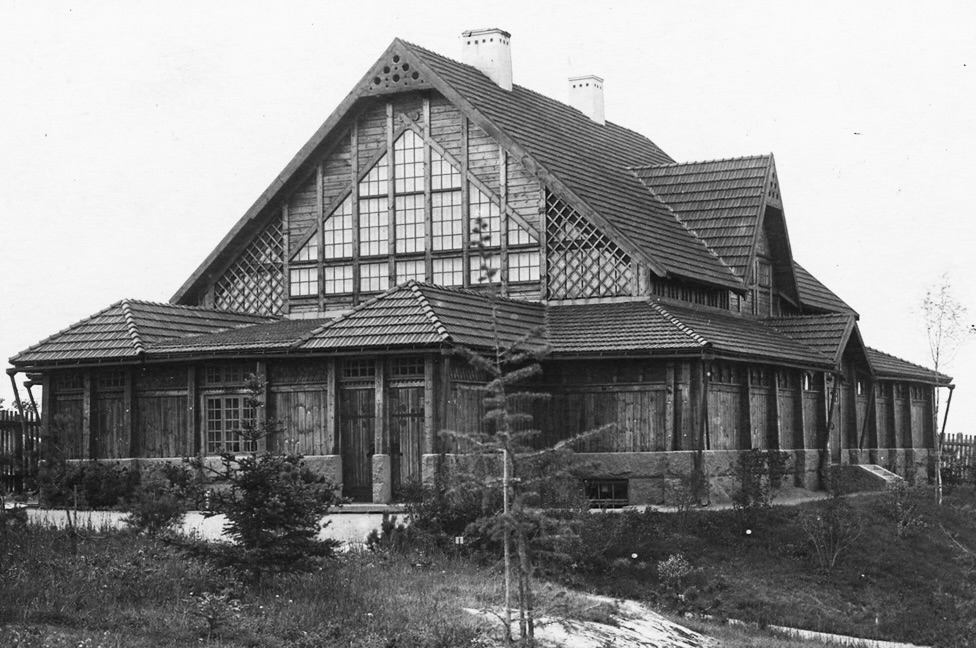
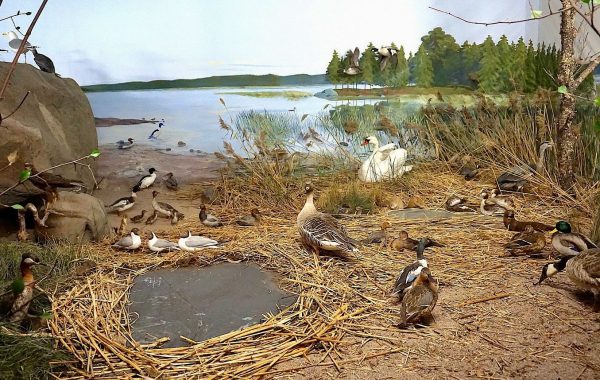
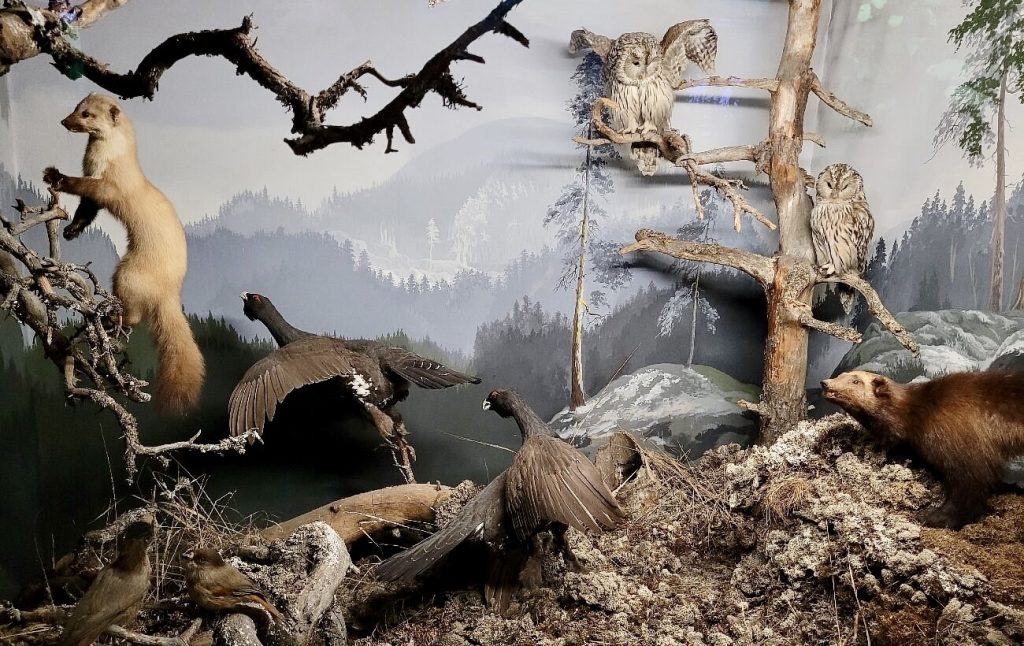
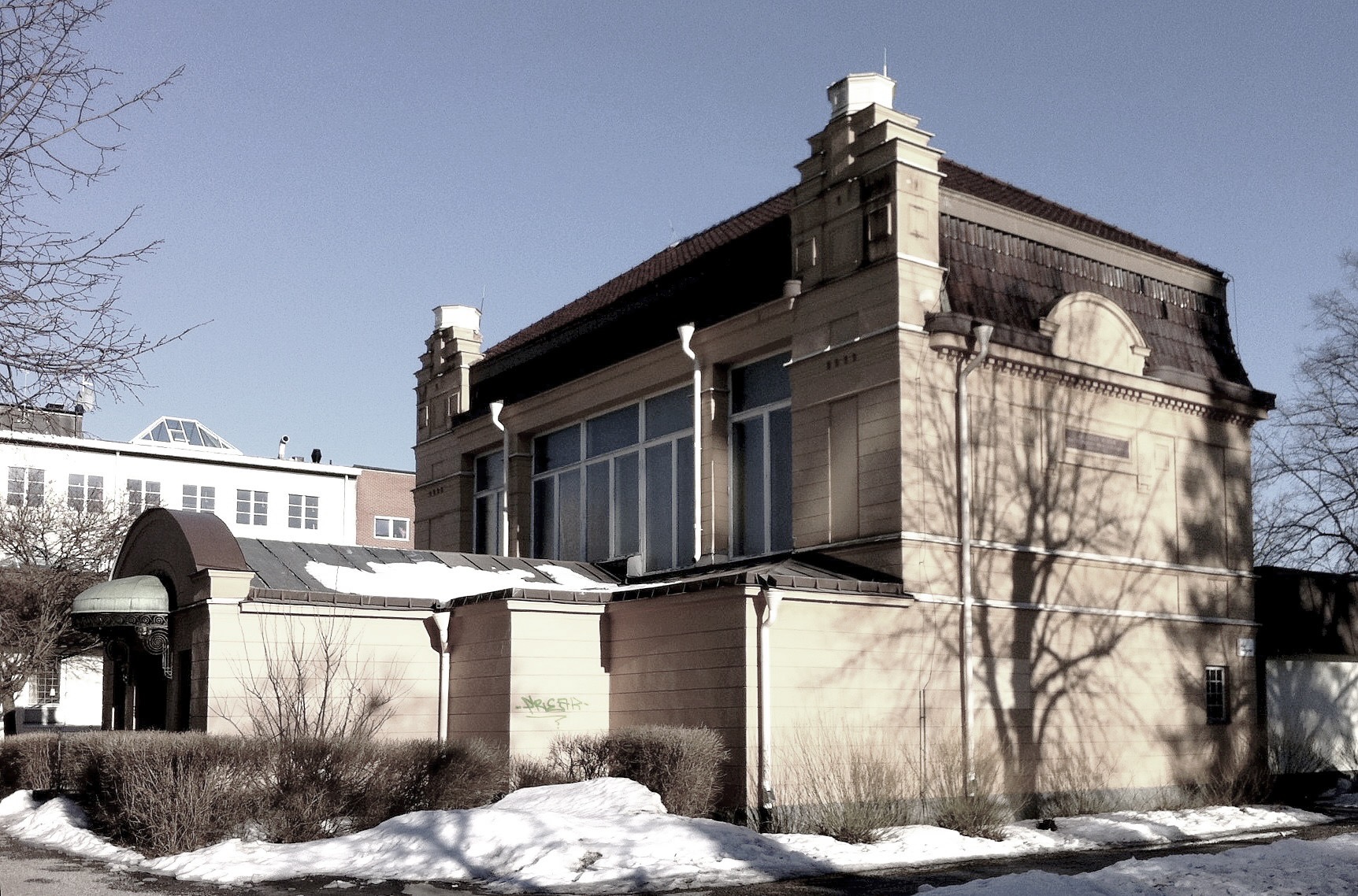
The Biologiska museet in Södertälje opened in 1913, the same year as the death of Kolthoff. It was designed in an art nouveau style by the prominent architect Hjalmar Cederström and was a gift to the town by the industrialist Carl Fredrik Liljevalch (1837-1909). Liljevalch had made his fortune first by cutting down the forests of Norrland and later by iron ore mining and railroads. Opening up the north to industrial development was lucrative; during the beginning of the 1900s, his company was the most valuable on the Swedish stock exchange. At the same time that he profited from the industrialization of nature, Liljevach hunted for sport and like many others, admired Kolthoff’s tracking and shooting skills and hunting narratives. A generous philanthropist, Liljewalch was a foundational donar to Kolthoff’s biological museums in Stockholm and Uppsala and in addition founded a well known museum of art that bears his name today.
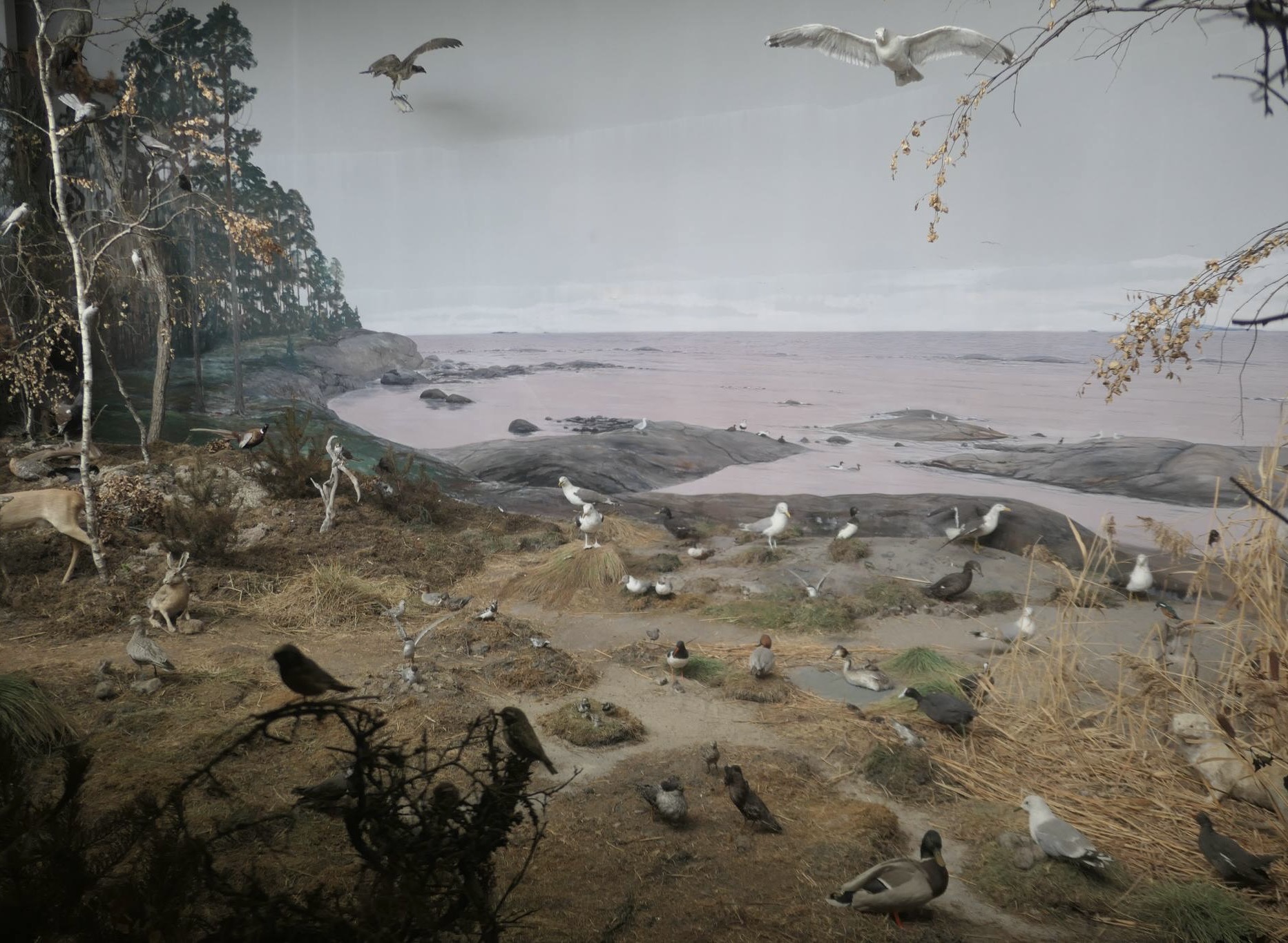
As with the museums in Turku and Uppsala, Kolthoff’s son, Kjell Kolthoff (1871 – 1947), helped to set up the displays. The focus of the Södertälje museum was to show the richness of the animal life in the Sörmländska region, in which Södertälje was located. Over 100 species were displayed in a great panorama of the archipelago habitat illuminated by natural light. The museum, which was originally built as a study collection for two nearby schools, was greeted with much admiration and praise when it opened. One taxidermic group in the foreground featured the celebrated Swedish game species Capercaillie (Tetrao urogallus) engaged in a courtship display. This ancient symbol of Nordic wildlife known as the “King of Birds” and prized game bird had become increasingly rare as the old growth coniferous forests in which the birds nested were industrialized. By the time the Biologiska museet was built, the capercaillie had been extirpated from most of Europe and was under threat in Sweden.
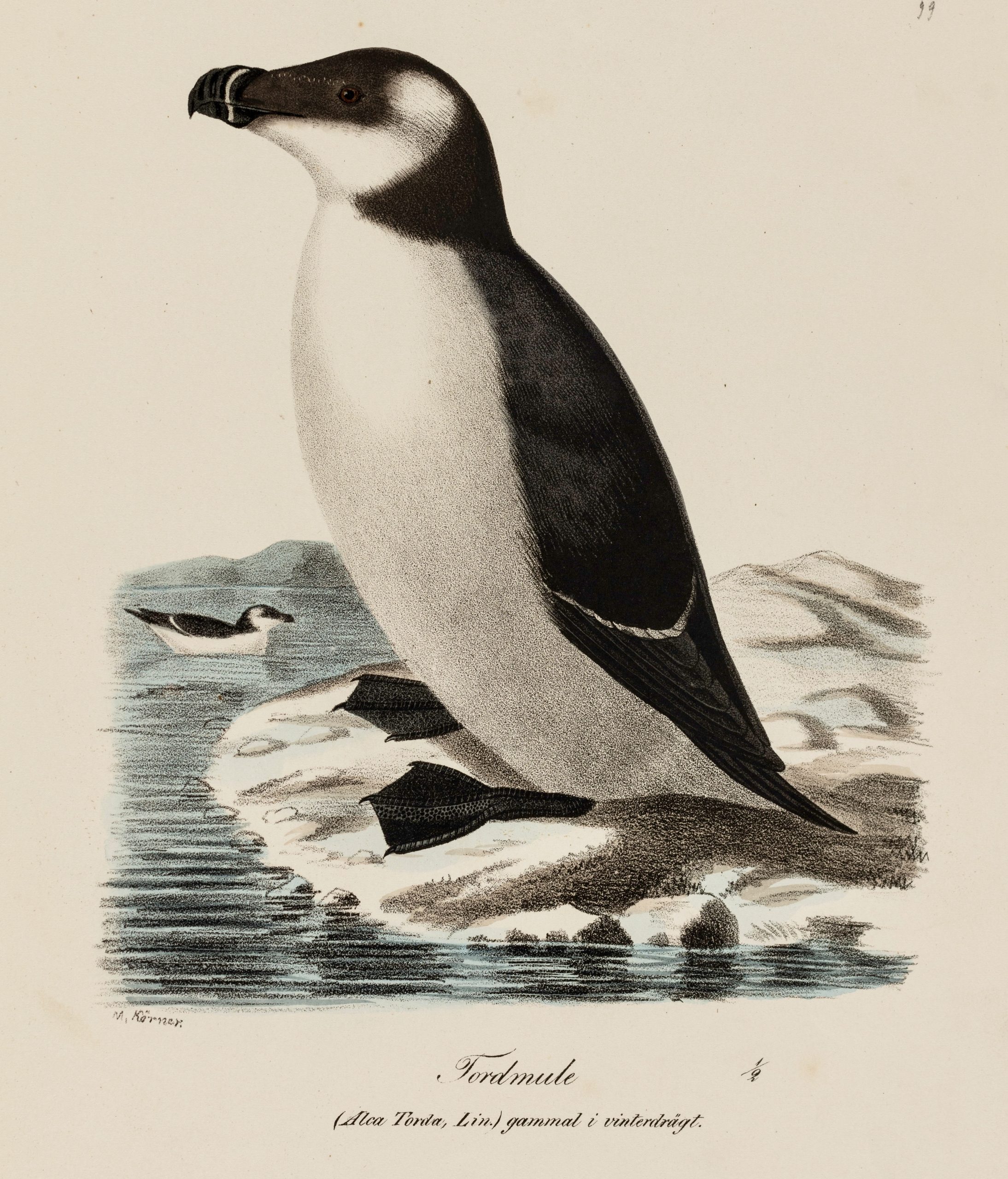
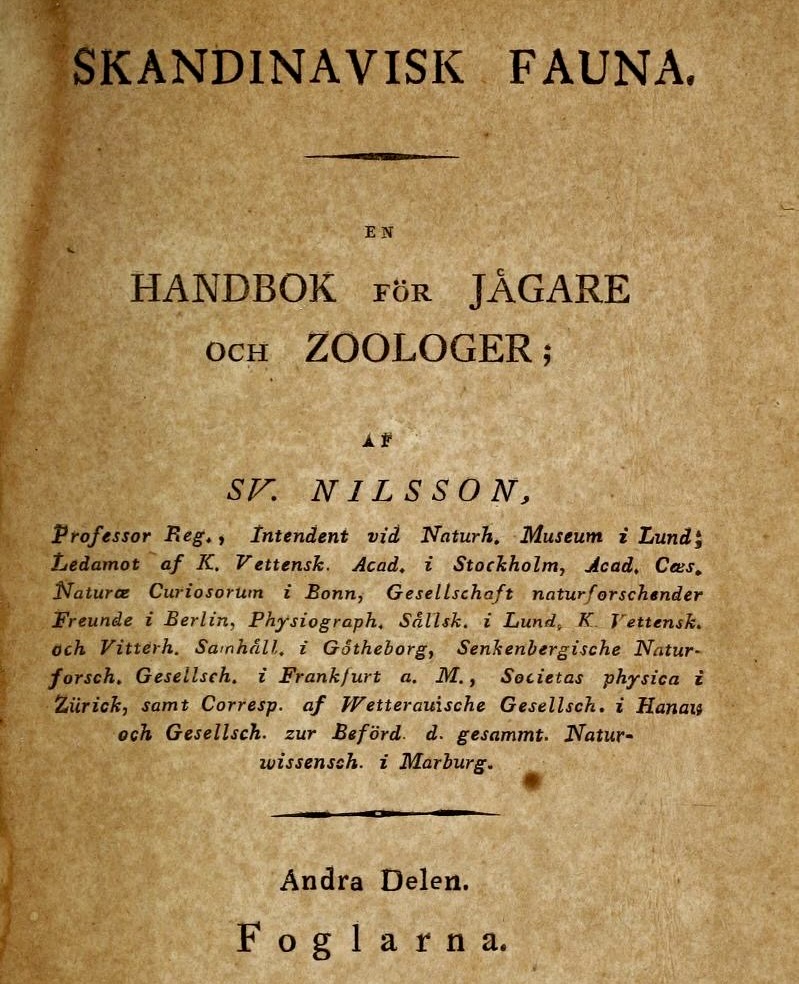
The foundational work in 19th century biology describing the anatomy, behavior, and habitats of Nordic animal and bird species was by the renowned Linnaean scientist Sven Nilsson; Skandinavisk Fauna, published between 1820 and 1860. The subtitle, Handbok för Jägare och Zoologer made clear its primary value as a field guide for hunters. Nilsson was a founding member of the Svenska Jägareförbundet (Swedish Hunters’ Association), established in 1830 to regulate hunting and save certain game species from extinction. The work was accompanied by an atlas with 200 lithographs by Magnus Körner and Magnus von Wright. An example is “Tordmule (Alca Lorda)” by Körner, depicting an adult razorbill in its winter plumage. This is the same species featured in the “Fågelberg” of the Biologiska museet, by then near to extinction due to hunting.
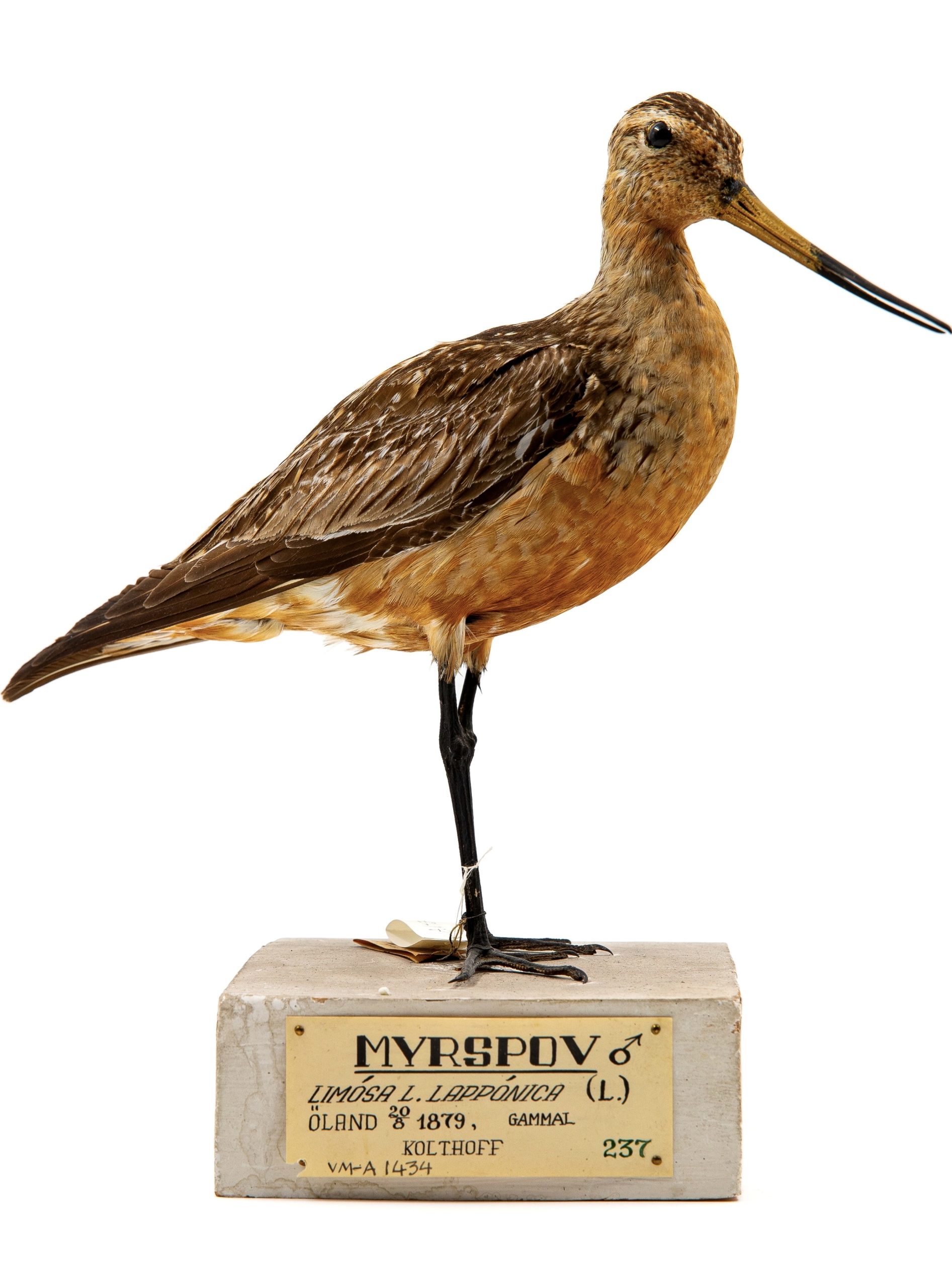
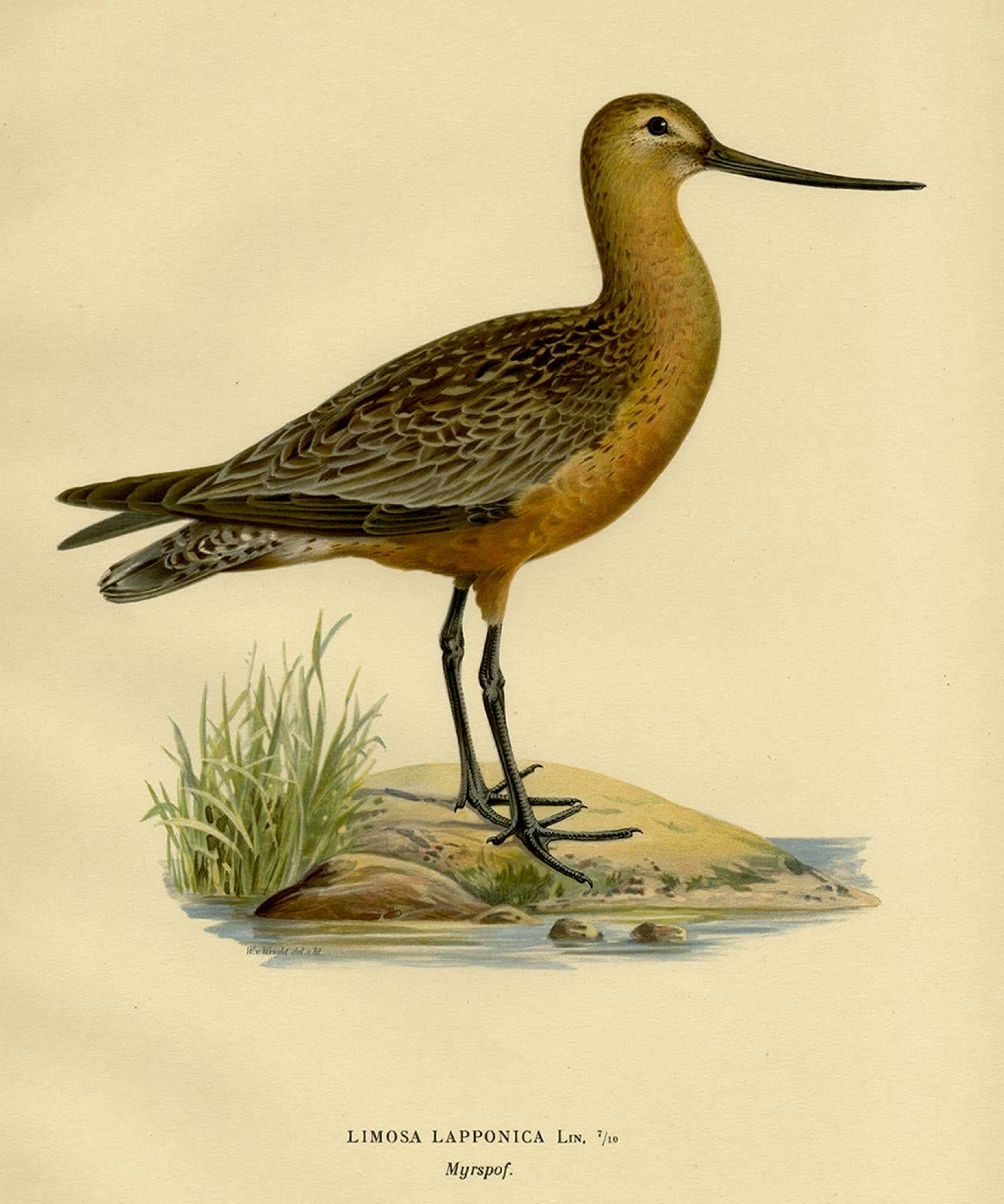
In Sweden, there was a close relationship between zoological texts, illustrations and taxidermy in the 19th century. An example is the lithograph by Wilhelm von Wright (1810 – 1887) of a Bar tailed Godwit (Limosa Lapponica), in Swedish called “Myrspov,” from the book Svenska Fåglar efter Naturen och på Sten Ritade (Swedish Birds drawn from Nature and onto Stone), which began publication as a series around 1828. The folio volume was created by the talented naturalists and artists, the three Finnish Swedish brothers von Wright (Wilhelm, Magnus and Ferdinand), who often collaborated their skills in hunting, ornithology, zoological illustration and taxidermy.
Linnaeus encountered and described the Myrspov during his journey to Öland and Gotland in 1741, and classified the taxonomy of the species in his Systema Naturae (1758). The Myrspov is a large shorebird that breeds in the north and is known for its spectacular migrations, one of the longest of any bird. The island of Öland with its coastal wetlands and mudflats is a critical migration route and resting stopover for flocks of thousands of the birds in the spring. But as waders, the Myrspov was vulnerable to hunters and by the end of the 19th century only a few pairs remained on the island.
The collapse of the Myrspov population was part of a larger, severe decline in Europe, due to habitat loss driven by the drainage of wetlands and agricultural changes, alongside hunting. The bird’s flesh was considered a delicacy; well into the early 20th century it was sold at markets for human consumption.
The national school reforms of the 1850s in Sweden gave impetus to Kolthoff’s career as a taxidermist. A new and stronger emphasis on the natural sciences, particularly on natural history specimens, made them an important learning resource in secondary schools. As a youth, Kolthoff worked mounting specimens at Katedralskolan in Skara until 1872. Founded in 1641, it was one of the oldest schools in Sweden and had a large natural history collection, donated to the school in 1759. As a result of his skill as a hunter, Kolthoff substantially enlarged the collection, including nearly 400 birds. One was a Myrspov mounted by Kolthoff in 1868, and ten years later, he mounted another one; the label gives its Linnaean name as well as its Swedish name, and notes that the specimen came from Öland, was an adult male, was shot on August 20, 1879, and was mounted by Gustaf Kolthoff.
Certainly, Kolthoff would have shot many of these birds during his lifetime for museum collections. In later years however, he recognized that the species was threatened by habitat destruction, including the draining of lakes, swamps, and wetlands. In 1896, he wrote: “Among the birds, it is the waders in particular that have suffered most from these changes in nature, and as a result have also declined to such a great extent that many species seem to want to disappear from the southern and central parts of our country,” and he pleaded for their protection. Perhaps Kolthoff’s influential role in the Linnaean tradition of nature education contributed to recognition of important migration sites in Sweden, including the southern tip of Öland. In 1946, it was declared a bird sanctuary and is today called the Ottenby Nature Reserve.