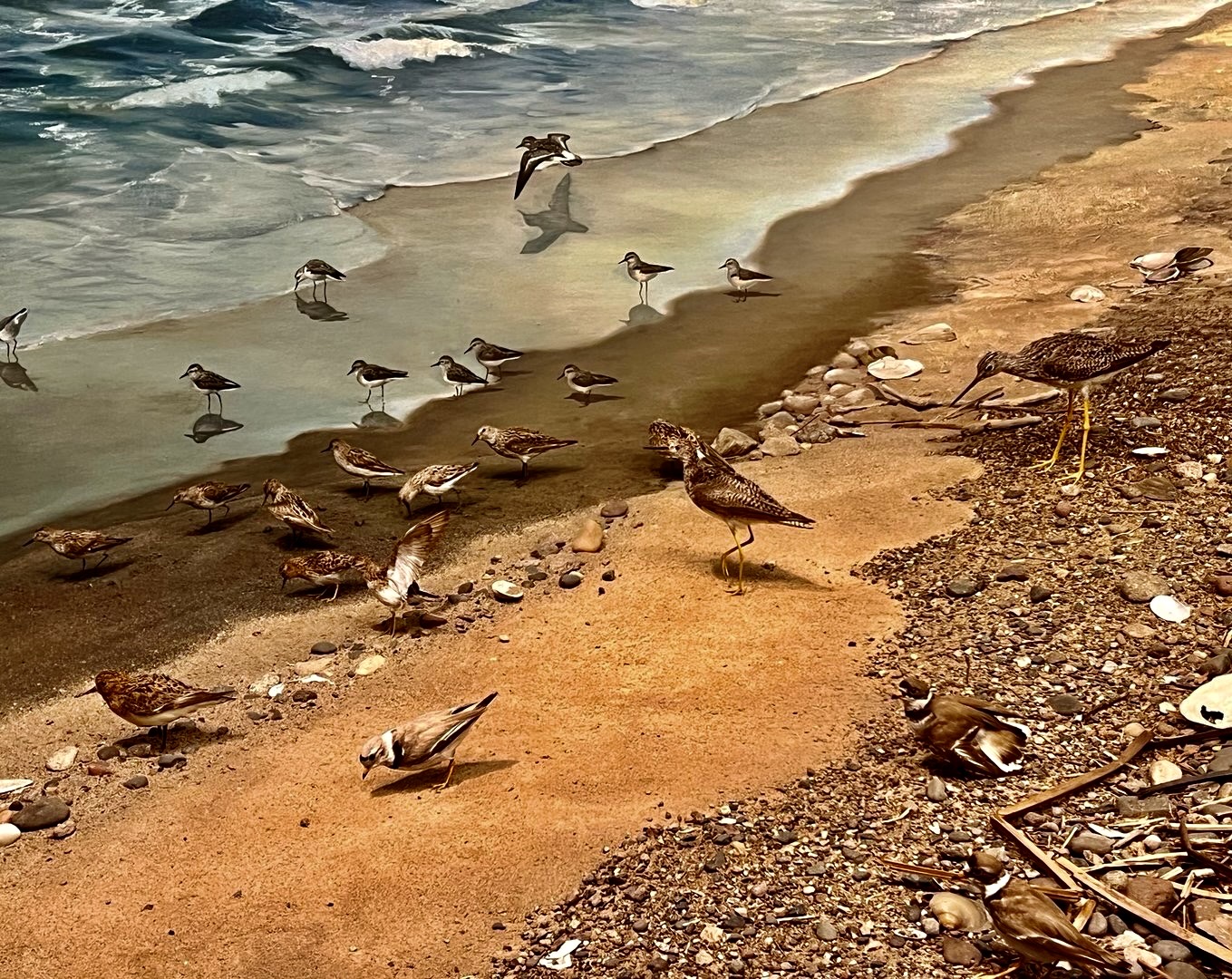
The “Shorebirds Habitat Diorama,” also called “Lake Pepin’s Sand Point,” was relocated in 2018 to the new Bell Museum at the University of Minnesota, in St. Paul, MN. It was completed in 1940 for the opening of the first museum to be purpose built for dioramas; the Minnesota Museum of Natural History. The diorama is an outstanding example of a collaborative creation by wildlife artist Francis Lee Jaques (1887 – 1969) and museum curator Walter J. Breckenridge (1903 – 2003). Based on a meticulously documented location depicting the spring avian migration along the Mississippi Flyway, the dramatic diagonal composition of the scene draws the viewer into a convincing illusion of spatial depth. A detail of the diorama reveals how the sandspit is segmented into five distinct zones (including pebbles, sand, wet sand, shallow water, and waves), each merging imperceptibly from the foreground into the panoramic painted background. Hundreds of birds and more than twenty species are represented in the diorama, both by mounted specimens and by painted forms.
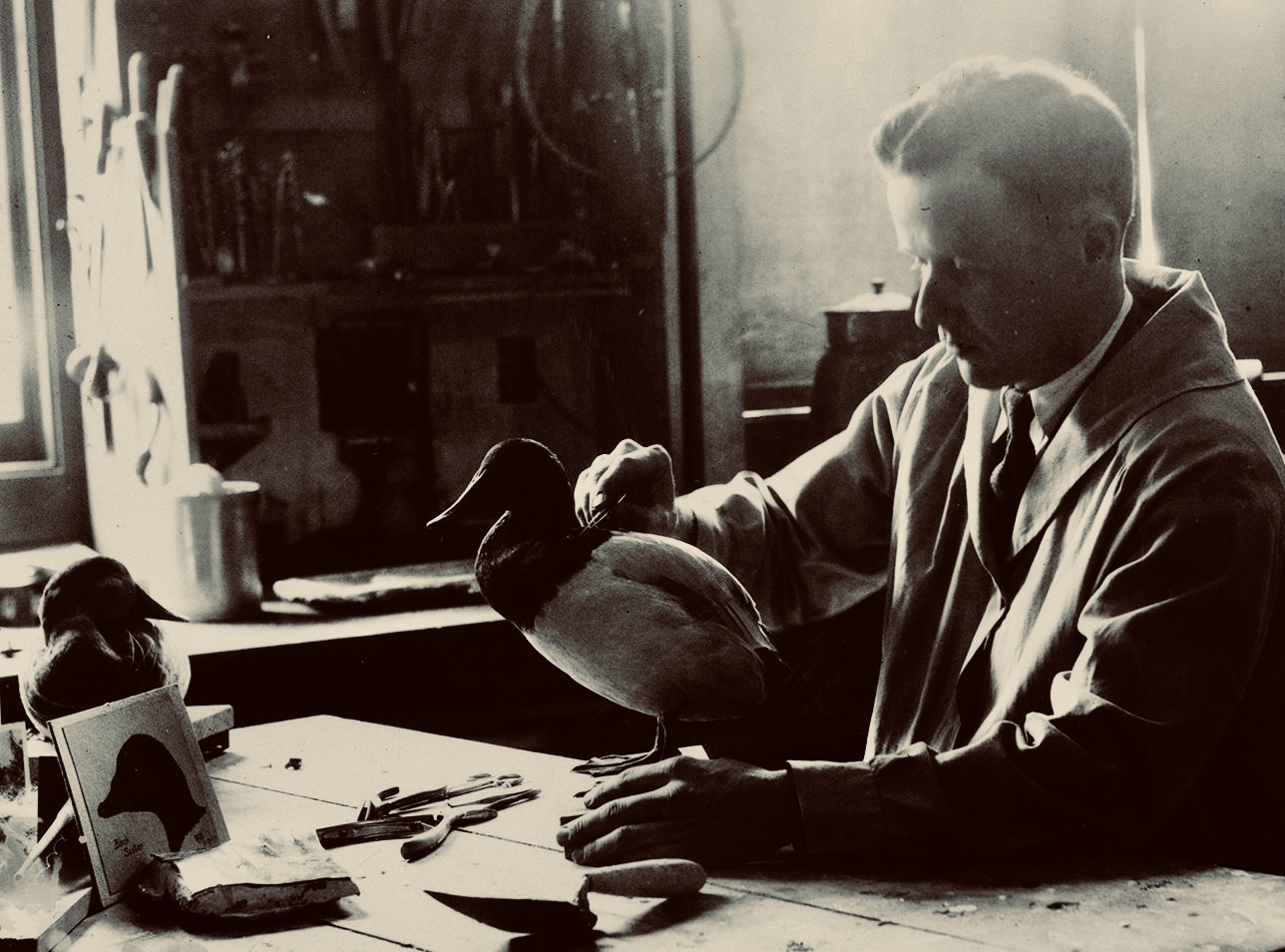
Working with Jaques, Breckenridge created a foreground that replicated the lakeshore site in nature and transitioned into a distant view. Careful planning enhanced the perspectival effect, including the placement of bird mounts to disguise and make invisable the junction between the foreground and the background painting. An enthusiastic field naturalist, ornithologist, and taxidermist since boyhood, Breckenridge later became a respected conservationist. At the Bell Museum, he served as preparator (1926 – 1940), curator (1940 – 1946), and director (1946 – 1970). A photograph taken in the 1920s shows him in a taxidermy studio mounting a duck, with an image of a duck’s head propped on the table as a visual reference. An avid natural history collector, Breckenridge made detailed field studies to document the biological habitats later reproduced in museum dioramas, taking precise measurements of zoological specimens, recording botanical species, taking photographs and making films.
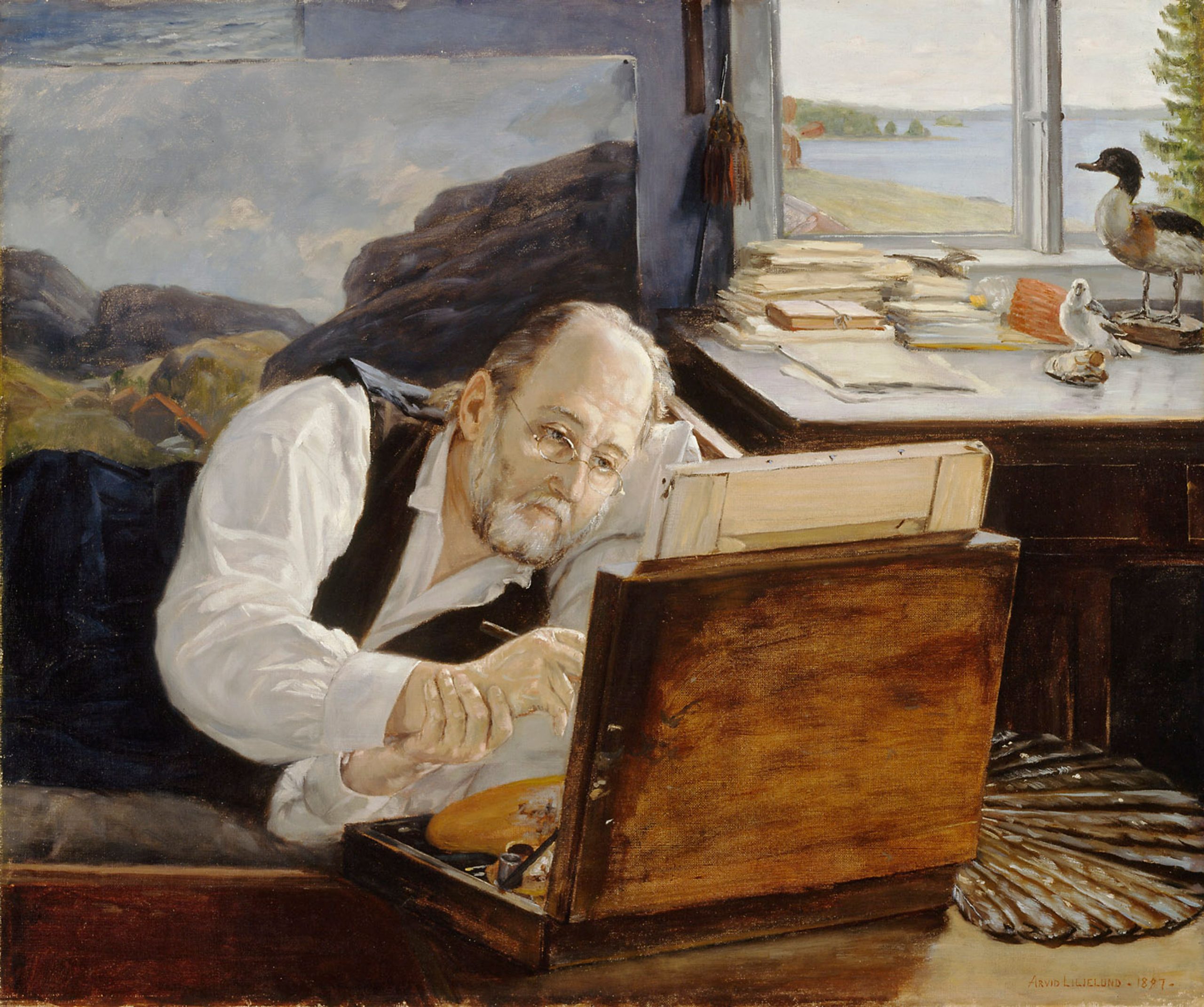
The fundamental relationship between bird taxidermy and the representation of birds in habitat dioramas is exemplified by the remarkable von Wright brothers, of Swedish – Finnish origins, whose professions as ornithologists, bird illustrators, taxidermists, and artists overlapped: Magnus von Wright (1805 – 1868); Wilhelm von Wright (1810 – 1887); and Ferdinand von Wright (1822 – 1906). All three brothers were field naturalists who hunted and collected the specimens they mounted. A portrait in the Finnish National Gallery by Arvid Liljelund (1844 – 1899) depicts Ferdinand painting a canvas in his studio in 1897, towards the end of his life. Two mounted birds sit on his desk, one of them clearly a duck. Outside the window is a view of the Finnish archipelago. Prominently positioned behind Ferdinand is a landscape sketch on canvas, perhaps to be completed with birds. During the 19th century, the interdependent relationship between scientific observation, artistic representation, and taxidermic practice exemplified by the von Wright brothers became increasingly important to the development of naturalistic museum displays.
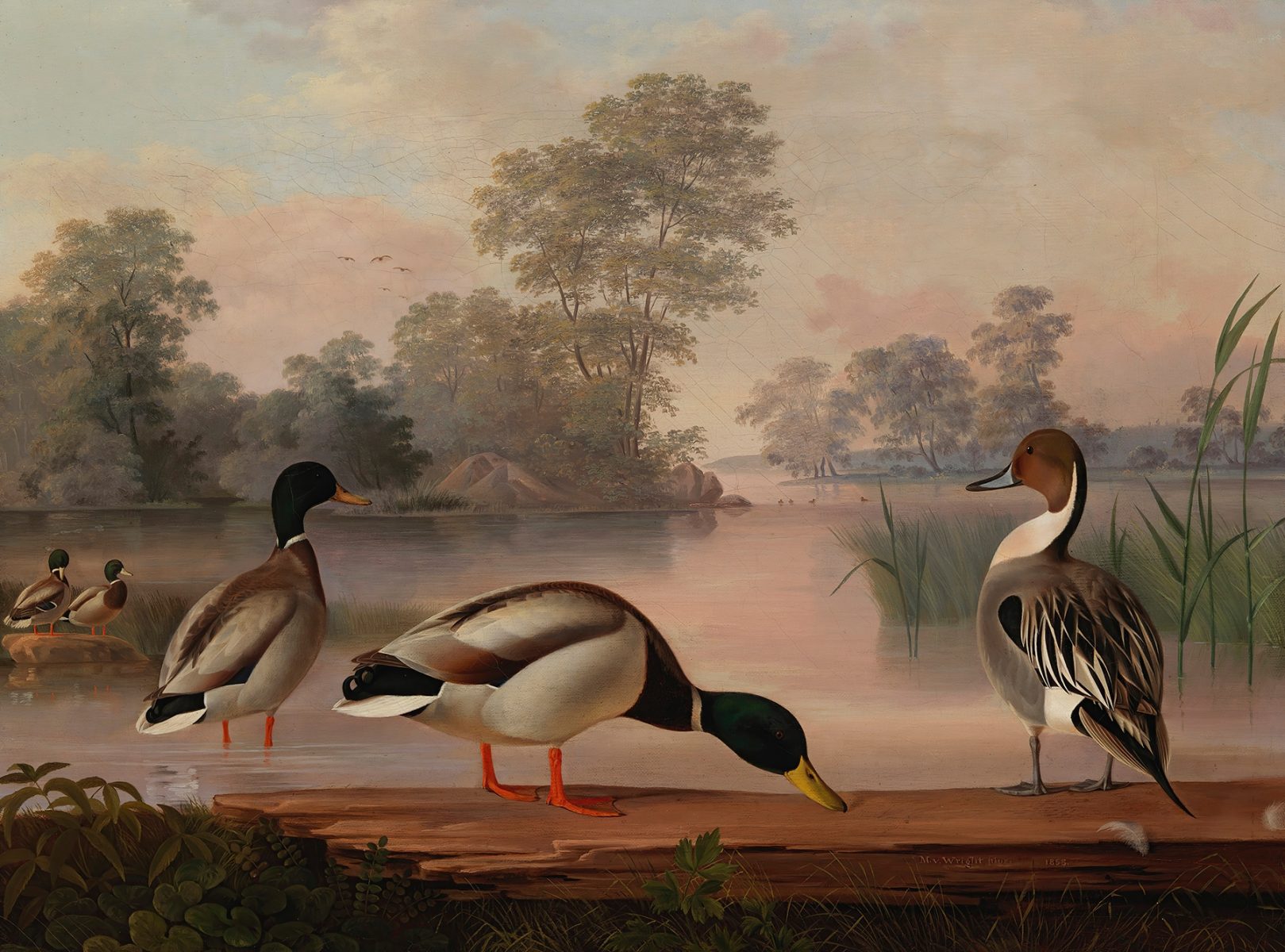
Magnus von Wright began mounting birds in the 1820s for Finland’s oldest biological society, the Societas pro Fauna et Flora Fennica, and in 1845 he was appointed “konservator” (taxidermist) at the University of Helsinki’s Zoological Museum. He also contributed to the Finnish Museum of Natural History (Luomus), which holds over 200 specimens mounted by him. An 1853 painting by Magnus in the Finnish National Gallery (Ateneum) features several male ducks in transitional plumage posed in a picturesque landscape: the Mallard (Anas platyrhynchos) and Northern Pintail (Anas acuta). Assisted by his brother Wilhelm (and later Ferdinand), Magnus provided scientific illustrations for the groundbreaking multivolume work on Swedish ornithology, Svenska Fåglar (1828 – 1838). In 1857, Magnus traveled to Düsseldorf to study art, and in 1859 he published his own work on Finnish birds. All three von Wright brothers were skilled artists, able to depict bird anatomy, behaviour and feather structure.
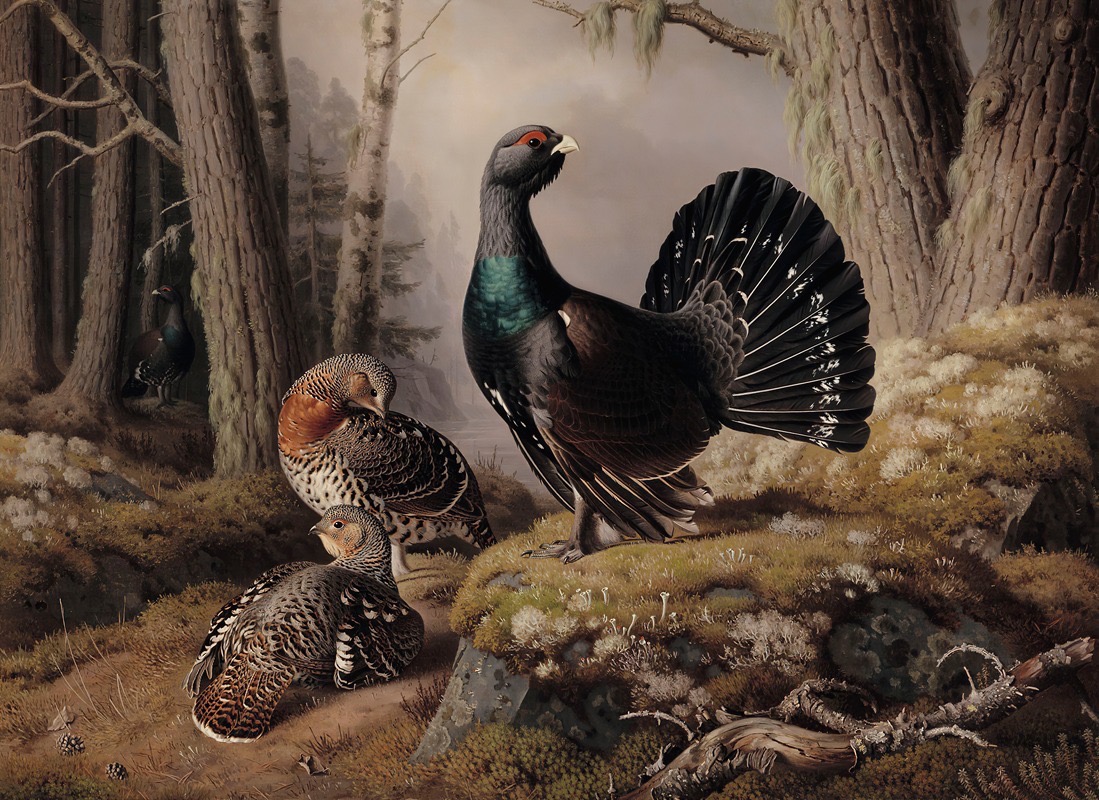
Ferdinand von Wright’s 1862 painting “Capercaillies Courting” in the Ateneum depicts a Western Capercaillie (Tetrao urogallus) lekking scene set in a boreal forest near Kuopio, Finland. The naturalistic rendering of the birds in their native habitat, together with the atmospheric perspective and spatial depth of the scene, anticipates some of the conventions of habitat dioramas that emerged a few decades later, notably at the Biologiska museet in Stockholm. Another association is the cultural identity of the Nordic landscape celebrated by the National Romantic movement in Sweden and Finland. This painting and other similar works were not merely scientific representations but functioned as powerful symbols of distinctive native flora and fauna, particularly during an era in the late 19th century when many treasured game species had declined or become locally depleted through overhunting elsewhere in Europe.
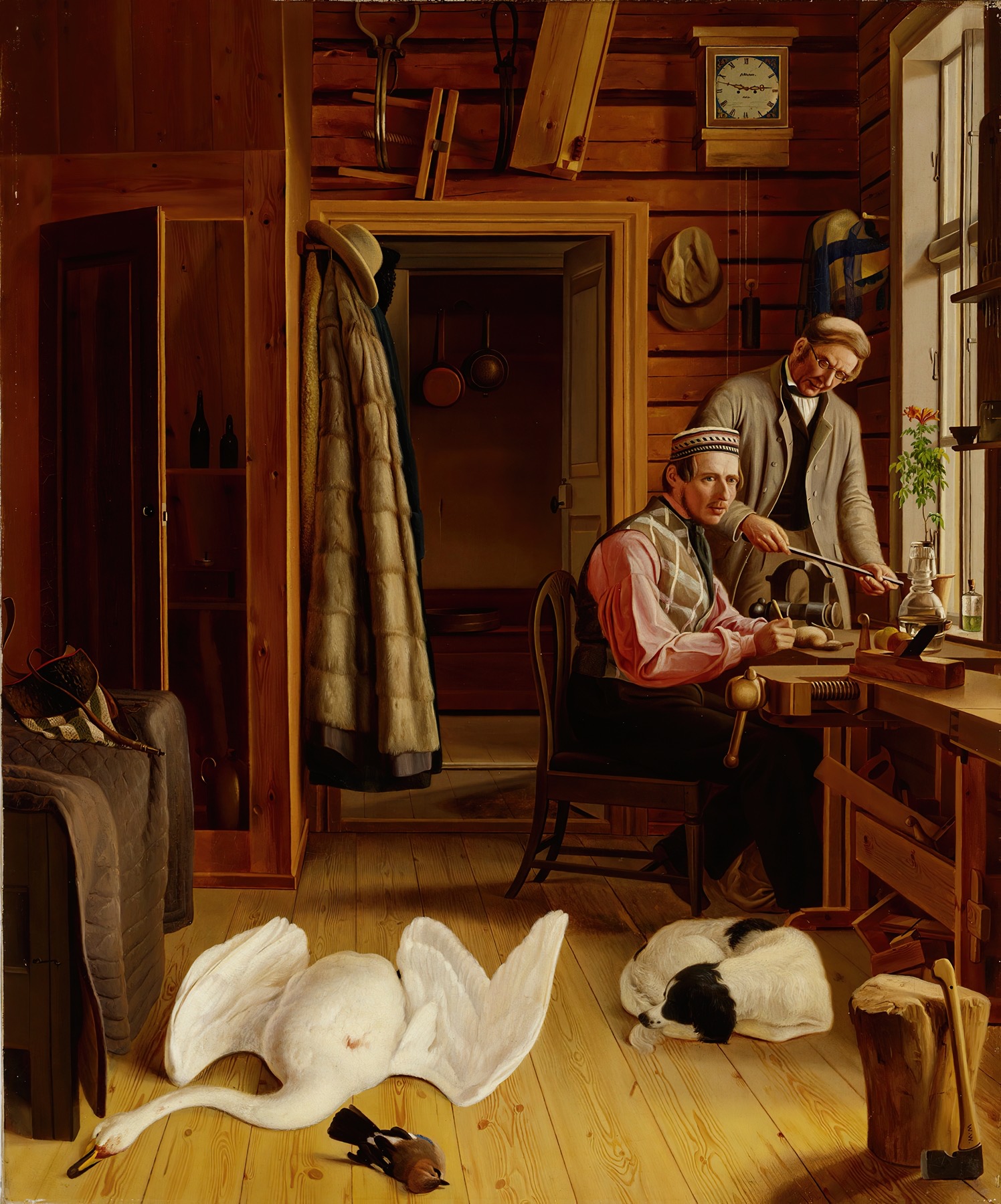
A painting by Olof Bildt (1787 – 1863) portrays Wilhelm von Wright at work mounting birds in his taxidermy studio, c. 1850. Built by Wilhelm in the 1840s, the studio is located at Marieberg, in Morlanda parish on the island of Orust in Bohuslän, Sweden, and is preserved today as a heritage site. A hunting dog is curled up at his feet, and two freshly killed bird specimens are seen on the floor, one easily identified as a Whooper Swan (Cygnus cygnus). As a scientific bird illustrator and taxidermist, Wilhelm relied on birds collected in the field, from which he made sketches and took measurements before preserving and mounting the skins. By the mid 19th century, the Whooper Swan had been driven to near extinction in parts of Europe due to hunting and demand for its meat, feathers, and eggs. Only small populations survived in remote northern refuges in Sweden and Finland. At the same time, the species had profound cultural significance in both countries. Described by Linnaeus in 1758, it was fondly known as the “Sångsvan” (singing swan), referring to its distinctive calls during migration and its association with the arrival of spring.
A famous bird mounted by Magnus von Wright in the Finnish national collection is the extinct Spectacled Cormorant (Urile perspicillatus), one of a small number of surviving specimens. It is recorded as prepared on May 1, 1845 from a skin collected during an expedition to the North Pacific. The intersection between natural history specimens and their representation in scientific illustration and fine art is exemplified by the work of the von Wright brothers, whose legacy is celebrated as part of the cultural heritage of both Sweden and Finland.
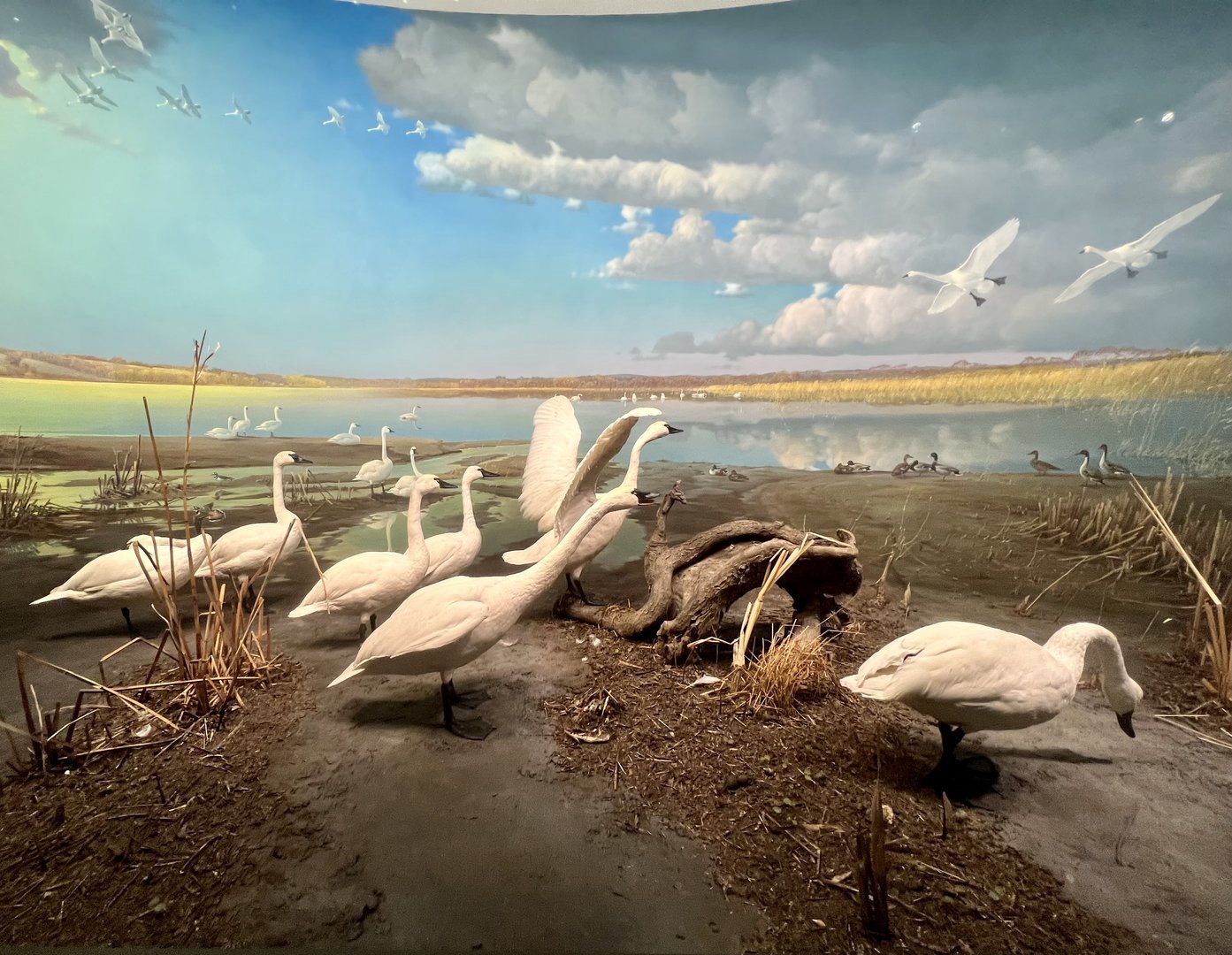
A century after the von Wrights, the visualization of ornithological specimens had changed dramatically, as seen in the habitat diorama titled “Tundra Swans at the Minnesota River Valley” at the Bell Museum. Completed in 1948, it features Tundra Swans (Cygnus columbianus) foraging at Meadow Lake during their spring migration to the Arctic. Francis Lee Jaques painted the diorama background, while the taxidermy and foreground preparation were by John Jarosz (1924 – 2008) and Walter J. Breckenridge. Known as the “Whistling Swan,” the species was severely depleted by market hunting in the late 19th century, as was the Trumpeter Swan (Cygnus buccinator), which by 1880 had been extirpated from Minnesota. The Tundra Swan survived primarily because of its remote breeding grounds in the high Arctic tundra. In 1976, to protect the migrating birds and their wetlands habitat from commercial and industrial development, the Minnesota Valley National Wildlife Refuge was established.
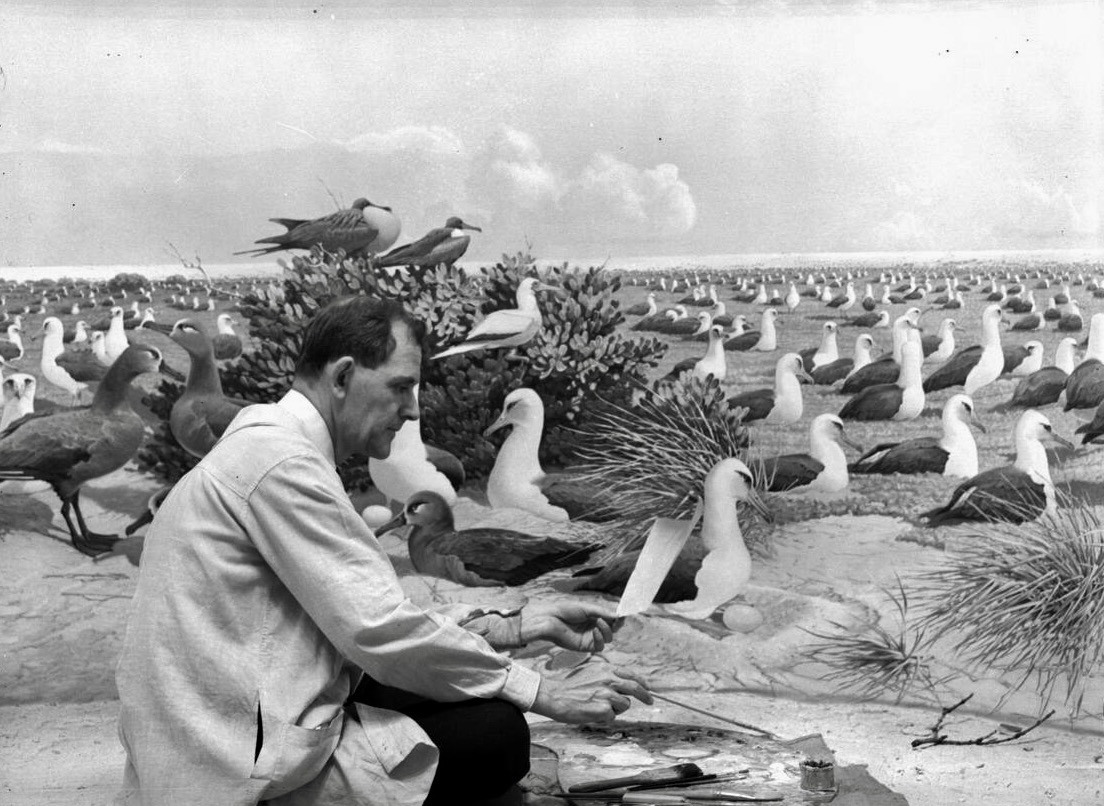
An archival photograph shows Francis Lee Jaques studying a reference sketch while painting the transition between the foreground and background of the Laysan Island Group at the American Museum of Natural History. The diorama depicts albatrosses, seabirds, and shorebirds at one of the world’s largest seabird colonies. Jaques was assisted with the background painting by Joseph Guerry; the bird taxidermy was prepared by Raymond B. Potter (1873 – 1947); and the foreground was constructed by George Petersen and Carlton McKinley. The diorama was among the first completed for the visionary new Whitney Hall of Oceanic Birds, which opened in stages between 1939 and 1942. The hall contained 18 dioramas, all with backgrounds painted by Jaques. To gather field data, Jaques accompanied the museum led Templeton Crocker Pacific Expedition (1934 – 1935), assisting in the preparation of bird specimens, collecting local vegetation for the foregrounds, recording geographical data, and making colour charts for the background landscapes.
Ornithological field studies were transformative to scientific knowledge and the visual representation of birds, and to the emergence of the habitat diorama. By contrast, 18th century ornithology was largely dependent on dead specimens and skins sent to European collections, where naturalists could examine them. The priority was the classification, anatomical study, and cataloguing of species rather than their geographic distribution and behaviour in the wild.
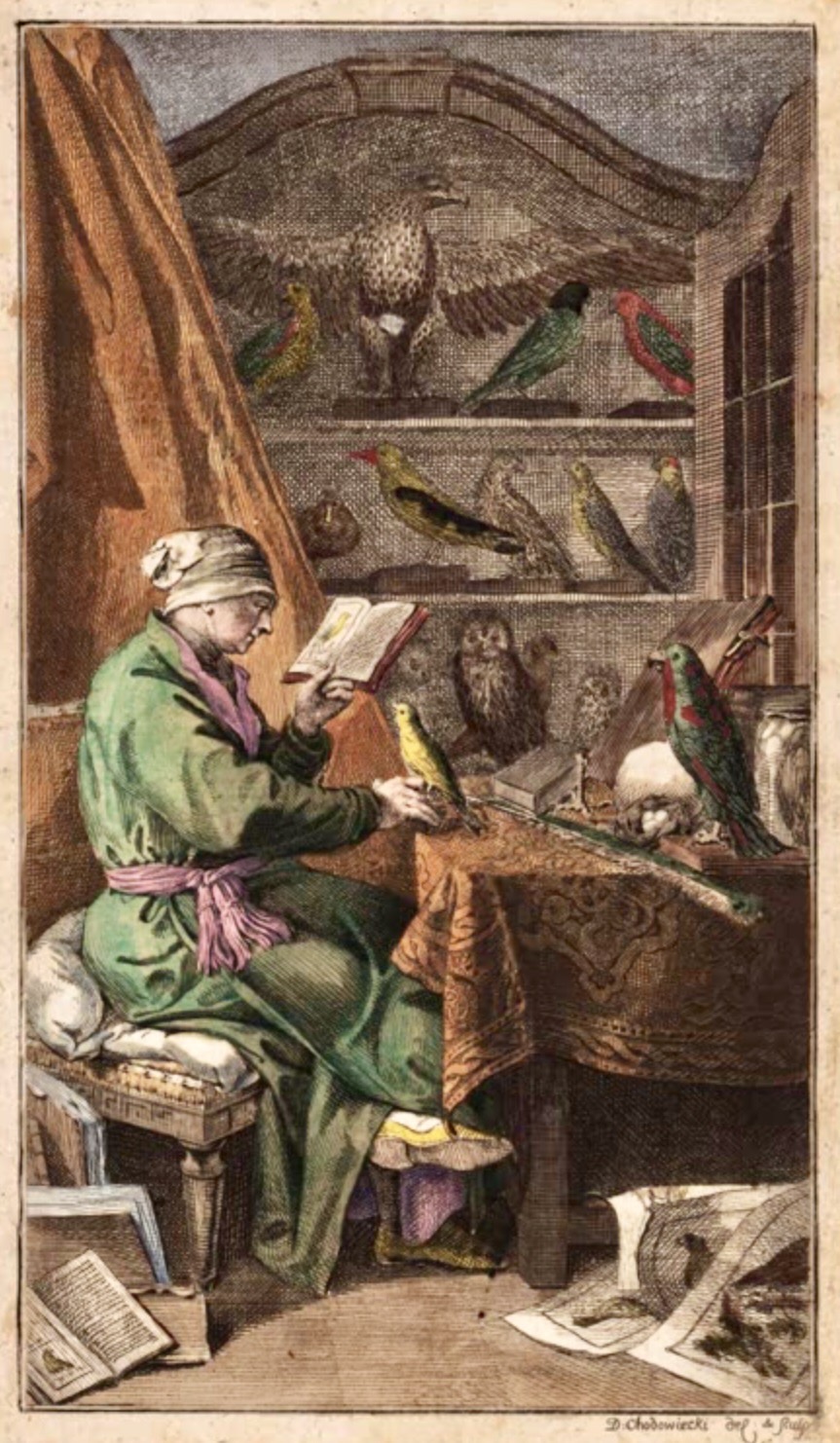
A copperplate engraving titled “German Ornithologist in His Study” portrays how birds were examined in natural history cabinets. Drawn by Daniel N. Chodowiecki, it was published in Berlin in 1772 in Comte de Buffon’s Naturgeschichte der Vögel (Natural History of Birds).
The naturalist is surrounded by a collection of birds from around the world, including eagles, owls, and parrots, preserved as specimens and displayed in cabinets. He carefully studies a description in a book while comparing its printed illustration with the specimen in his right hand. The importance of illustrations to the study and classification of birds is evident in the books and engravings depicted throughout the study.
Buffon’s monumental Histoire naturelle, published in 36 volumes between 1749 and 1789, was a major work of the French Enlightenment that sought to describe and explain the natural world through empirical observation and comparative analysis.
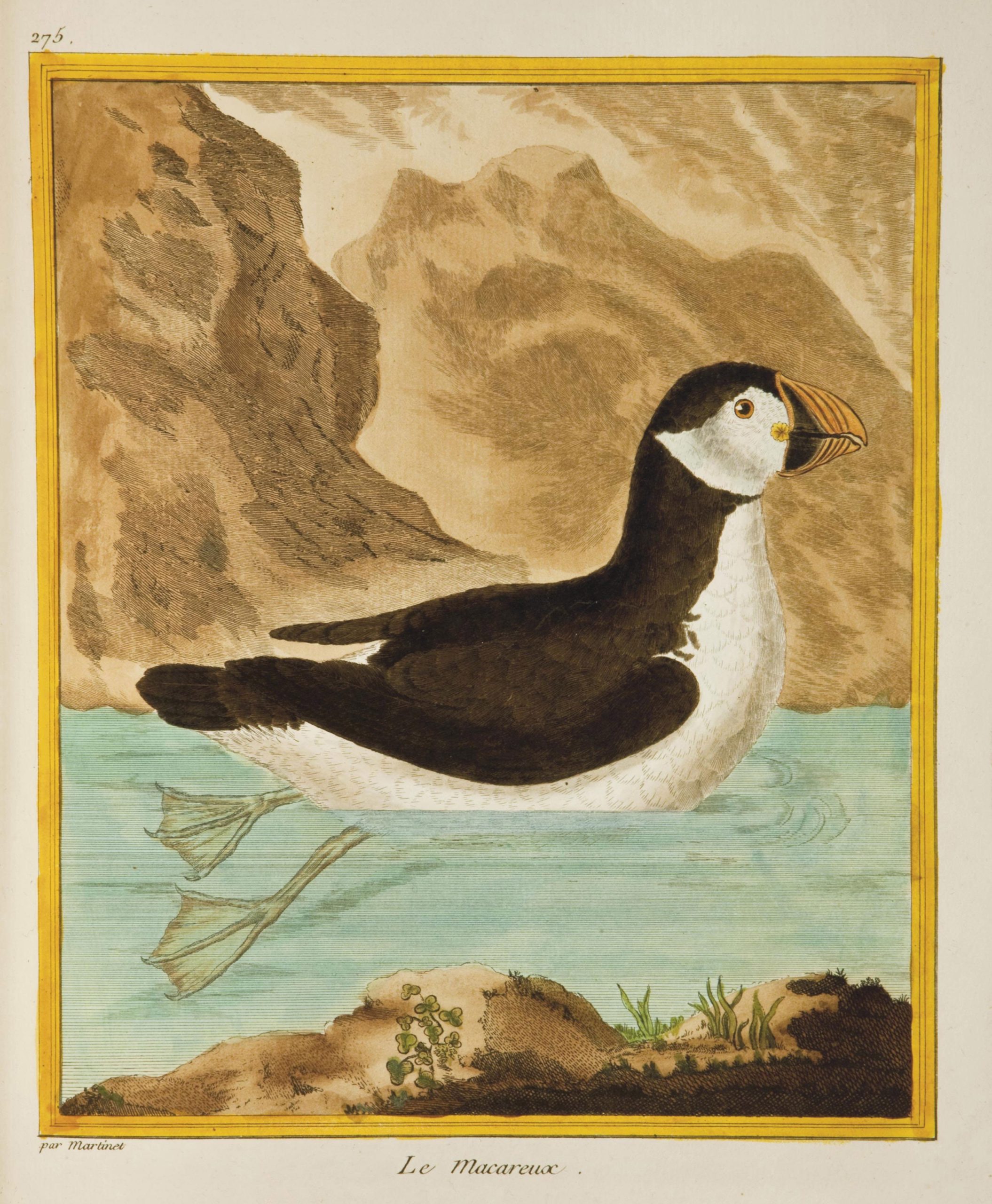
Zoological illustrations in Buffon’s work were often inaccurate, having been rendered by artists who had never seen the living animals in their native habitats. An example is Plate 275, titled “Le Macareux” (The Puffin), published in Planches enluminées between 1765 and 1780 to illustrate Buffon’s Histoire naturelle des oiseaux. The artist was the renowned François Nicolas Martinet (1731 – 1800), an engineer and royal engraver who worked from specimens and existing illustrations rather than from direct observation of living birds. The species depicted is the Atlantic Puffin (Fratercula arctica), shown on the water against a backdrop of coastal cliffs. While the puffin’s distinctive triangular orange striped beak, striking plumage, and webbed feet are rendered with considerable accuracy, its habitat is generic and lacks distinguishing geographic details. Historically known as “sea parrots” and “clowns of the sea,” puffins were once subject to extensive commercial hunting, which severely reduced populations in some regions during the 19th century.
By contrast, the engraved lithograph of the Atlantic Puffin by Wilhelm von Wright is more true to nature. It was published in 1838 in the landmark ornithological work to which all three von Wright brothers contributed, Svenska Fåglar efter Naturen och på Sten ritade (Swedish Birds Drawn from Nature and on Stone).
Wilhelm participated in the 1837 expedition that documented a breeding population of Atlantic Puffins in Bohuslän on the west coast of Sweden, where he established his studio in 1840. His firsthand field observations and the specimens he collected provided detailed scientific references for his work.
Wilhelm’s name appears on the engraved plate, which is titled “Fratercula arctica” and “Lunnefågel,” the Swedish name for the species. “Linn” refers to Carl Linnaeus, who classified the species in Systema Naturae (1758). The fractional notation “5/10” indicates that the depicted bird is 50 percent of its actual size. The von Wright brothers used a consistent linear scale on their plates to maintain scientific accuracy across species of different sizes.
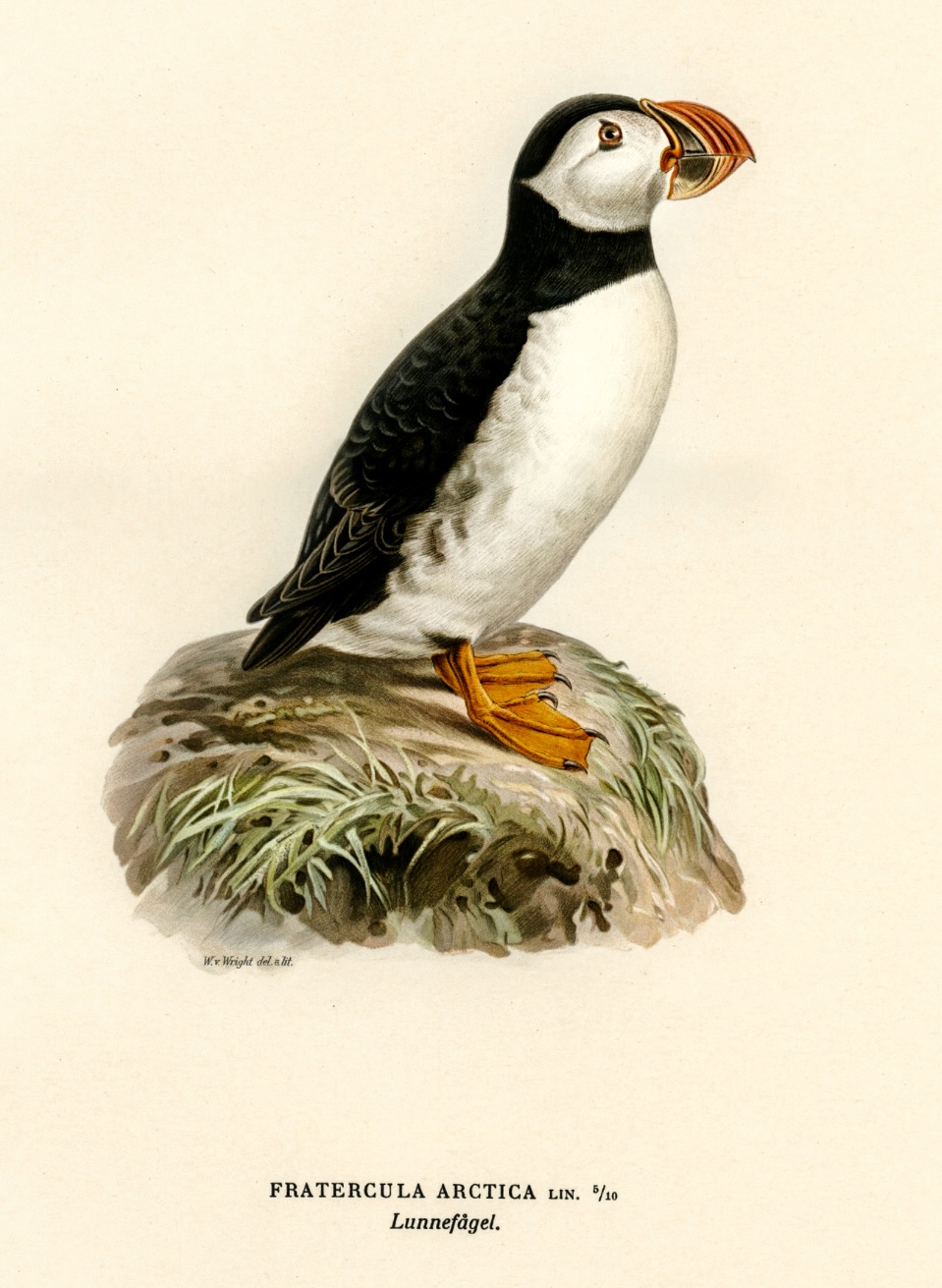
The subtitle of Svenska Fåglar refers to the illustrations being “drawn from nature” and “drawn on stone;” the former indicating their reliance on direct observation and specimens; the latter referring to the lithographic process used to reproduce the images. The meticulously produced lithographs are exceptional for their fine detail, achieved by drawing directly onto the lithographic stone rather than transferring the image from another medium. The von Wrights had to draw the image in reverse, a demanding process that produced the correct orientation when printed.
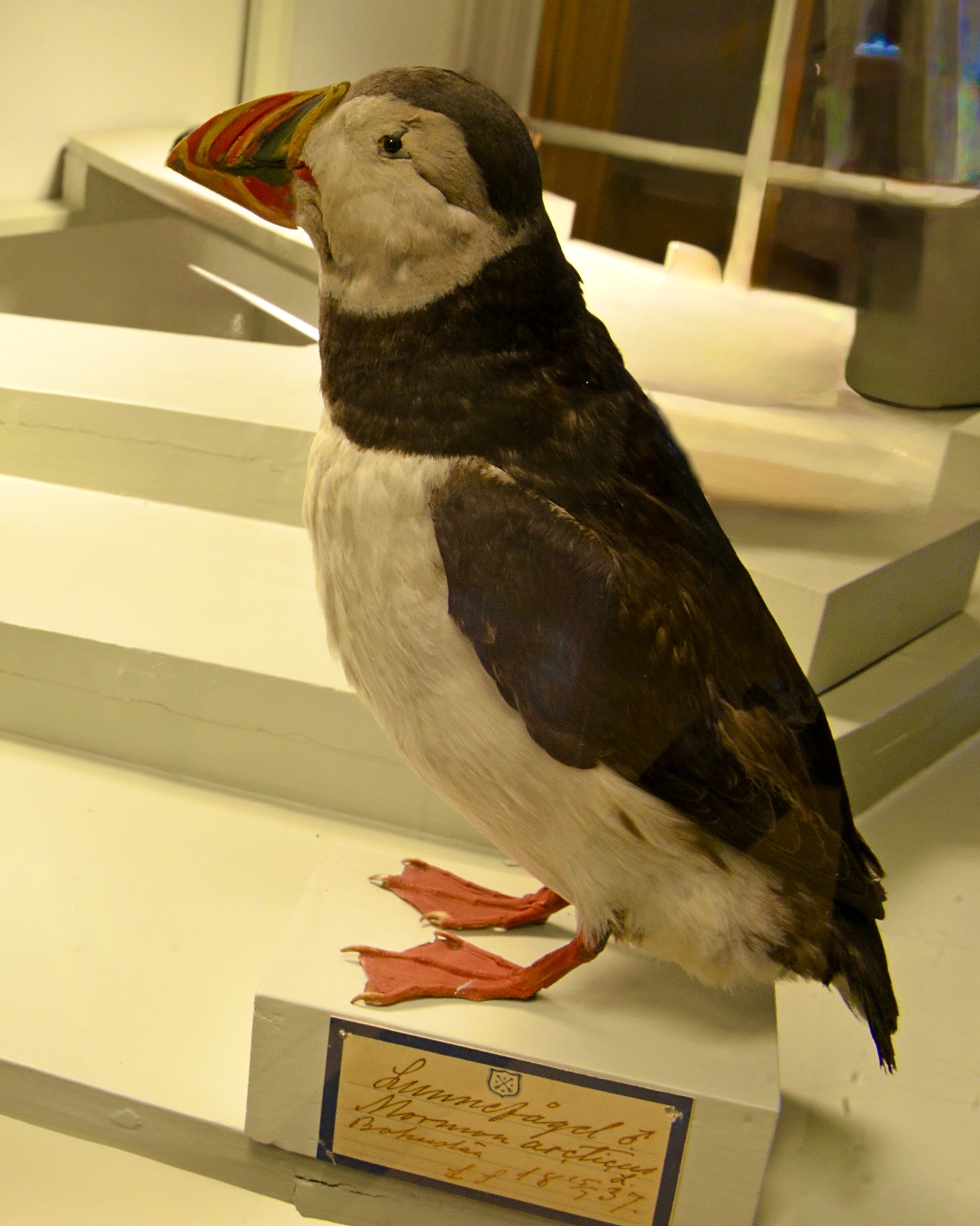
The Biologiska museet in Örebro has in its collection a Lunnefågel from Bohuslän, dated 1837. There is no notation on the label, but it may have been collected, preserved, and mounted by Wilhelm von Wright. In any case, the specimen underscores the close relationship between taxidermy and the visual representation of zoological specimens.
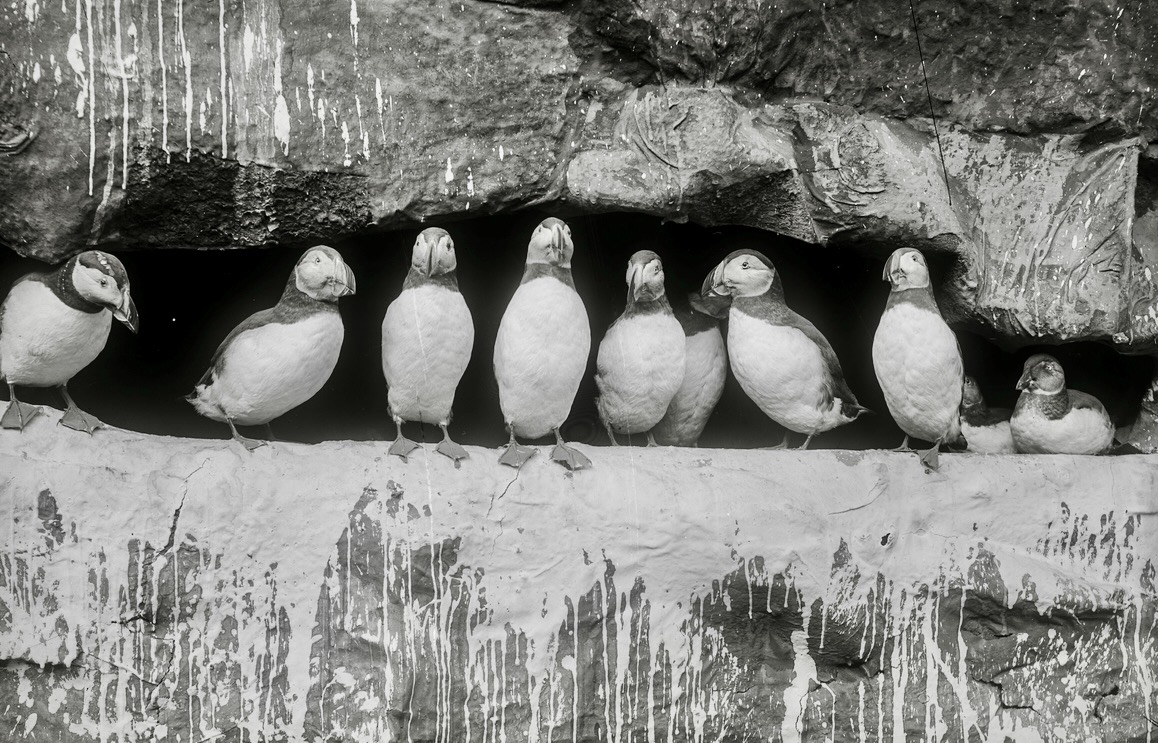
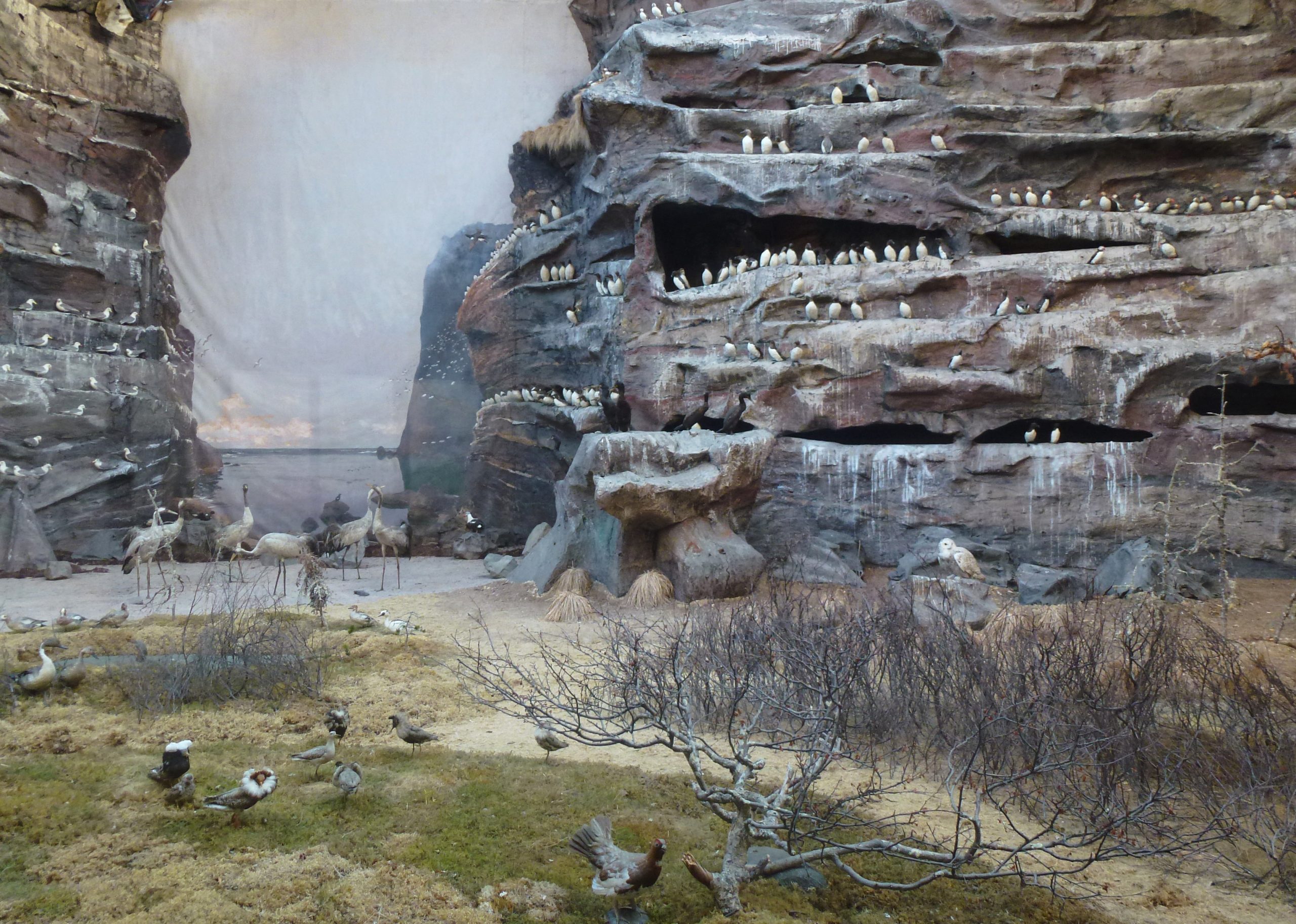
The Atlantic puffin (Fratercula arctica) is one of the many zoological species showcased in Stockholm’s Biologiska museet, a taxidermic panorama of Nordic animals in their natural habitats. This museum was an early example of the illusionistic museum display idiom that later became known as the habitat diorama. Conceived by Gustaf Kolthoff (1845 – 1913), the Biologiska museet opened in 1893. At the time, Kolthoff was the country’s leading zoological conservator, as well as a well known naturalist and writer. He began his career as a hunter and collector of natural history specimens and in the 1870s set up a studio in Bohuslän, where a breeding population of Atlantic puffins had been documented in 1837 by Wilhelm von Wright. A closeup archival photograph taken in the Biologiska museet c. 1900 shows dozens of these “Lunnefåglar” in a rock crevice replicating their breeding grounds in Bohuslän.
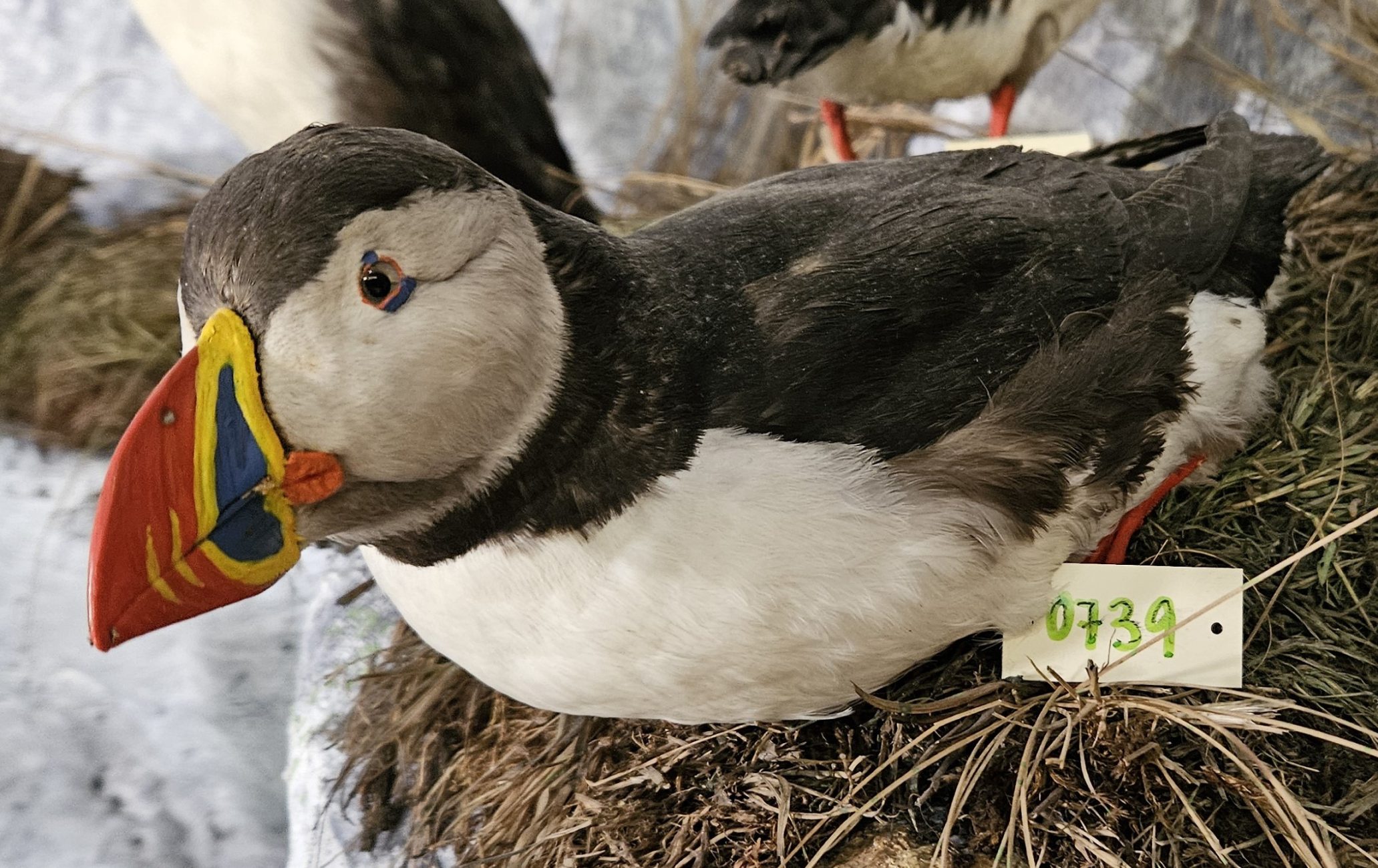
The provenance of the dozens of Atlantic puffins displayed in the Biologiska museet is not documented, but it is likely that they were collected and mounted by Kolthoff himself. Since 1970, the museum has been administered by Skansen, its open air museum neighbour on the island of Djurgården in Stockholm. Skansen is currently restoring the building and its contents, including hundreds of mounted specimens, such as the puffin labelled 0739. At the time the puffins were collected by Kolthoff in the 1870s, the species was found only in small, scattered colonies nesting in the outer archipelagoes of Bohuslän on Sweden’s west coast. They were heavily impacted by hunting and egg collecting, and by 1900 their numbers were declining. Legal protection introduced in 1913 did not prevent the extinction of the Atlantic Puffin in Sweden some decades later.
The Atlantic Puffin is one of a variety of seabird species represented in Kolthoff’s 1893 taxidermic tableaux of bird breeding cliffs in the Biologiska museet. The coastal archipelago scene features vertical limestone stacks of a breeding colony, densely perforated with nests and occupied by a multitude of birds nesting in rock crevices. The panoramic background landscape was painted by Kolthoff’s hunting companion, the artist Bruno Liljefors, who later became one of Sweden’s most celebrated painters of wildlife. Two iconic auk species can be seen on the cliffs: the Common Guillemot or Murre (Uria aalge) and Razorbill (Alca torda). By 1880, hunting and egg collecting had reduced the number of these birds, and by 1900 both species were threatened with local extinction. Concerned about the disappearance of Sweden’s fauna, Kolthoff wrote an essay in 1900 advocating against the shooting of birds during the breeding season and spring migration.
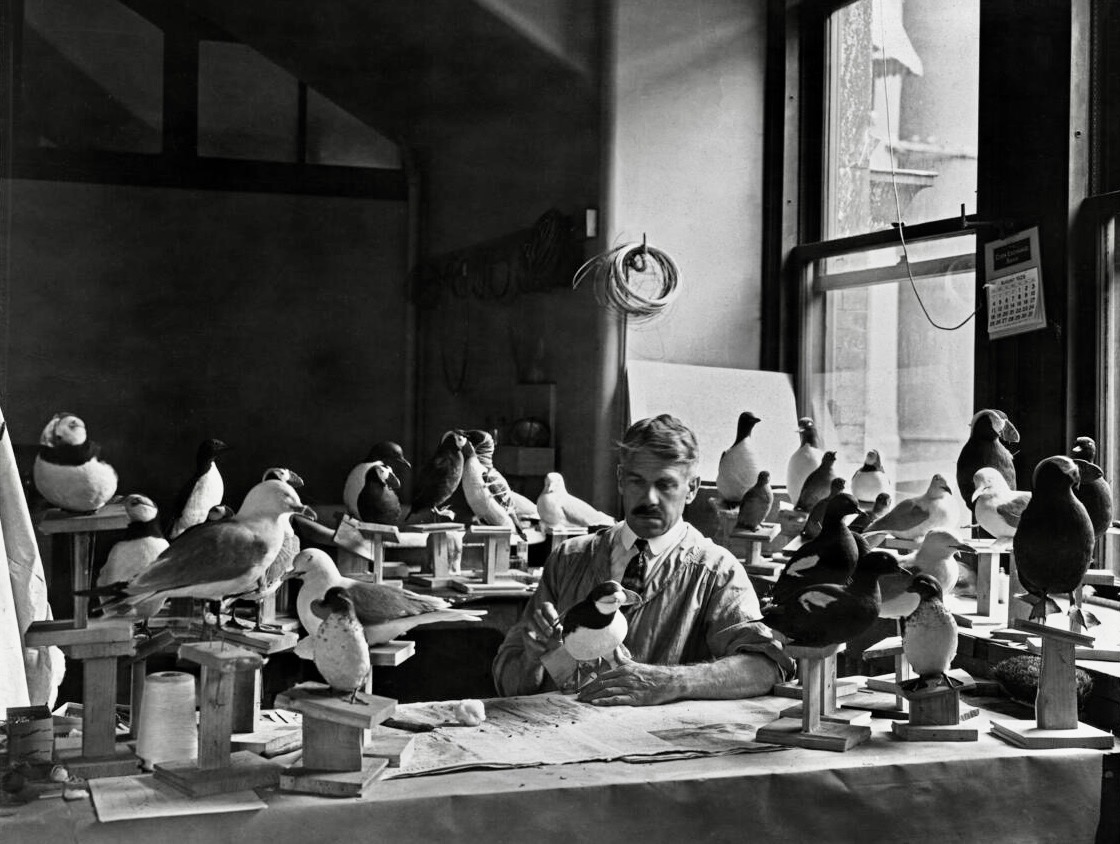
One of the earliest bird rock groups of nesting colonies was installed at the American Museum of Natural History in 1898, a radical new departure in museum display initiated by the museum ornithologist Frank Chapman. This was followed by the Little Diomede Island Bird Group, a habitat diorama that was conceived by Chapman during field expeditions to the Bering Strait in the late 1920s. An archival photograph shows the museum taxidermist Raymond B. Potter preparing bird specimens for the Diomede Group in 1930. Potter, who was also an ornithologist, accompanied numerous expeditions to collect material for the museum’s exhibits during his tenure there. He is seen working on a Horned Puffin specimen, amidst dozens of other mounted specimens collected on Little Diomede Island. The skill of taxidermists such as Potter in preparing lifelike mounts was critical to the creation and illusionistic success of the diorama, along with the careful preparation of the foreground.
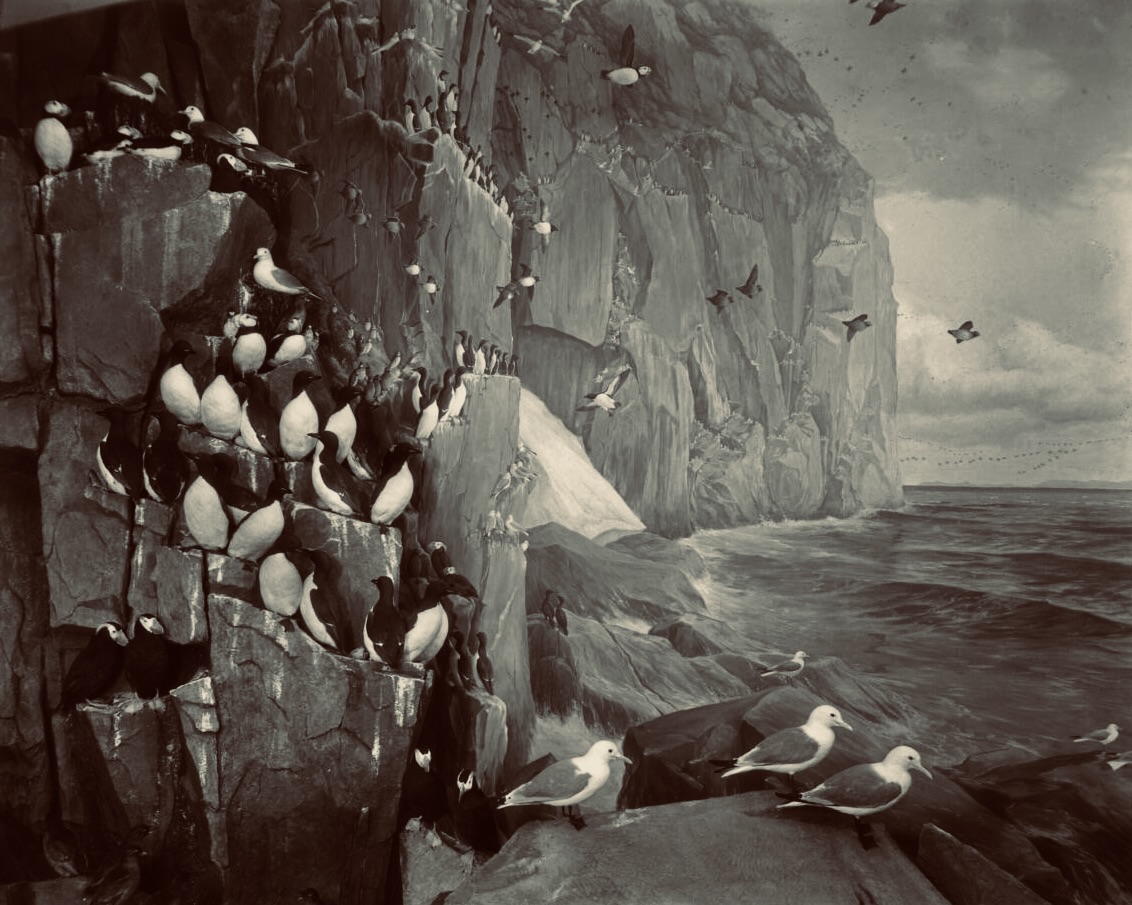
The background landscape of the Little Diomede Island Group was painted by Frances Lee Jaques, who traveled to the Bering Sea in 1928 aboard the Northern Light expedition to make field sketches and collect specimens. His composition of the rugged coastal scene is based on a dramatic foreshortening of the lower part of a 1000 foot high cliff, accentuated by the painted birds that lead the eye into the distance. George Petersen was a member of the exhibition team who prepared the foreground of the display. As a specialized artist who had worked for decades at the Field Museum, he fabricated botanical and inorganic models, including the rocks on which the birds are perched. Replicating a nesting colony habitat containing a multitude of species and thousands of birds within a constricted space was a design challenge for the exhibition team. Each species required its own ecological niche: Puffins nest in deep rock fissures, where they lay a single egg; Murres and Kittiwakes build their nests on narrow rock ledges; and Least Auklets nest in the protected gaps among loose boulders.
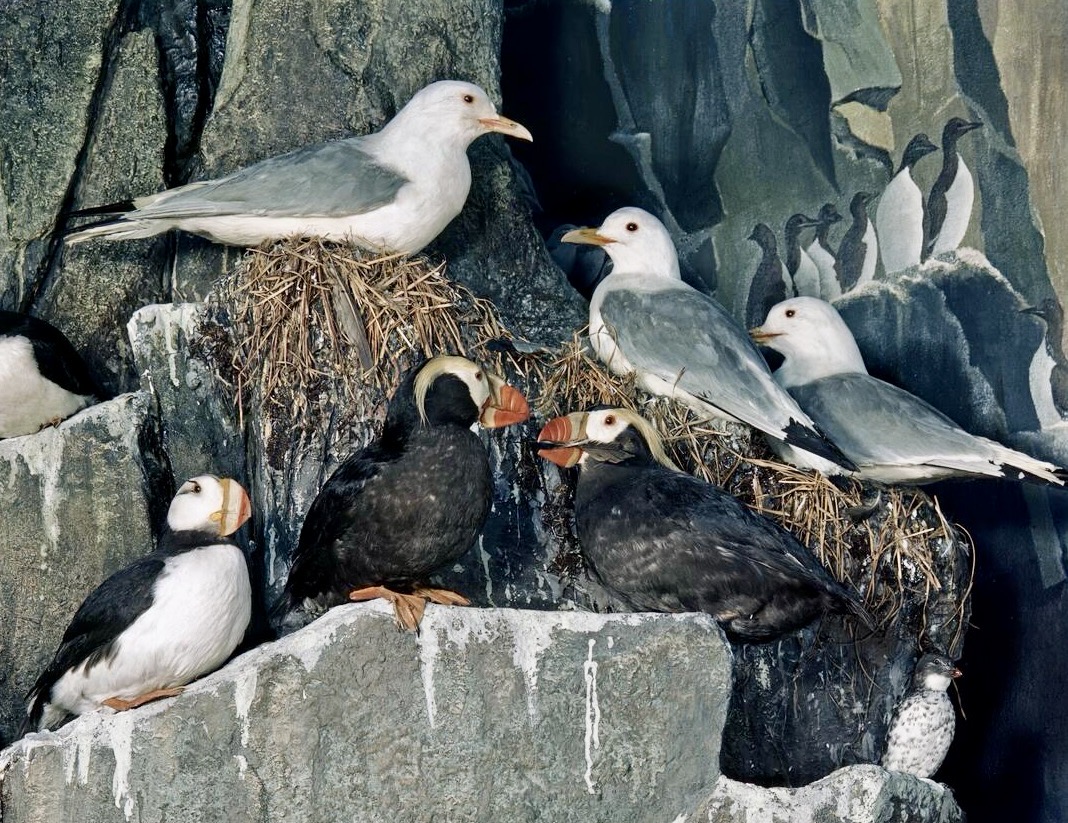
A close up photograph of the sea cliffs in the Little Diomede Island Group shows some of the birds featured in the display. In the foreground are two Tufted Puffins (Fratercula cirrhata) sitting on the lower rock ledge; they have yellow head tufts, dark bodies, and thick orange and red bills. Sitting below them on the same ledge is a Horned Puffin (Fratercula corniculata), with white underparts, a black collar, and a high contrast striped bill. Above them are three Black Legged Kittiwakes (Rissa tridactyla) perched on their straw and mud nests; they have pale grey mantles, white heads, black wingtips, and yellow bills. A Least Auklet (Aethia pusilla) is displayed next to a crevice at the lower right edge. Painted in the distance, perched on the crags with correct diminishing perspective, are Thick Billed Murres (Uria lomvia) and Common Murres (Uria aalge). Although both Murre species were represented in the bird rock of the Biologiska museet, they appeared only as mounted specimens; the artist, Bruno Liljefors, did not include birds in his painted background.
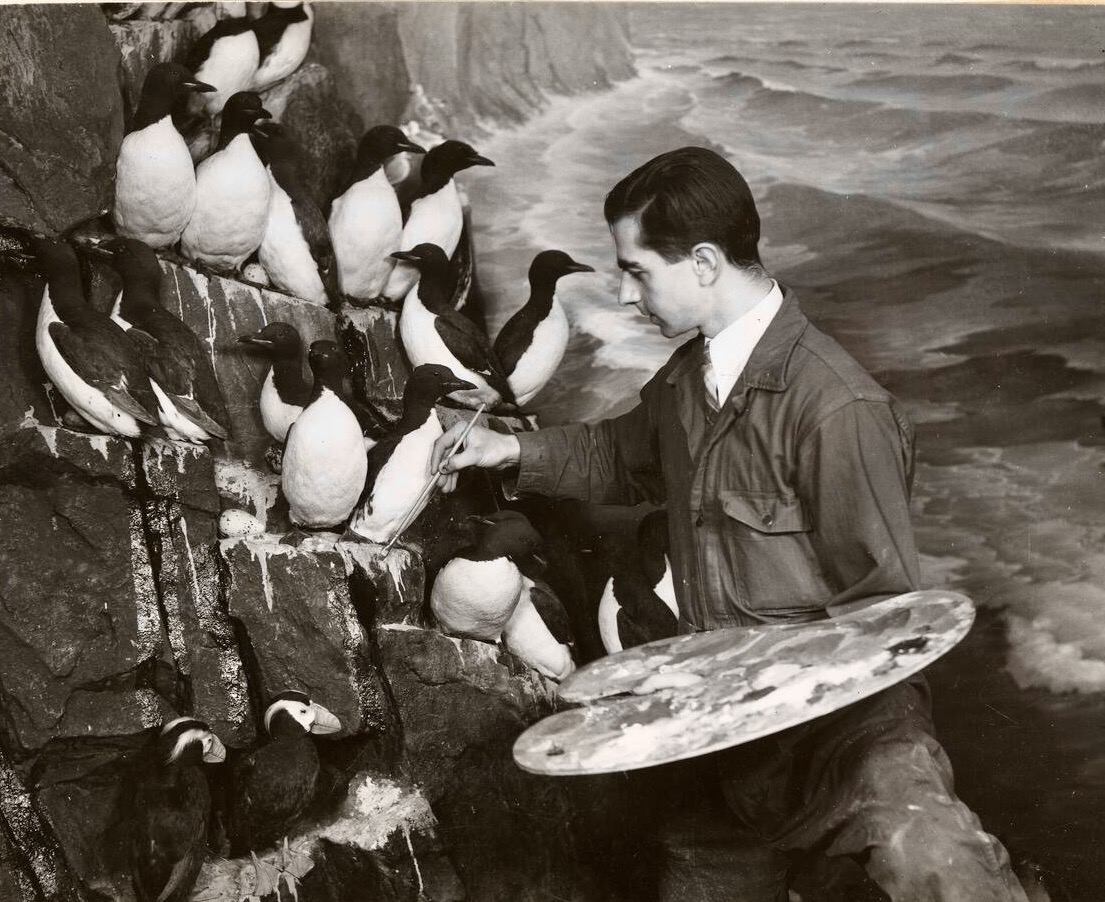
The Little Diomede Island Group was moved when the old bird halls were transitioned into the Whitney Hall of Oceanic Birds between 1939 and 1942. One of the foreground artists who restored the Diomede Group was Raymond deLucia (1915 – 2005), seen in a photo as a young man holding a painter’s palette while touching up the guano on a rock ledge where the murres are perched, and under them can be seen the two puffins. The foaming waves of Jaques’s seascape are clearly a painted backdrop in the closeup photo, but would create an illusion of depth when viewed from the correct position behind the glass of the diorama. DeLucia graduated from the Yale School of Art in 1938 and soon afterward began a 40 year career in the exhibition department of the American Museum of Natural History, retiring in 1978. During this era of great creative productivity, when some of the most magnificent halls of habitat dioramas were inaugurated, DeLucia worked on foreground preparation in collaboration with legendary background painters such as Francis Lee Jaques and James Perry Wilson.
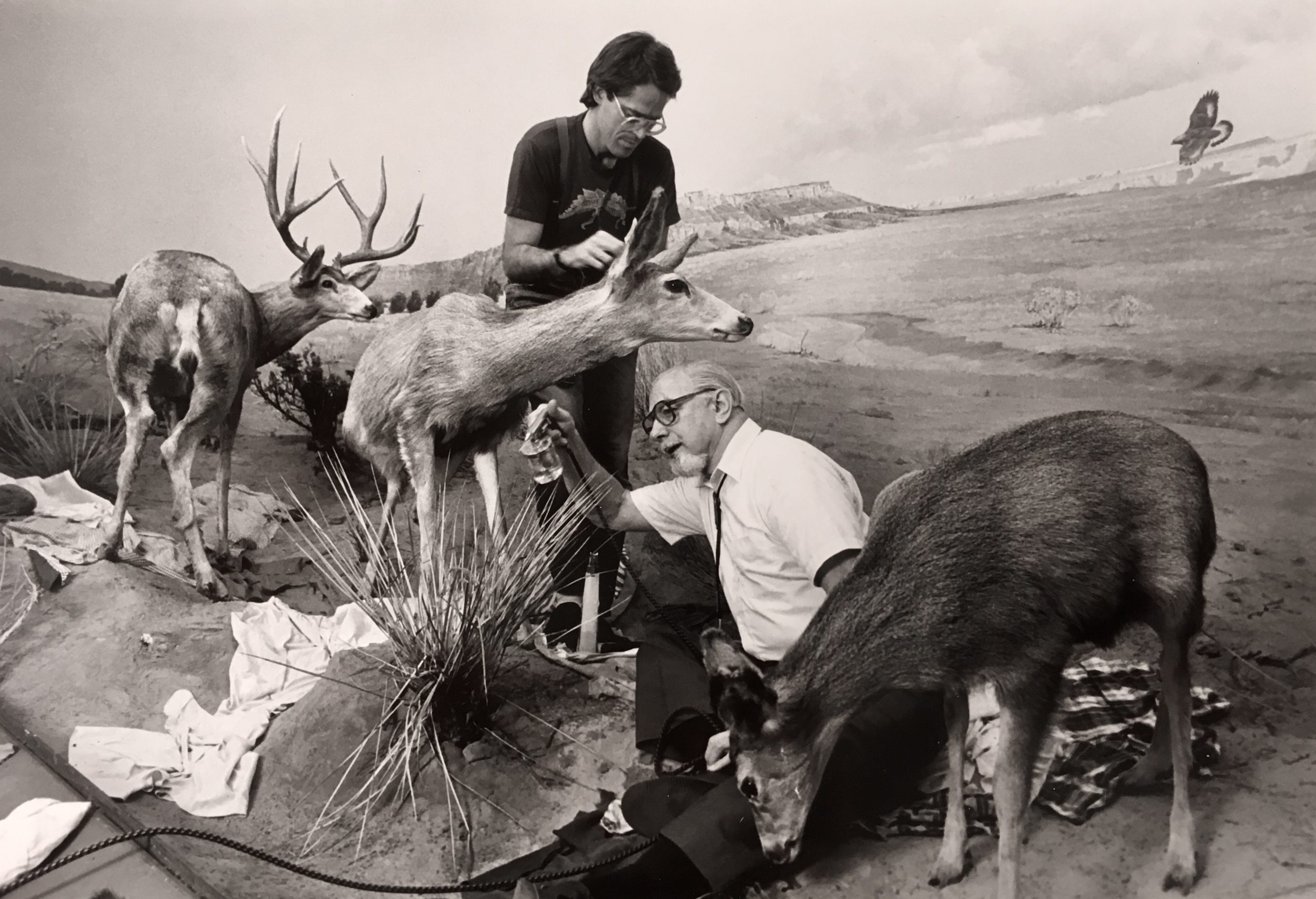
In the 1940s, Ray deLucia assisted James Perry Wilson on two dioramas depicting local Connecticut ecosystems at the Yale Peabody Museum of Natural History: the Forest Margin Habitat Diorama and the Cold Bog Habitat Diorama. Following his retirement, deLucia continued to work for six years from 1990 on the restoration of the Peabody’s dioramas. A photograph shows him in 1991 working on grasses in the Kaibab Plateau Habitat Diorama alongside preparator Michael Anderson. The diorama showcases a family group of mule deer in their desert habitat north of the Grand Canyon in Arizona. The background landscape was painted by Francis Lee Jaques; one of his “signature” flying birds can be seen above the horizon line. The taxidermist and foreground preparator who mounted the three mule deer and constructed the foreground for the Kaibab Diorama was Ralph C. Morrill (1902 – 1996), who served as the Peabody Museum’s chief preparator of vertebrate zoology for more than 40 years.
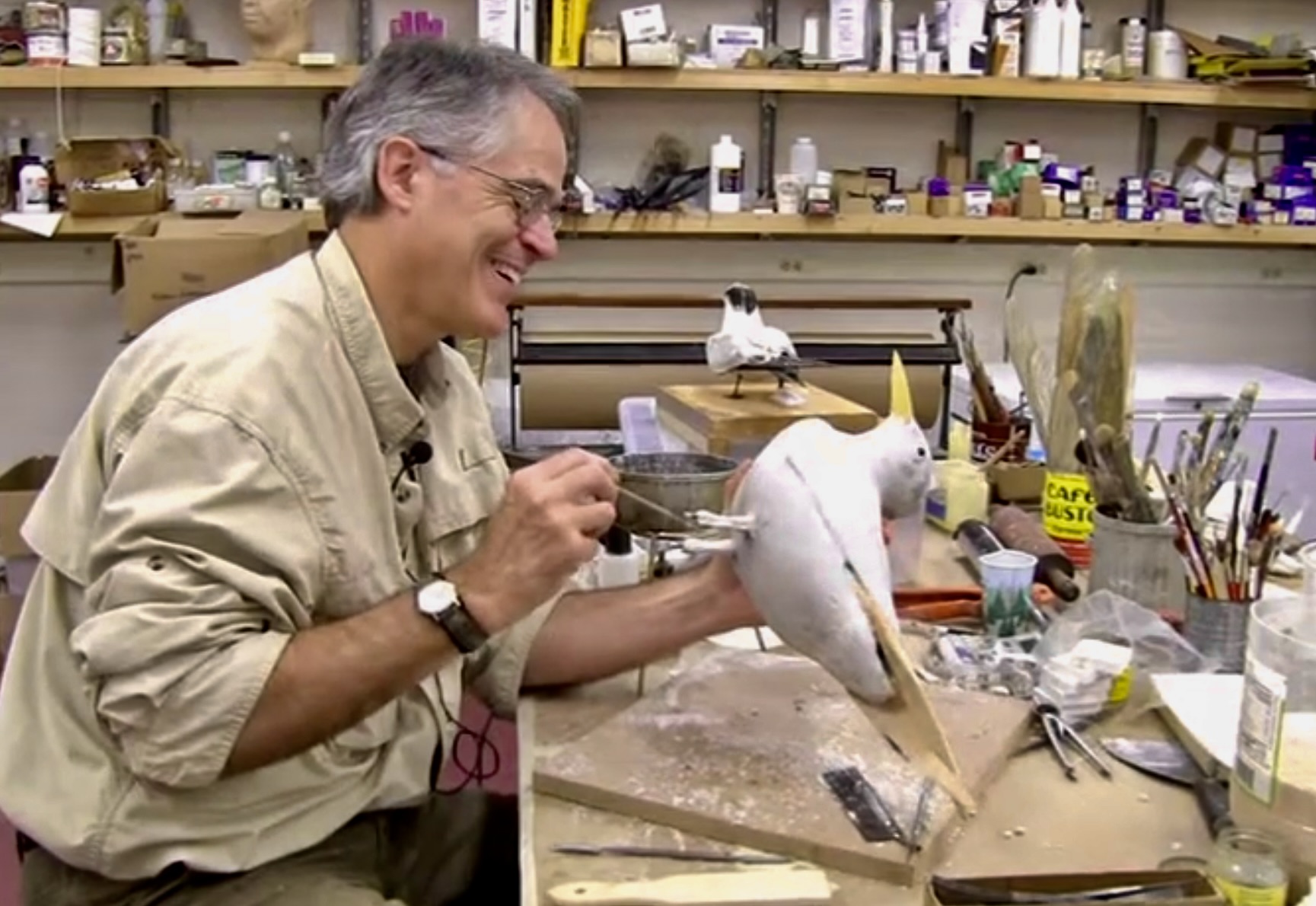
Continuing its tradition of merging art and science, in 2005 the Yale Peabody Museum unveiled a lifesize bronze sculpture of Torosaurus that paid tribute to one of the most celebrated dinosaur discoveries made by the museum’s founder. The sculpture was created by museum preparator Michael Anderson, who began his career as an intern artist at the American Museum of Natural History. Following some thirty years at the Peabody, Anderson led a four year restoration of the Hall of North American Dioramas, completed in 2019. The project involved extensive cleaning and repair of the original taxidermy mounts, as well as the restoration and replacement of botanical specimens and models in the foreground. In his online account of working behind the scenes in museum model making, Anderson documents the highly specialized and wide ranging challenges faced by museum preparators.
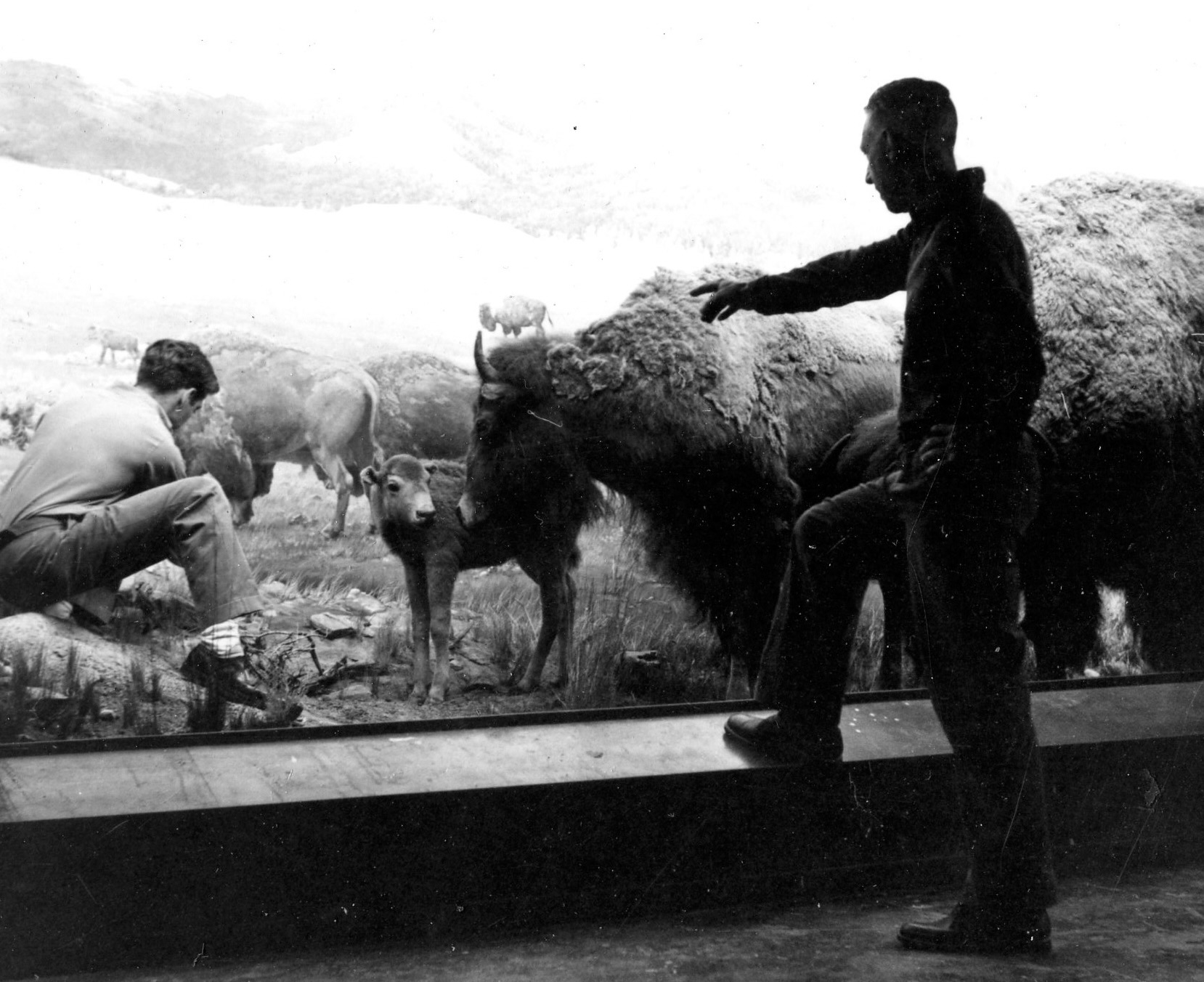
Another older habitat diorama at the Yale Peabody Museum that was recently restored features three bison specimens (a bull, a cow and a calf) acquired in 1945 from the American Museum of Natural History. These became the centrepiece of a specially designed display in the Hall of North American Dioramas. A photograph shows preparator Ralph C. Morill directing the installation of the group with Dave Parsons assisting inside the diorama. The background landscape was painted by Francis Lee Jaques.
The historic taxidermy specimens were originally collected in Wyoming in 1888 during a museum expedition led by Jenness Richardson, chief taxidermist at the American Museum. At the time, this iconic national species was near extinction and natural history museums were in competition to collect some of the last remaining wild animals for their zoological displays and scientific collections. The United States National Museum initiated this trend in 1886, when it sent taxidermist William T. Hornaday to Montana to collect six bison specimens.
In his background landscape, Jaques portrayed the specific shortgrass prairie habitat of the bison in Wyoming, with its rolling foothills terrain and distant snow covered mountain tops. To make the visual transition from the foreground to the painted scene function as an effective illusion, Jaques worked with preparator Ralph C. Morill who made the colours of the physical earth, rocks and grass match those that had been painted. While the condition of the background painting had not much deteriorated over the years, the mounted specimens and botanical models required major restoration and in some cases replacement. The tears and cracks in the skins of the bison, for example, were repaired along with their broken tails, a task made more difficult by the discovery that arsenic had originally been used as a preservative.
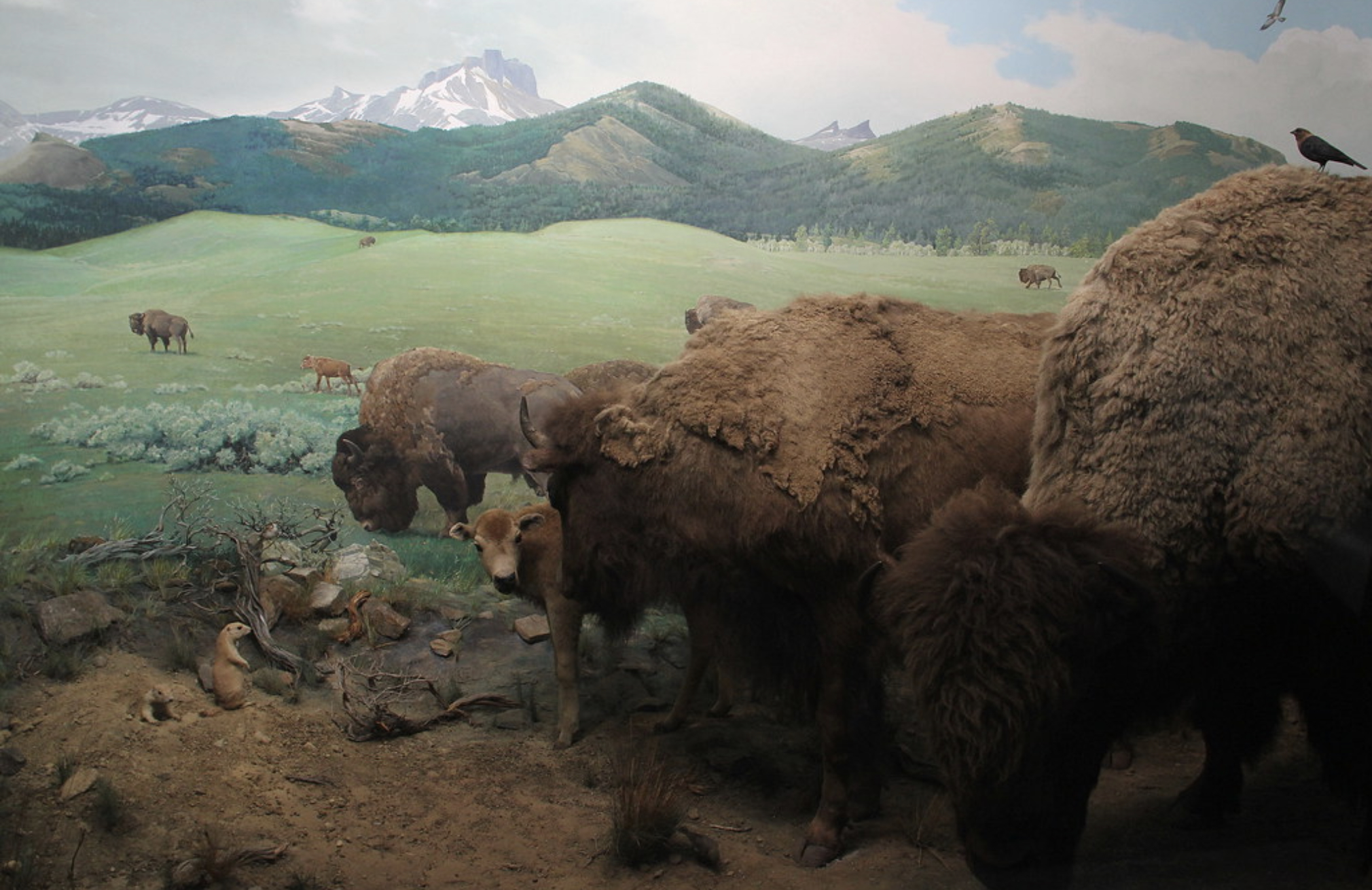
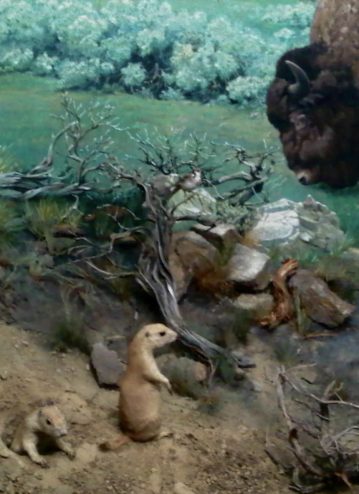
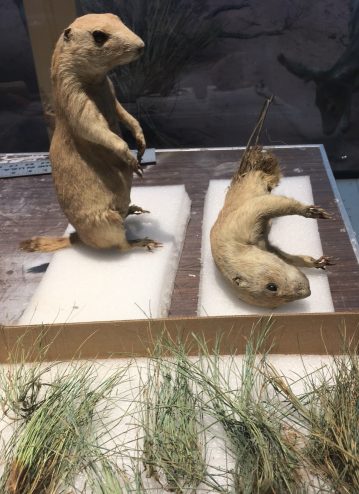
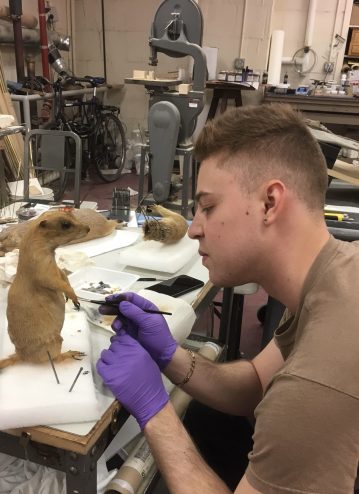
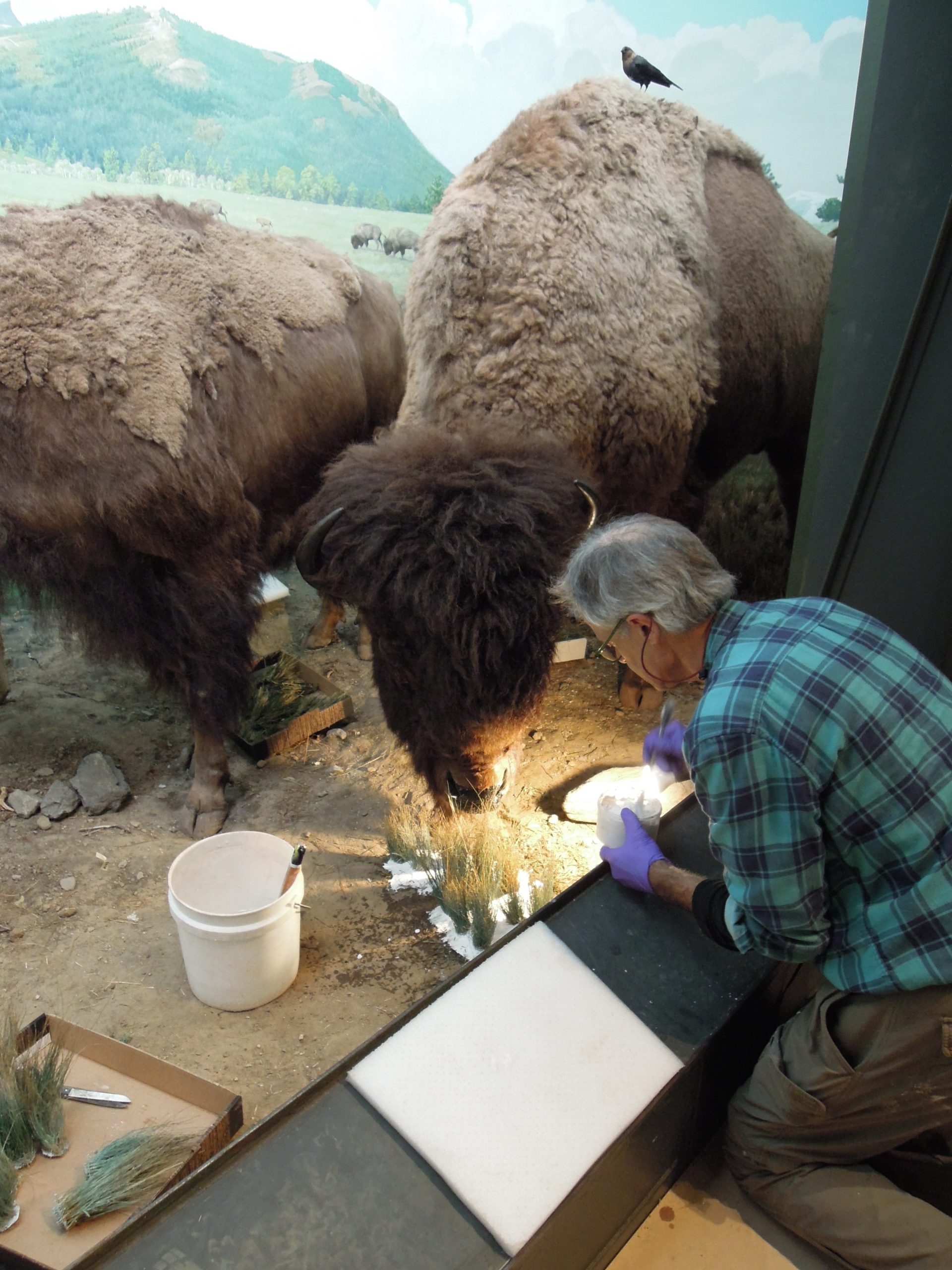
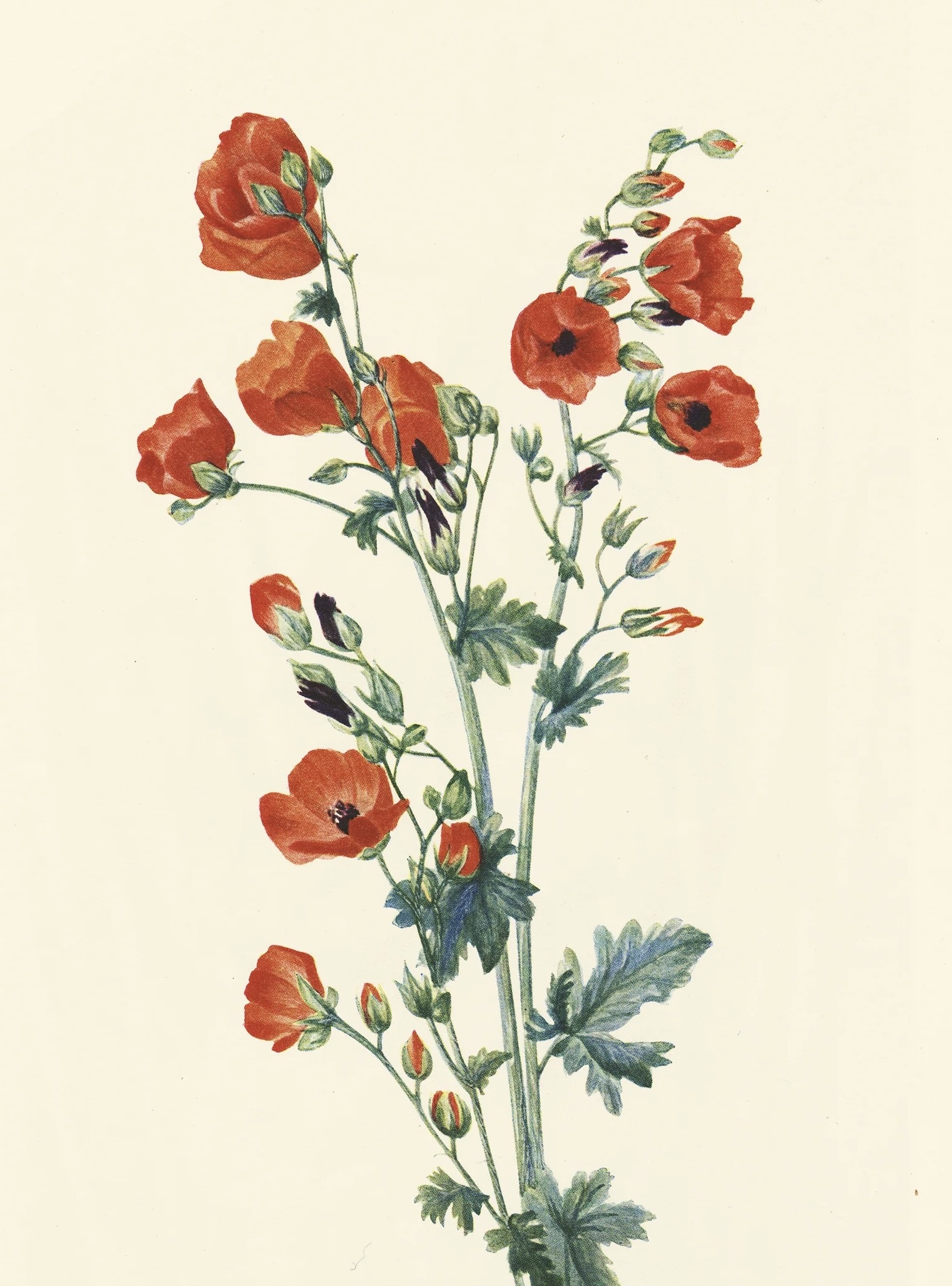
Also requiring conservation was the fur of both the Bison and Black Tailed Prairie Dogs, which had faded and was restored using a new colouring process. In the case of the Bison, it was necessary to take into account the darker, richer colour of the painted animals in the background and contrast this with the faded colour of the mounted specimens. The foreground vegetation had also deteriorated over the years. The original grasses, created in the early 1950s from dried, tied clumps of real grass, were replaced with more botanically accurate and realistic specimens of buffalo grass. Even the small, orange coloured Scarlet Globemallow (Sphaeralcea coccinea), a common forage species for bison, had to be recreated through sculpting, mould making, and casting.
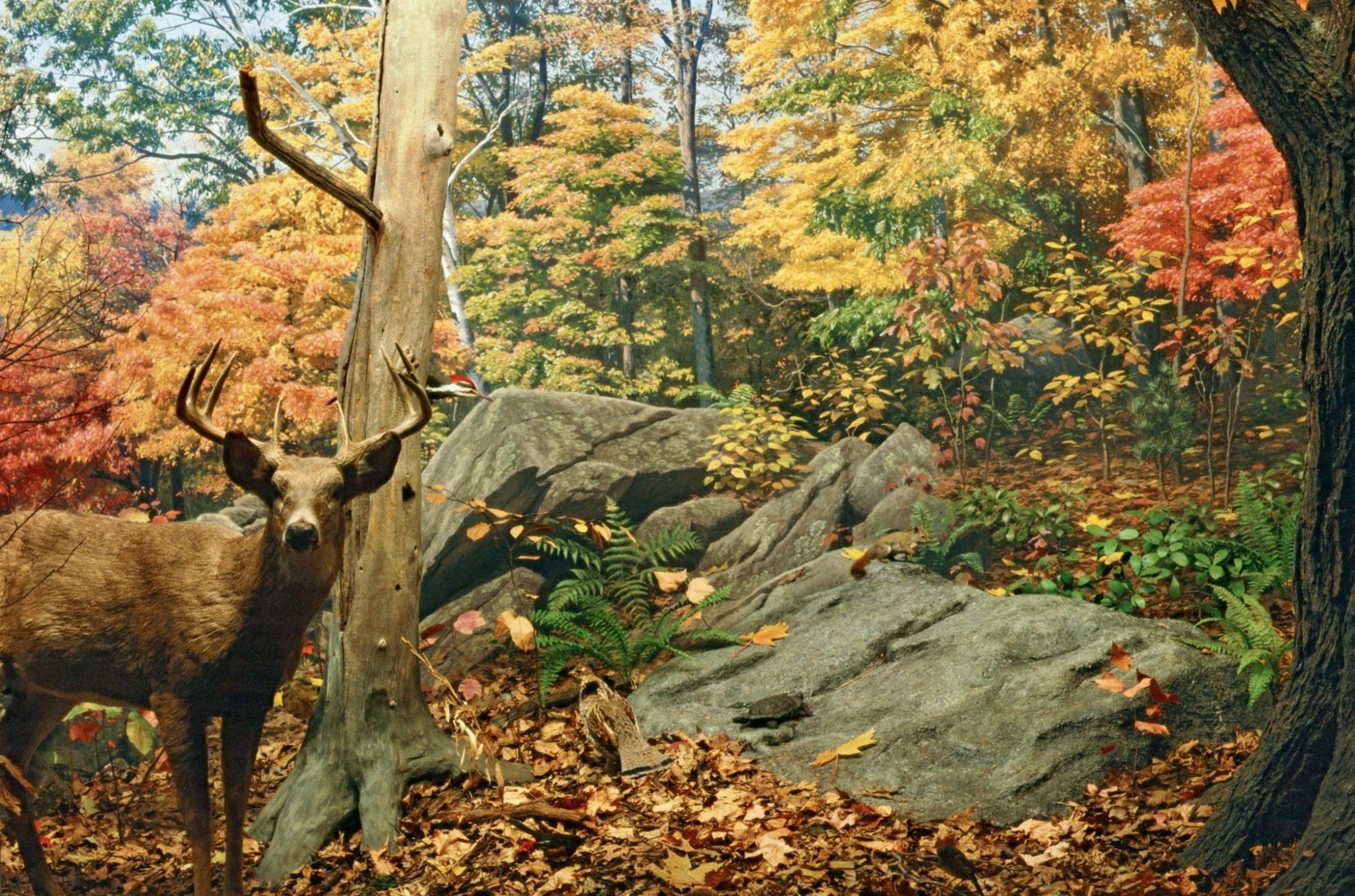
The production of habitat dioramas requires expert artists able to replicate the plants and animals that comprise a biological landscape. Especially noteworthy are three dioramas at the Peabody Museum depicting New England ecosystems: the beach and salt marsh of the coastal region; acidic wetlands; and areas along the forest periphery. The background of the Forest Margin Habitat Diorama was painted by James Perry Wilson and features a Whitetailed deer (Odocoileus virginianus) buck mounted by Ralph C. Morrill. The forest scene, with its bright autumn foliage, was completed in 1950 and is exceptional for its precise attention to scientific detail in the modelling of the foreground and its skillful rendering of distance and space.
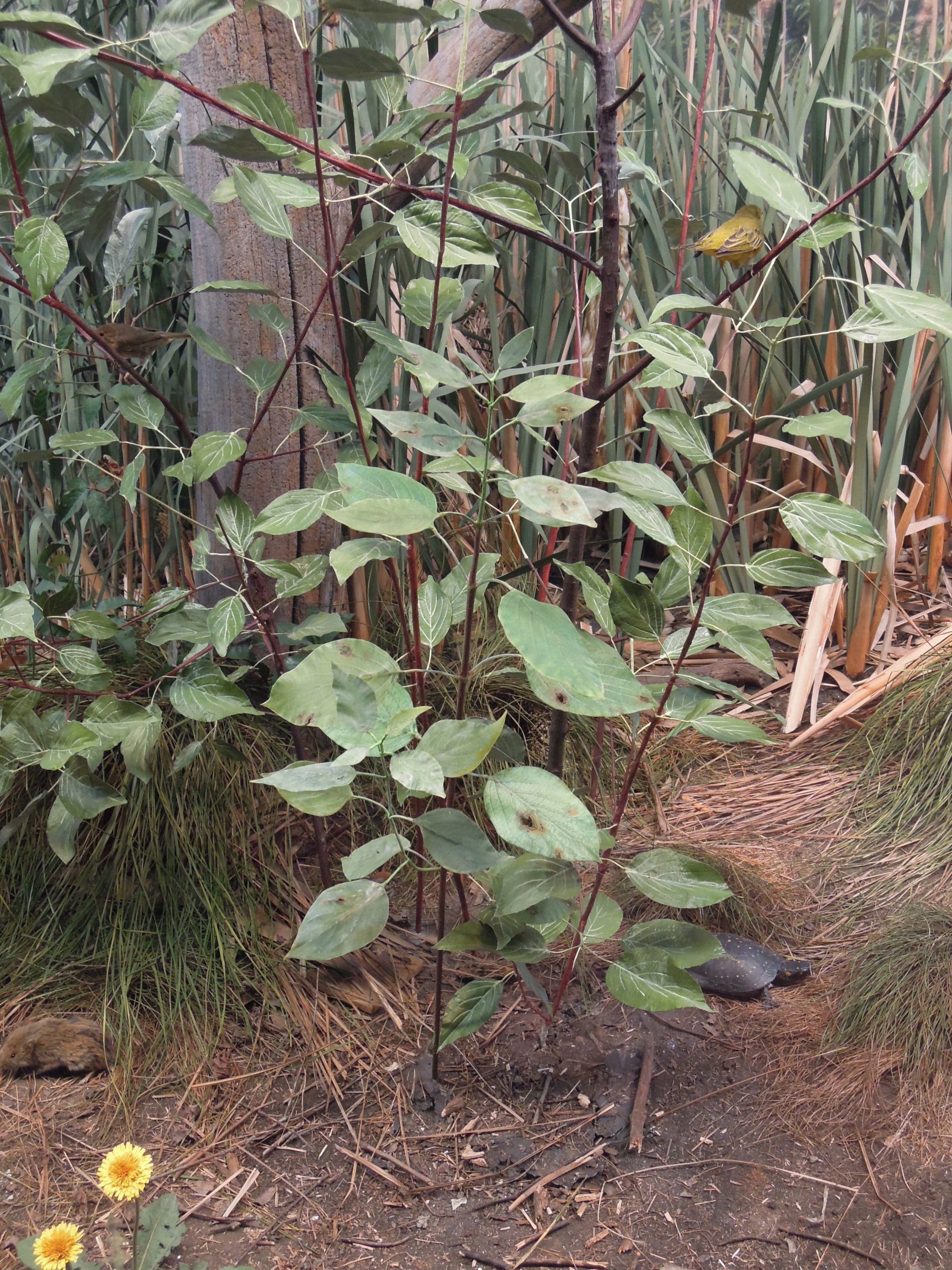
Over the years, the diorama leaves created by Morrill in the Forest Margin Habitat Diorama had cracked and become more fragile, drooping down like butterflies that had closed their wings. To replace them, Anderson created epoxy leaves on aluminum branches that included small bud remnant details and exhibited symptoms of tar spot, a common fungal disease affecting maple trees.
Another challenge involving the production of leaves to bring new life to an aging diorama foreground required that Anderson replace sprigs of Red Osier Dogwood that had faded. To make the leaves, he used a special 3D fabric on which he could print the images, an innovative solution to creating accurate replicas of foreground accessories.
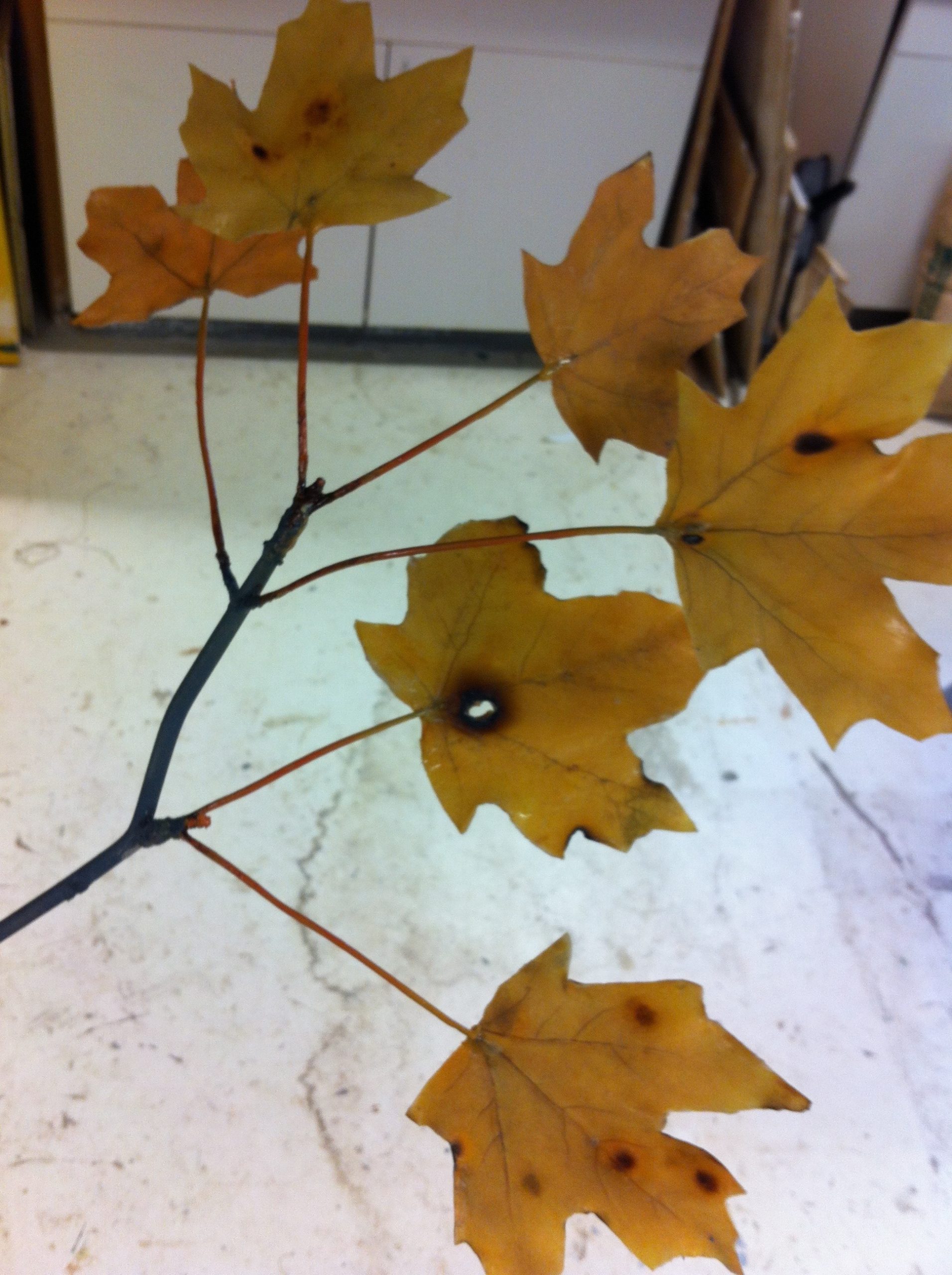
To restore the foreground of the Forest Margin Habitat Diorama, which featured an overhead canopy of Sugar Maple leaves illuminated from above, new leaves had to be fabricated. Michael Anderson explains how preparator Morrill choreographed the complex production of leaves in the late 1940s: “He had a team of art students from Southern Connecticut University cutting leaves one by one out of crepe paper. Lines were penned in along the central and secondary veins with some tertiary veins added. Wires were glued along the central vein and the leaves were dipped in colored wax with a quick spin to remove excess wax. Final touches included spattering oil paint over the surface, burning insect holes, and adding thin spray blushes of colour.”
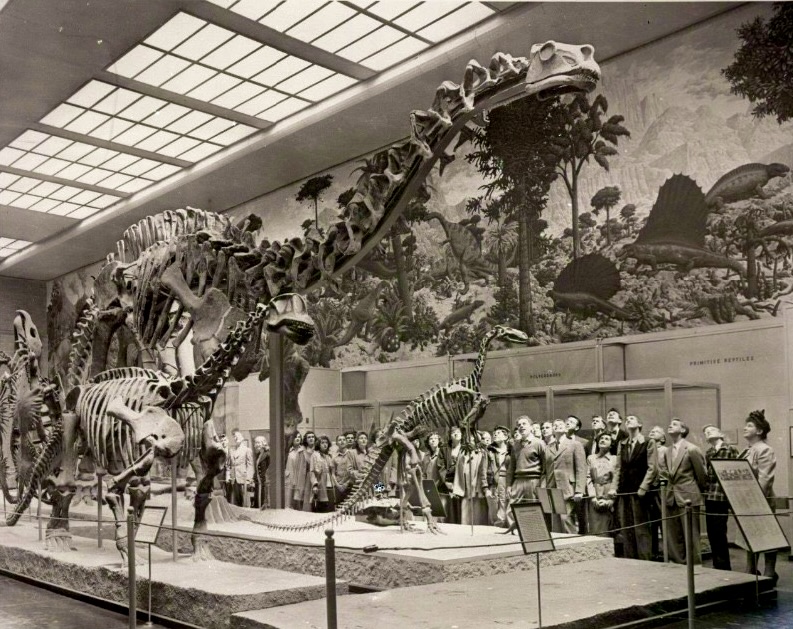
The creation of a habitat diorama requires the efforts of many museum specialists, trained in different areas of expertise, including the realistic reproduction of plants and animals, the illusion of atmospheric space, and the design of an architectural setting. Above all, museum dioramas require an institutional home committed to the considerable planning and costs involved in installing such exhibits. At the Yale Peabody Museum of Natural History, the exhibition of its specimens has long been a priority alongside advanced scientific research. When the current museum opened in 1925, it featured a Great Hall specifically designed for its remarkable dinosaur collection. As a backdrop to the Brontosaurus and other dinosaurs, in 1941 the museum commissioned artist Rudolph F. Zallinger to paint a 110 foot long mural depicting the evolutionary history of the Mesozoic Era. Completed in 1947, the iconic “Age of Reptiles” evolutionary mural depicted prehistoric plants and animals in realistic landscapes based on the artist’s collaboration with scientists. Today, it is widely regarded as one of Yale University’s most recognizable features.
The “Age of Reptiles” mural was supported by Albert E. Parr (1900 – 1991), who served as director of the Yale Peabody Museum from 1938 to 1942. During his tenure, Parr promoted a greater emphasis on ecology and public education, a philosophy he continued during his directorship of the American Museum of Natural History from 1942 to 1959. Parr believed that dioramas ought to function as “ecological theaters,” illustrating an animal’s environmental context. Mostly created in the 1940s and 1950s, the dioramas at the Peabody Museum portray a variety of North American habitats and illustrate how geology and climate shape biological diversity and how animal and plant species adapt to specific ecological conditions in nature. Today, they are widely regarded as exemplary models of natural history displays that merge science with art.