Contact:
karenwonders@gmail.com
Karen Wonders, PhD (Uppsala)
Victoria, British Columbia
Canada
Outdated CV (to be revised)
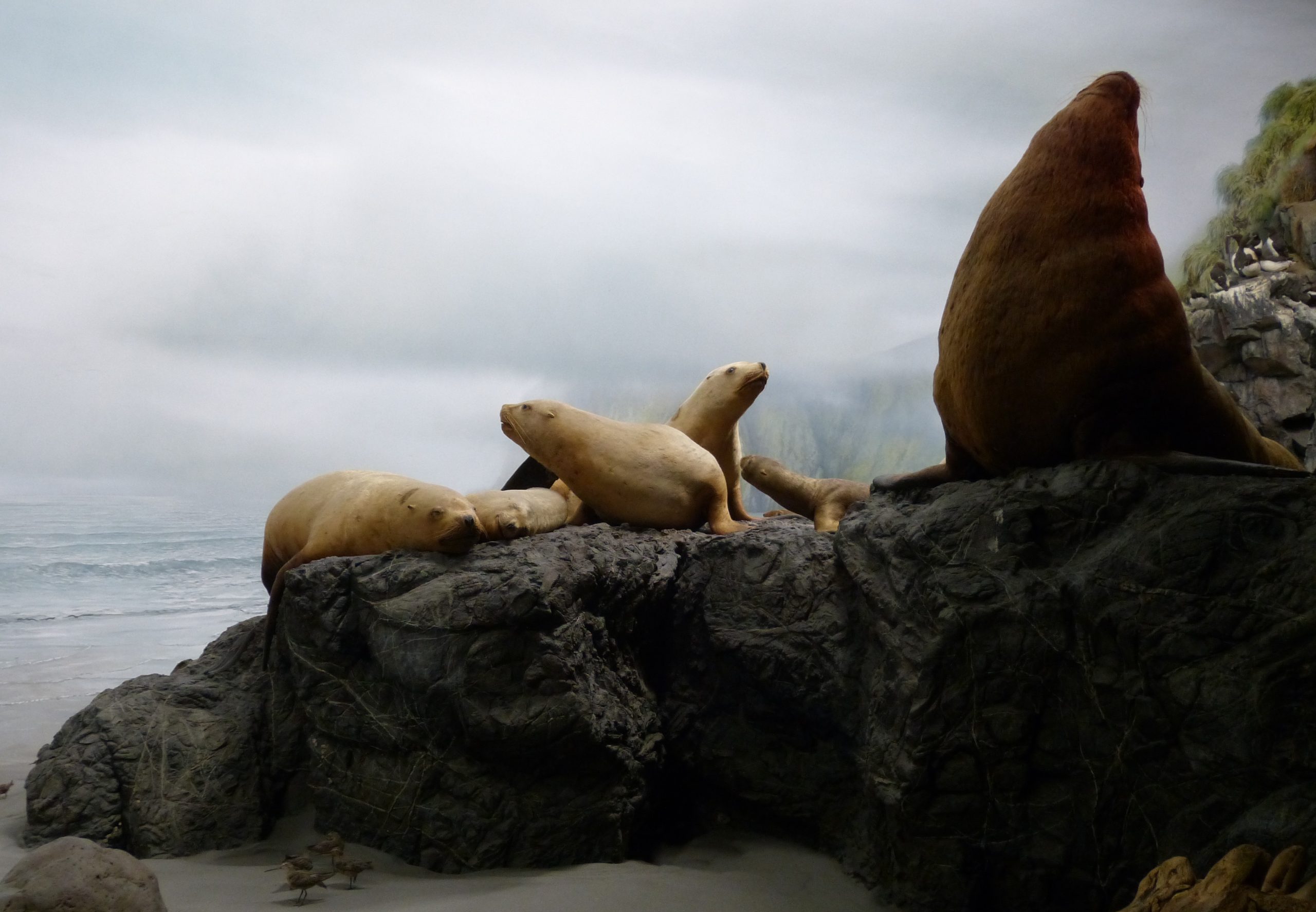
This website was launched in 2026. It presents a visual narrative of habitat dioramas, illusionistic natural history museum displays that integrate taxidermied specimens with fabricated foregrounds replicating specific ecosystems. Ideally, this faux terrain merges imperceptibly into a curved, painted background to create the illusion of spatial distance and atmospheric depth. The project examines habitat dioramas as cultural artifacts that reflect shifting human perceptions of the natural world, alongside advances in technologies for visualizing global biogeography. This history spans a pivotal era encompassing 19th century travel accounts, natural history and hunting narratives, the rise of evolutionary biology, and contemporary crises of biodiversity loss and species extinction.
Disclaimer: This website is a work in progress and serves as a conduit for a revised and expanded edition of my 1993 book, Habitat Dioramas. Because I approach this project as a visual narrative, I build its stories through images. Each page remains in flux, and the selection of digital images may change. At this stage, I have not systematically identified the titles or sources of all the images, but will do so as the website approaches completion and the accompanying printed manuscript takes shape. Many images are in the public domain; others have been located in the digital archives of museums and assorted institutions. Finding the appropriate imagery to convey these narratives is an ongoing challenge. Whenever possible, I identify the people depicted in photographs and the museums in which the photographs were taken. Proper contextualization is central to my visual narrative, and I draw upon my academic training in the history of art and science to this end.
The American Museum of Natural History has been indispensable to the research on habitat dioramas that I began in 1985. Widely recognized as having produced some of the most accomplished examples of this specialized form of exhibition, in which science and art converge, the Museum has generously supported my research by providing access to its rich and carefully preserved archives. Like its sister institution across Central Park, the Metropolitan Museum of Art, it holds cultural treasures that can never be replaced.
Once this website is completed, I plan to find a museum willing to host it and thereby support the broader need to preserve the artistic and cultural legacy of habitat dioramas. As with a conventional scholarly publication, content from this website should be appropriately cited when referenced or used by others. Note that habitatdioramas.net and my archived websites (listed below) are non commercial and ad free.
The following three websites grew out of research projects exploring the intersections of art history and environmental history. They were created by Dr. Karen Wonders during her fellowship at the Institute for the History of Science at the University of Göttingen, under the direction of Professor Nicolaas A. Rupke, from 2004 to 2009. The original websites have been archived and remain available here:
This website is a visual narrative of the plight of Big Trees endemic to the Pacific Northwest and the devastating impact of rapacious clearcutting on their ancient forest habitats. It explores the pictures and politics of Big Trees, contrasting their cultural meanings in Europe and the New World. Particular attention is given to the vanishing giant cedar trees upon which the art of totem poles and Indigenous carving traditions depend. One activist example is Cathedral Grove on Vancouver Island, which became an international flashpoint when its ecological integrity was threatened by the proposed construction of a parking lot, just as Joni Mitchell famously sang about.
This website is a visual narrative of the principal ways in which European colonists asserted control over the lands and waters of what is now called “British Columbia,” displacing and impoverishing First Nations peoples. Five interconnected categories of exploitation — Invasion, Forestry, Fisheries, Mining, and Development — are examined within the broader context of land rights and environmentalism, with particular attention to Indigenous activists who defended their traditional territories, resources, and ways of life.
This website is a visual narrative of the Nuxalk House of Smayusta, created at the request of Nuxalk Hereditary Chief Qwatsinas (1947 – 2010). Central to this narrative is the assertion of Nuxalk sovereignty: “The Sovereignty of the Nuxalk Nation comes from Tatau, the Creator. It is not subject to the approval of any other Nation. As the Nuxalk Nation, we have the sovereign right to jurisdictional rule within our own Territory.” One expression of this assertion of Nuxalk land rights was the battle of ISTA on King Island, where the Nuxalk fought to protect the ancient rainforest from clearcutting by Interfor. Following their arrests, Nuxalk protesters were transported from their homes in Bella Coola on the West Coast by plane to Vancouver, British Columbia, where they were jailed.