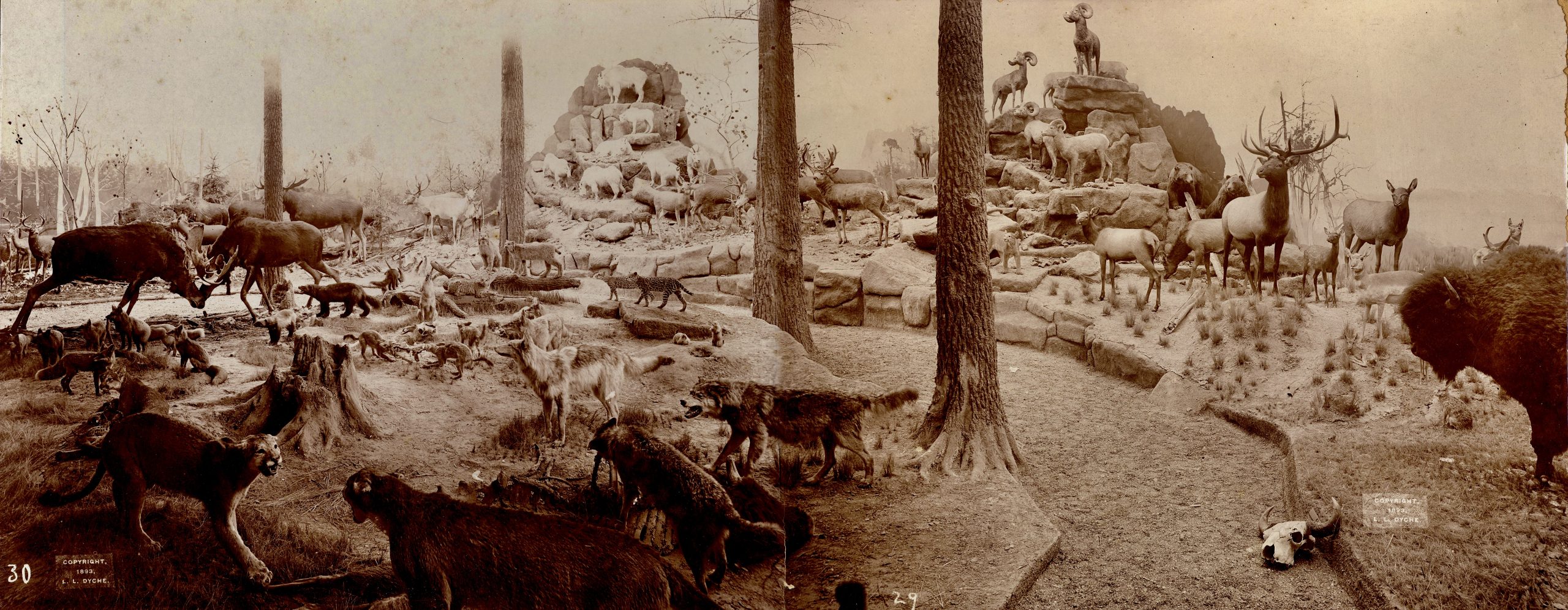
The “Panorama of North American Mammals,” as it is commonly known, was originally titled the “Kansas Exhibit of Mounted Specimens of the Animals of the State” when it opened at the 1893 World’s Columbian Exposition in Chicago, where it was installed in the Kansas Building. Created by taxidermist Lewis Lindsay Dyche (1855 – 1915), the panoramic display of hundreds of animals arranged in naturalistic habitats was later restaged in the Natural History Museum at the University of Kansas in Lawrence.
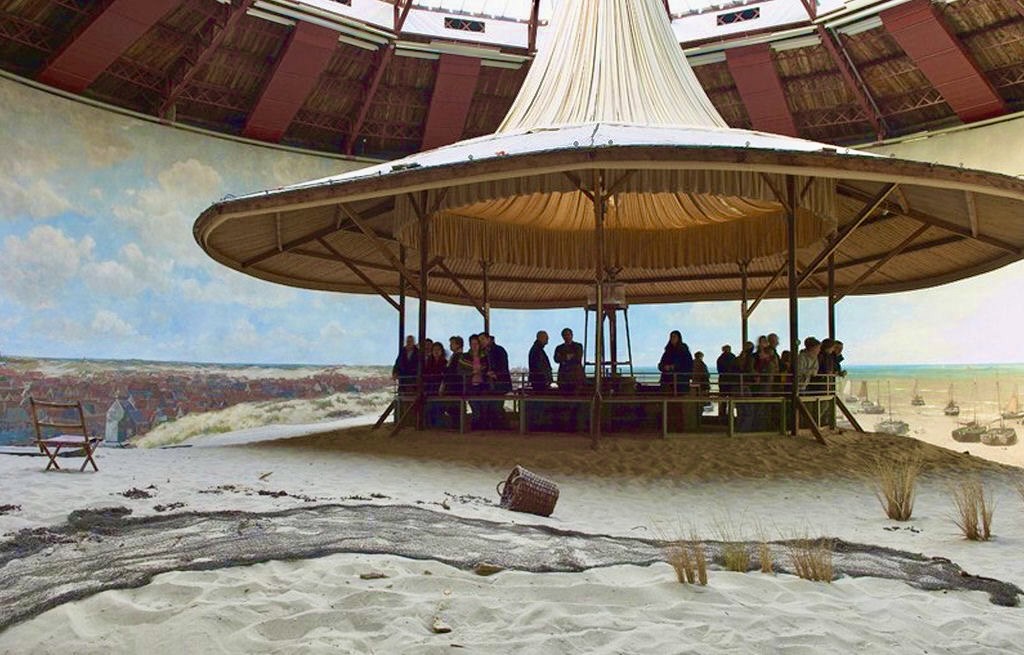
The first panorama was conceived by the Scottish painter Robert Barker, who patented his idea in 1787. Essentially a panorama was a circular painting showing a landscape in the round, housed in a specially built viewing structure. Barker coined the word “Panorama” from the Greek words pan (all) and horama (view or spectacle), meaning an “all encompassing view,” to describe his invention. A rare surviving example, created in 1881, is the Mesdag Panorama in The Hague, Netherlands. A photograph taken from inside the Panorama shows visitors standing on a central viewing platform, surrounded by a circular painting approximately 14 metres (46 ft) high and 120 metres (394 ft) in circumference. An overhead canopy shields viewers from looking upward and seeing the skylights that provide natural light for the scene. A foreground of real objects, a faux terrain of sand dunes and bushes, makes it difficult for viewers to distinguish where the foreground ends and the painting begins.
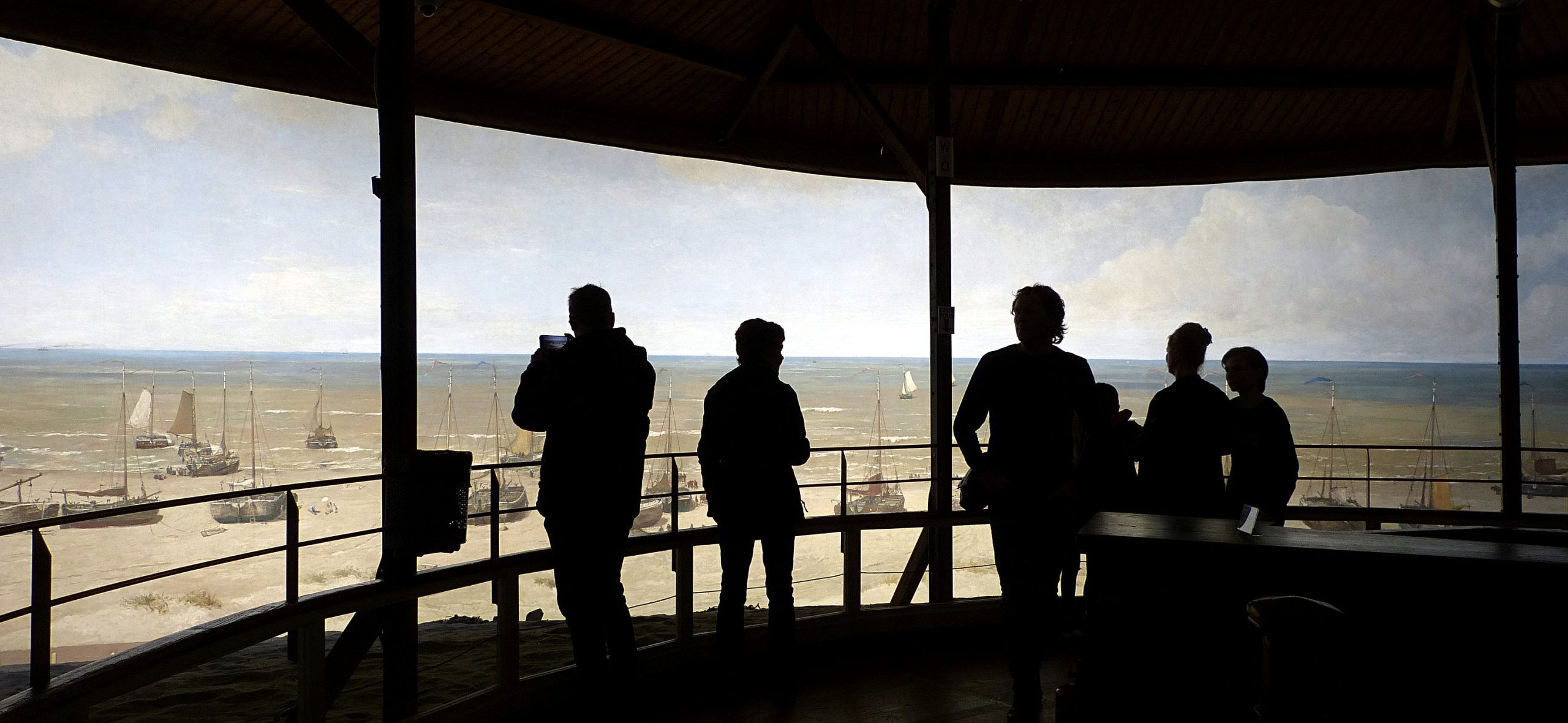
This image shows what viewers see when looking out across the 360 degree view of the Mesdag Panorama. Painted in 1881 by the Dutch marine painter Hendrik Willem Mesdag (1831 – 1915), assisted by his wife and other artists, the scene depicts the dunes and seaside village of Scheveningen, with its fishing boats. For viewers standing at the centre of the vast painting, which functions as a kind of theatrical stage, the Panorama’s optical illusion creates an immersive experience of the landscape scene. The role of the spectator is critical, as viewers can look in multiple directions and observe different elements from varying angles and vantage points.
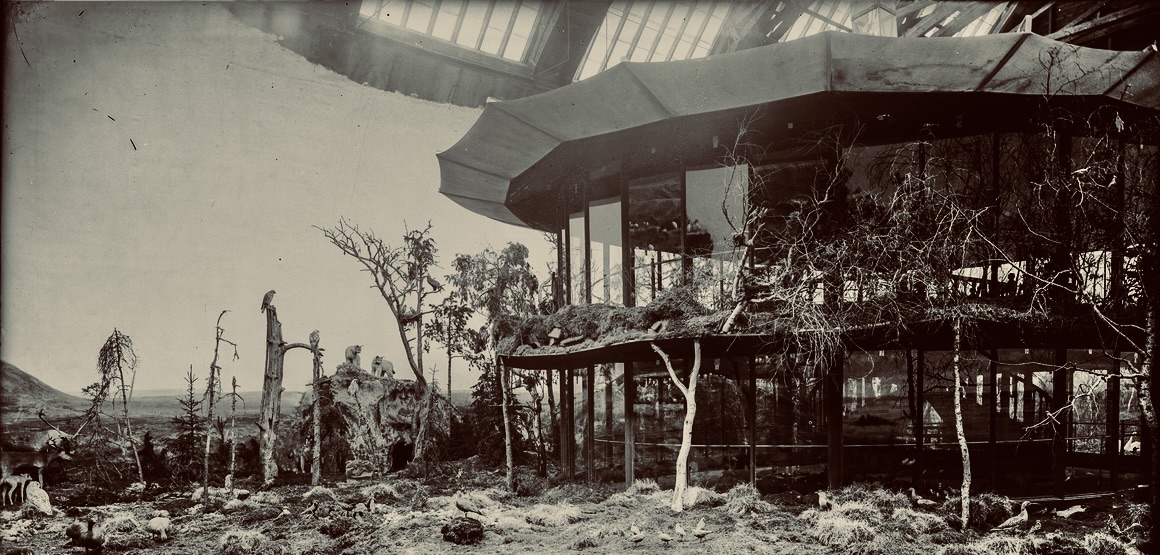
The panorama was a massive circular painting whose effect on the viewer was deliberately enhanced through an original apparatus for viewing it. A third example of an extant panorama is the Biologiska museet, which opened in 1893 in Stockholm, Sweden. Gustaf Kolthoff (1845 – 1913), a hunter naturalist and zoological conservator, designed the museum as a 360 degree panorama in which to display Nordic wildlife and nature. The background painting was by the famed wildlife artist Bruno Liljefors (1860 – 1939). On entering the museum’s dark and enclosed inner vestibule, visitors ascend a spiralled staircase into a circular observation rotunda located in the centre of the exhibition area. Originally the museum was advertised by an exterior banner over its entrance that stated: “One of a Kind – Panorama of Animal Life – Without Equal in the World.” Later the banner (still in place today) was changed to: “The Nordic Animal World, Seen in Nature.
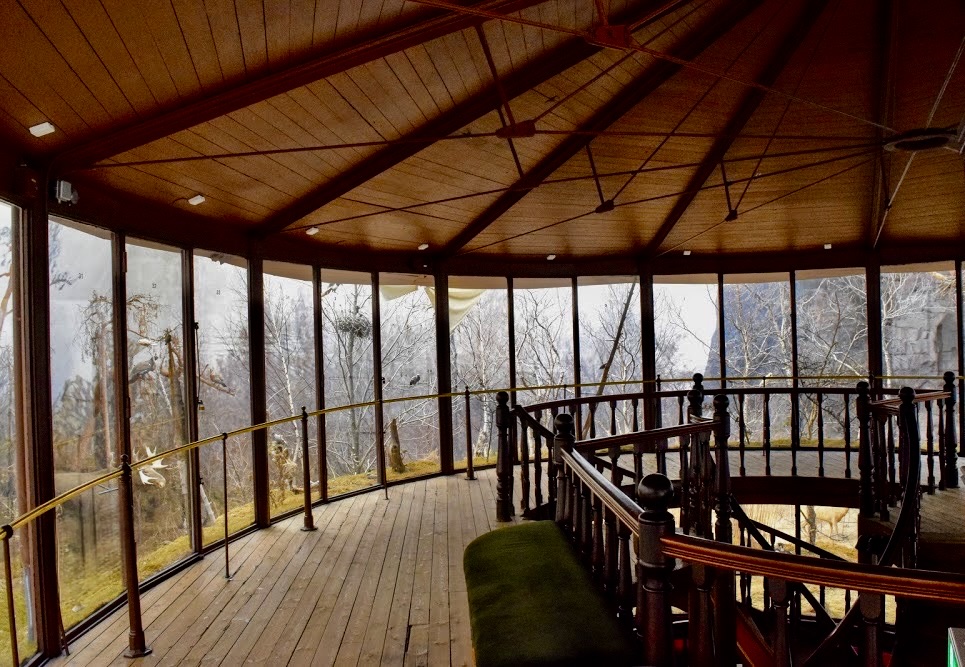
An archival photograph from 1900 shows the two levels of the viewing rotunda of the Biologiska museet, as seen from inside the exhibit. The overhead canopy prevents viewers from seeing the skylights and the top edge of the painted canvas that wraps round the interior walls of the building. On this expansive surface, Liljefors painted a grand encompassing landscape, skillfully tying it together with the 3D foreground and creating the illusion of distance and atmospheric space. Viewers look through the glass and see hundreds of mounted animals and birds arranged in a naturalistic landscape scene of the biogeography of Norden.
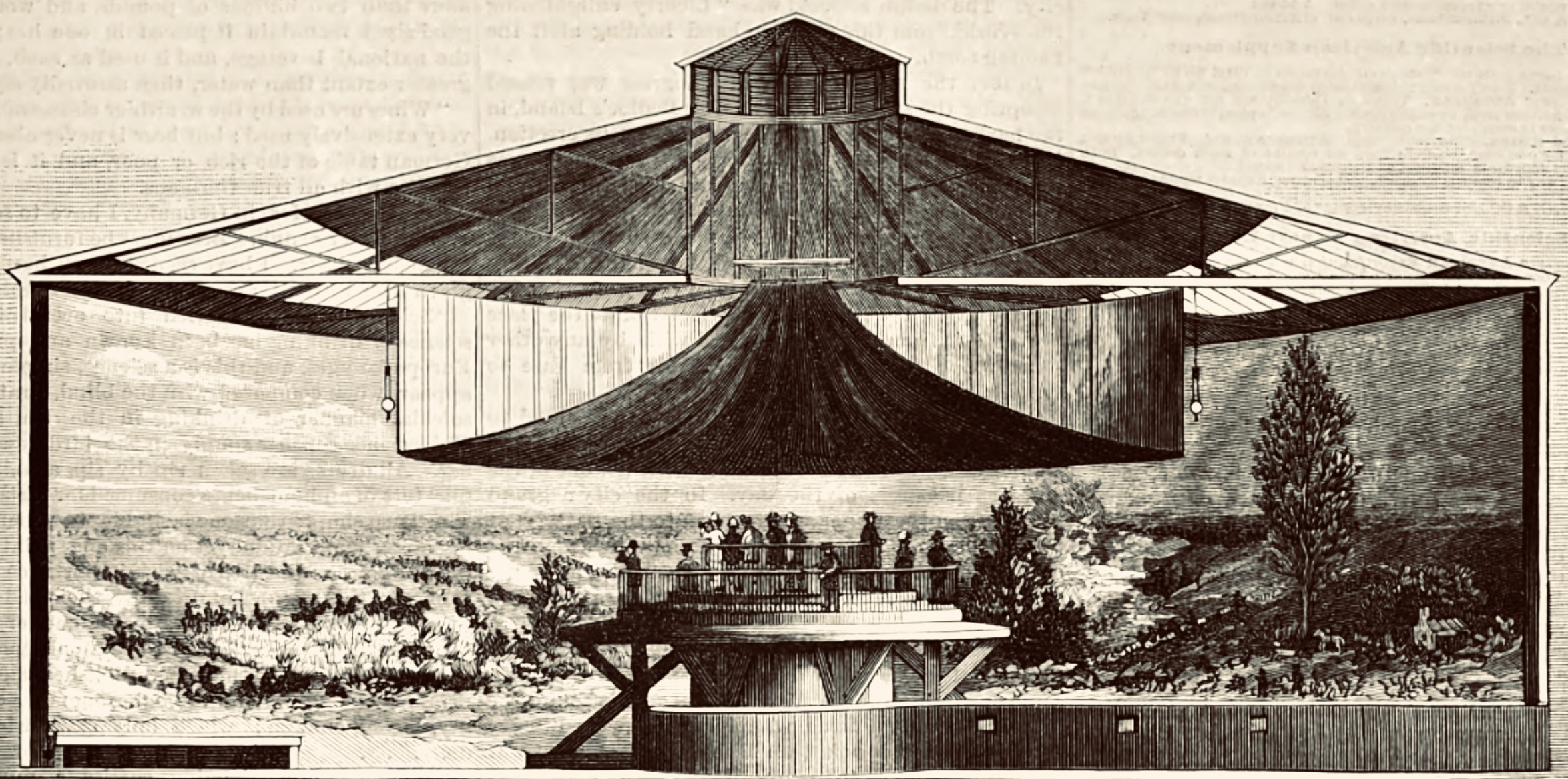
An 1886 engraving shows a cross section of a cyclorama building in which the “Battle of Gettysburg” was staged. In the US, the term “cyclorama” was often used instead of “panorama” as it had been patented by Barker. The engraving depicts the optical devices used to create the illusion of atmospheric depth in panoramas and allow viewers to immerse themselves in another world: the darkened and elevated central viewing platform; the overhead canopy (velarium) to hide the light source; the circular painting on a curved canvas background; and the 3D physical foreground that transitions seamlessly to the flat painted surface.
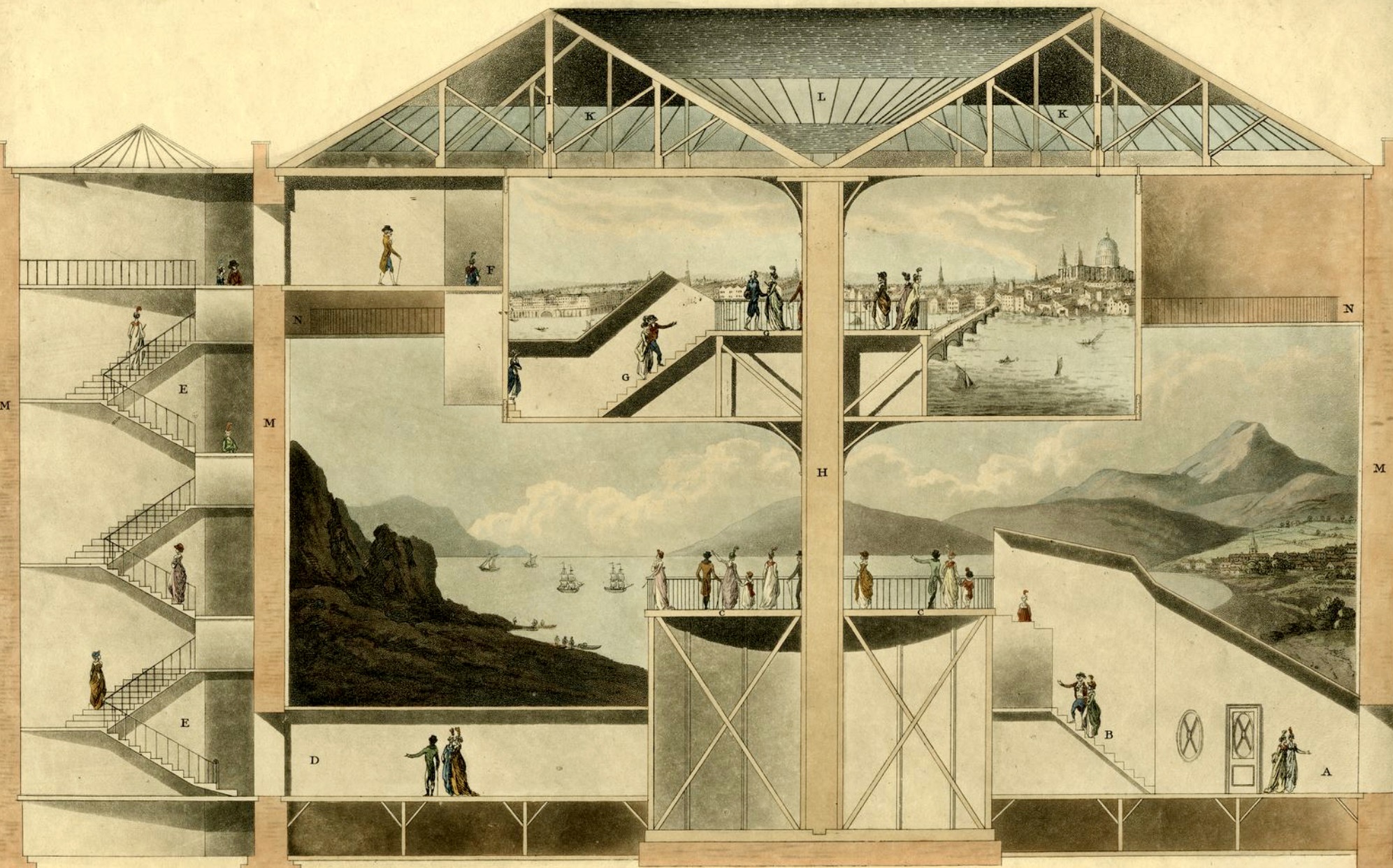
An engraving published in 1801 shows a cross section of the round Panorama building that was erected in London in 1793. A two level hall with a central rotunda is depicted along with a dark internal staircases and two viewing platforms from which two circular paintings could be simultaneously shown. An upper canopy shields source of illumination from the spectators. The lower scene is a seascape of Spithead with the moored Royal Navy fleet; the upper is a rooftop view of London. Barker’s celebrated Panorama was described as “a venue of instruction as well as entertainment which depicted places so accurately that you may well suppose yourself transported thither.” Already in 1795 an American artist copied Barker’s view of London and installed in a 130 ft in circumference panorama in New York City.
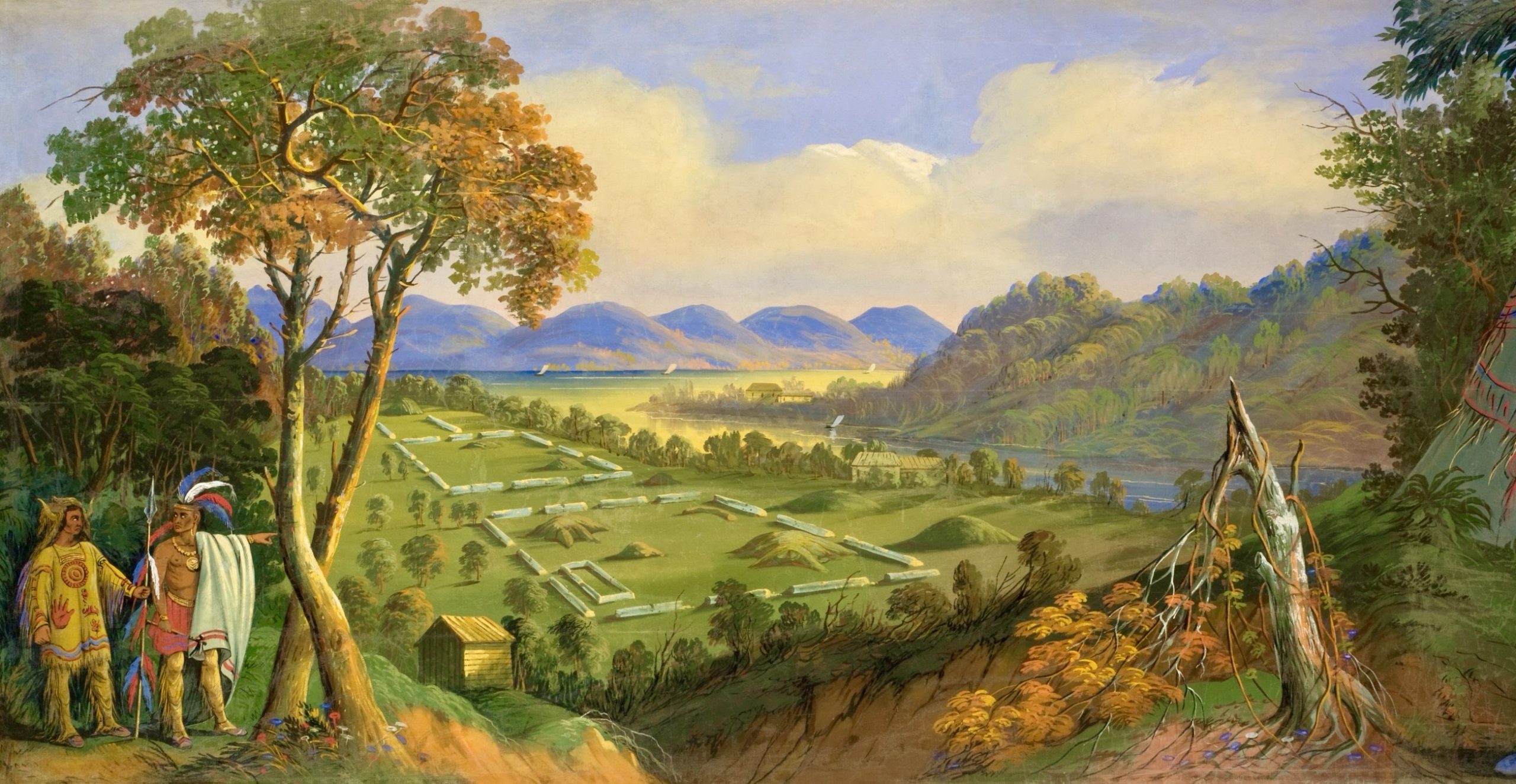
In the US, moving panoramas became the dominant form of popular illusionistic scenery during the mid 19th century. These “moving pictures” were paintings that unrolled from one roller onto another in front of an audience and were toured to various cities. A example, preserved at Saint Louis Art Museum, is the “Panorama of the Monumental Grandeur of the Mississippi Valley,” painted around 1850 by artist John J. Egan (1810 – 1882). One scene from the painting, which measures 348 feet long and 7.5 feet high, depicts Native Americans overlooking the ancient mounds that mark the river valley. Increasingly the definition of a panorama was broadened, and envisaged as a wide, or extended field of view of a landscape.
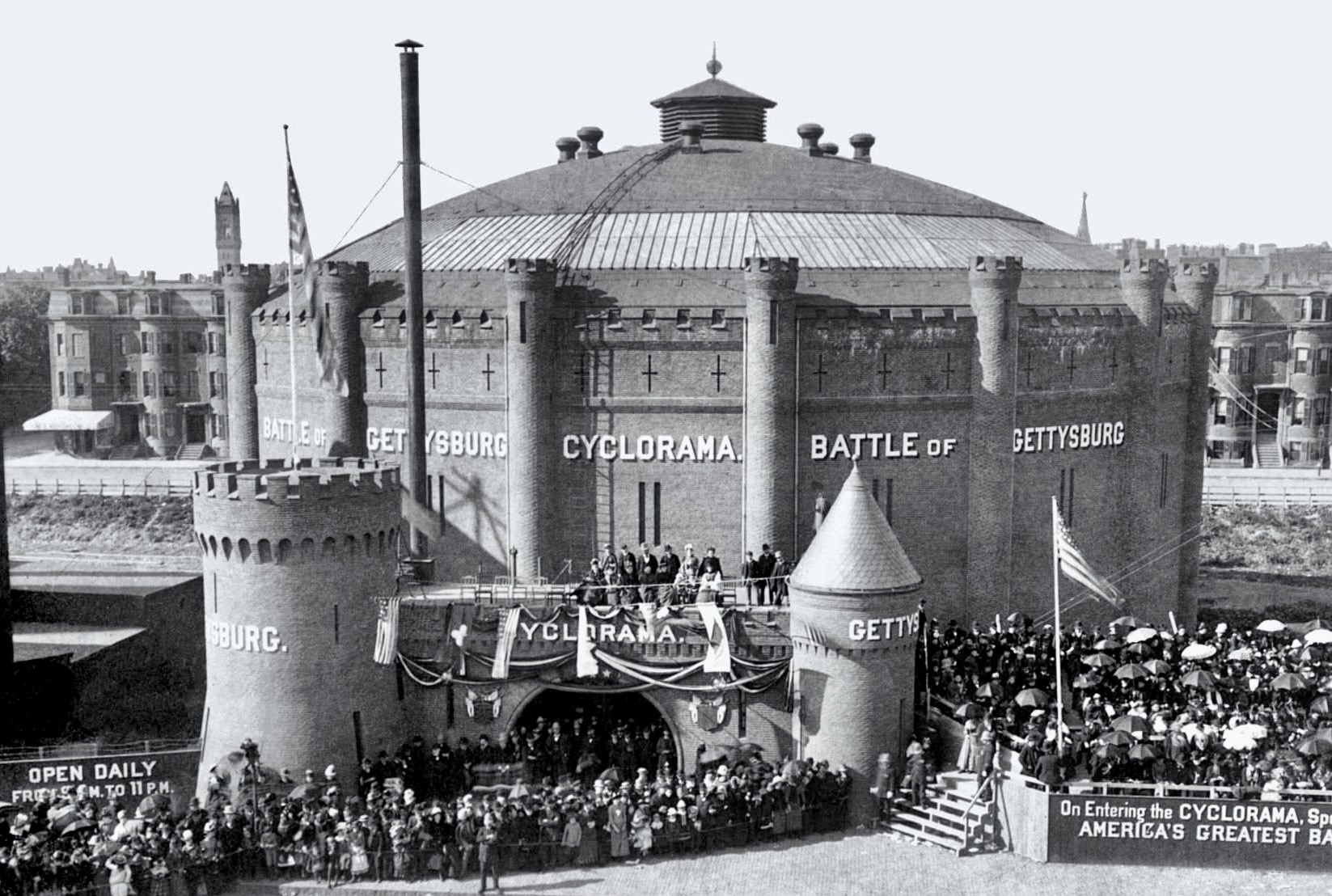
The term “cyclorama” (circle view) was introduced to differentiate the immersive cylindrical painting and the round architectural space that housed it from the moving panorama. The cyclorama was based on the same technical and spatial features as the original panorama patented by Barker in 1783. In the US, there was a boom of cyclorama building during the 1880s and 90s. An example is the cyclorama constructed in 1884 in Boston to showcase the “Battle of Gettysburg,” a massive 360 degree painting by the French artist Paul Philippoteaux (1846 – 1923). In 1913 it was moved to Gettysburg where it remains today. Another example is the 358 foot long cyclorama that features the “Battle of Atlanta,” painted by German artists who worked at the American Panorama Company, which was dedicated to cycloramic art. Both of these paintings are not preserved in the original cycloramic building that housed them although the Boston cyclorama remains.
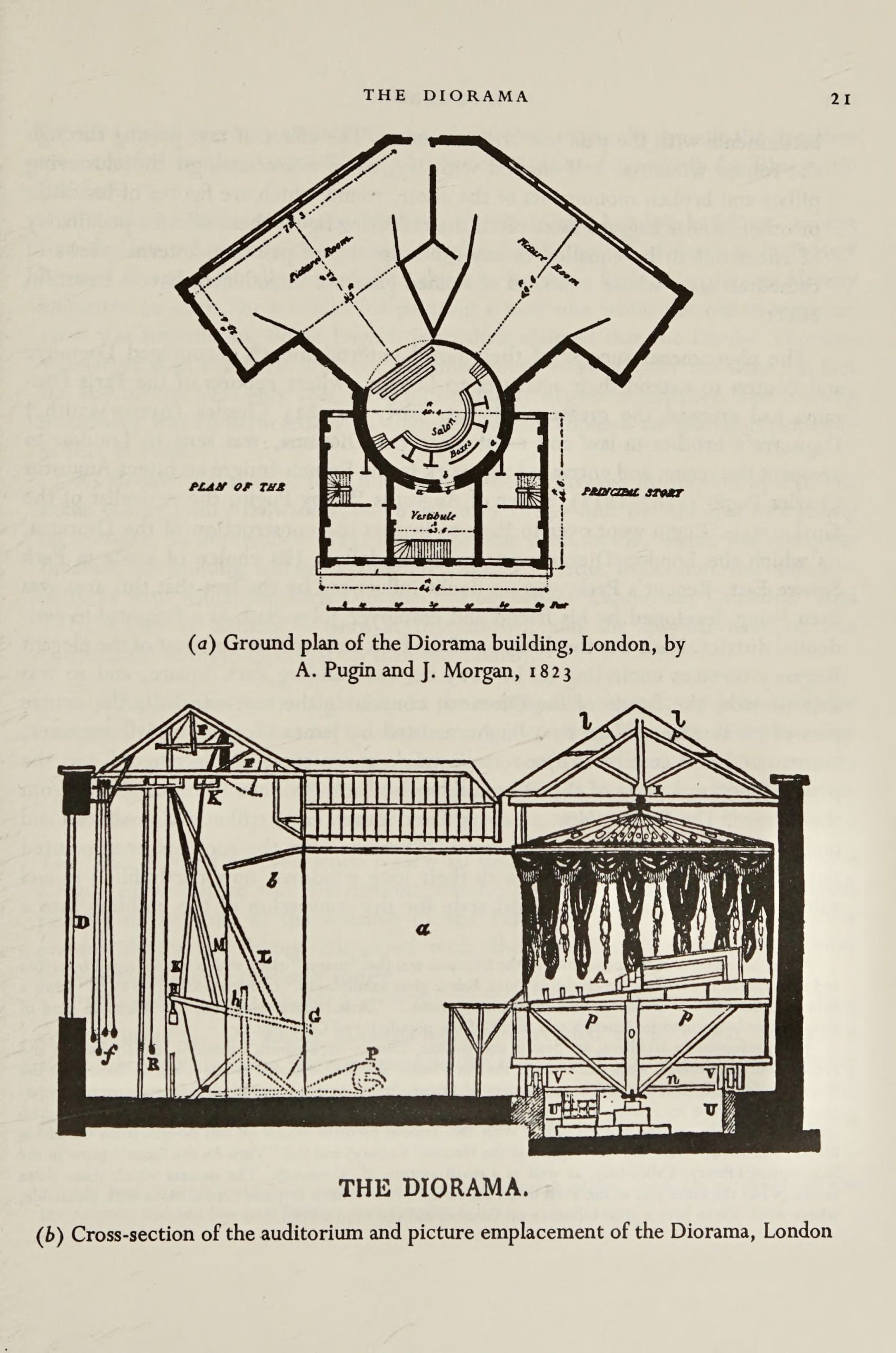
An alternative to the panorama, the diorama was a theatrical form of illusionistic entertainment invented in 1822 by Louis Daguerre (1787 – 1851), years before he became known for the daguerreotype photographic process. The first diorama was built in Paris and was such a success that it was followed by another in London in 1823. An illustration depicts its ground plan, with a cross section below showing the auditorium and arrangement of the painted scenery. A darkened cylindrical auditorium holding up to 350 people revolved between two stationary tableaux viewed through an opening. These were manipulated by a system of shutters and screens that directed natural light onto the massive, translucent painted images, one a landscape and the other an interior view. The resulting optical illusion of depth and space was said to be awe inspiring.
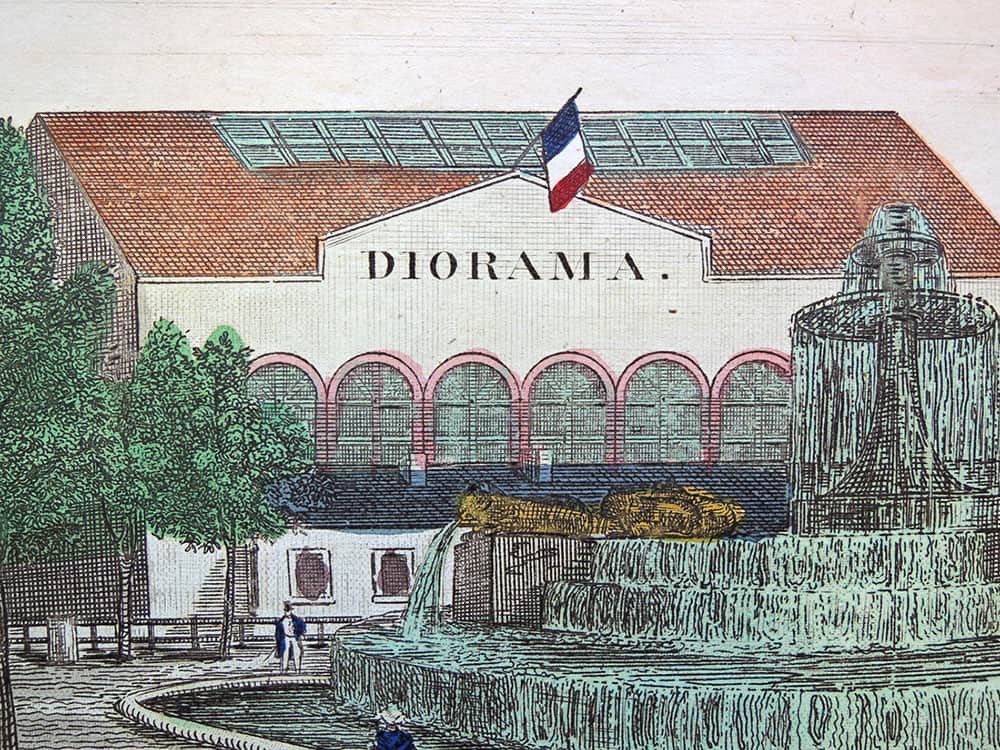
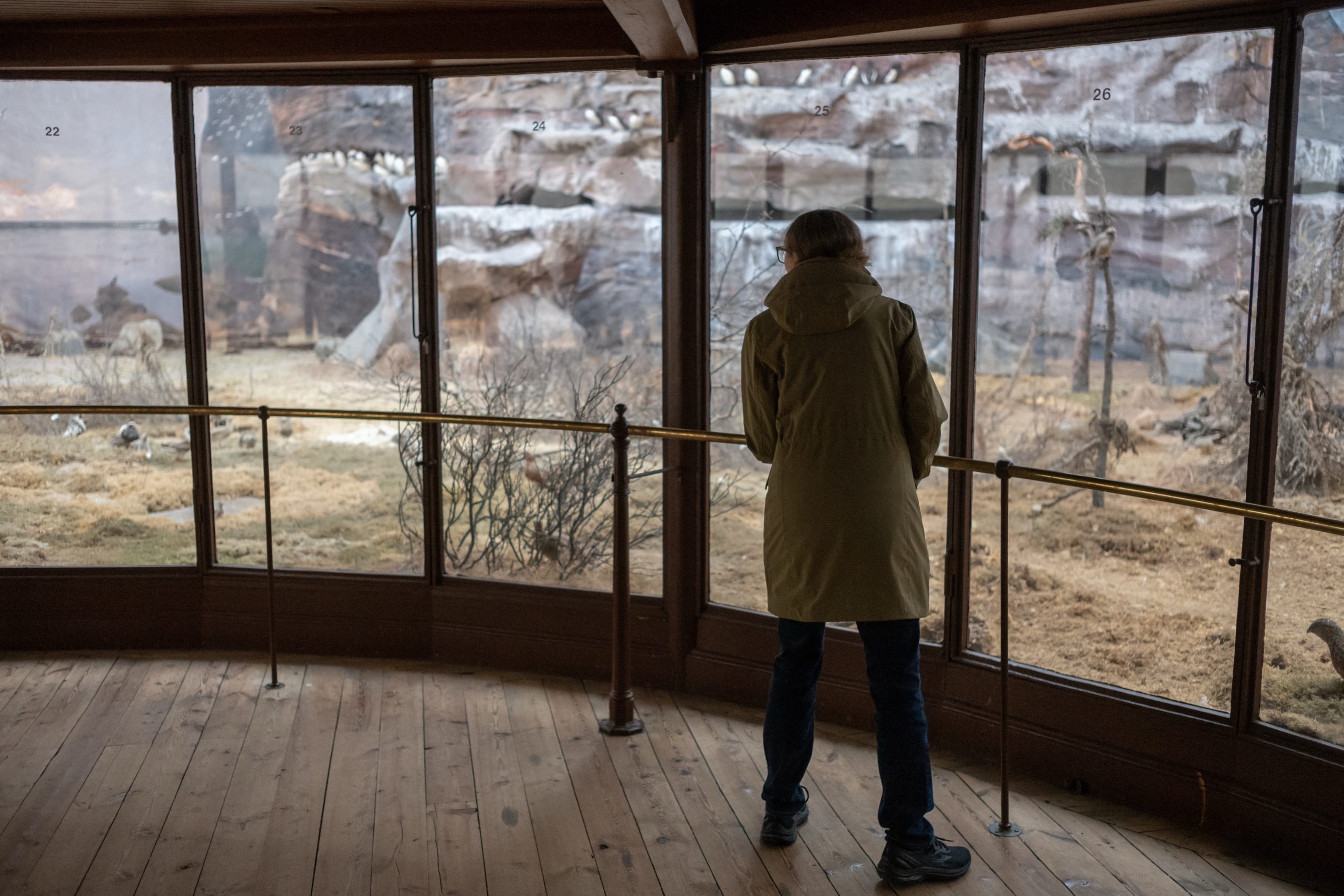
The word diorama means “to see through” or “through a view.” It comes from the Greek roots dia (through) and orama (a view or that which is seen). Over time, the definition shifted from Daguerre’s original 1822 display; in the US, “diorama” first became associated with miniature historical models, and later the compound term “habitat dioramas” was used to describe illusionistic museum displays of natural history specimens, primarily zoological mounts. The act of looking through glass onto recreated scenery was essential to the 1893 Biologiska museet, which incorporated the optical devices of the panorama: the restricted darkened central viewing area, the overhead illumination and canopy to conceal the source of light, the circular painted backdrop, and the physical foreground that merged into the flat painted surface of the backdrop. These elements are central to the illusionistic display tradition that also defines the art of habitat dioramas in museums today.
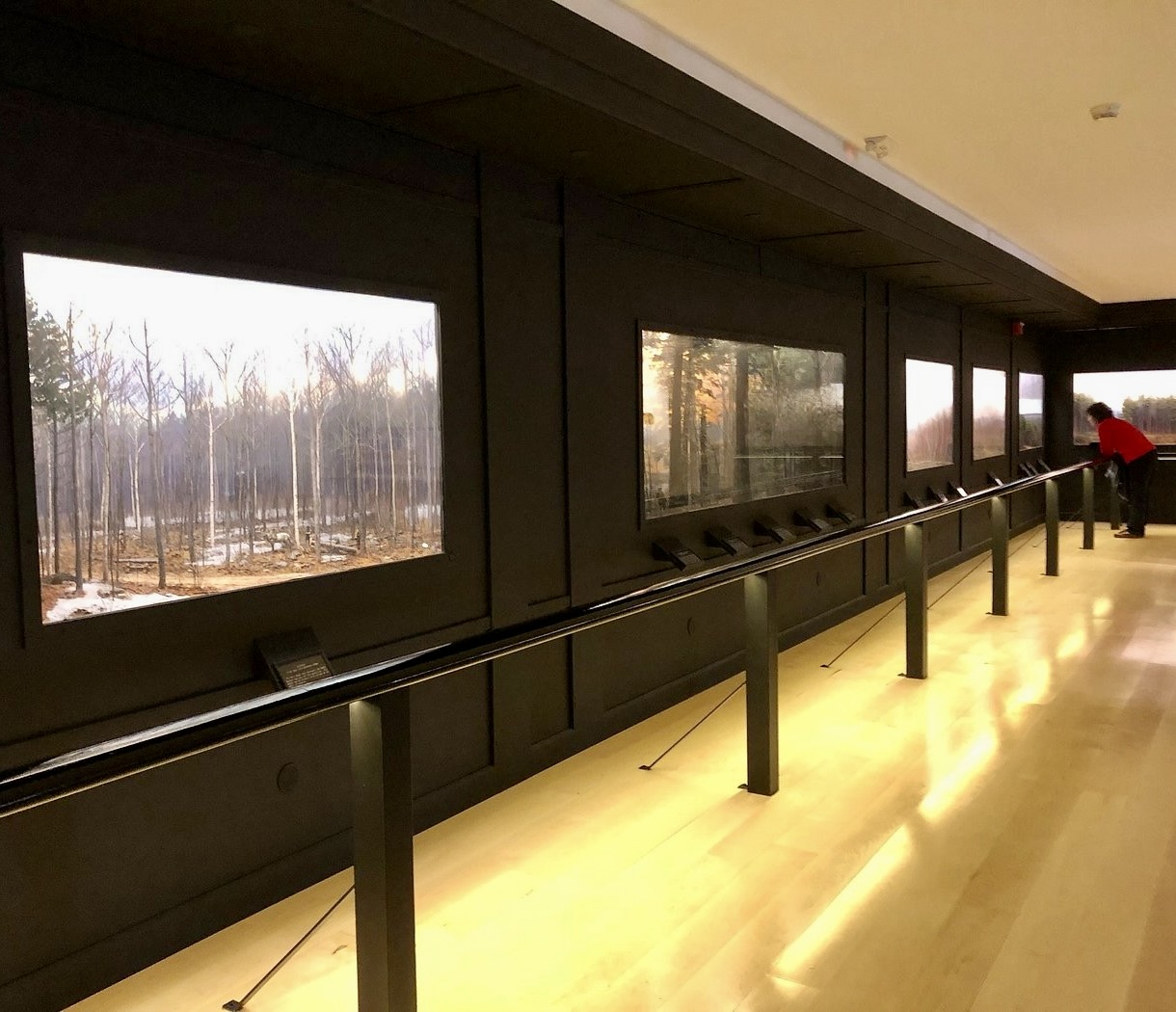
An exceptional instance of miniature dioramas replicating naturalistic landscapes is found at the Fisher Museum at Harvard Forest in Petersham, Massachusetts. It houses 23 dioramas depicting changes to the New England landscape and forest practices from 1700 to the present: “The first seven dioramas trace 230 years of ecological succession and human impact in a single local site from 1700 through clearing for agriculture, abandonment, and the return of native forests. The remaining models illustrate 20th century timber management, silvicultural techniques, and environmental disturbances like fire and soil erosion.” The dioramas were conceived and designed by Harvard Forest’s founding director, Richard Fisher (1876 – 1934), and built in the 1930s by Samuel Guernsey (1868 – 1936), curator of archaeology at Harvard University’s Peabody Museum, and sculptor Theodore Pitman (1892 – 1956). Arranged along a darkened corridor, the dioramas are separated from viewers by a railing that maintains an optimal position for looking through the window or portal of the recreated forest scene and experiencing its illusion.
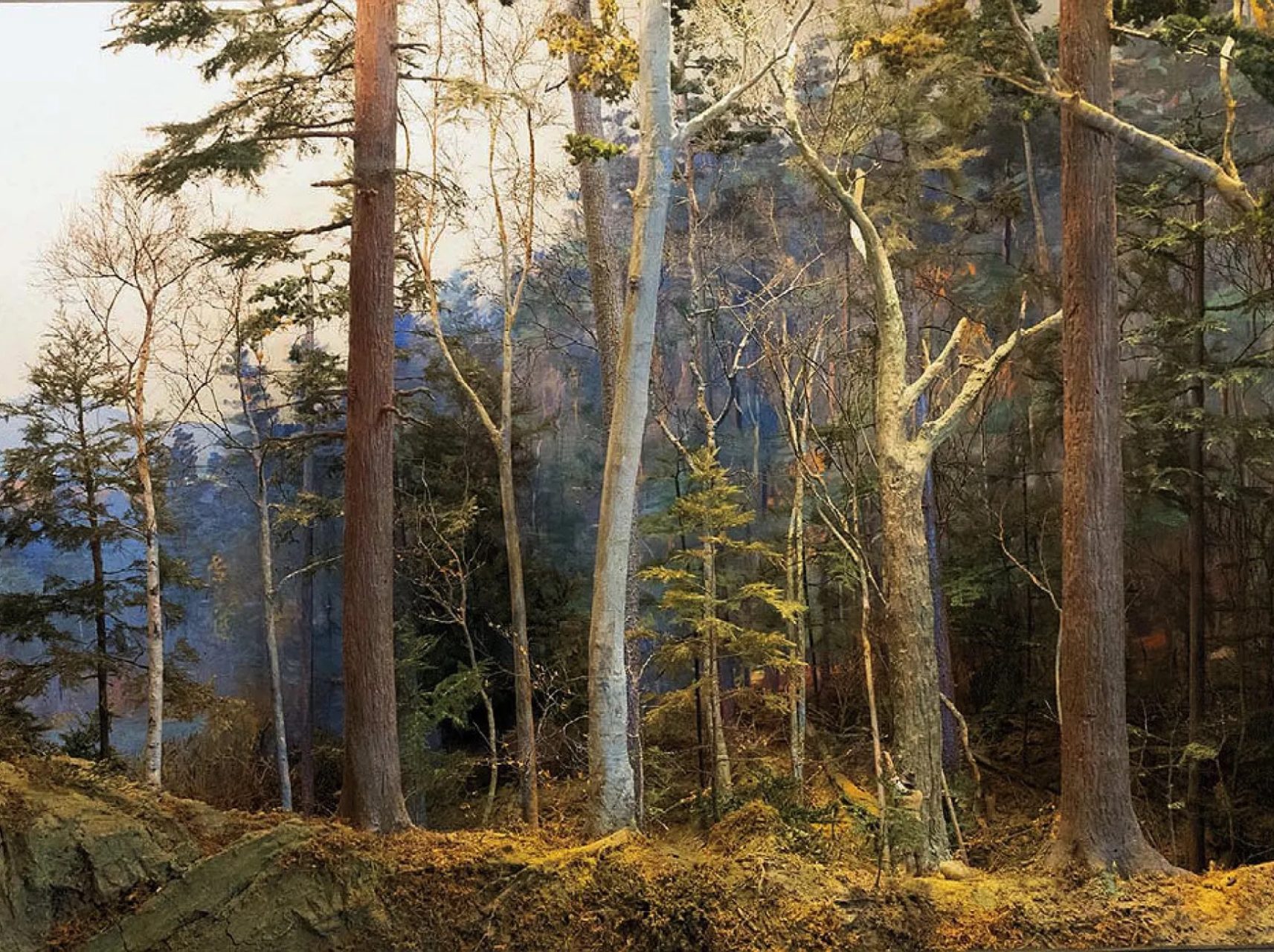
The Harvard Forest dioramas serve a didactic and educational purpose, documenting the evolution of New England forest ecosystems over centuries. An integral part of this history is the relationship between humans and the environment, which becomes increasingly pronounced over the period beginning in 1700. The first diorama, titled “Precolonial Forest,” portrays an old growth forest that includes oak, maple, and birch trees. There is no sign of Indigenous stewardship of the forest, despite the presence of Nipmuc Native Americans long before European settlement. The vegetation was modelled with scientific precision: each tree was made of multiple strands of copper wire wrapped together to accurately mimic the natural growth patterns and appearance of specific species. Like the full scale habitat diorama, the background landscape was painted to merge with the faux terrain; rather than taxidermic mounts of zoological specimens, however, any animals or birds in the scene were modelled in wax on a miniature scale.
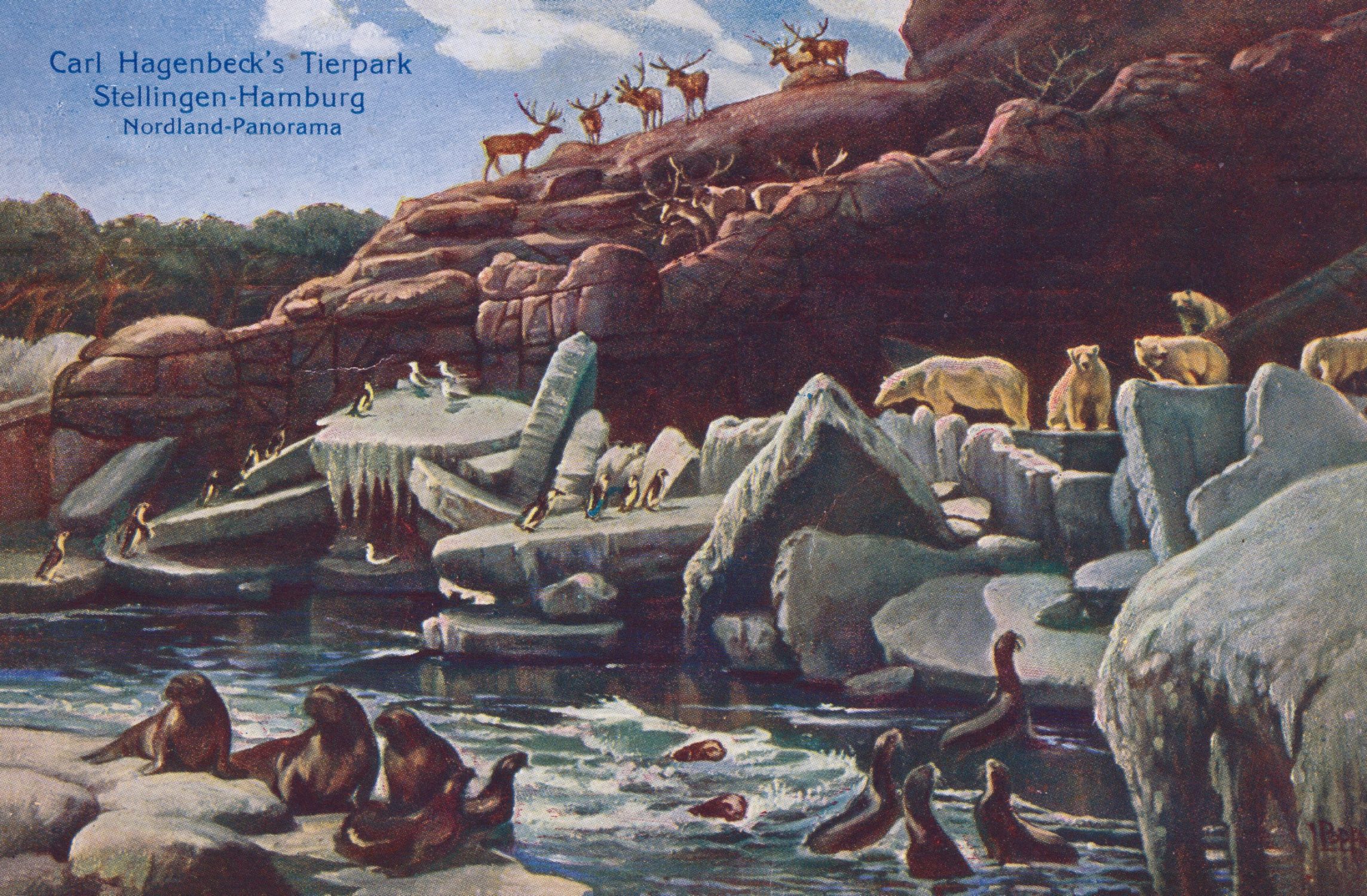
The display of large mammals in panoramic landscapes took on a living form at Hagenbeck’s zoological garden in Stellingen, Hamburg. The German animal trader Carl Hagenbeck (1844 – 1913) conceived and designed a zoo based on an innovative panorama system, an idea he patented in 1907. Displaying animals in naturalistic habitats that recreated far off exotic landscapes with wide vistas was a popular form of illusionistic entertainment that revolutionized zoos across the world. A vintage postcard of Hagenbeck’s Tierpark, titled “Nordland Panorama,” shows walruses and seals in a pool that functions as a hidden moat. Behind them are polar bears and penguins, and beyond another moat, is a large herd of reindeer. The rocks and cliffs in the foreground of the panoramic display were artificial structures made from concrete and metal framing.
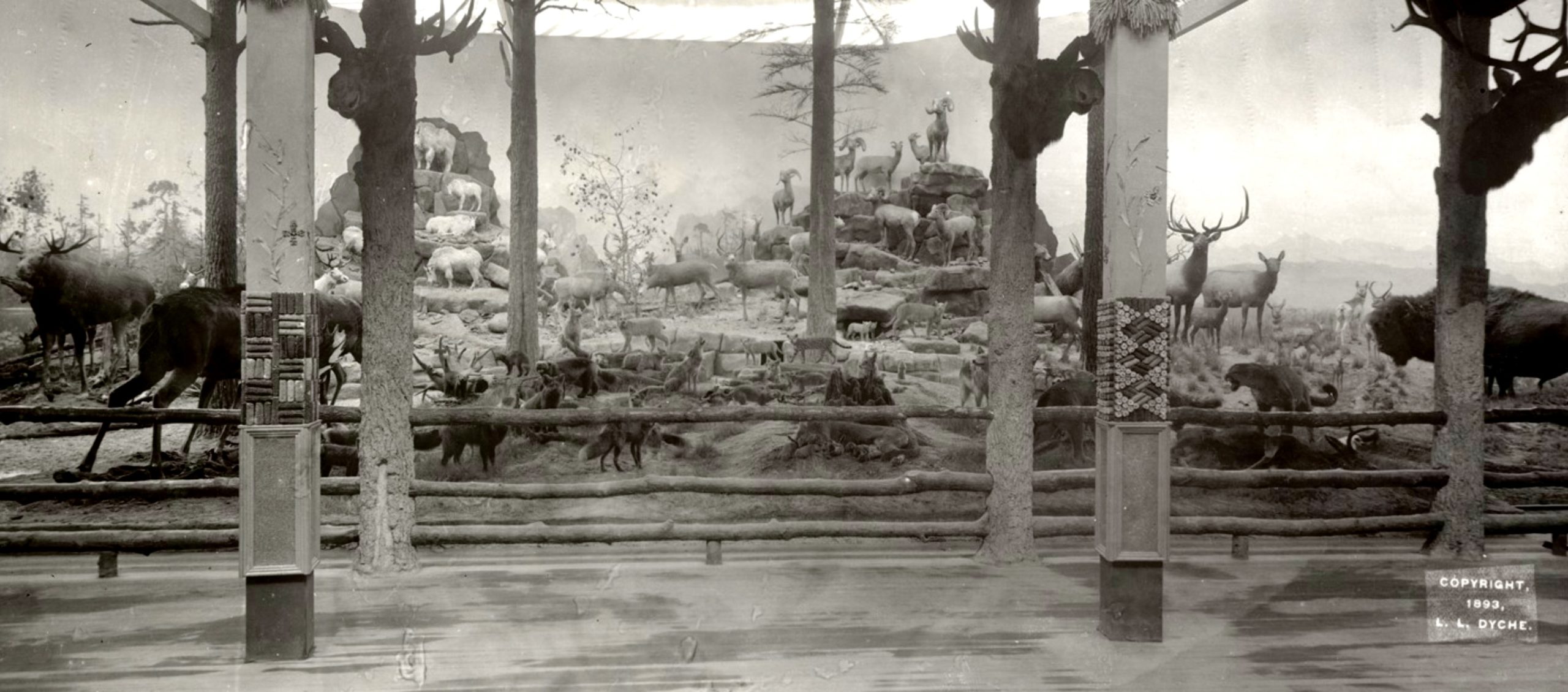
A counterpart to Hagenbeck’s panorama of living animals was Lindsay Dyche’s taxidermic display of North American mammals, many of them arranged in mountainous landscapes of artificial rocks. A photograph of the original installation, as it was exhibited in Chicago in 1893, was copyrighted by Dyche himself. It shows the wide panoramic vista of the illusionistic spectacle, with a faint suggestion of a painted background landscape. Trophy heads of moose and elk are displayed on tree trunks in the foreground, while a rustic rail separates visitors from the exhibition.
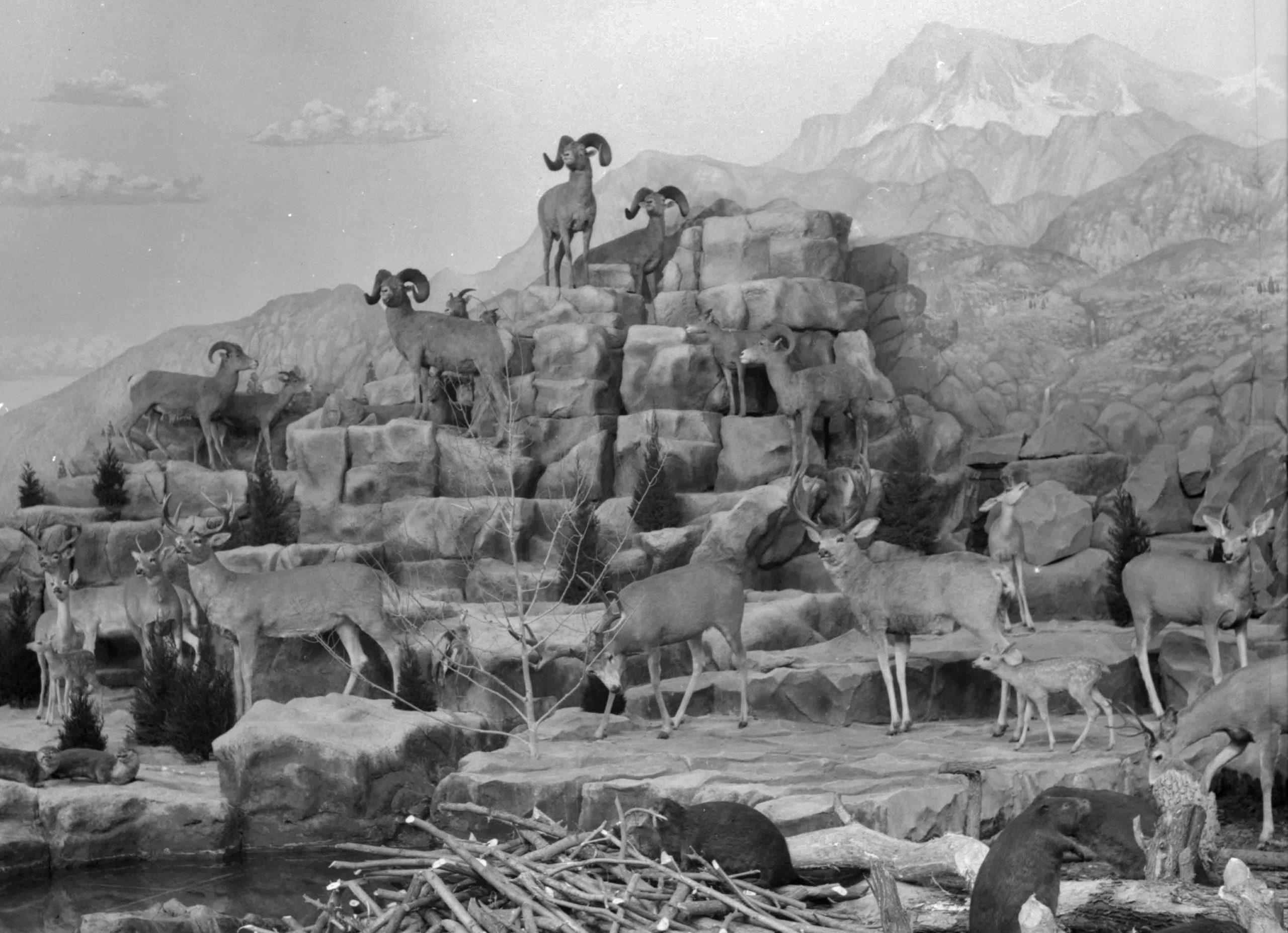
When later installed in the Natural History Museum at the University of Kansas, Dyche’s display — nearly 90 feet across, 60 feet deep, and containing 121 animals — came to be called a “panorama.” Dyche was a hunter naturalist who had studied taxidermy under William Hornaday in 1887, when Hornaday was chief taxidermist at the United States National Museum. From his mentor, Dyche learned to use clay covered models and to arrange zoological specimens in groups with foreground habitats. Like Hornaday, Dyche focused on the heads and horns of big game animals, most of which he had shot himself on hunting trips to British Columbia, Canada. An example is the group of Rocky Mountain bighorn sheep rams standing regally on the highest mountain ledge. The distant mountain peaks and clouds are clearly articulated in the background landscape of the taxidermic tableau.
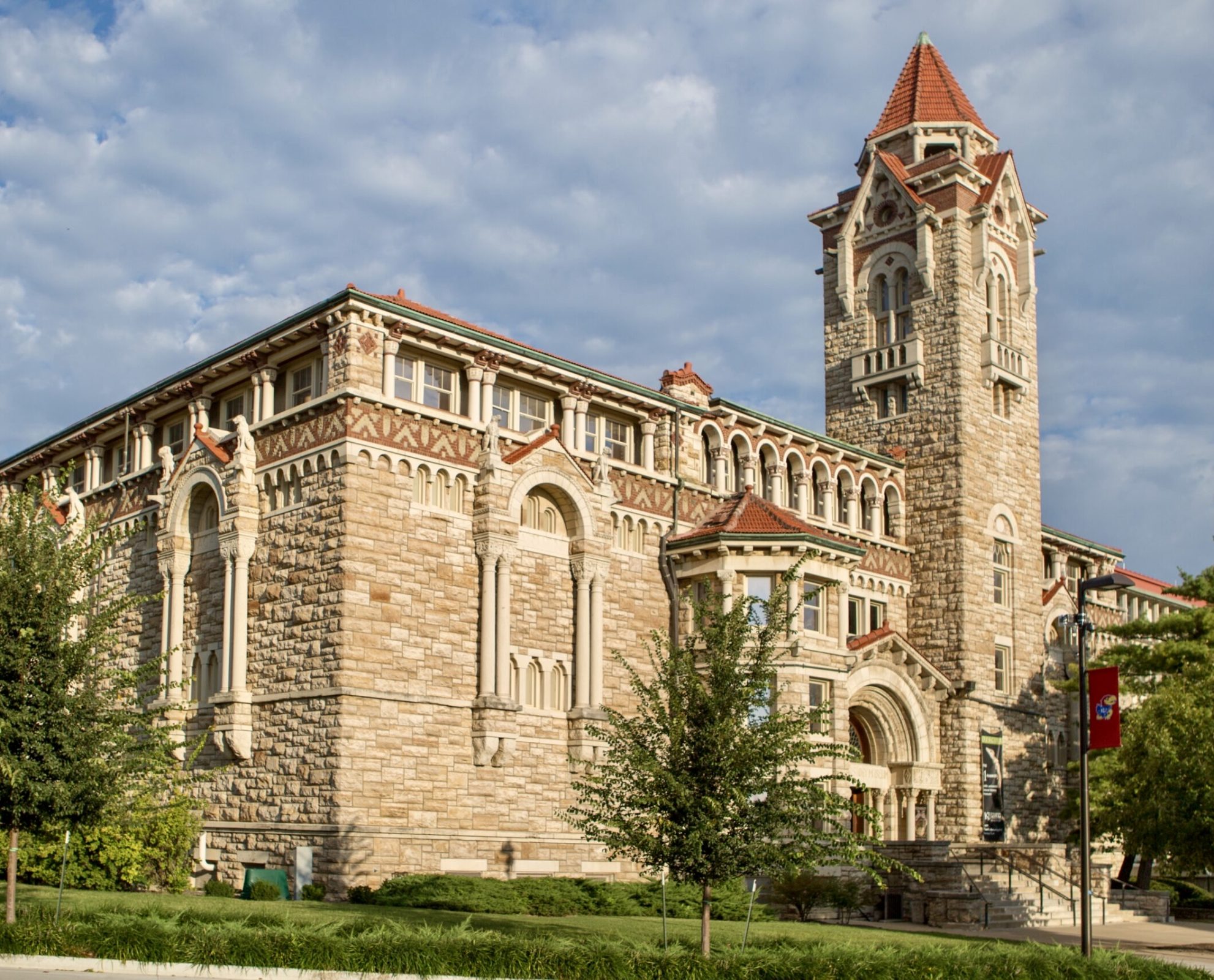
The Natural History Museum at the University of Kansas began in 1864 as a small cabinet of specimens and quickly expanded its collections. In 1885, Dyche became a professor of zoology at the museum, with the goal of building the world’s finest collection of native North American mammals before many of them had become extinct. To this end, he began a series of collecting expeditions in 1890, resulting in a large number of animals that he mounted for a Kansas State exhibition at the 1893 World’s Columbian Exposition. Following its success, the state funded a new museum to house Dyche’s exhibition. Designed in a Romanesque style with a tower and carved animal ornaments, the building was completed in 1903 and later renamed Dyche Hall. Its main floor layout and vaulted entryway functioned like a church apse and was laid out by Dyche to frame and display his zoological collection, which contained hundreds of mounted mammal specimens. Closed in 1932, the museum did not reopen until 1941, after Dyche’s exhibit had been reconstructed as a continuous, circular central viewing space.
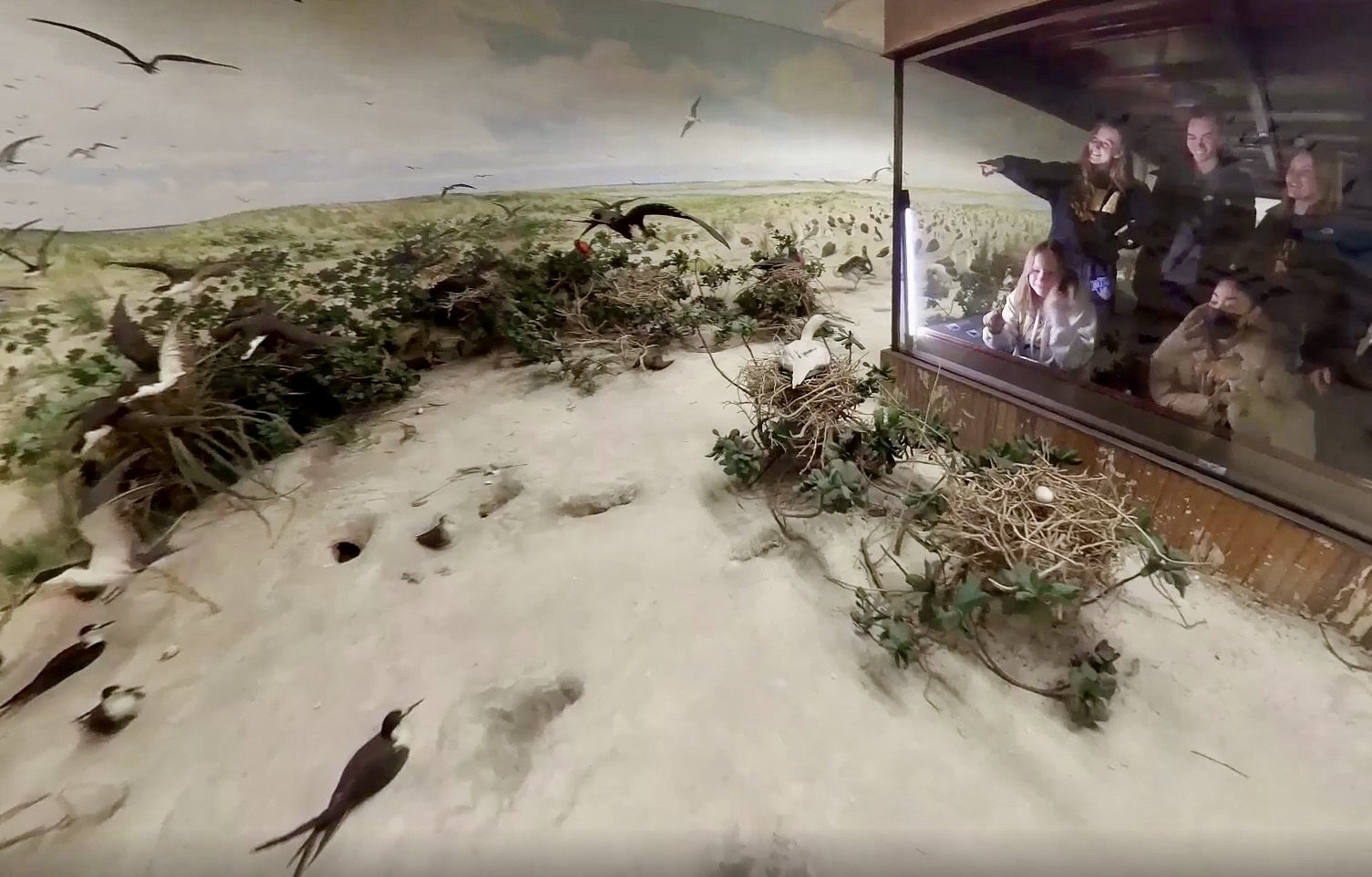
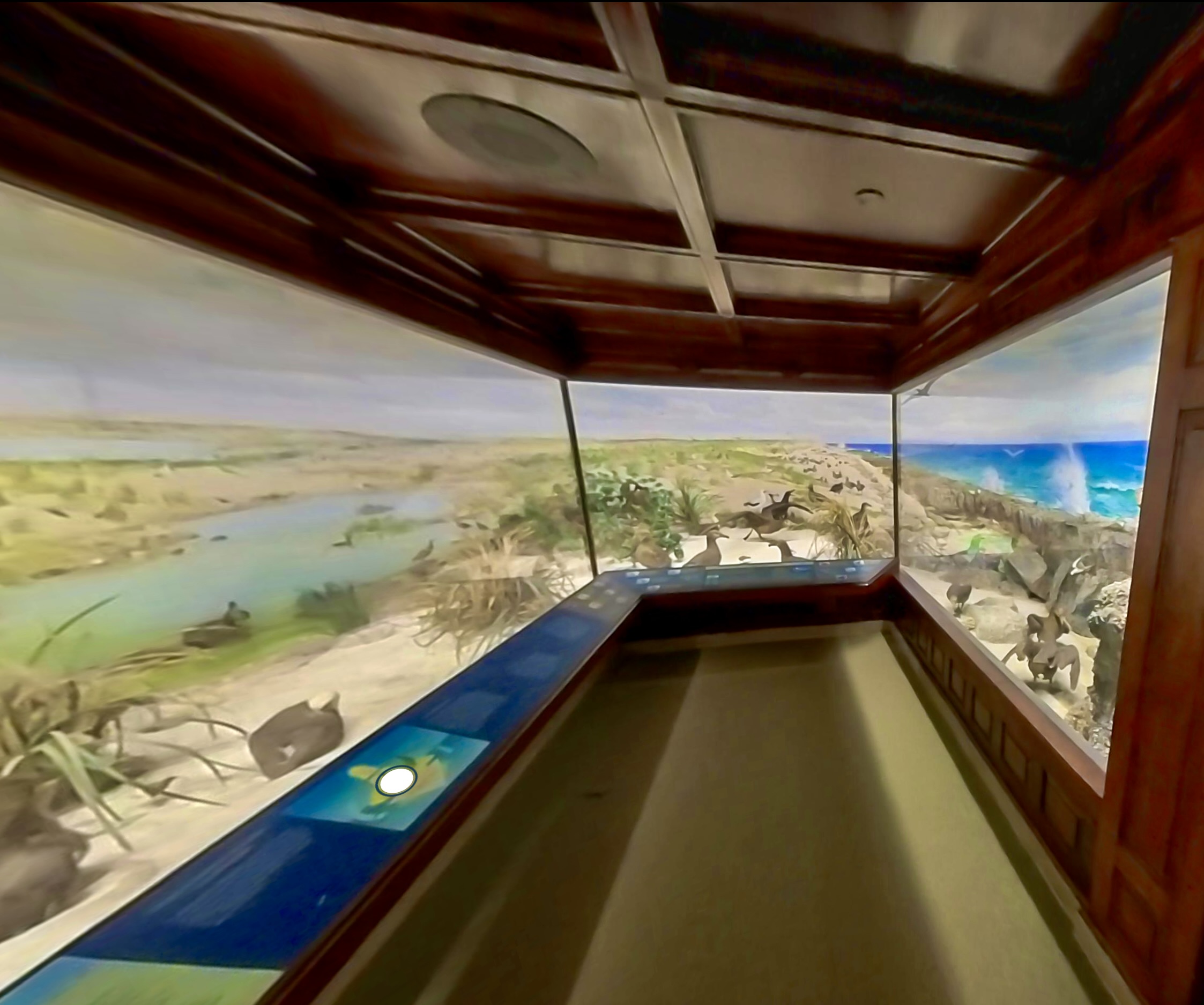
A second example of an immersive and illusionistic zoological exhibition is the ground breaking Laysan Island Cyclorama, which opened in 1914 at the Natural History Museum of the University of Iowa. Viewers of the panoramic scene are confined to a central, darkened observation room. The display features a coral atoll in the Hawaiian archipelago known for its extraordinary birdlife. In its heyday, the atoll supported more than eight million birds representing 22 different species, all within its 1.5 square miles. To recreate an impression of this remarkable biodiversity presented a uniquely difficult challenge, well suited to the circular format of the cyclorama. More than 100 mounted birds representing 24 species, including three now extinct species, were arranged in a naturalistic foreground before a 138 foot long painted mural.
The Laysan Island Cyclorama was conceived by Charles Cleveland Nutting (1858 – 1927), professor of zoology and director of the Museum of Natural History at the University of Iowa. He had been appointed curator of the university’s Cabinet of Natural History in 1886. Founded in 1858, it was the second oldest university museum west of the Mississippi River. Nutting led a major era of scientific expeditions, gathering large numbers of natural history specimens. In 1902, he joined a Smithsonian Institution expedition to survey the Northwestern Hawaiian Islands, including Laysan Island. Nutting was overwhelmed by the sight of millions of birds and later wrote: “For no one . . . could possibly contemplate this assemblage of avian life without being profoundly moved by the experience.”
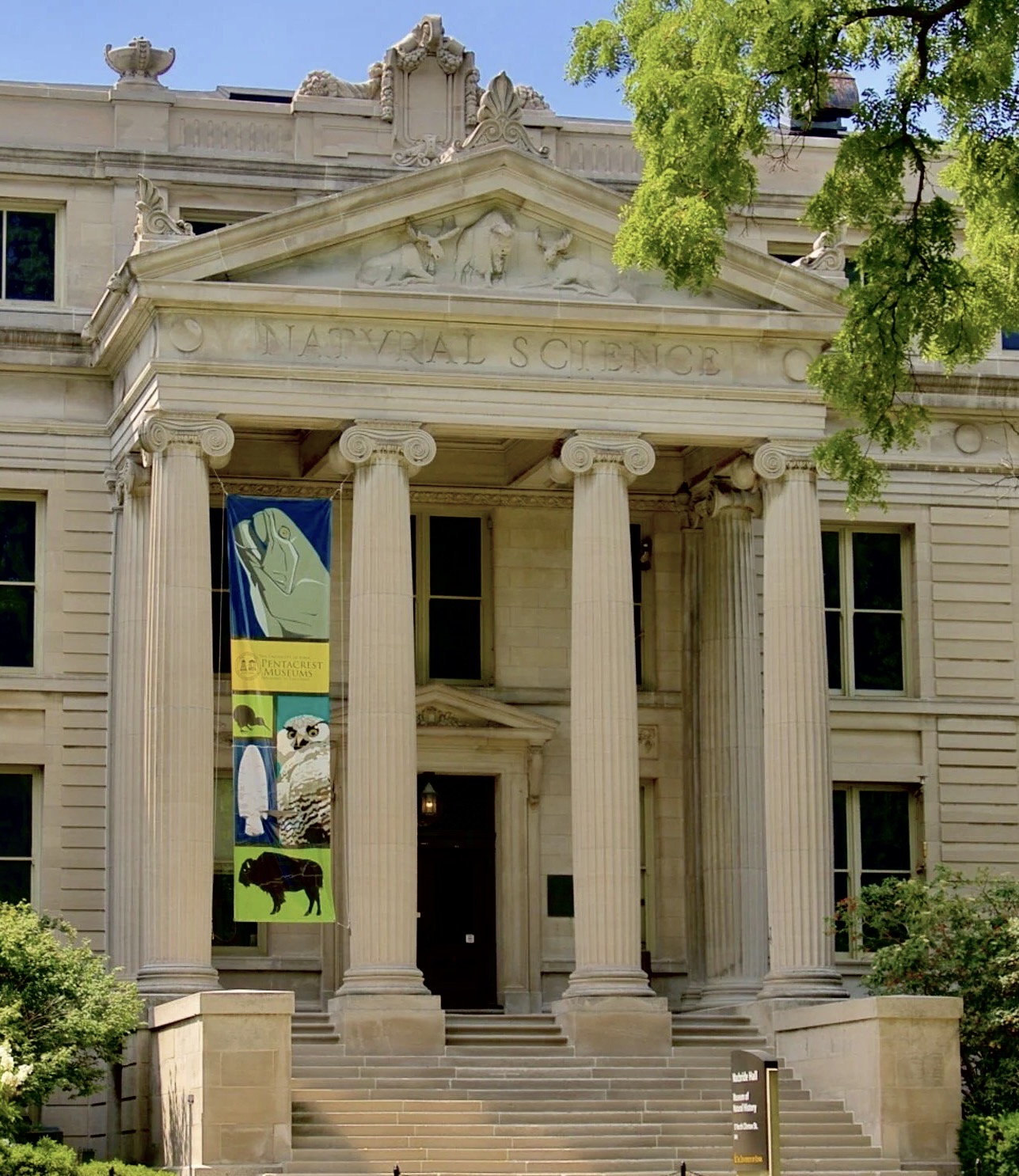
To accommodate its growing collections, the museum moved in 1908 into a new building called the Hall of Natural Science. This unique Beaux Arts structure featured a distinctive curved front façade and monumental Ionic columns framing the grand entrance. Above the entrance, a triangular pediment featured a stone relief sculpture of a bison bull flanked by a moose bull and an elk bull. The educational impetus for these and other vertebrate carvings on the building came from William Temple Hornaday, then director of the New York Zoological Society. Originally from Iowa, in 1886 Hornaday donated his personal collections of birds and mammals to support the Museum of Natural History at the University of Iowa, while serving as chief taxidermist at the United States National Museum.
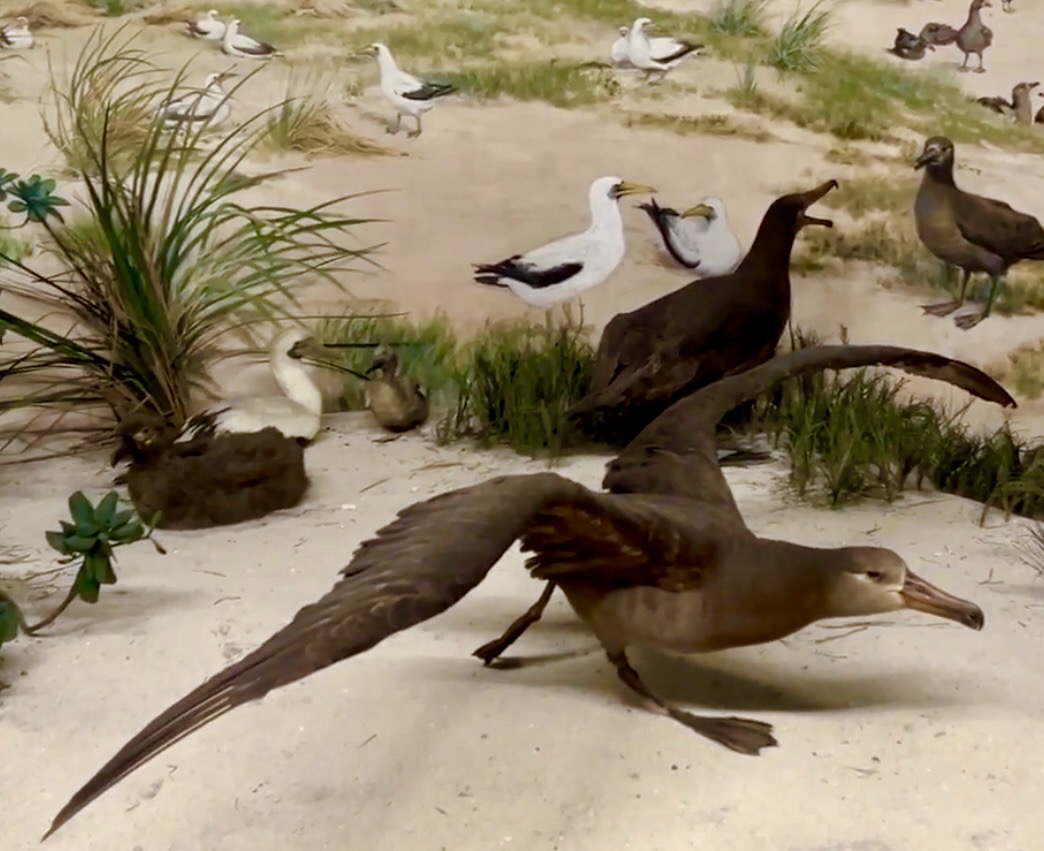
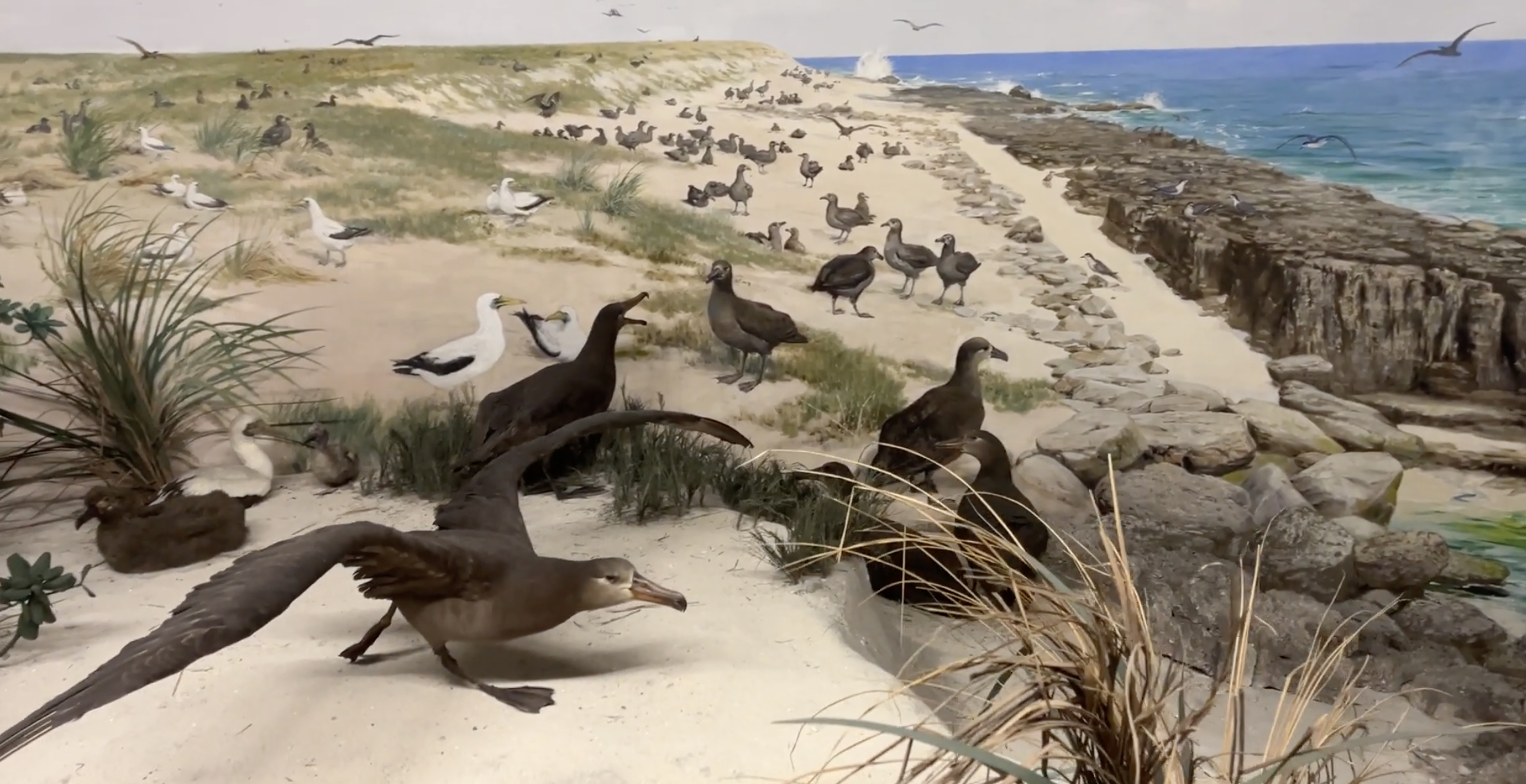
Hornaday was among the first museum professionals to adopt the habitat method of displaying zoological specimens, and his influence can be seen in the Laysan Island Cyclorama in the Hall of Natural Science. Many species of nesting birds are represented in the exhibit, for example In the foreground is a mounted Blackfooted Albatross (Phoebastria nigripes) with outstretched wings, posed for display. In the background are depictions of the endemic Laysan Albatross (Phoebastria immutabilis). The flora depicted in the cyclorama represents coastal strand and dune vegetation, including tall, tufted clumps of bunchgrass, or variable lovegrass (Eragrostis variabilis). The dark formations along the shoreline in the background painting are phosphatic beach rock and uplifted coral reef sandstone. Although intended foremost as a scientific recreation of a specific site in its primeval state, the cyclorama also functions as an illusionistic work of art, evoking the aesthetic beauty of a scene of undisturbed wild nature whose spectacular biodiversity overwhelms the senses.
In 1906, Nutting hired Homer Dill (1877 – 1964), a young taxidermist who had trained under Hornaday in New York, as an assistant zoologist to prepare the vertebrate specimens for exhibition. Nutting described his visionary concept:
“The plan is . . . to construct in our new museum a cyclorama of Laysan Island. . . . It was with the Laysan idea in view that room was reserved for this exhibit in the north end of ‘Bird Hall’ in the new museum, and marked ‘Laysan Room’ in the plans.” In 1911, following nearly a decade of fund raising, Nutting sent an expedition led by Dill to Laysan Island to collect specimens and foreground accessories. Dill returned with 398 birds representing 23 species, as well as plants and sand. Mounting the 106 bird skins in dynamic poses and crafting tens of thousands of wax leaves took almost three years to complete.
The background mural was painted by Charles Abel Corwin (1857 – 1938), a professional artist who took a leave of absence from the Field Museum, where he worked as a staff artist and diorama painter from 1903 until his death in 1938.
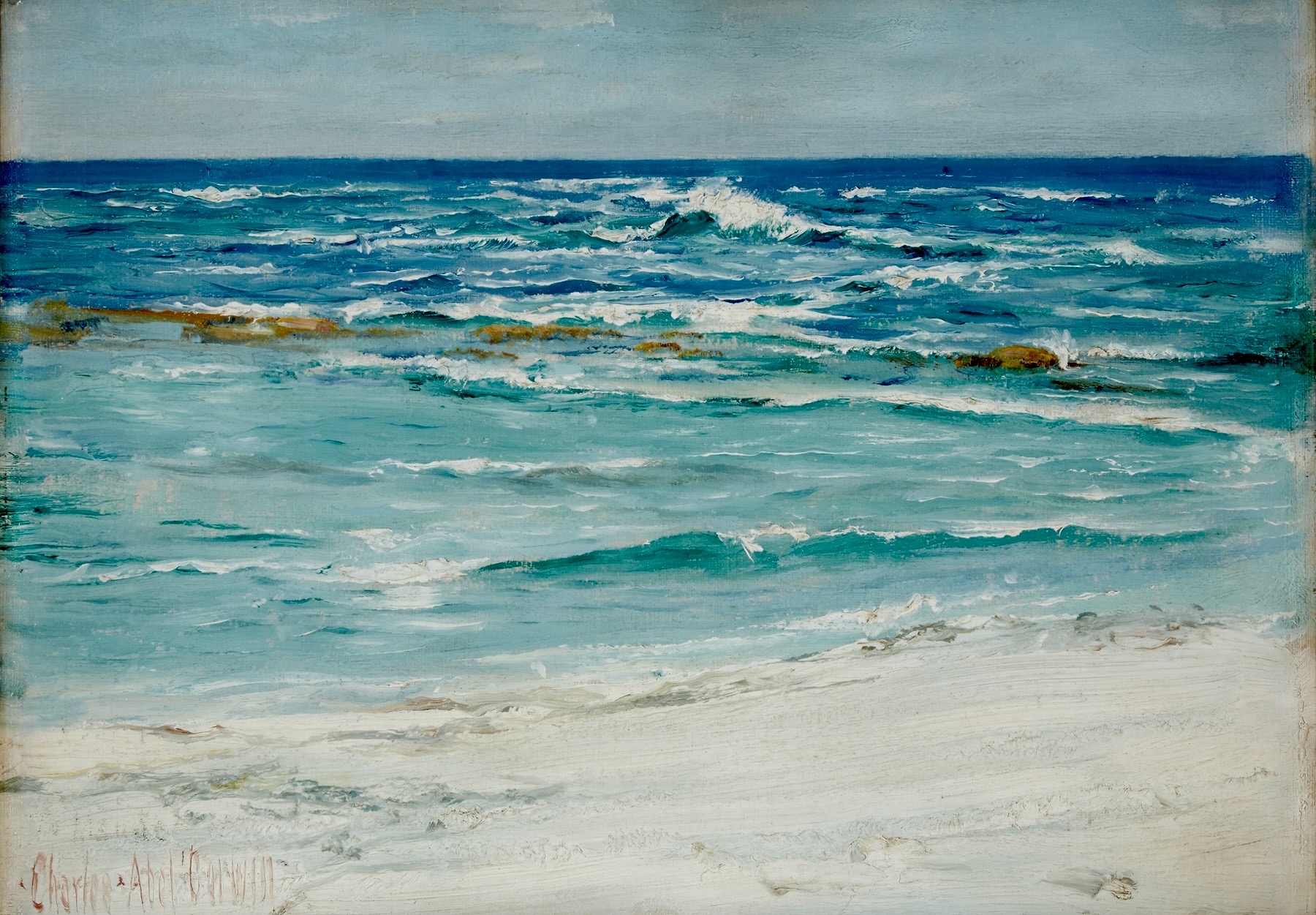
Corwin accompanied Dill’s 1911 expedition to Laysan Island and made numerous landscape studies on site in preparation for painting the background mural. One of his signed fine art paintings depicts the same intense turquoise colour of the ocean seen in the cyclorama. Trained partly in Germany, Corwin was a member of the Chicago Society of Artists and contributed to the painting of two murals for the Boston Cyclorama Company in the 1880s, one of them the famous 1884 Battle of Gettysburg. Nutting had seen this Cyclorama and, in 1909, described it as the inspiration for recreating the rich birdlife spectacle he had witnessed on Laysan Island in 1902: “Try as we may; this scene can not be described, and as day after day the wonder of it grew and deepened, the writer found constantly recurring and intensifying the great desire to have it reproduced as a masterpiece of art for the benefit of the State University and the people of Iowa.”
Nutting continued his description of how the idea for a Laysan Island cyclorama had taken form in his mind: “To any one who has seen a really good cyclorama, such as that of the ‘Battle of Gettysburg,’ where the observer gazes upon hundreds of thousands of men and miles of space, a veritable miracle of vast numbers in intense action. . . . the actual figures in the foreground so skillfully joined to the painted background as to deceive the very elect, the ‘Laysan Island’ scheme will make an immediate appeal.” His appreciation of the beauty of the landscape included its intense colours: “the snow white coral sand, the dark green vegetation, and the intense blue of the tropic sky. . . often mottled with purple clouds; while embracing all is the thundering surf of intense green, white crested waves near shore, and, further out, the wonderful deep blue of the Pacific.”
Though an accomplished scientist, Nutting was determined that the Cyclorama should first and foremost be a work of art. To this end, he employed Corwin, whom he regarded as the most accomplished mural painter and museum artist of his age.
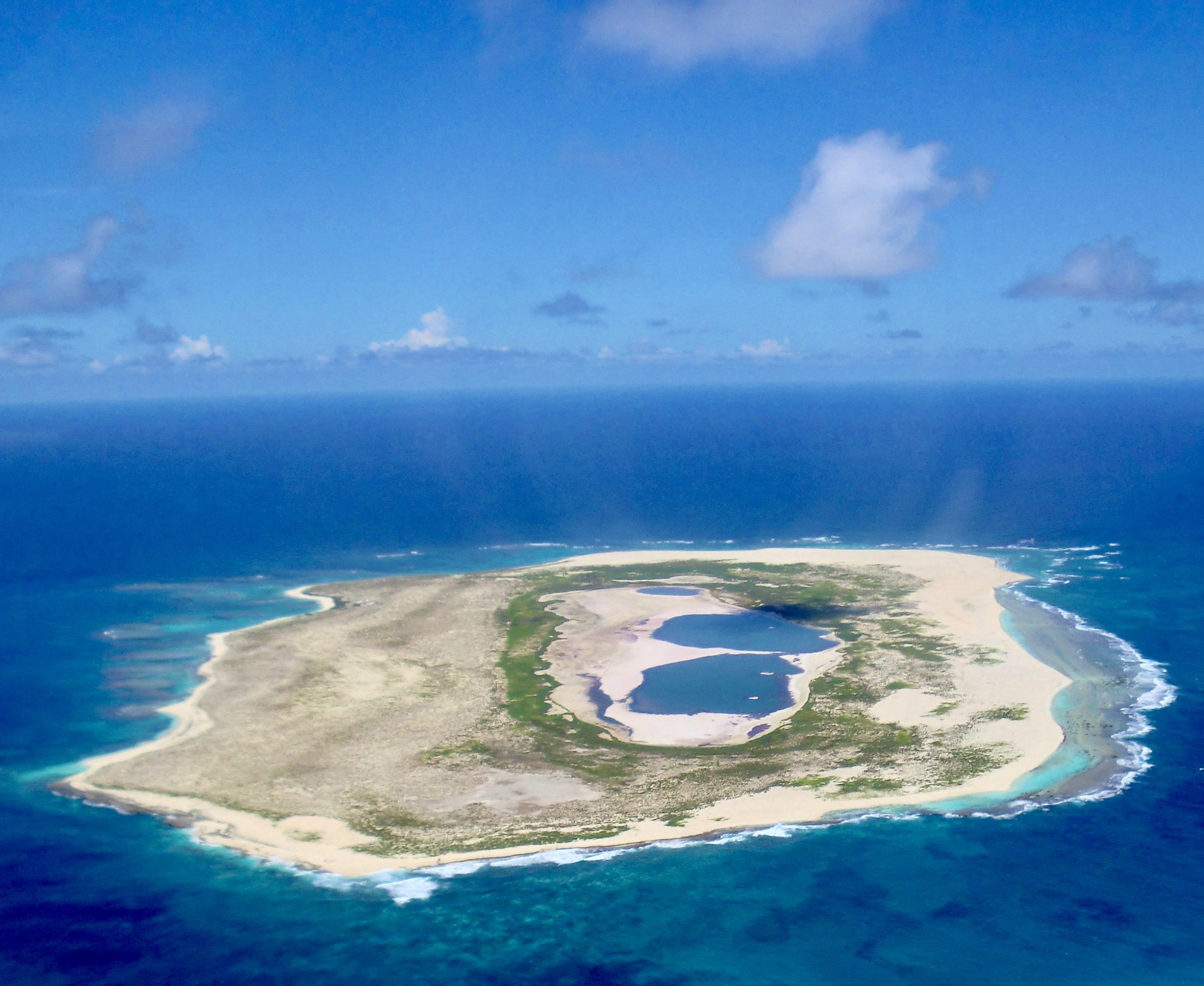
In 1911, when Homer Dill arrived on the isolated coral atoll, he was shocked to discover that, during the decade since Nutting had visited Laysan Island, its spectacular bird populations had been devastated by human actions. He wrote: “Our first impression of Laysan was that the poachers had stripped the place of bird life. . . Only the shearwaters moaning in their burrows, the little wingless rail skulking from one grass tussock to another, and the saucy finch remained. . . on every side are bones bleaching in the sun, showing where the poachers have piled the bodies of the birds as they stripped them of wings and feathers.”
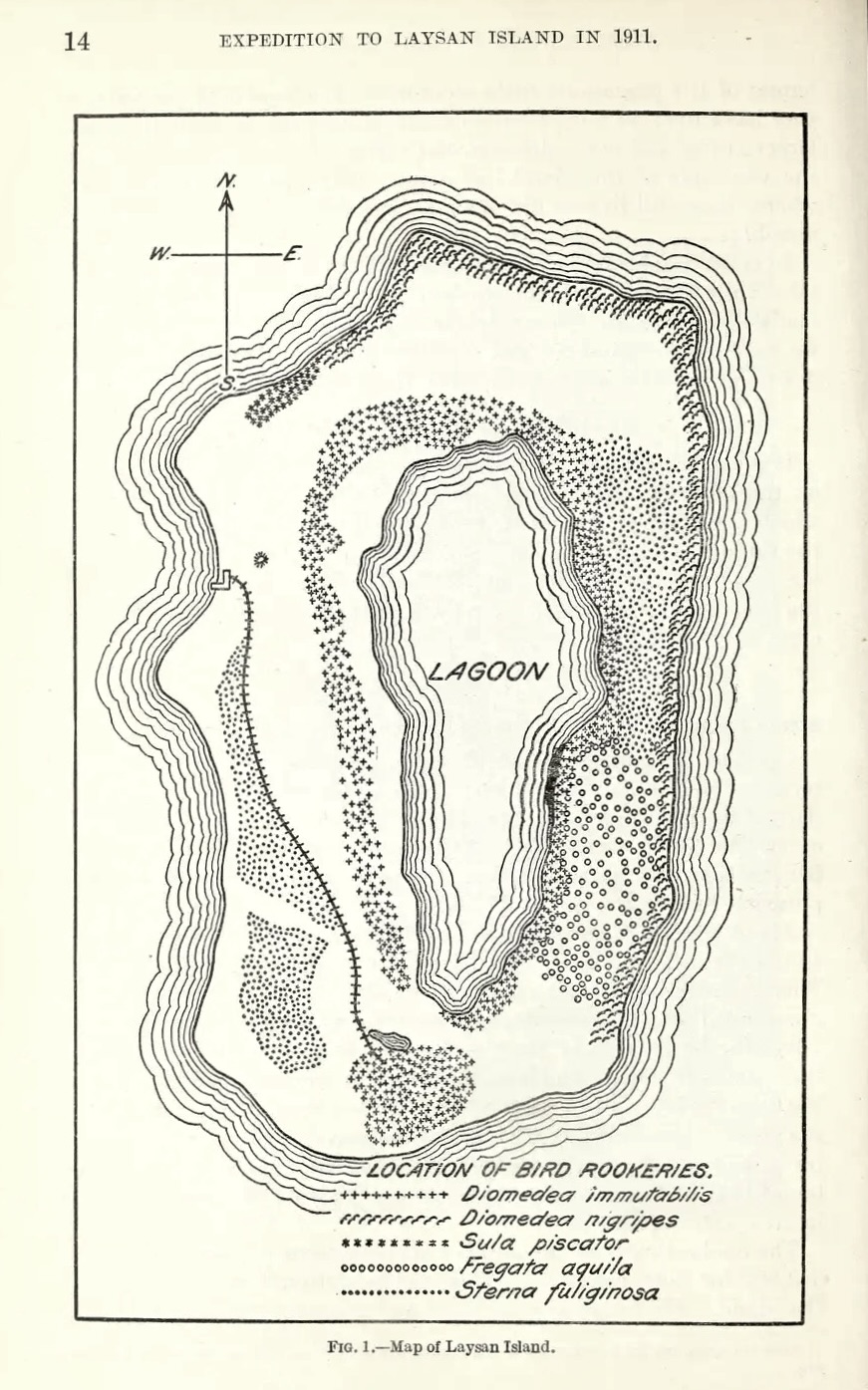
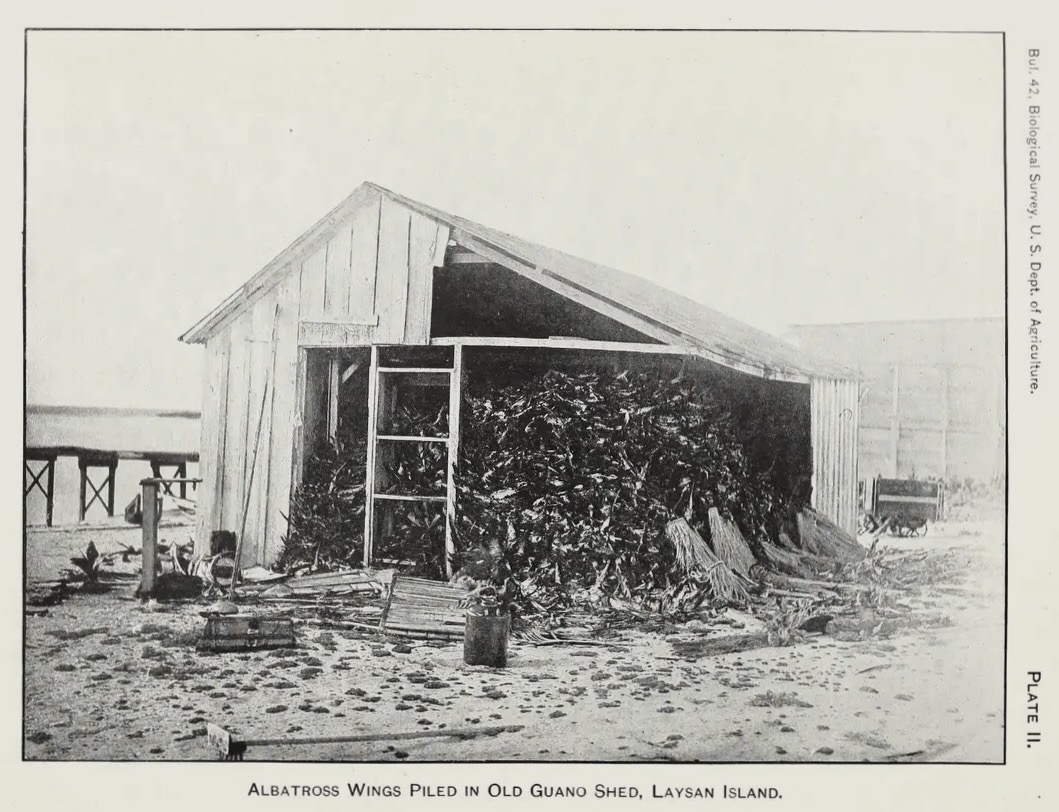
A map of Laysan Island, with diagrams of its bird rookeries located around the central lagoon, was included in the scientific report of the expedition by Homer Dill and William Bryan, published in 1912 for the U.S. Department of Agriculture. Bryan, a zoologist at the College of Hawaii, noted that, although the breeding grounds had once been densely packed with birds, now “not a single bird remains, while heaps of the slain lie as mute testimony of the awful slaughter of these beautiful, harmless, and without doubt beneficial inhabitants of the high seas.” Altogether, the poachers were thought to have killed more than 300,000 birds, a figure that did not include the orphaned chicks.
The map identified the rookeries of five species: Laysan Albatross (Diomedea immutabilis); Blackfooted Albatross (Diomedea nigripes); Redfooted Booby (Sula piscator); Great Frigatebird (Fregata aquila); and Sooty Tern (Sterna fuliginosa). It also diagramed the industrial tram track used first to transport guano, and later to transport the bird carcasses collected by plumage hunters supplying the European market. Dill noted in his report that the primary devastation of the bird populations occurred within the range of this track.
The second plate in Dill’s report is a photograph titled “Albatross Winds Piled in Old Guano Shed, Laysan Island.” Unusual for a scientific report, Dill recorded his outrage over the ecological devastation caused by the market hunters for the feather industry whom he called “pirates.”
“An old cistern back of one of the buildings tells a story of cruelty that surpasses anything else done by these heartless, sanguinary pirates, not excepting the practice of cutting the wings from living birds and leaving them to die of hemorrhage. In this dry cistern the living birds were kept by hundreds to slowly starve to death. In this way the fatty tissue lying next to the skin was used up, and the skin was left quite free from grease, so that it required little or no cleaning during preparation. Many other revolting sights, such as the remains of young birds that had been left to starve and birds with broken legs and deformed beaks, were to be seen. Killing clubs, nets, and other implements used by these marauders were lying all about. . . It was very evident they intended to carry on their slaughter as long as the birds lasted.”
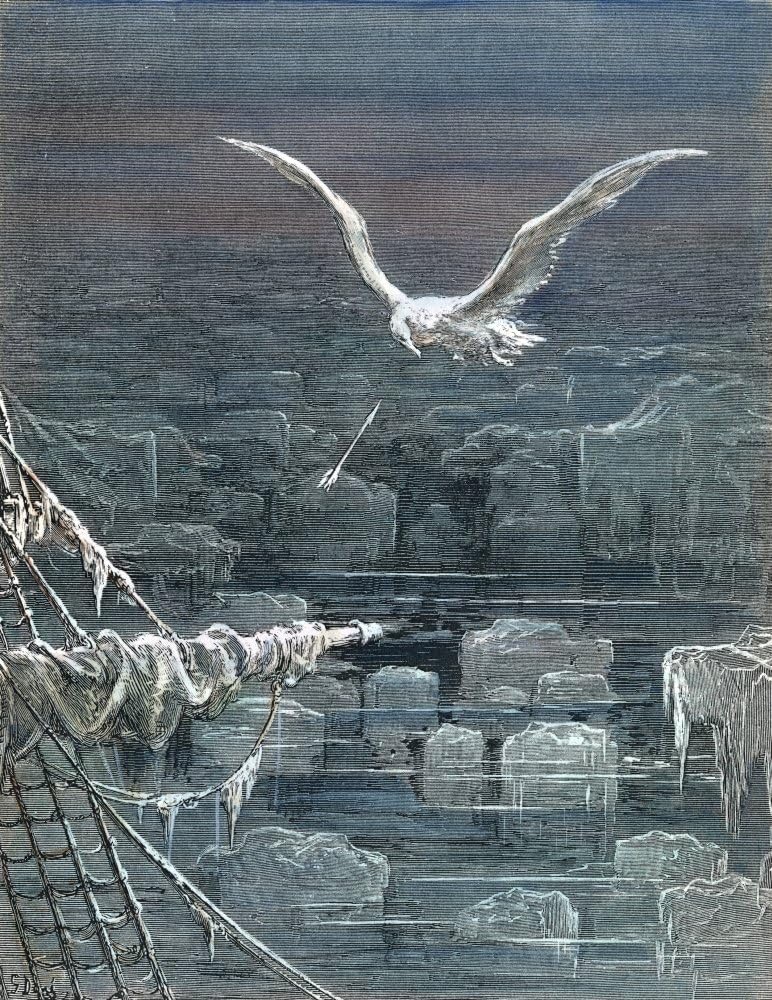
The mass commercial exploitation of wild birds in their breeding colonies intensified at the end of the 19th century, when feathers became a fashion craze in women’s hats. Among the targeted species was the Laysan albatross, a remarkable bird with wings that span more than six feet and can glide effortlessly over vast ocean expanses for many months without touching land. In some maritime traditions, the albatross was revered as a sacred guardian of the sea and a symbol of safe passage. It was also believed to embody the souls of lost sailors, and harming one was thought to bring a curse or misfortune. This mythology was famously articulated in Samuel Taylor Coleridge’s 1798 poem “The Rime of the Ancient Mariner.”
An engraving published in 1876 by the French artist Gustave Doré illustrates a scene from the poem in which a mariner shoots an Albatross above the icebergs of the polar sea. Coleridge describes the act: “With my crossbow / I shot the Albatross.” The senseless cruelty of the shooting brings a curse upon the ship and contributes to the deaths of the crew. Later, Coleridge writes of the need for penance: “He loved the bird that loved the man / Who shot him with his bow.” The poem offers a powerful allegory for the near extinction of the Laysan albatross through human greed and disregard for the unique qualities of this revered bird.
Like the poem, the Laysan albatross became a cautionary tale of species extinction. The economic exploitation of Laysan Island and the destruction of its avian inhabitants resulted in the collapse of the Laysan Albatross population which plummeted by 97 percent in just over 30 years, dropping from an estimated ten million in 1891 to about 30,000 by 1923.
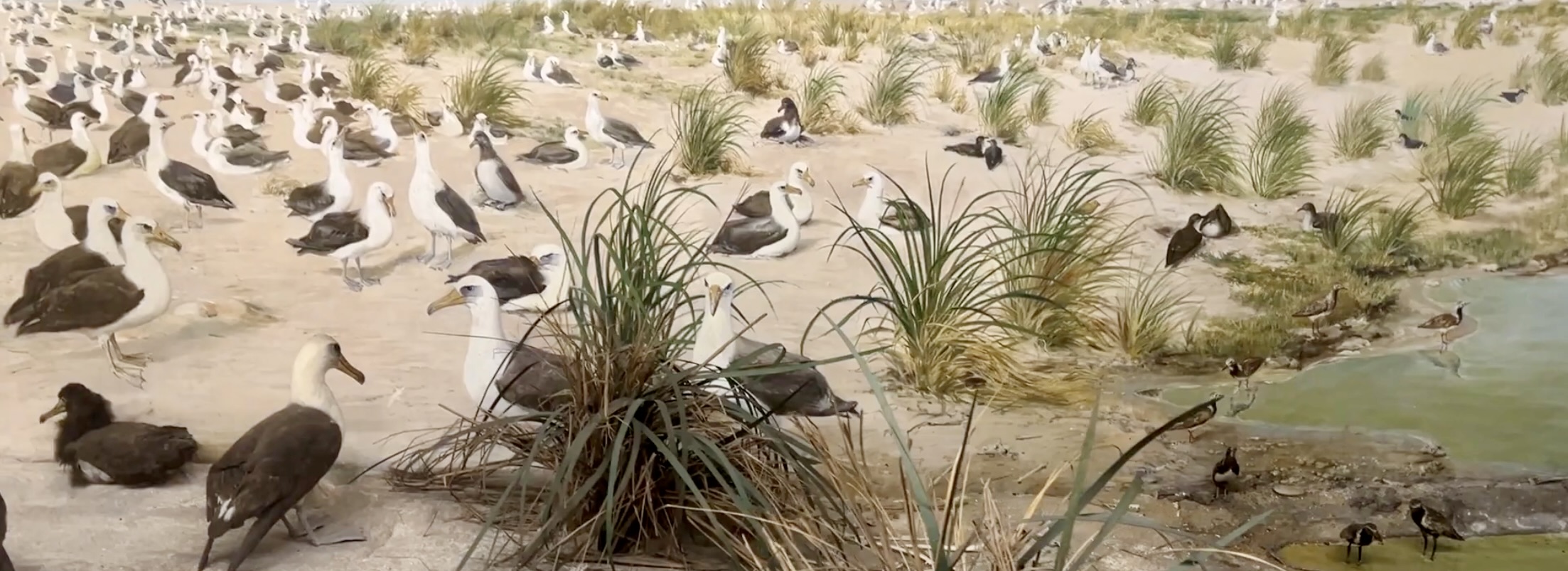
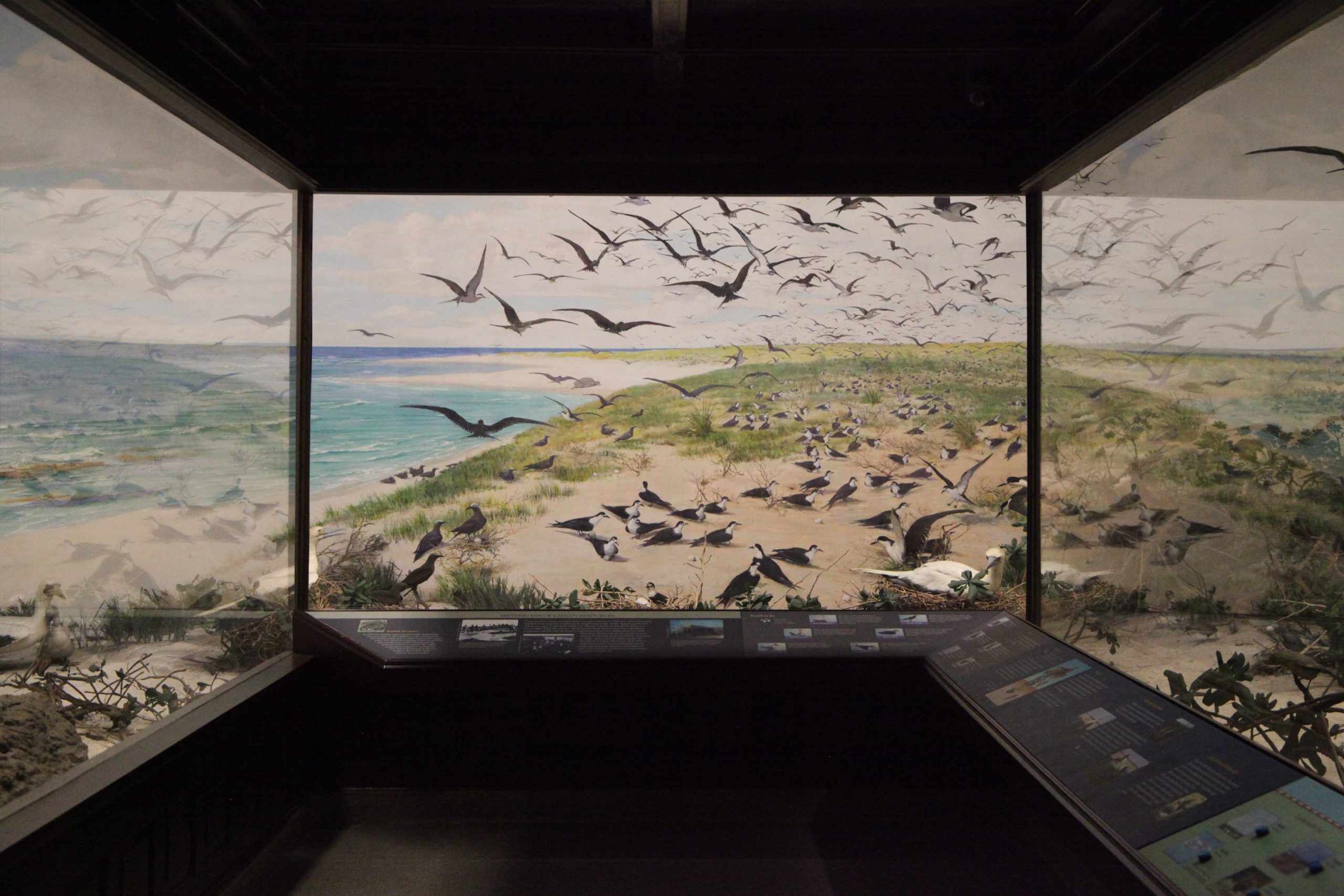
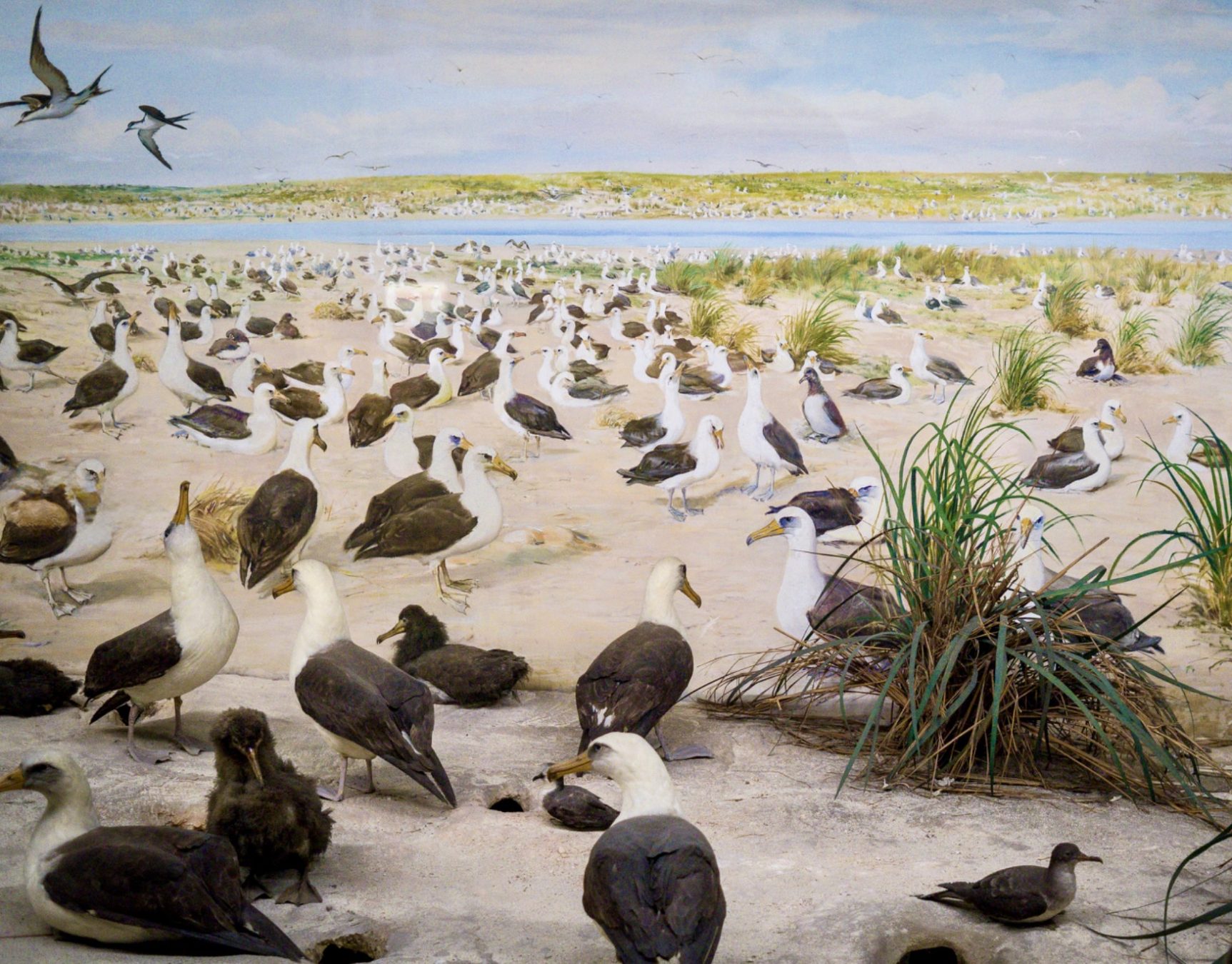
The avian inhabitants of Laysan Island have no natural predators and therefore show little fear of humans, making them easy to observe and capture. An intimate scene in the Laysan Island Cyclorama portrays hundreds of Laysan albatrosses nesting among the sand dunes. The transition between the foreground and the painted background has been so skillfully rendered by the artist Charles Corwin that it is difficult to distinguish between the mounted birds and those painted in the background. The larger panoramic view of Laysan Island, as seen from the darkened observation room, portrays many of the island’s endemic bird species, some mounted in taxidermic groups and others painted in animated poses, including hundreds of terns in flight. With the overhead source of illumination concealed from the viewer, Corwin adjusted his colours to capture the illusion of sunlight falling across the landscape.
A photograph of one section of the Laysan Island Cyclorama shows several species, including a pair of mounted Laysan Albatrosses, one standing in a preening posture with its wings partially unfurled. The Albatross can live for more than half a century and remains with a single mate for life. Also present is a mounted Redtailed Tropicbird (Phaethon rubricauda), a large white seabird with a red bill perched on a bush. A painted Laysan Honeycreeper (Himatione fraithii) is perched on the tall bunchgrass, while a painted Laysan Rail (Zapornia palmeri) stands on the sand just behind the head of the central Albatross. The Laysan rail is a small brown flightless bird with short wings and thin legs. Both species painted by Corwin became extinct after the Cyclorama was completed in 1914. It is remarkable that Corwin was able to paint both birds and landscapes with such competence, since these are usually regarded as separate specialities in fine art.
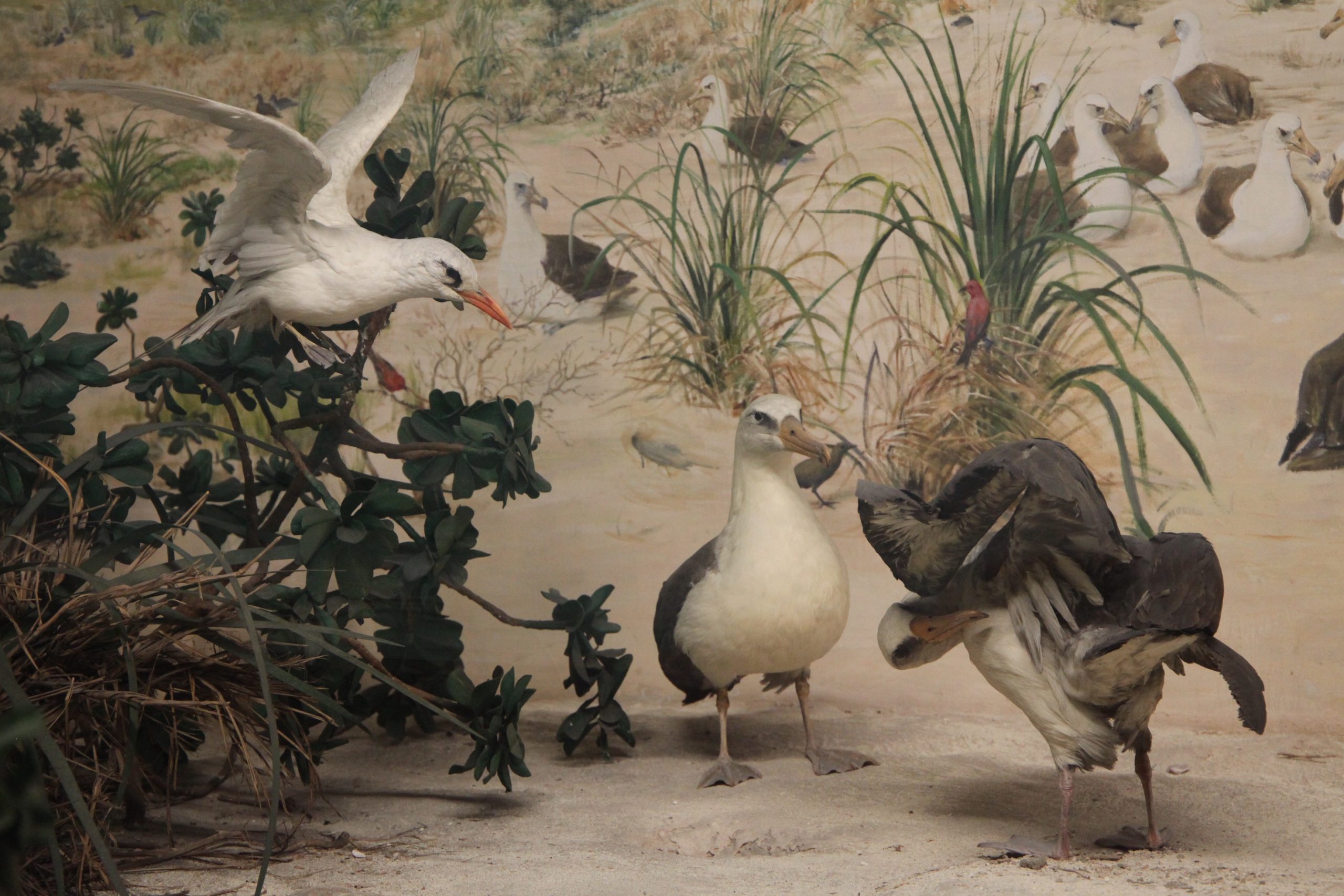
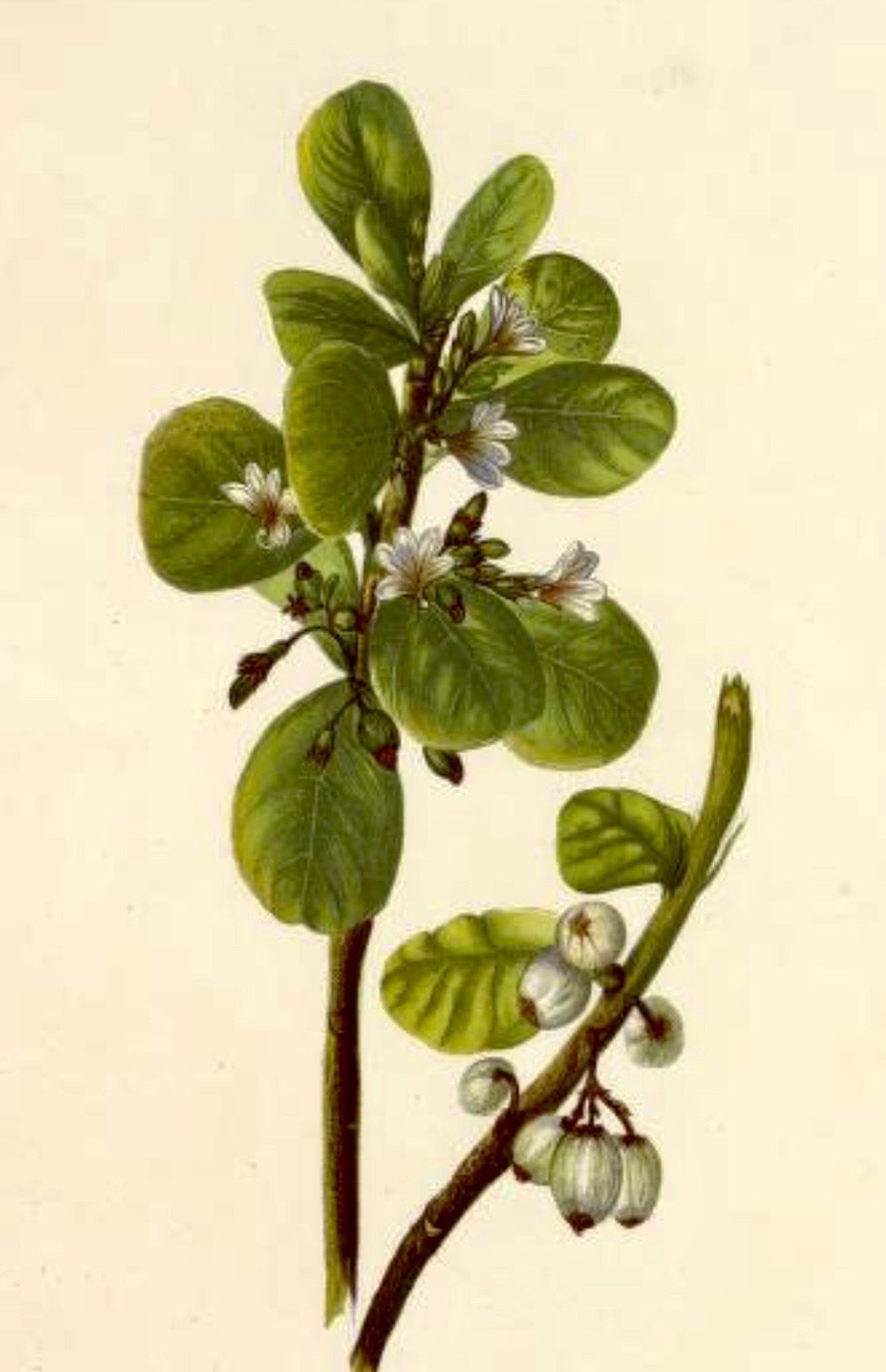
The Redtailed Tropicbird is perched on a bush known as Beach Naupaka (Scaevola taccada). It is among the many plant species collected by Homer Dill’s 1911 expedition to Laysan Island to be brought back to Iowa and replicated in wax for the foreground of the Cyclorama. To his great dismay, Dill discovered that not only had the island’s birdlife been decimated by market hunters, but its vegetation had also been stripped by a plague of rabbits, an invasive species introduced to the island by the notorious guano miner Max Schlemmer in 1903.
The Naupaka plant was first illustrated by the remarkable botanist Isabella McHutcheson Sinclair (1842 – 1900), author of the pathbreaking Indigenous Flowers of the Hawaiian Islands (1885). The book was illustrated by the eminent zoological artist and lepidopterist Frederick William Frohawk (1861 – 1946). Plate 32, titled “The Naupaka,” described the plant as “a low spreading shrub, with thick soft branches and fleshy leaves. It is always found close to the sea, often within reach of the waves.”
Sinclair was among the early naturalists to recognize the ecological threat that invasive species and other human induced changes posed to native Hawaiian flora. In the introduction to her book, she wrote: “The Hawaiian flora seems to grow in an easy, careless way, which, though pleasingly artistic, and well adapted to what may be termed the natural state of the islands, will not long survive the invasions of foreign plants and changed conditions.”
The first ornithological exploration of the Hawaiian archipelago was undertaken by the zoologist Scott Barchard Wilson (1864 – 1923), who published the landmark treatise Aves Hawaiienses: The Birds of the Sandwich Islands (1890–1899), featuring 64 lithographs by Frohawk. In his introduction, Wilson credited Sinclair with allowing Frohawk to use portions of the botanical plates in her book as backgrounds for his bird illustrations.
Frohawk and the renowned natural history artist J. G. Keulemans (1842 – 1912) contributed illustrations to the definitive scientific monograph by the wealthy baron and avid zoologist Lionel Walter Rothschild, The Avifauna of Laysan and the Neighbouring Islands, a lavish folio work published in three parts between 1893 and 1900. It was based on bird specimens sent to Rothschild in England by his field collector, Henry Palmer, whom he employed in 1890 to collect as many birds as possible with “special attention to inter island variation” across the Hawaiian archipelago.
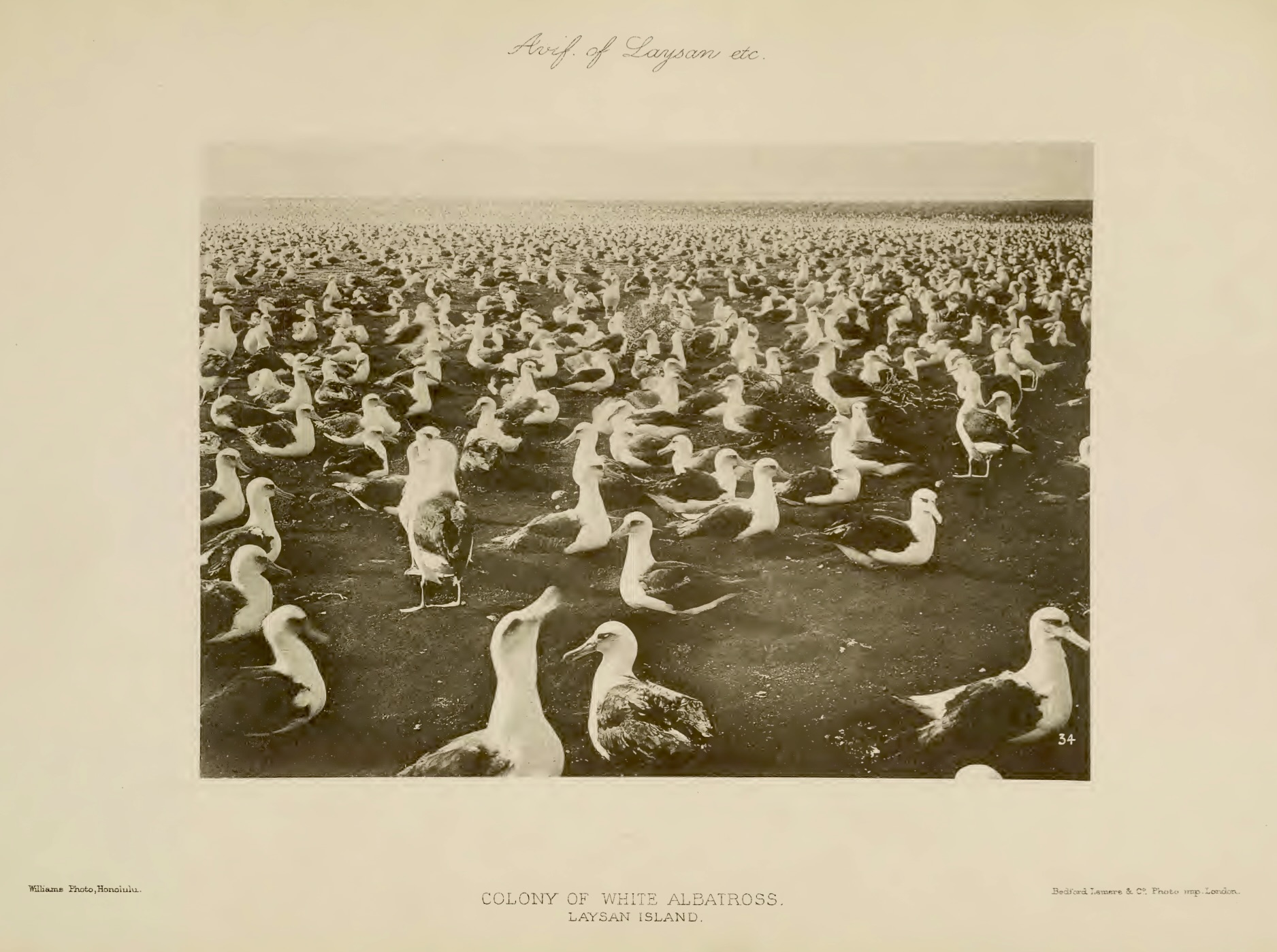
Separately, Rothschild commissioned the Honolulu based photographer James J. Williams (1853 – 1926) to document Laysan Island and its rich birdlife. His photographs were reproduced as 20 collotype plates in Rothschild’s book, including the “Colony of White Albatross,” an image showing a huge congregation of birds that was widely reproduced and helped bring attention to the extraordinary bird colony.
Neither Rothschild nor his two artists accompanied the expedition to Laysan Island; rather, their work of classifying the species and depicting them in art was based on the dried skins and preserved specimens in Rothschild’s museum. In contrast, Charles Corwin was able to study the living birds of Laysan Island to prepare for painting the Cyclorama. In a scene that resembles Williams’s collotype print, Corwin painted a nesting colony of Laysan albatrosses. His depictions of the birds capture not only their form but also aspects of their behaviour and habitat. Corwin was also able to use the taxidermic mounts created by Dill as visual references for his painting of the background. Whereas Palmer had collected some 2,000 skins and specimens, including those of 15 species previously unknown to science and several species that subsequently became extinct, these were not mounted for display. Instead, they were sent to Rothschild to add to his study collection of some 300,000 bird skins kept in museum cabinets.
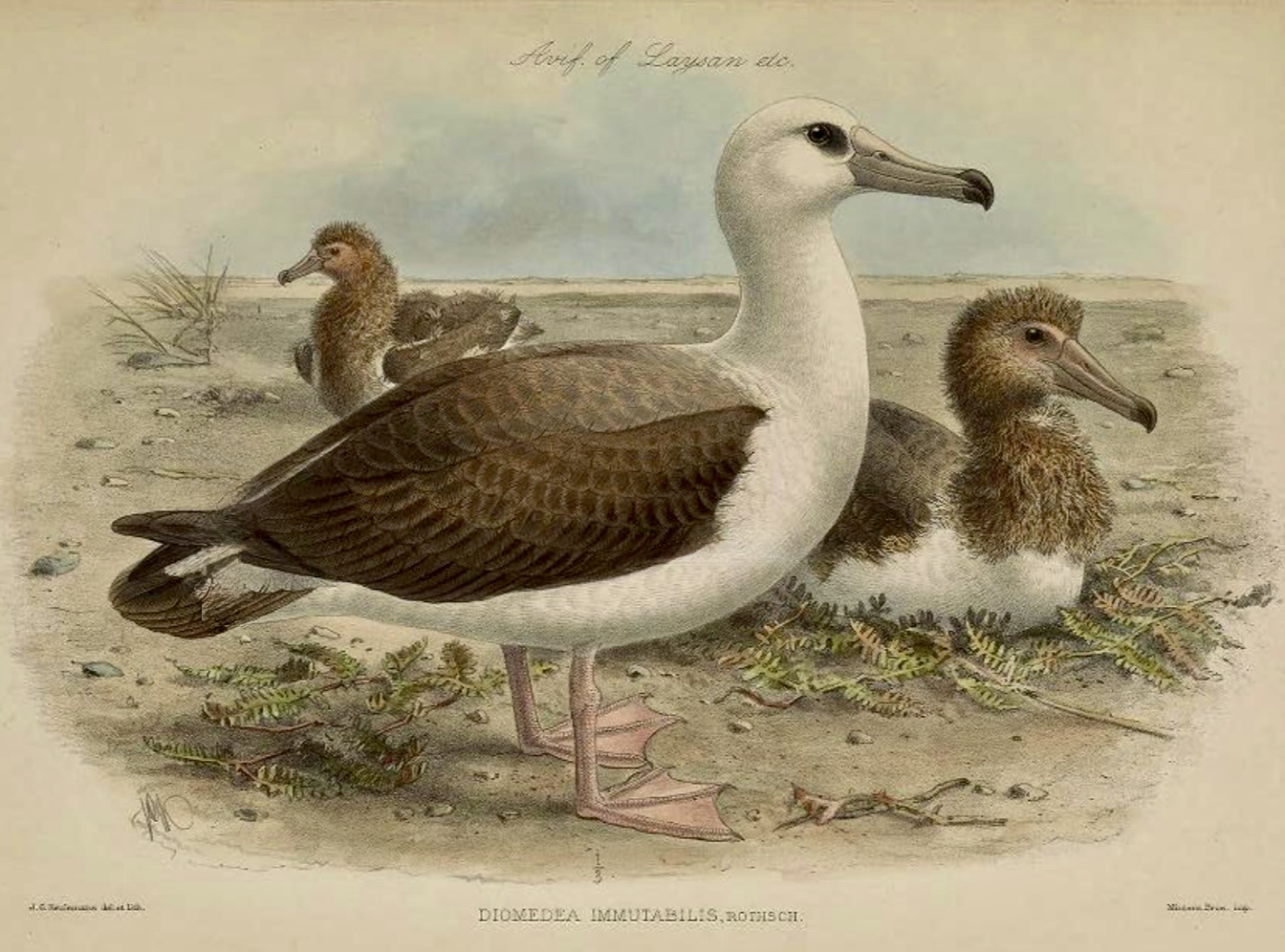
The Laysan Albatross was not formally described until 1893, when Rothschild named it Diomedea immutabilis Rothschild, denoting him as the species’ original author (it was later transferred to the genus Phoebastria). The skin described by Rothschild is the type specimen for the species, now housed at the American Museum of Natural History, which became the repository for the majority of Rothschild’s collection in 1932. Rothschild’s original name for the Laysan albatross is the title of Plate XXXIV, a lithograph by J. G. Keulemans depicting an adult bird and two juveniles, one resting on a nest incorrectly rendered as being composed of leaves. Rothschild emphasized the scientific value of the illustrations by noting, after the taxonomic names of each species, that it had been illustrated “from skins in my Museum.” The accuracy of the images was further reinforced by the scale ratios printed above their titles, indicating the relationship between the illustrated bird and its actual linear measurement from the tip of the beak to the tip of the tail.
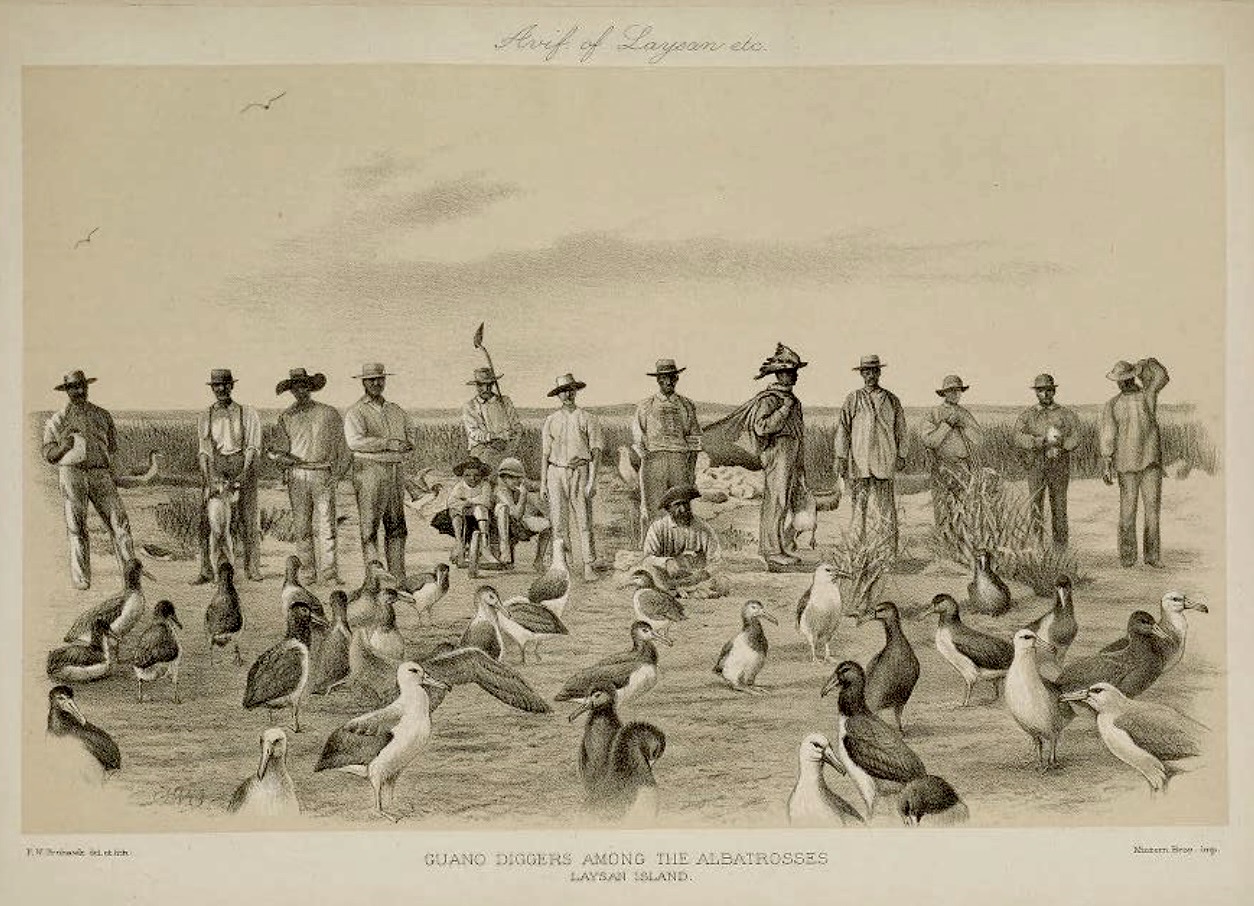
The Avifauna of Laysan was a seminal book, not least for its 55 beautiful bird portraits, the majority by Keulemans, but also for its illustrations documenting the guano mining industry, most of them collotype prints by Williams. In 1890, the same year that Palmer, Rothschild’s collector, arrived on Laysan Island, the Hawaiian Kingdom leased its rich guano deposits to George D. Freeth for commercial extraction. Japanese labourers working for his company removed approximately half a million tons of guano in the years that followed, producing a highly lucrative fertilizer. Plate XXXIII in Rothschild’s book, titled “Guano Diggers Among the Albatrosses on Laysan,” was noted as “delineated by Frohawk from a blurred negative taken by Palmer’s party.” The original photographic image was apparently not of sufficient quality for reproduction, so Frohawk interpreted and engraved it for Rothschild, despite normally working solely as a bird artist rather than depicting human subjects.
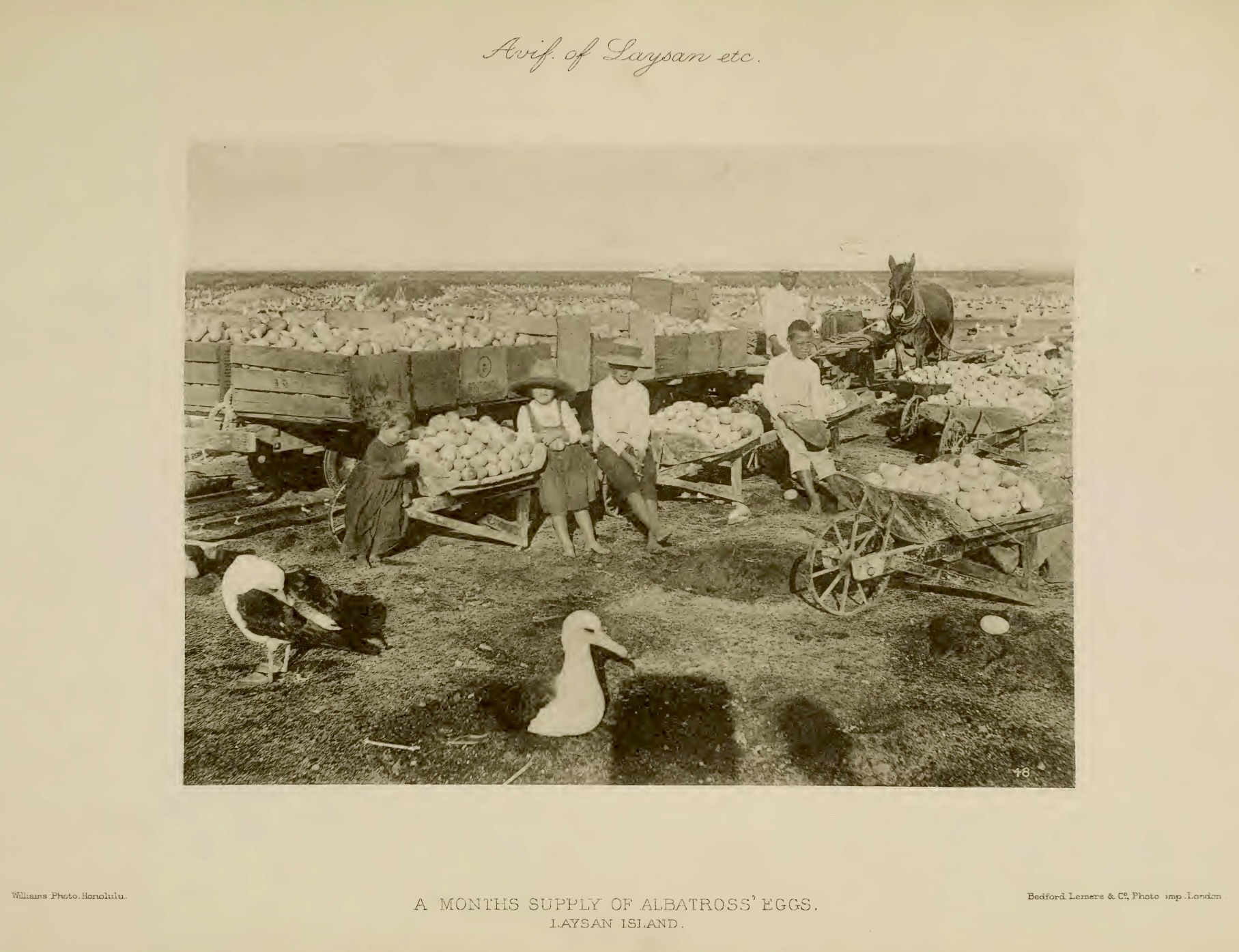
Rothschild credited Freeth for assisting in the collecting of specimens and even included his name in his classification of the Laysan honeycreeper. In his preface, Rothschild wrote that “Mr. Freeth protected most vigorously the birds on his island,” but added that following his departure, the birds were exploited. As evidence, Rothschild pointed to a photograph by Williams showing guano labourers using carts on a tram track to collect thousands of albatross eggs, titled ‘A Month’s Supply of Albatross Eggs.’ Because the albatross lays only one egg per year, such intensive harvesting would have had a severe impact on the species, compounding the habitat destruction caused by guano mining.
Rothschild paid a considerable sum for Williams’s high quality field photographs, which were used for the 20 collotype reproductions in his book. According to Rothschild, these images demonstrated “the immense numbers of this bird, and its utter fearlessness and tameness” more effectively than any written description could.
The scientific collecting of eggs on Laysan Island was conducted by Henry Palmer for Rothschild. Plate LXXXI in the Avifauna of Laysan depicts the nests and eggs of two endemic birds; the Laysan Finch (Telespiza flavissima, Rothsch.) and Laysan Rail (Porzanula palmeri, Frohawk). The coloured lithograph was drawn by Frohawk from nest and egg specimens collected by Palmer. The Laysan finch was a large, heavy billed honeycreeper first described In 1890 by British ornithologist Scott Barchard Wilson as Telespiza cantans. Two years later, in 1892, Rothschild mistakenly described it as a new, separate species. Rothschild later realized his error but not in time to change the description in his book.
The Laysan rail (or crake) was a tiny flightless bird with pale brown mottled feathers, an ash grey face and breast, and thin greenish legs. Frohawk published the formal description of the species in the Annals and Magazine of Natural History in 1892, giving it the epithet palmeri to honour Henry Palmer as the collector and establishing himself as the official taxonomic authority. However he incorrectly assigned it to its own genus and later the species was classifed as Zapornia palmeri.
Within a few decades of the discovery of the Laysan Rail, it disappeared, made extinct by the habitat destruction caused by rabbits and other invasive species introduced to Laysan Island by Max Schlemmer, a German immigrant who took over the guano industry when Freeths left in 1893, becoming known as the notorious “King of Laysan Island.” Under his watch, not only was there a massive export of guano and albatross eggs, but he encouraged Japanese poachers to slaughter hundreds of thousands of albatrosses to supply feathers for the European millenary trade.
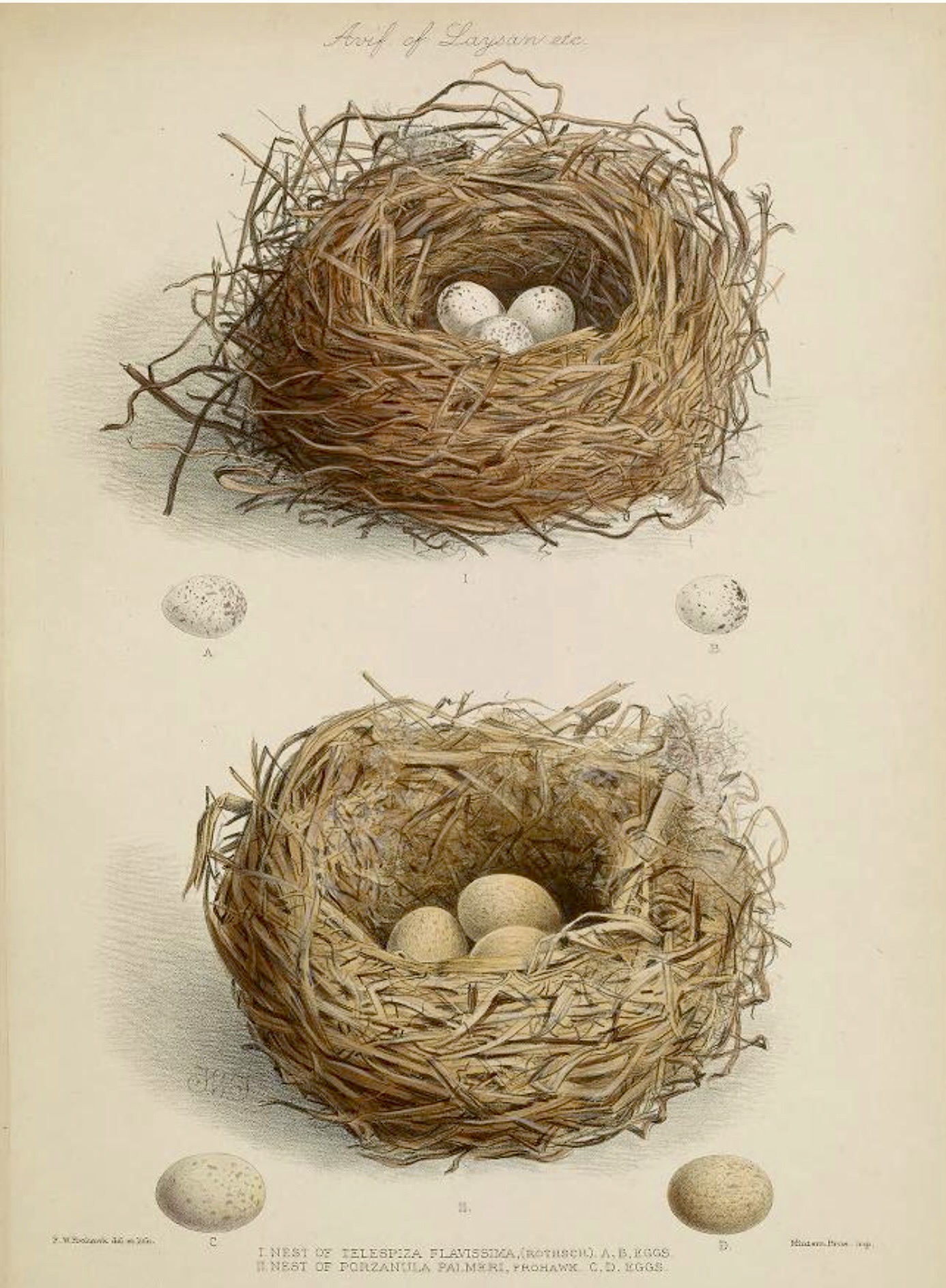
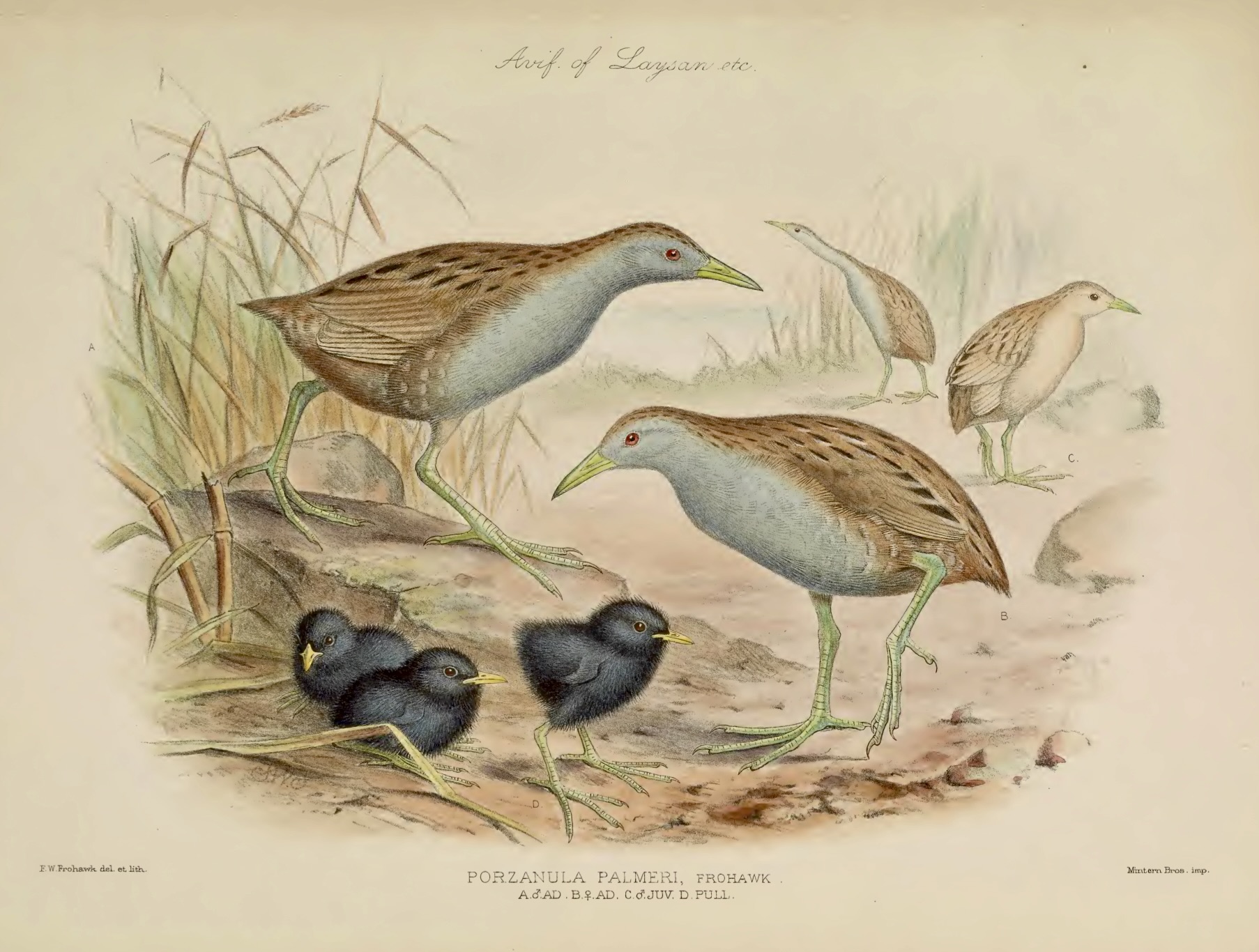
Plate XII in the Avifauna of Laysan was titled Porzanula palmeri, Frohawk and described by Rothschild as a “Coloured plate by Frohawk from skins in my Museum.” It depicts a family of the Laysan rail, two adults tending their three chicks and two juveniles in the distance. At the time that Frohawk illustrated this bird, he would not have known that it was close to extinction.
Rothschild’s interest in the disappearance of the Hawaiian bird species was based on their geographical distribution and inter island variation. He was inspired by the influential Cambridge professor Alfred Newton (1829 – 1907) who taught evolutionary zoogeography and was an expert on island ecosystems and how human activity and isolation drive species to annihilation. These ideas are reflected in the last two plates in Rothschild’s book depict internal avian anatomy and osteological structures such as bills, sternum and tongues to demonstrate evolutionary phylogeny and adaptation.
Another rare endemic species named by Rothschild was the Laysan Duck (Anas laysanensis Rothschild). Plate XIII by Keulemans depicts a mated pair drawn from skins in Rothschild’s museum. As he had never visited Laysan Island or seen a living Laysan duck, Keulemans invented a rocky aquatic habitat for the birds, even though Palmer’s notes stated that they frequented scrub vegetation and that “They were never observed in the water, though often on the beach.”
In 1907, Rothschild published a book on birds that had become extinct within historical times, illustrated with 45 plates by Keulemans. Its subtitle was: “To which are added a few which still exist, but are on the verge of extinction.” Rothschild lamented the “melancholy fact” that humans were the primary “agent of destruction of the native avifaunas wherever they go.” He did not include the Laysan Duck, which today is close to extinction and commonly described as the rarest duck in the world.
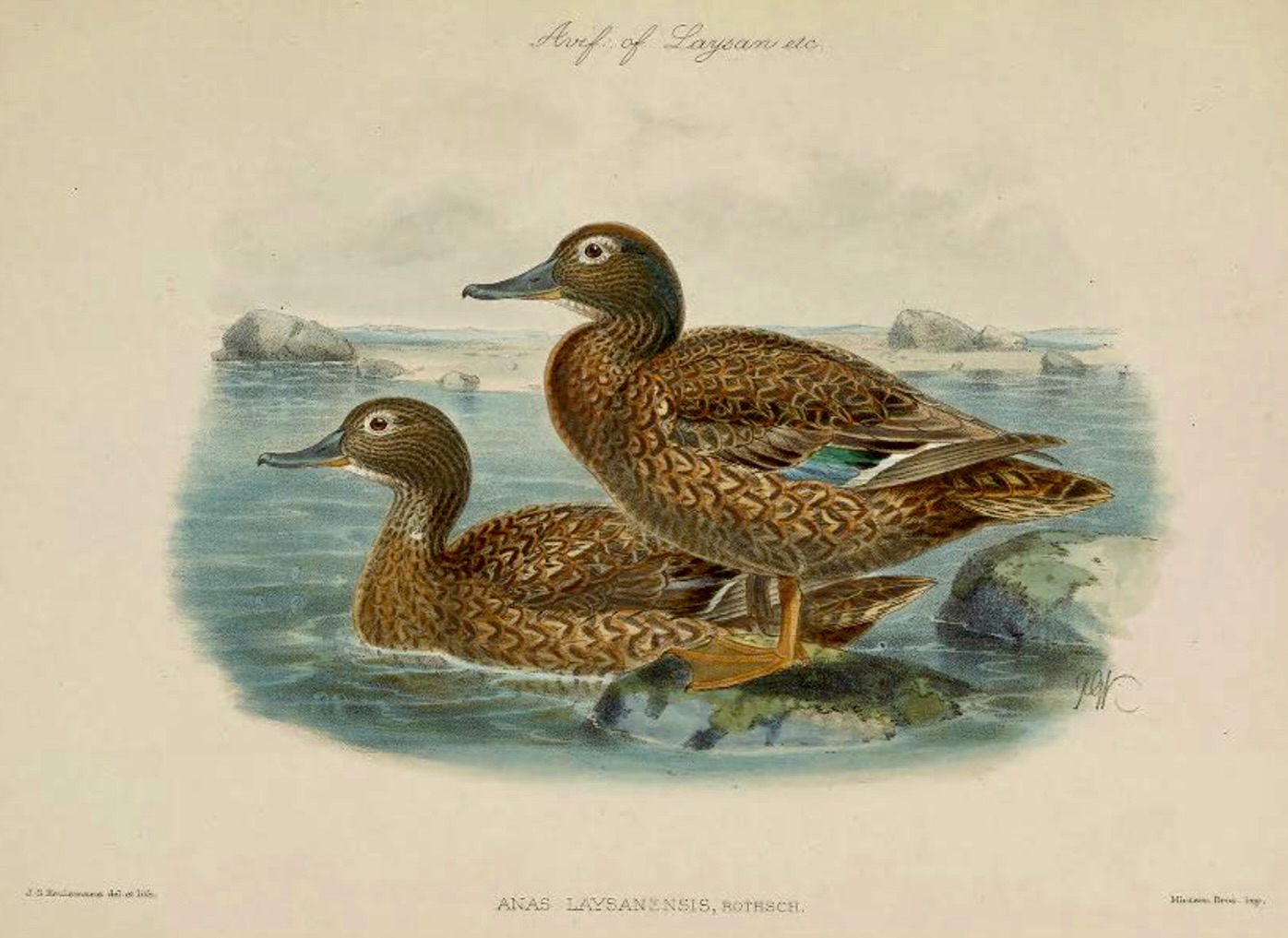
The Laysan duck is included in the Laysan Island Cyclorama at the University of Iowa, along with the endangered Laysan finch and several extinct species, including the Laysan rail, Laysan honeycreeper, and Laysan millerbird. When the zoologist Charles Nutting took part in a research expedition to Laysan Island in 1902, he could not have anticipated the devastating ecological impact that the subsequent invasion of feral rabbits would have on the island. His inspiration for the Cyclorama was to recreate the untrammelled bird paradise he had experienced there. Another remarkable species represented in the Cyclorama is the Frigatebird, a large seabird renowned for its aerial abilities and habit of stealing food from other birds. The mounted specimen is a male, with its inflatable red throat pouch expanded like a balloon to attract females. In Rothschild’s Avifauna of Laysan, Williams contributed four collotype prints of the Frigatebird, none of them in colour.
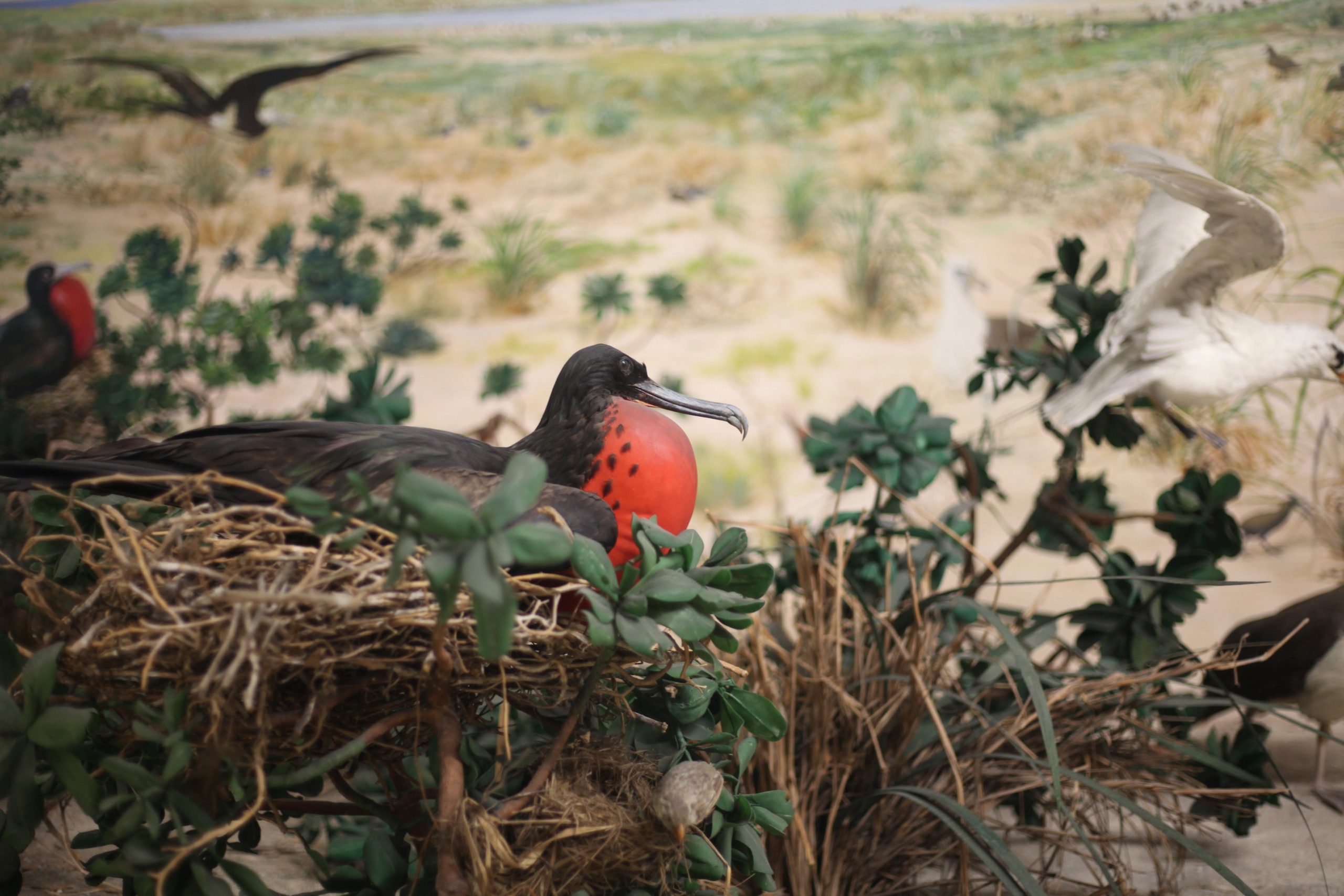
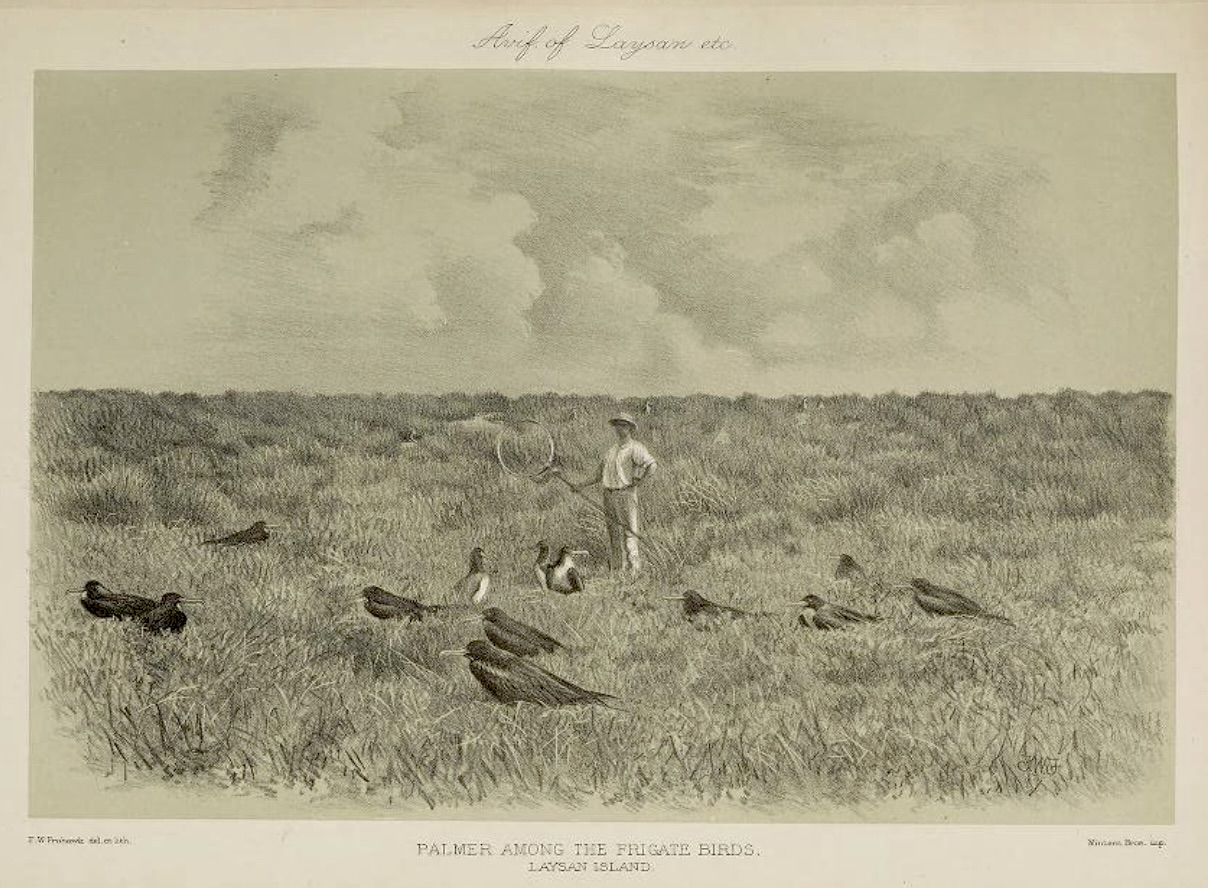
Plate XVIII, an engraving titled “Palmer Among the Frigate Birds” was noted by Rothschild to be “Delineated by Frohawk from broken negative.” Palmer is seen with his collecting net surrounded by the unsuspecting Frigatebirds; like all avifauna on Laysan Island, because they had no natural predators, they did not fear humans, making it easy to capture them by hand. Within a decade of the 1893 publication of Rothschild’s Avifauna of Laysan, the birdlife was being massacred to supply feathers to the global millinery industry. Rotshchild did not foresee the impact of fashion on the survival of these birds. He wrote in Extinct Birds (1907): “Man has destroyed, and is continually destroying species directly, either for food or for sport, but also. . . by destroying the natural habitat of various species. By cutting down or burning the forests, prairies, or scrub, and by bringing the land under cultivation, man indirectly kills off a species through starvation, from extermination of certain insects or plants on which it depends for food.”
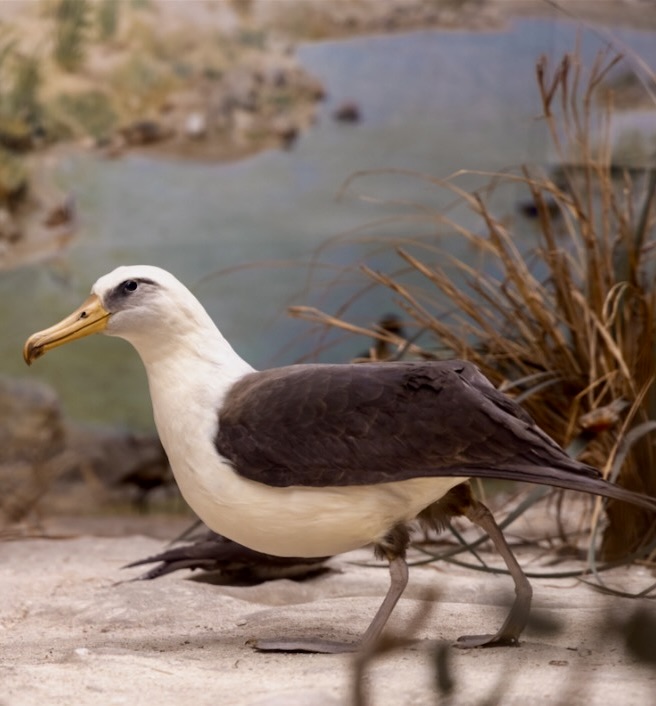
A single Laysan albatross mounted among hundreds of other specimens in the Laysan Island Cyclorama is today a valuable historical artefact. While it may originally have served a scientific purpose, playing an ecological role in an evolutionary drama, it now serves as testimony to the survival of this remarkable species, captured during a period when the island had suffered severe ecological degradation.
The Laysan Cyclorama was among the early illusionistic displays of mounted zoological specimens to convey an environmental message about the importance of preserving biodiversity by arousing in viewers an appreciation of the aesthetic beauty of nature.
The same can be said of the folio sized ornithological works by Scott and Rothschild, which included beautiful illustrations by some of the most accomplished bird artists of the age. Williams’s collotype photographs likewise helped draw public attention to the extraordinary richness of Laysan Island’s bird rookeries. His image of the Laysan albatross colony, for example, was republished by Nutting in 1903 in a paper calling for the protection of the island. It appeared again in Hornaday’s influential 1913 book Our Vanishing Wildlife, alongside photographs taken by Dill in 1911 that documented the habitat destruction of Laysan Island caused by feral rabbits.
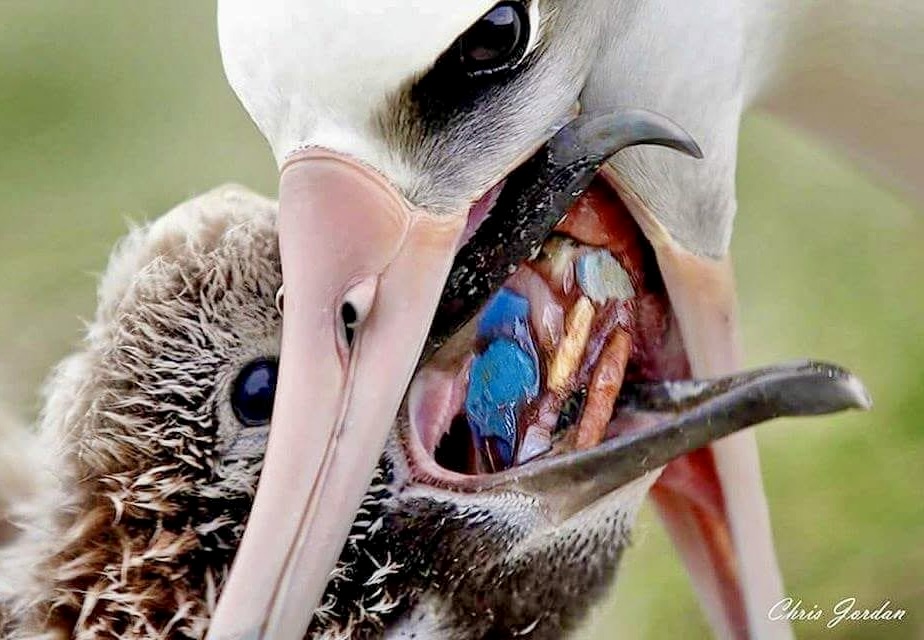
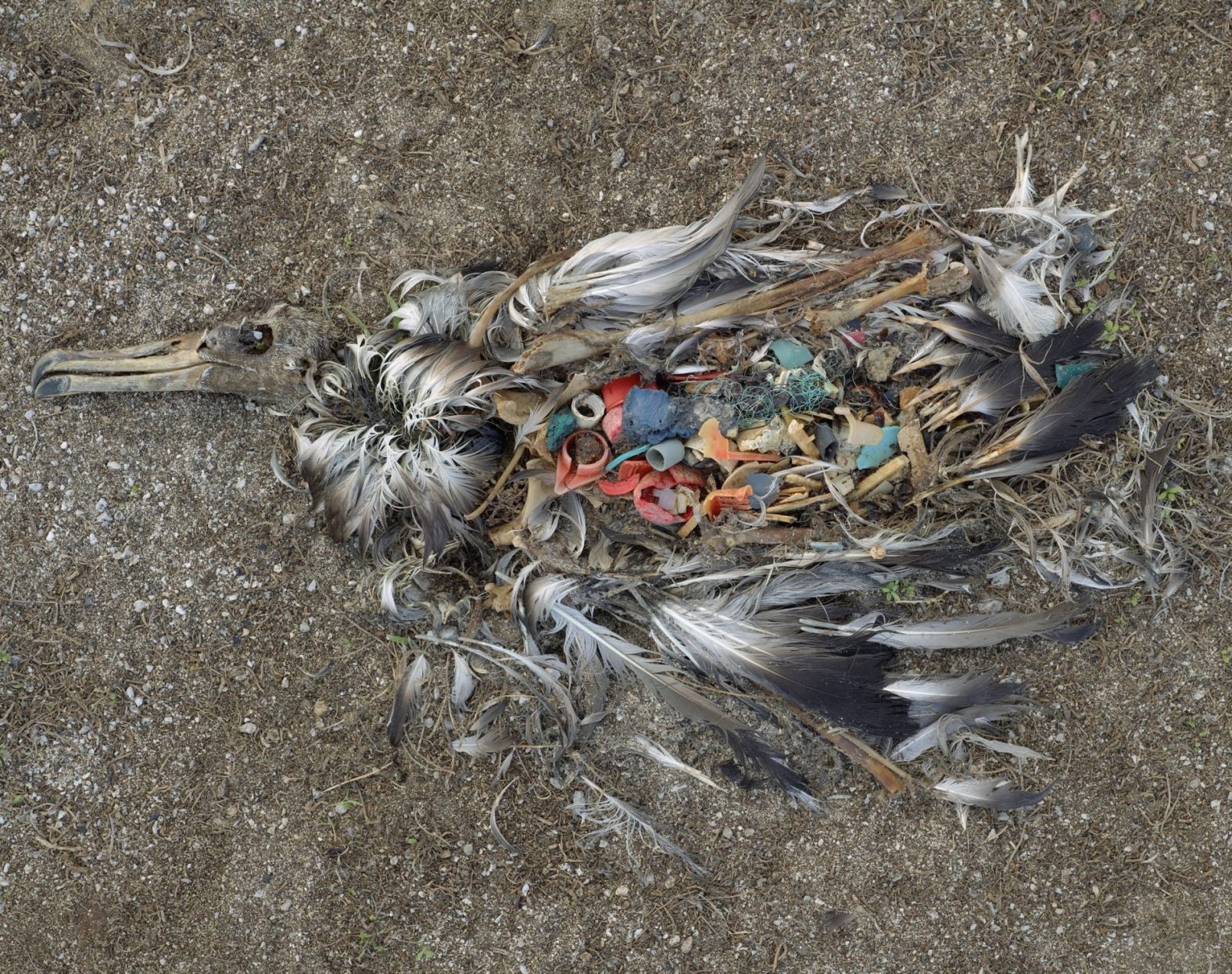
When the Laysan Island Cyclorama was created in 1914, it offered an immersive visual experience that anticipated aspects of cinema, transporting viewers to the distant atoll, where multiple bird colonies once flourished amid extraordinary biological diversity. Reports that the island had been transformed into a wasteland by feral rabbits, resulting in the extinction of several bird and plant species, spurred the U.S. government to implement an eradication programme in 1927. Although Laysan Island had lost much of its former biodiversity, it is now recovering. New human caused threats, however, are endangering the survival of the Laysan albatross, among them commercial fisheries bycatch and plastic marine debris. Photographer Chris Jordan has documented the tragic result of the latter with an image that shows a parent albatross feeding lethal plastic waste to her chick, mistakenly foraged from the polluted waters of the vast Pacific Ocean.
Many of the documentary photographs taken by Jordan depict albatross carcasses on the beach, the brightly coloured plastic waste they have ingested standing out starkly against the grey, decaying flesh and bones of their unwitting victims. Jordan warns: “This is our culture, turned inside out,” exposed by what he calls the “detritus of our mass consumption” in the stomachs of thousands of dead birds. “Choked to death on our waste,” he says, “the mythical Albatross calls upon us to recognize that our greatest challenge lies not out there, but in here.”
A collotype print by Williams titled “Albatrosses Love Making” was published in Rothschild’s 1893 Avifauna of Laysan. Although he had never personally witnessed this behaviour, Rothschild relied on Palmer’s field notes to describe the “antics” of the Laysan albatross, evidently so moved by them that they became part of his scientific account of the species. Similar scenes are depicted in the Laysan Island Cyclorama (1914) and in Jordan’s 2017 film documentary, Albatross. These three forms of representation, separated by more than a century, share a common sense of awe and reverence for the Laysan albatross.