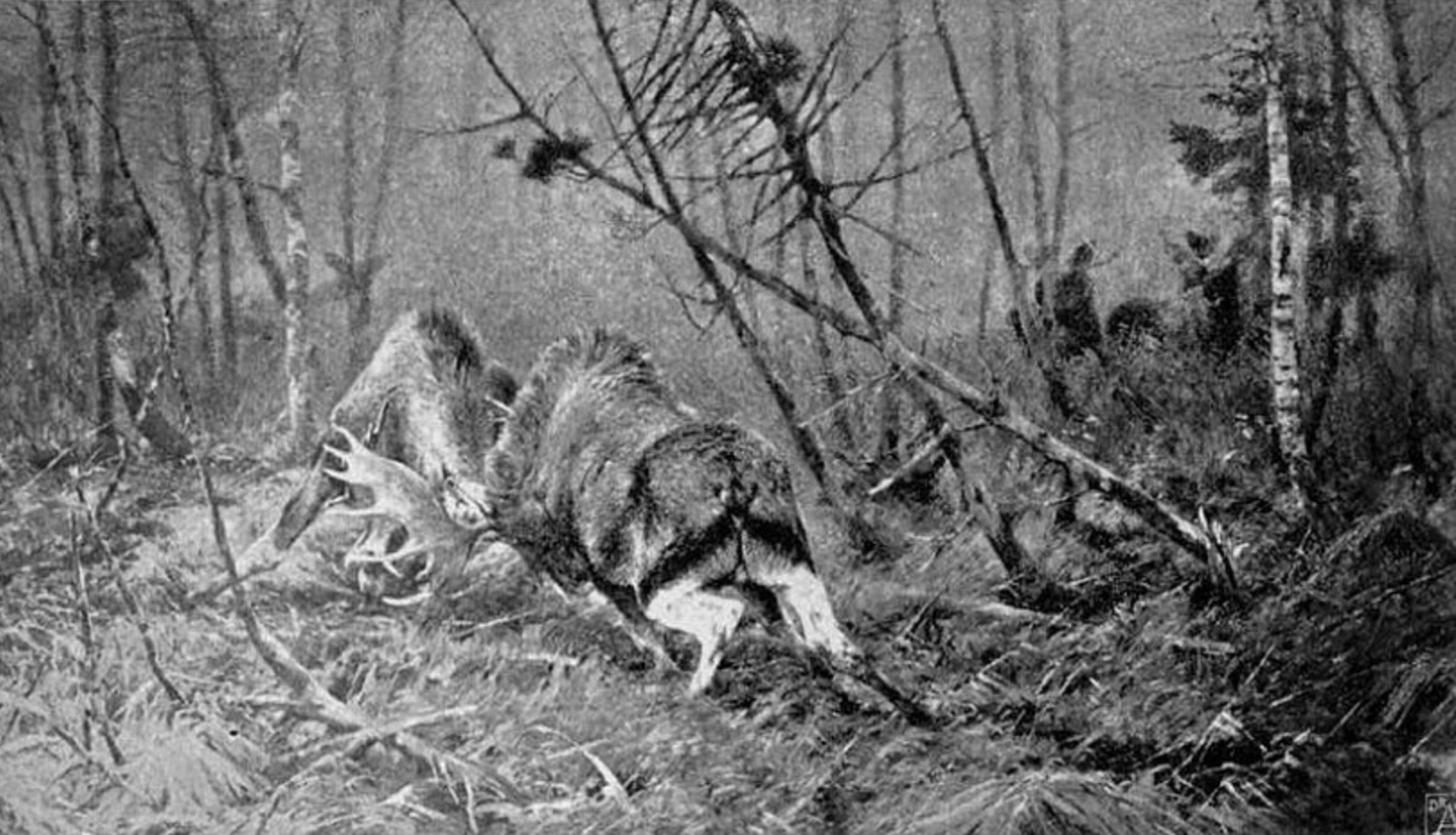
The Alaska Moose Diorama recreates a primordial scene of two bulls battling one another during the rutting season in the boreal bog of the Kenai Peninsula. Completed in 1940, the diorama background was painted by Carl Rungius (1869 – 1959). The foreground artist was G. Frederick Mason, and the taxidermist was Robert Rockwell. Rungius was a German artist trained at the Academy of Arts in Berlin where animal painting was taught by Richard Friese (1854 – 1918). An 1897 work by Friese entitled “Of Life and Death” depicts a forest scene dominated by two muscular rutting stags (Edelhirsch) with huge antlers engaged in a survival of the fittest competition. Like Friese, Rungius was a hunter of big game whose work embodied the iconology of majestic trophy antlers, an ancient European tradition that symbolizes nobility, power, primeval nature and masculinity.