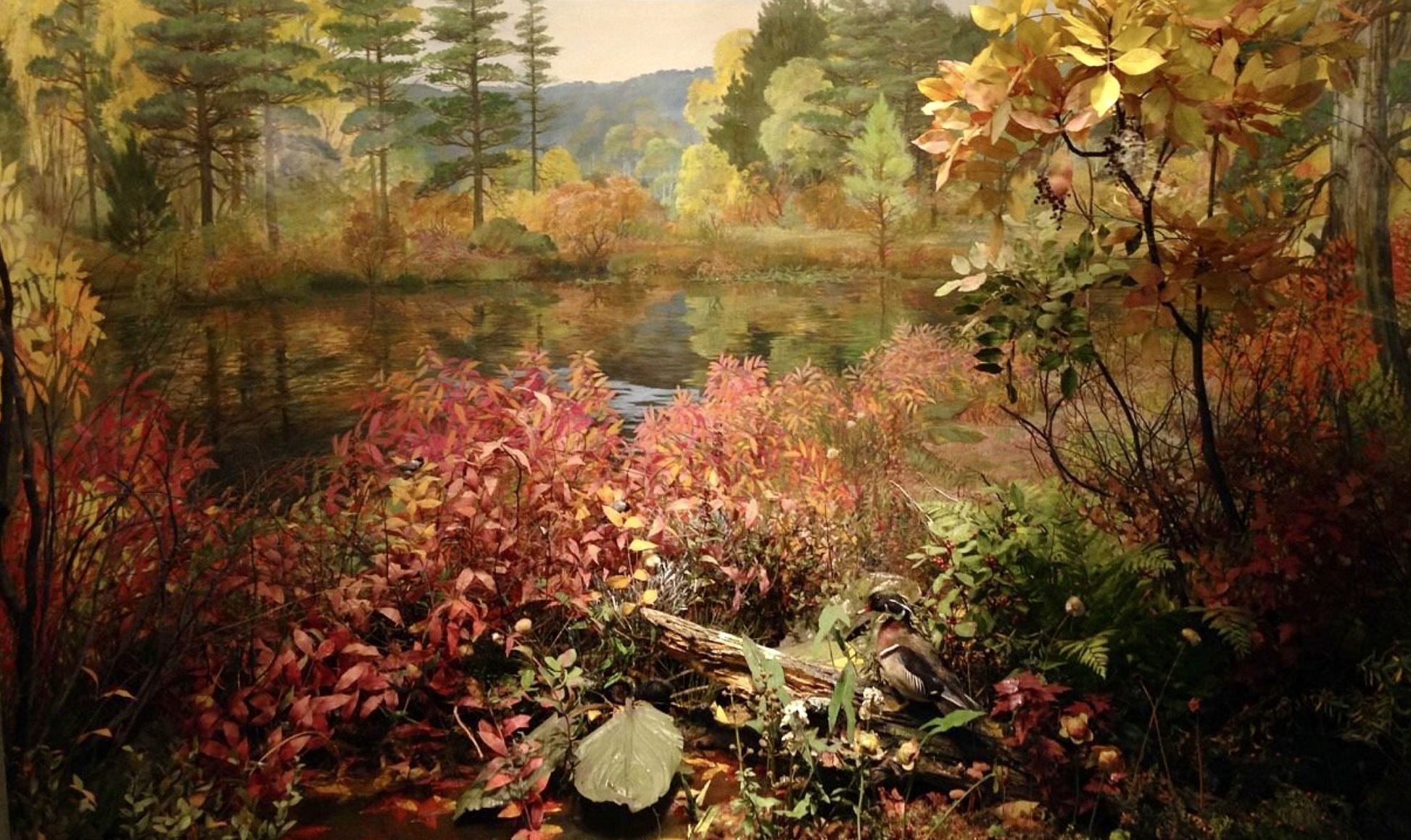
The Warren Bog Diorama, located in the Botany Hall of the Carnegie Museum of Natural History, is part of a visionary series of seven dioramas conceived by the curator of botany, and later museum director, Otto Jennings. He sought to illustrate how environmental factors like temperature and moisture drive ecological succession, and to showcase the biodiversity of specific plant habitats. In a progressive move for the 1920s, Jennings hired husband and wife artists Ottmar von Fuehrer (1896 – 1967) and Hanne née Hering, perhaps due to his own wife (Grace Kinzer), who took part in fieldwork with him. The von Fuehrers completed five major dioramas between 1928 and 1934 that were recognized for their scientific and botanical artistry: the Pennsylvania Spring Flora Group; Arizona Desert Group; Tropical or Florida Group; Alpine Meadow Group; and the Warren Bog Group. The groups represented specific sites in nature at certain times of year and were meticulously researched in the field by collecting specimens, making sketches and models and taking photographs. Dozens of plant species were recreated in each group by thousands of hand modelled and painted leaves and flowers. The dioramas were supported by the Garden Club of Allegheny County in their mission to educate the public about the endangered plants and their habitats in nature.
Hanne von Fuehrer was originally from Germany and received her art training there. An exceptionally talented preparator and artist, she worked at the museum from 1926 until 1965. While her husband painted the diorama backgrounds, Hanne led a team of mostly women who hand modeled and painted thousands of individual botanical specimens using wax and paper. Hanne also took part in field research, harvesting plant specimens, taking colour notes and recording specific on site details. She used a meticulous preservation technique for botanical specimens, later casting them in plaster. The wax impressions were then painted as exact replicas. The Warren Bog Diorama plants included Poison Sumac; Hemlock Mushroom; and Vermilion Waxcap Mushroom.
The foregrounds of habitat dioramas in natural history museums are primarily composed of botanical and zoological specimens with representational precedents in both two dimensional art and illustrations and three dimensional models and sculpture. Like botanical illustrations, which traditionally functioned as exact copies for scientific analysis, plant models in habitat dioramas aim to be facsimiles of the living specimen. Organic plant matter is susceptible to rapid decomposition and fading and cannot be preserved for long term display.
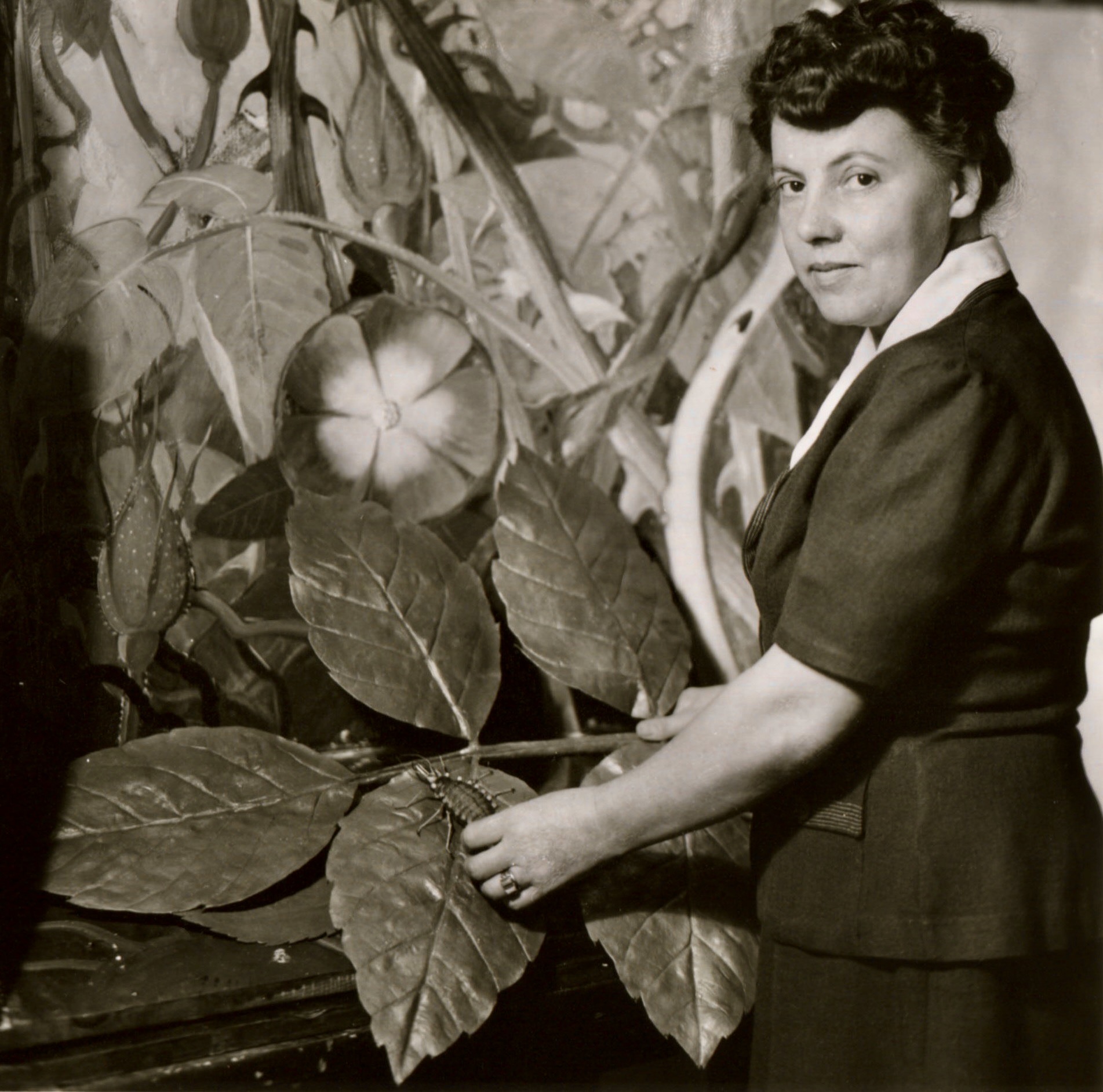
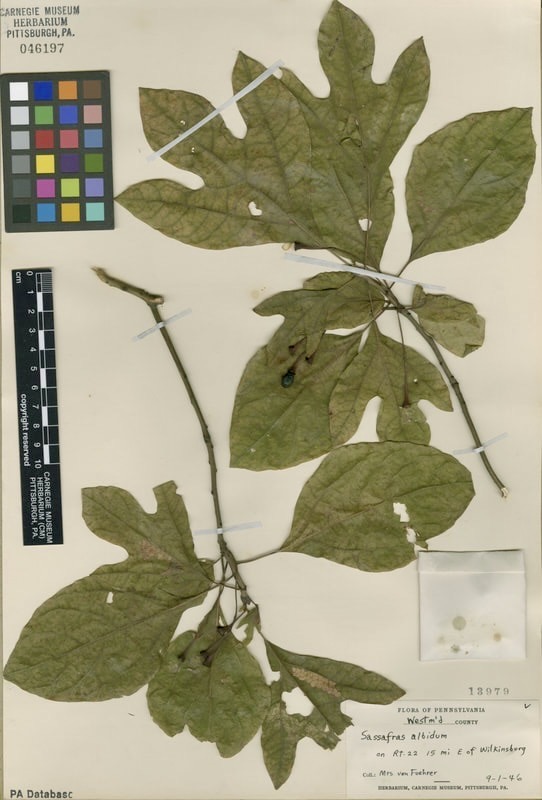
The labour intensive process of producing facsimile plant models in the museum involves collecting field specimens for anatomical study, as exemplified by the Sassafras leaves Hanne von Fuehrer gathered for the Carnegie Museum to document their morphological diversity. Her technical proficiency in fabricating foliage from molds, wax, and paper resulted in the production of thousands of botanical replicas as documented in a photo showing her with a handcrafted model of a larvae and rose leaf.
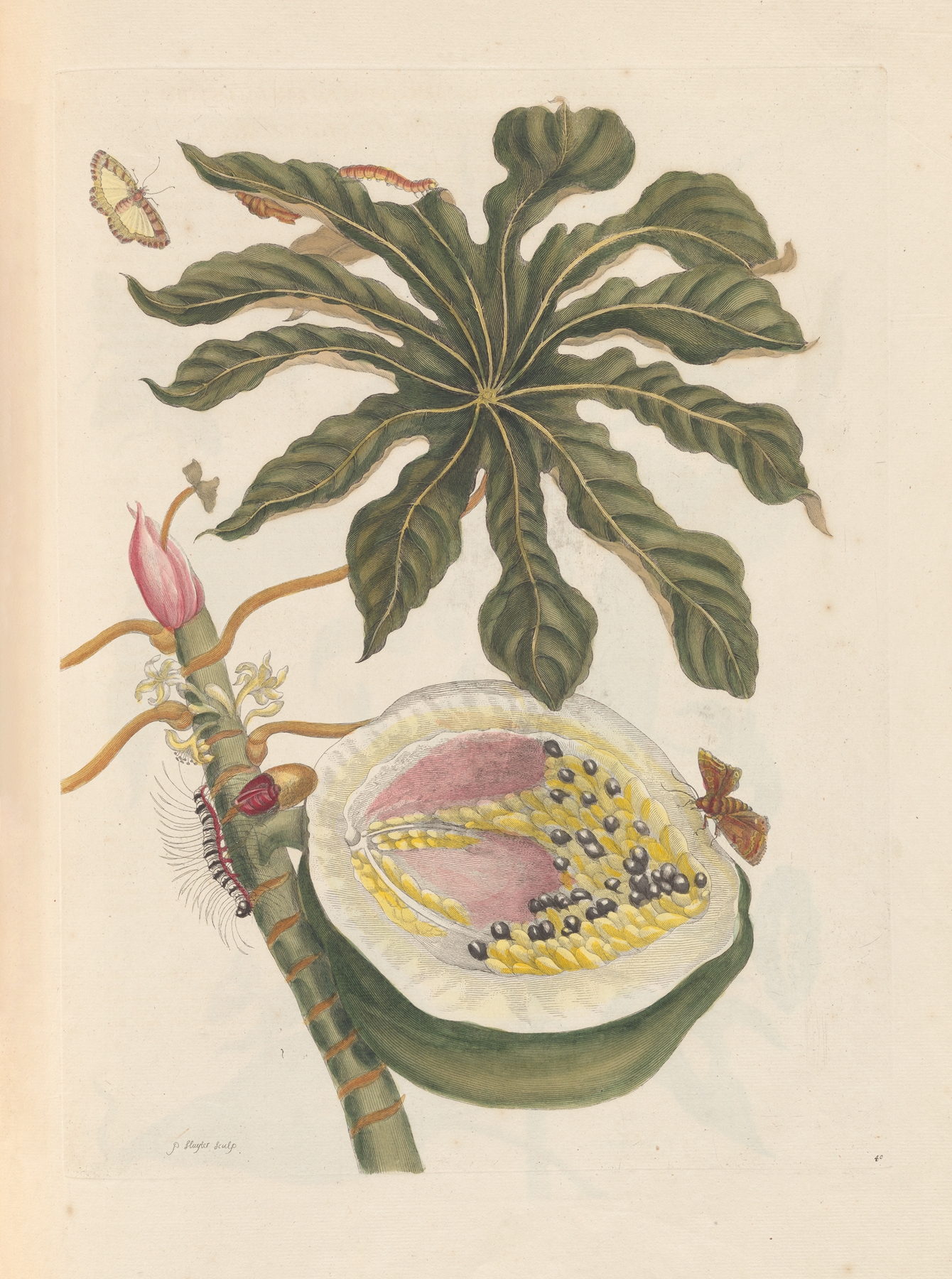
The 19th century tradition of botanical illustration was a feminized field of expertise in which the scientific contributions by women often went uncredited and were unpaid, viewed as a genteel pastime rather than a profession. Banned from universities and professional scientific societies, women dominated the production of botanical art, which was seen as a hobby or craft much like embroidery. An early exception was Maria Sibylla Merian (1647 – 1717), a German entomologist, naturalist and artist who took part in a scientific collecting expediition to Suriname. Her detailed depictions of plants and insects were based on direct observations; an example is her engraving of a papaya plant (Carica papaya), featuring both fruit and flowers, alongside various life stages of caterpillars and butterflies, published in her book Metamorphosis Insectorum Surinamensium (1705). The contributions of women in botanical representation continued to go unrecognized for two more centuries, including in natural history display as in the case of the English plant modeller Mrs. Mogridge, for whom no dates or photographs exist.
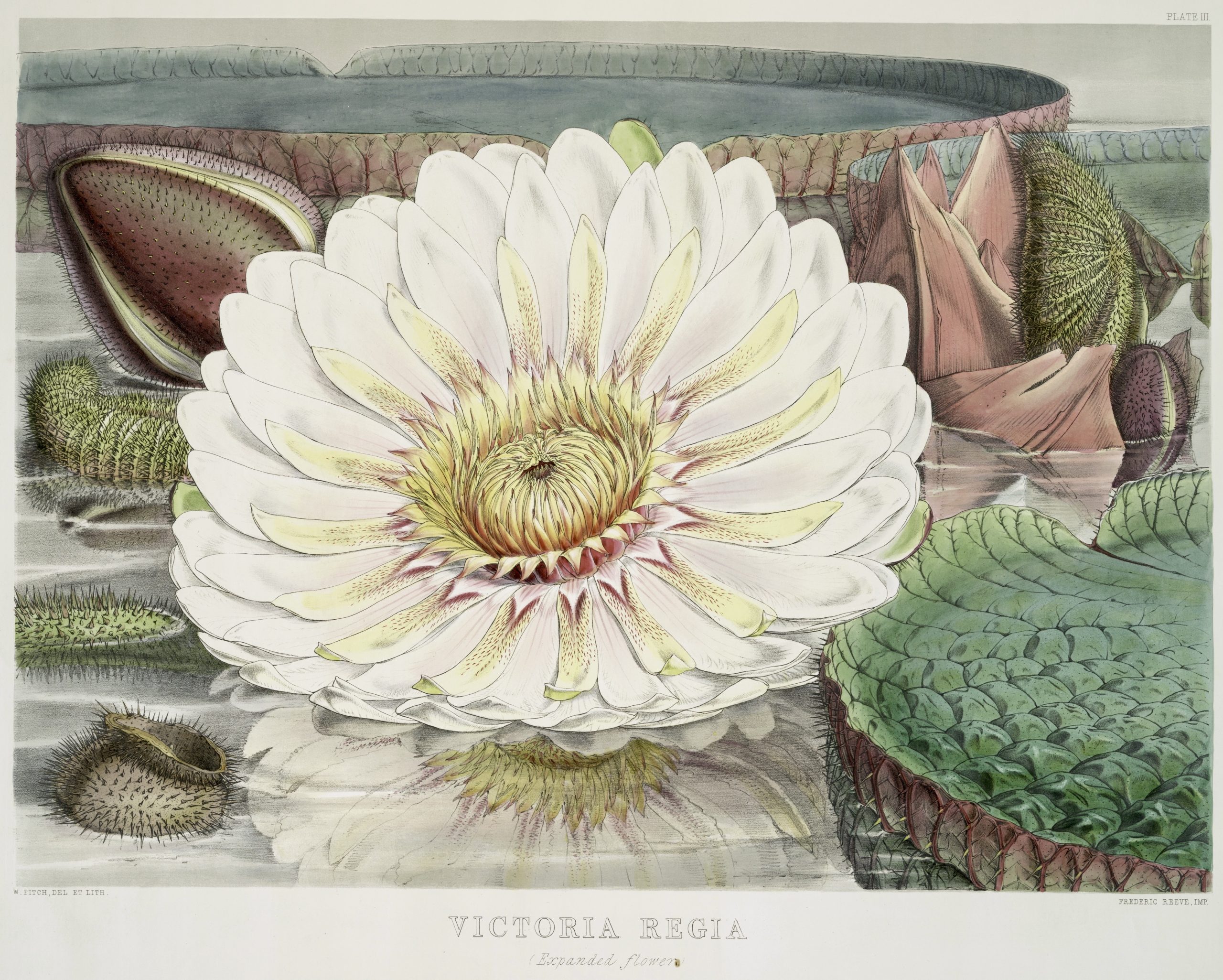
E. S. Mogridge (née Mintorn, 1903) was a British modeller in wax who used her skill in blending artistry with scientific precision to create the foregrounds of zoological groups at the British Museum and the American Museum of Natural History. She was a member of the Mintorn family business in London, renowned for its lifelike wax flower models. Most famous of these were the Mintorn wax facsimiles of the celebrated “Victoria Regia Royal Waterlily” that were widely displayed in 1850 and introduced the botanical sensation to the public. An illustration of the gigantic species accompanied a description by Sir W. J. Hooker, director of the Kew Gardens. Wax flowers were exhibited widely at the Great Exhibition of 1851. They were first of all classified as artistic creations, much loved by Queen Victoria, rather than specifically botanical. Yet the Mintorn “Victoria Regia” can be described as the apotheosis of the Victorian wax flower movement. Few of these models survived due to the fugitive quality of wax, so this was yet another product of feminine domestic labour and artistic accomplishment that simply vanished into historical obscurity.
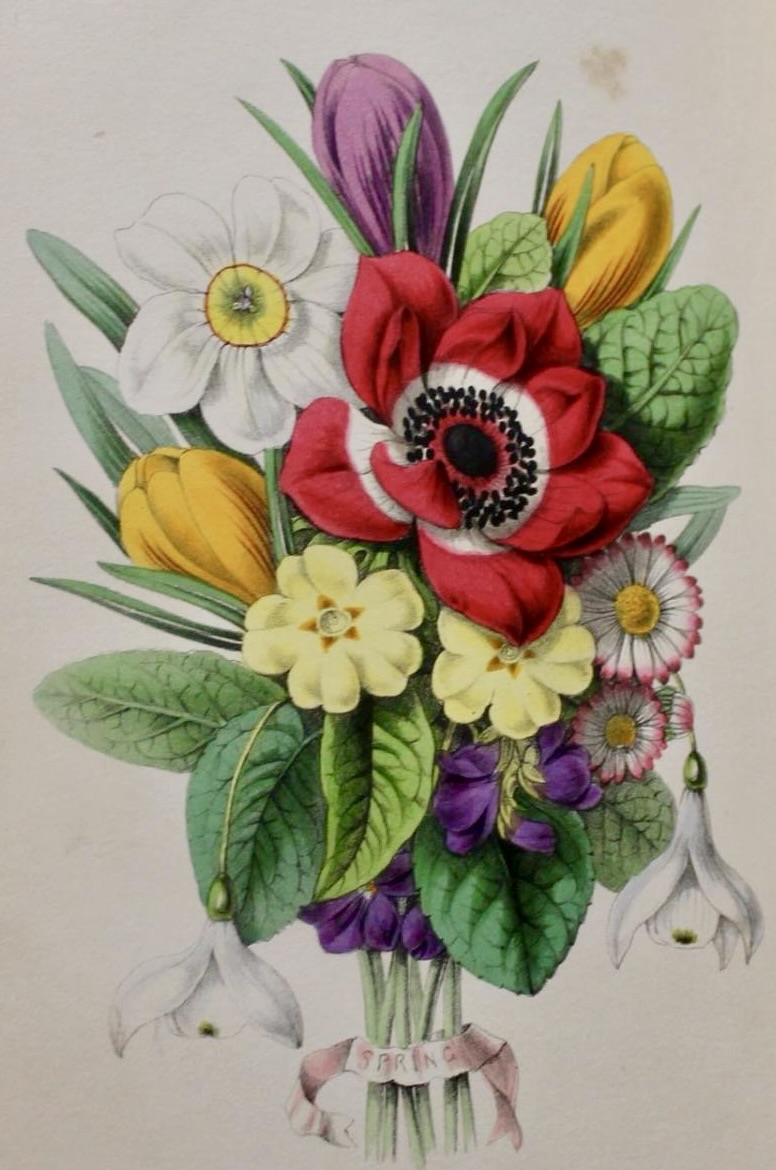
A number of popular handbooks on the techniques for producing the wax models were published in the mid 19th century. One of these was by Emma Peachey (died 1875) who was appointed “Artiste in Wax Flowers” to Queen Victoria in 1839. Her influential manual The Royal Guide to Wax Flower Modelling (1851) reveals the gendered bridge between artistic expression and scientific observation. The hand coloured frontispiece to Peachey’s book featured a vibrant bouquet of spring flowers including anemones, daffodils, and crocuses. Peachey elaborates on the techniques and materials required for wax flower modelling but confines her creativity to the socially acceptable class boundaries of domestic feminine decorative labour.
E. S. Mogridge (known as Mrs. Mogridge) was an innovative path breaker in the art of making wax models. She made the transition from purely decorative floral motifs to natural history models that reproduced botanical specimens with scientific accuracy. In 1879, Mogridge began to create wax models for the British Museum’s natural history department, creating botanical facsimiles for over a hundred ornithological displays. She also modelled caterpillars on plants for the entomologist Thomas de Grey (6th Lord Walsingham), and later created educational plant models at larger than life size for the botanist William Carruthers at the British Museum.
The ability of Mogridge to mimic the textures of moss, rotting wood, and delicate wildflower petals was seen as a major advancement in exhibition technique. None of these early displays by Mogridge were credited and it is unfortunate that few have survived despite the importance they had as forerunners to a new form of natural history display. Mogridge is described as “without a rival” in making anatomically correct botanical models for museums in an 1887 article in the prestigious British science journal Nature. It noted that because her reproductions were so precise, done with “microscopic care,” they allowed for the identification of individual plant species.
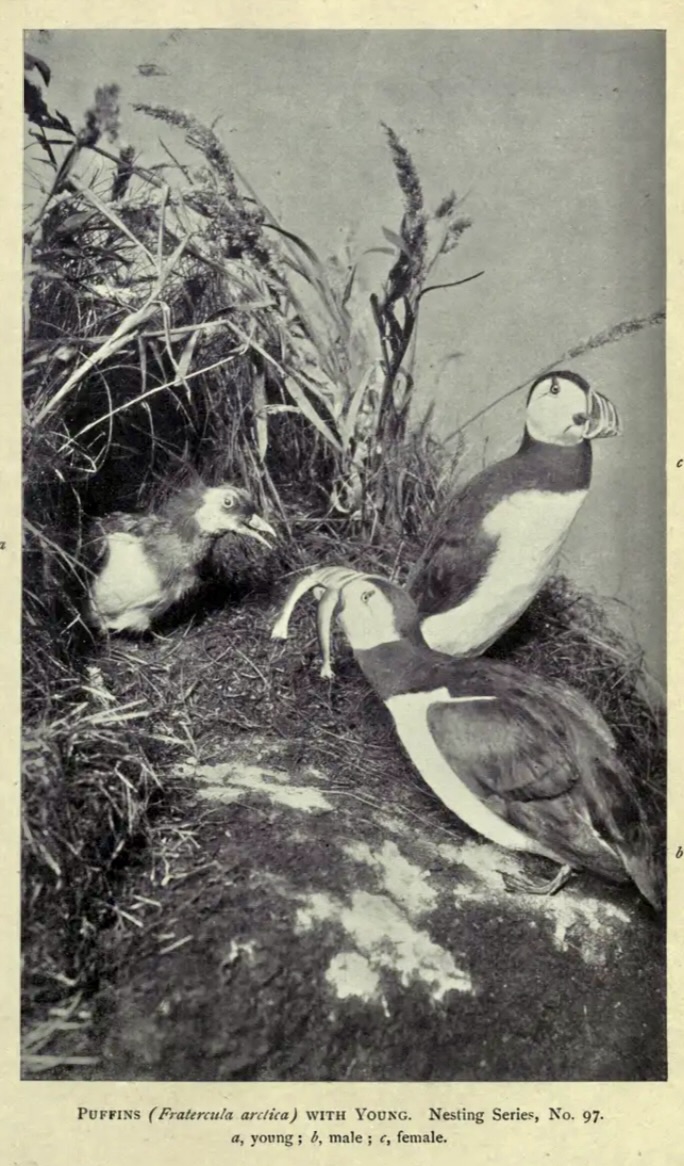
In 1883, following the opening of the British Museum of Natural History at South Kensington in 1881, zoologist Richard Bowdler Sharpe instigated a “nesting series” of British birds, part of Lord Walsingham’s initiative. “Puffins (Fratercula arctica) with Young,” was No. 97 of this series, completed in 1886. The material for the group was collected from Farne Islands, Northumberlandby by Lord Walsingham who shot the birds, dug out the breeding burrows, cut out chunks of the native turf, and shipped the actual soil, nests, and birds to London. Mogridge and her brother, Horatio Mintorn, replicated the vegetation around the burrow entrance which included detailed wax and wire models of sea pinks (thrift) and scurvy grass. The display showed the birds alongside a cross section of their subterranean nesting cavity, the flora creating a seamless boundary between the birds and their habitat due to the skill of Mogridge in mimicking the textures of moss, rotting wood, and delicate wildflower petals.
The success of her work in London had led the president of the American Museum of Natural History, Morris Ketchum Jesup, to personally recruit Mogridge and her brother in 1877 to bring this “British style” of habitat display to New York. Working together they contributed to approximately forty museum exhibits, including the first mounted group of American bison. The foreground replicas by Mogridge achieved significant accolades; notably, a review in Science (1898) commended the “microscopic care and verisimilitude” of her work; an article in Scientific American (1906) praised Mogridge’s “very perfect reproduction of natural environment in every detail,” and botanists cited her plant reproductions for their taxonomic fidelity. Through her technical innovations, Mogridge played a pivotal role in redefining the standards of biological representation in late 19th century museum displays, teaching the public more about “the life history and economy of birds” in a single glance than a whole gallery of isolated specimens ever could. Other institutions that profited by her skill in reproducing plant accessories included the US Department of Agriculture, the Carnegie Museum, the Field Museum, the Brooklyn Institute, and the Natural History Museum at Springfield (MA).
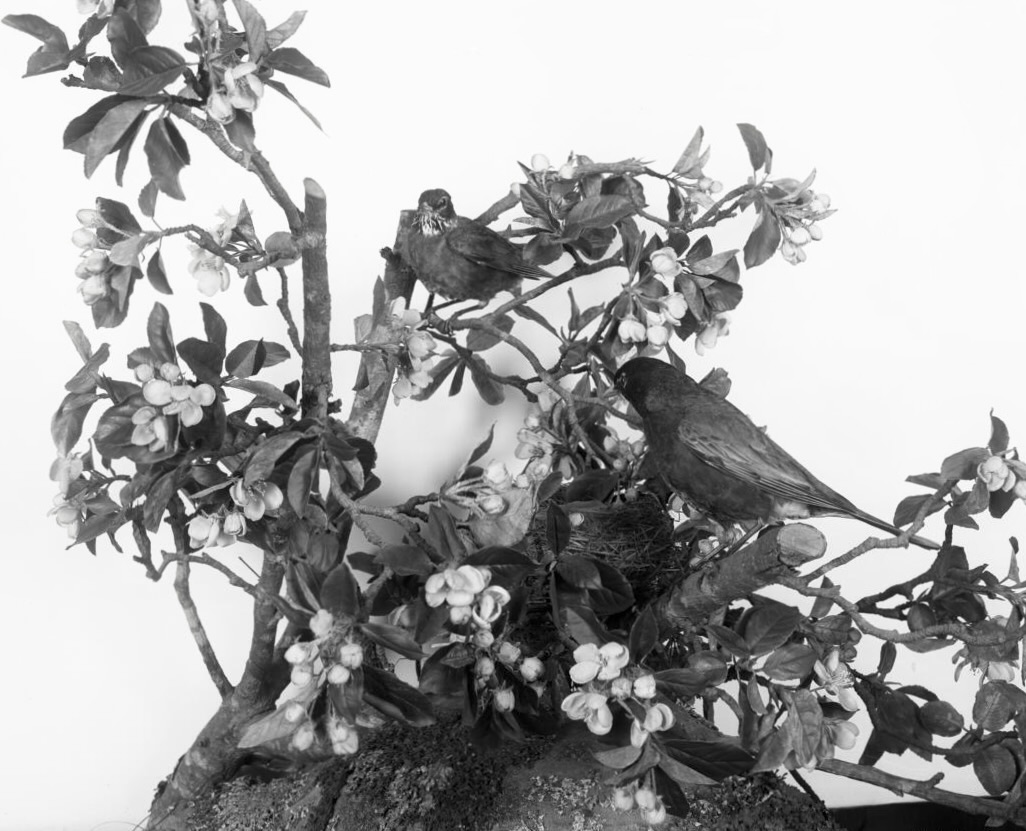
Upon their arrival in New York in the mid 1880s, Mogridge and her brother began collaborating with Jenness Richardson, the museum taxidermist. By early 1887, 12 bird cases with 18 grouped specimens were completed, showcasing the mounted birds and their nesting habits. A group of American Robin (Turdus migratorius) specimens was the first of these displays, funded by Mary Stuart, widow of a founder of the American Museum of Natural History and its president until 1881. Preparatory field work involved shooting the specimens in situ and collecting their nests and vegetation for transport to the museum. Mogridge initially kept secret her techniques for reproducing the foliage and flowers that were the principal accessories of these groups. Later however, she taught her methods to others and engaged in the preparation of botanical models and accessories. Mogridge returned to the museum in the 1890s; her later work included models illustrating the destructive impact of insects on trees, an achievement lauded by Scientific American for its “very perfect reproduction of natural environment in every detail.
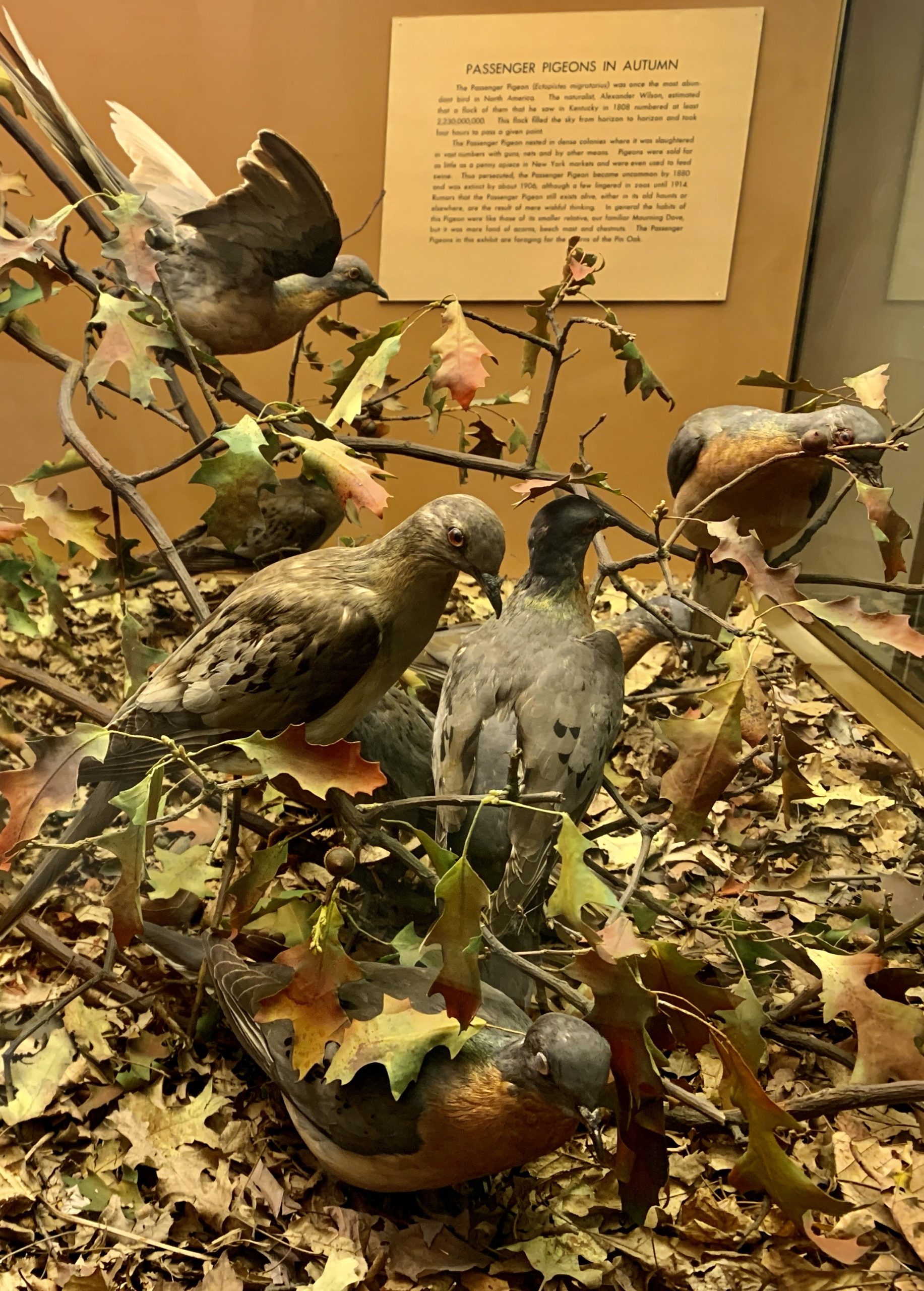
A rare extant example of the modeling skill of E. S. Mogridge is the c. 1888 display of the Passenger Pigeon (Ectopistes migratorius) at the American Museum of Natural History, which remains on exhibit today in the Hall of New York City Birds. Created in collaboration with museum taxidermist Jenness Richardson, the display depicts a flock foraging for pin oak acorns on the forest floor, serving as a poignant tribute to a species that would become extinct within three decades. The rich assemblage of hand coloured oak leaves provided viewers with an immediate sense of the bird’s vanishing habitat. The success of Mogridge’s botanical accessories relied on a durable, custom fabric she developed, a wax product based on “silk lisse” coated with chemicals and coloured with oil paints. By 1911, however, a preparation guide noted that this mousseline de soie technique had been largely superseded by cotton batting, outlining newer methods for replicating foliage via wax dipped muslin, plaster molds, and celluloid casting for delicate structures.
Produced during a period of catastrophic population decline driven by industrial scale hunting, the Passenger Pigeon Group underscored the precarious status of what had recently been North America’s most populous bird. The group emerged from a broader 1880s initiative spearheaded by museum ornithologist Frank M. Chapman, who championed such exhibits as vital pedagogical tools for avian conservation. This urgent educational push reflected the advocacy of zoologist J. A. Allen, the museum’s first curator of mammals and birds, who had issued a passionate plea in 1886 to halt the needless destruction of American bird life before irreplaceable species were lost entirely, calling attention to the “disgraceful greed for slaughter, in part for the mere desire to kill something: the so called love of sport.”
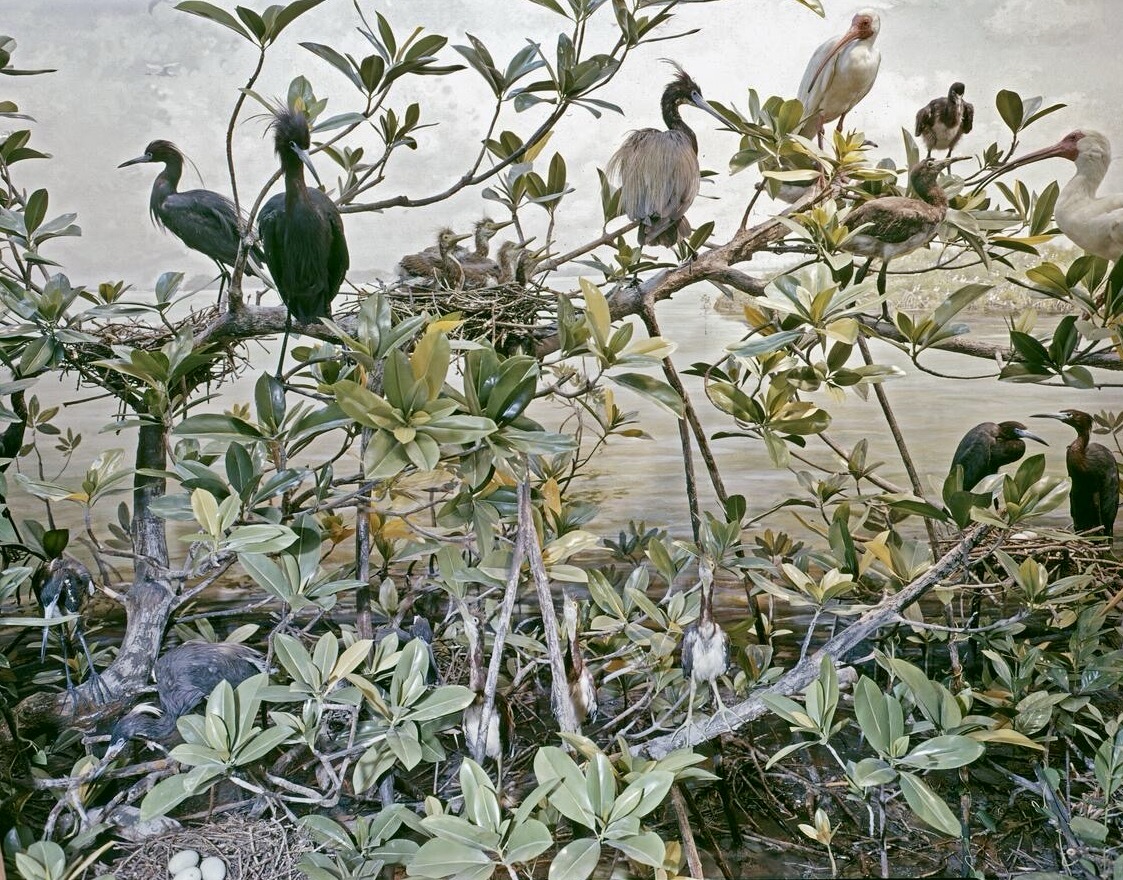
The Cuthbert Rookery Group at the American Museum of Natural History, completed in 1909, is an example of how elaborate the production of foreground accessories became in the years that followed the earliest groups. Frank M. Chapman explained that the Florida rookery, situated in the heart of a mangrove swamp in the Everglades, was once one of the most remarkable sights of bird life in the US, until the demand for their plumage brought the aigrette bearing Snowy Heron (Egretta thula), American Heron (Ardea alba), and Roseate Spoonbill (Platalea ajaja) to the edge of extermination. According to Chapman, the group was designed to show a portion of the rookery with the birds nesting and roosting in the mangroves, while the background portrays the whole islet at evening when the birds are returning. The artist and ornithologist Louis Agassiz Fuertes (1874 – 1926) had accompanied Chapman’s field expedition in 1908 to the rookery and produced sketches that were executed into a background landscape for the group by background painters Bruce R. Horsfall (1869 – 1948), and Herbert Lang (1879 – 1957).
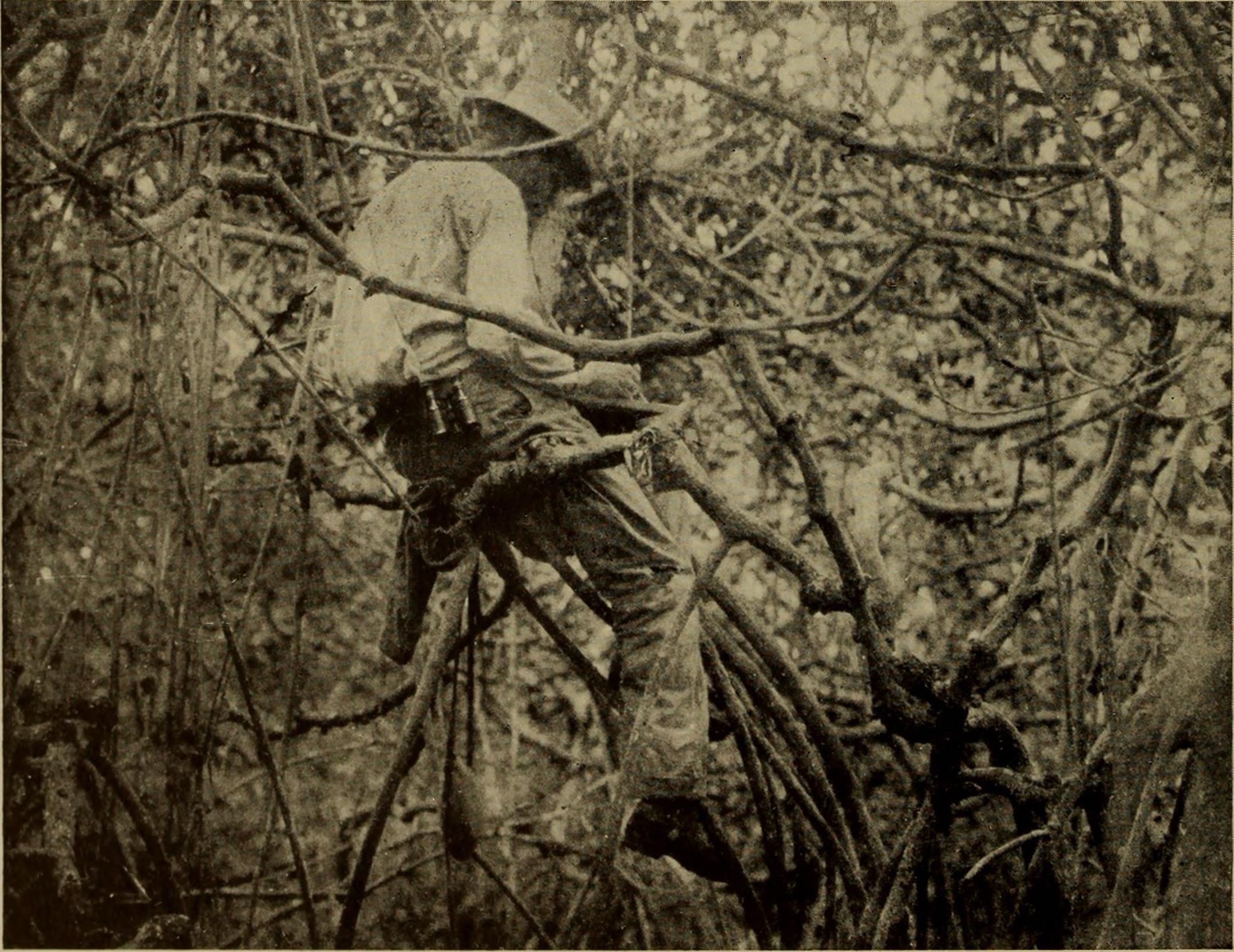
The taxidermy for the group was done by Jenness Richardson and his assistant Herbert Lang, the museum preparator was Ignaz Matausch, who specialized in casting intricate botanical accessories. A photo depicts Fuertes sketching at the remote and difficult to access site of the rookery, surrounded by a dense maze of mangrove branches. Chapman estimated that the rookery contained about 35 Roseate Spoonbills, 15 Snowy Egrets, 350 American Egrets, 50 Little Blue Herons, 2000 Louisiana Herons, several hundred Ibises and a few Cormorants and Water Turkeys. Thousands of birds were slaughtered here for the lucrative millinery trade. By bringing a view of the beauty of the rookery and its vulnerable inhabitants to the urban public, the horror of the senseless killing spurred the conservation movement to protect the species. By 1911, the Hall of North American Birds featured dozens of groups conceived by Chapman to form a ecological survey of avian life zones showcasing places such as Cobb’s Island, San Joaquin Valley, Hackensack Meadows, and the Hudson Palisades.
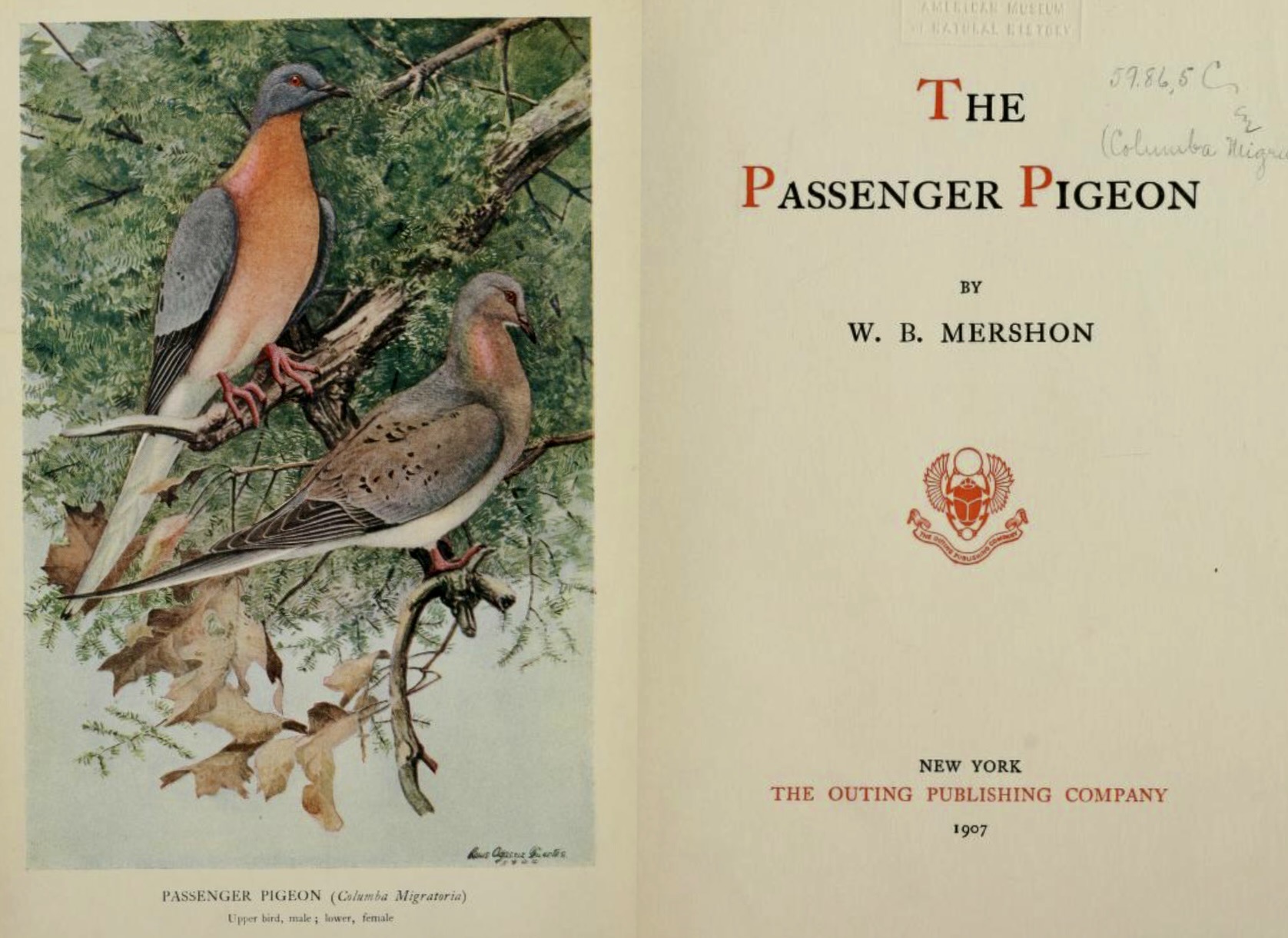
In 1906, the same year that the Cuthbert Rookery Group was completed, a book on the endangered status of the Passenger Pigeon was published by W. R. Mershon with a striking frontispiece by Louis Agassiz Fuertes depicting a pair of birds perched on forest tree. In his introduction, the author lamented the cruel extinction of a species that Audubon had said contained flocks of billions of birds. He warned that it was the destruction of the forest habitat that would lead to its demise, more than even the devastating industrial scale market hunting of the bird. Fuertes never witnessed the legendary, sky darkening flights of the species, nor did he observe them in the wild; instead he had to reconstruct the birds for the frontispiece using museum skins and taxidermy mounts. Like other ornithological artists, Fuertes was deeply concerned about the survival of the birds he illustrated and used his art as a plea for preservation. No other species had as many representations of it, both scientific and popular, as the Passenger Pigeon yet that did not save it from extinction.
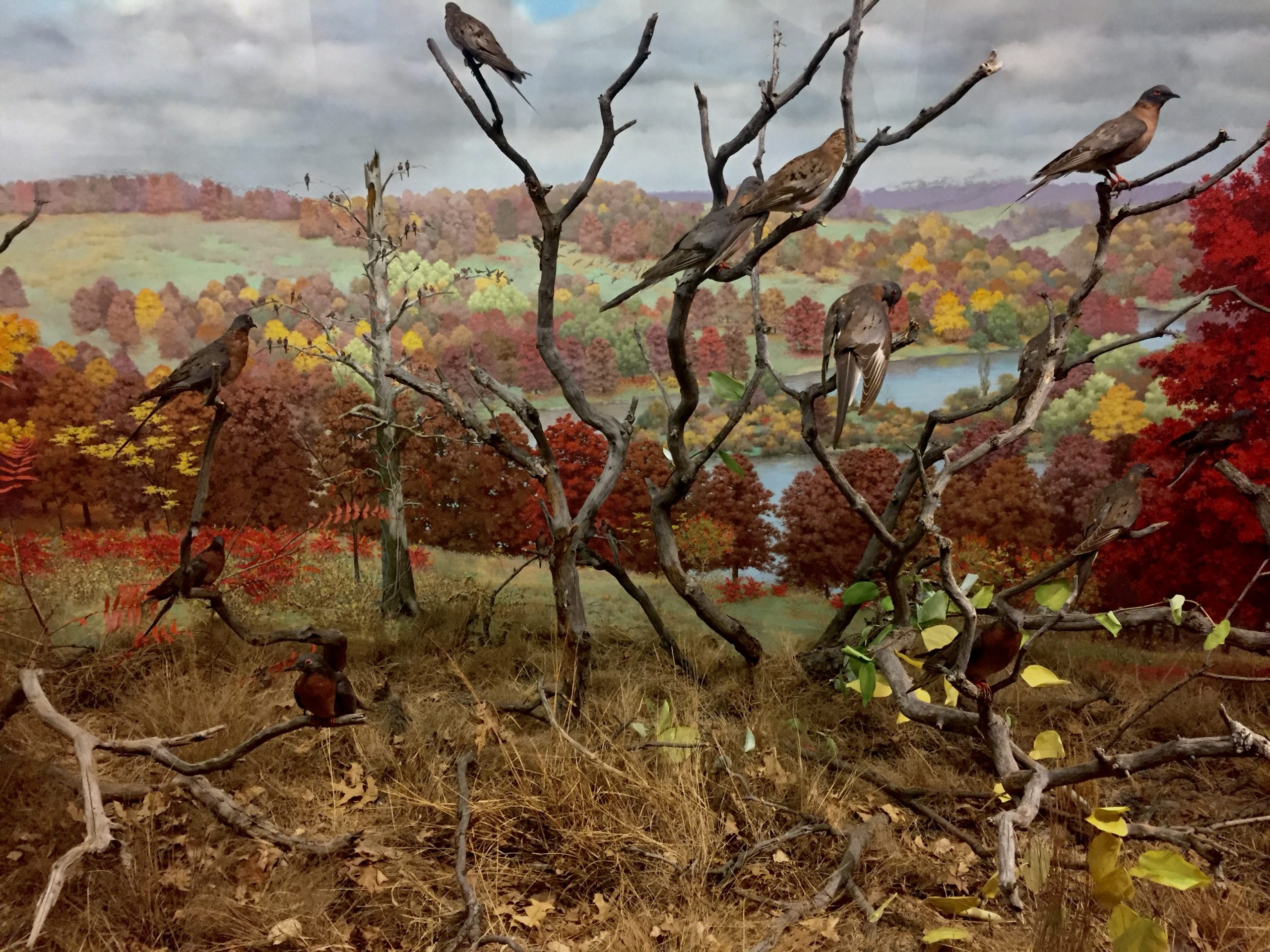
A habitat group featuring the Passenger Pigeon (Ectopistes migratorius) was first created at the Denver Museum of Natural History (now the Denver Museum of Nature & Science) in 1919. The skins of the birds had been purchased from a farmer in Iowa who shot the birds during the 1880s. The scene replicates a flock of birds descending into a woodland clearing in Johnson County, Iowa, in the 1890s, the last decade before the final collapse of the wild pigeon population. Museum director Jesse D. Figgins (from 1910 to 1936) had been in charge of the department of preparation and exhibits at the American Museum of Natural History and was an early advocate of the habitat concept of natural history display. When Alfred M. Bailey became director in 1936, he initiated a project to revitalize the exhibits. During this time, the background of the Passenger Pigeon group was repainted by Charles Waldo Love (1881 – 1967), an accomplished artist whose work is featured in many of the habitat dioramas in Denver.
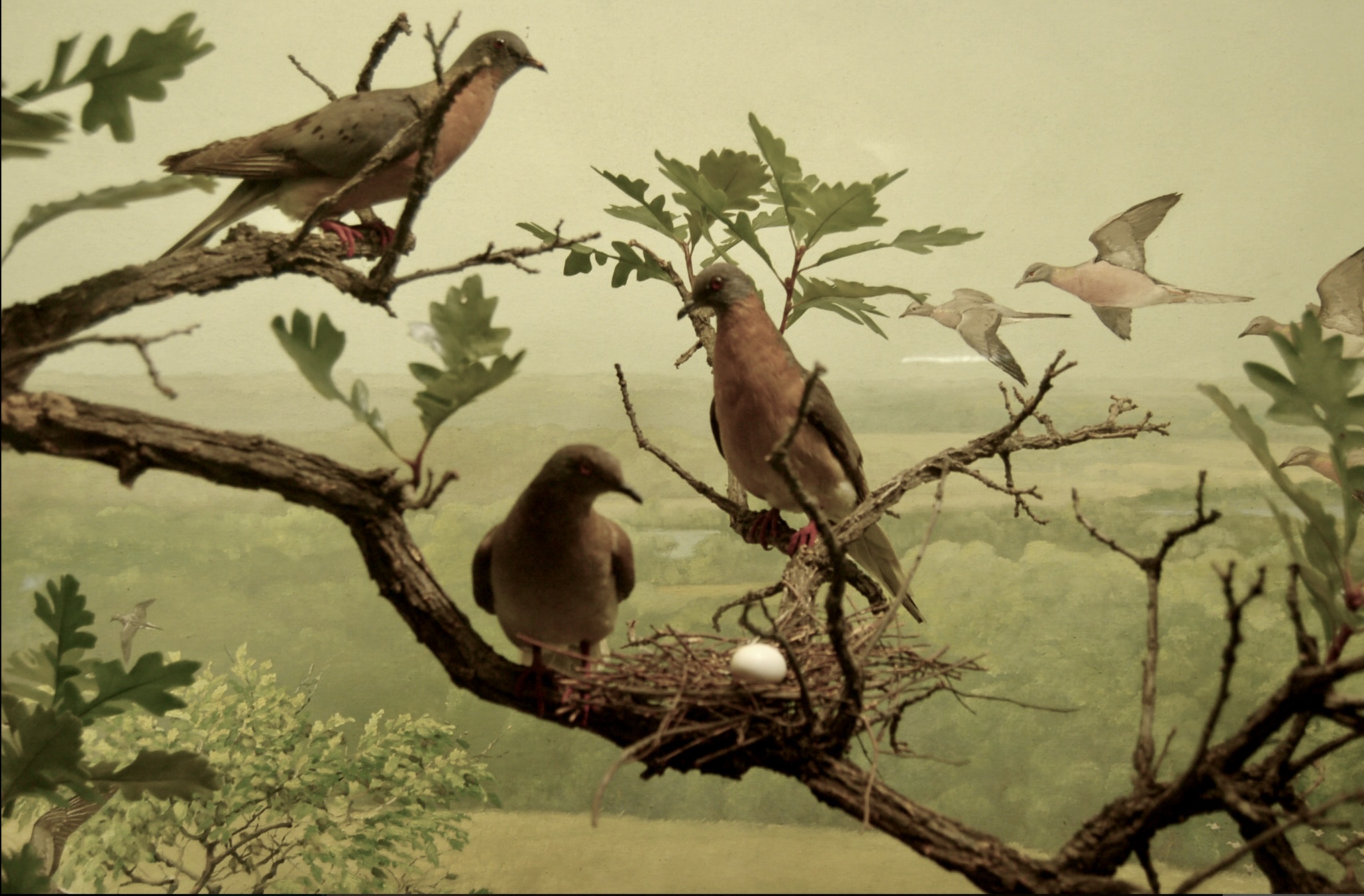
The Passenger Pigeon Nesting Diorama at the Bell Museum of Natural History in Minnesota was completed in 1951. It recreates a typical nesting scene modelled after records from about 140 years ago when the birds were abundant in the state. The diorama foreground features a group of mounted passenger pigeons roosting in oak branches. In the distance are undulating flocks moving low across the rolling oak savanna of southeastern Minnesota. The background landscape was painted by the exceptional wildlife artist Francis Lee Jaques (1887 – 1969) who worked at the American Museum of Natural History for two decades. In total, his oeuvre includes about 90 diorama backgrounds at museums across the US. The Bell Museum director, Walter J. Breckenridge, was a field naturalist and taxidermist who supported the diorama style of exhibition as a means of teaching the value of conservation. Both he and the preparator John Jarosz created the foreground of the Passenger Pigeon diorama.
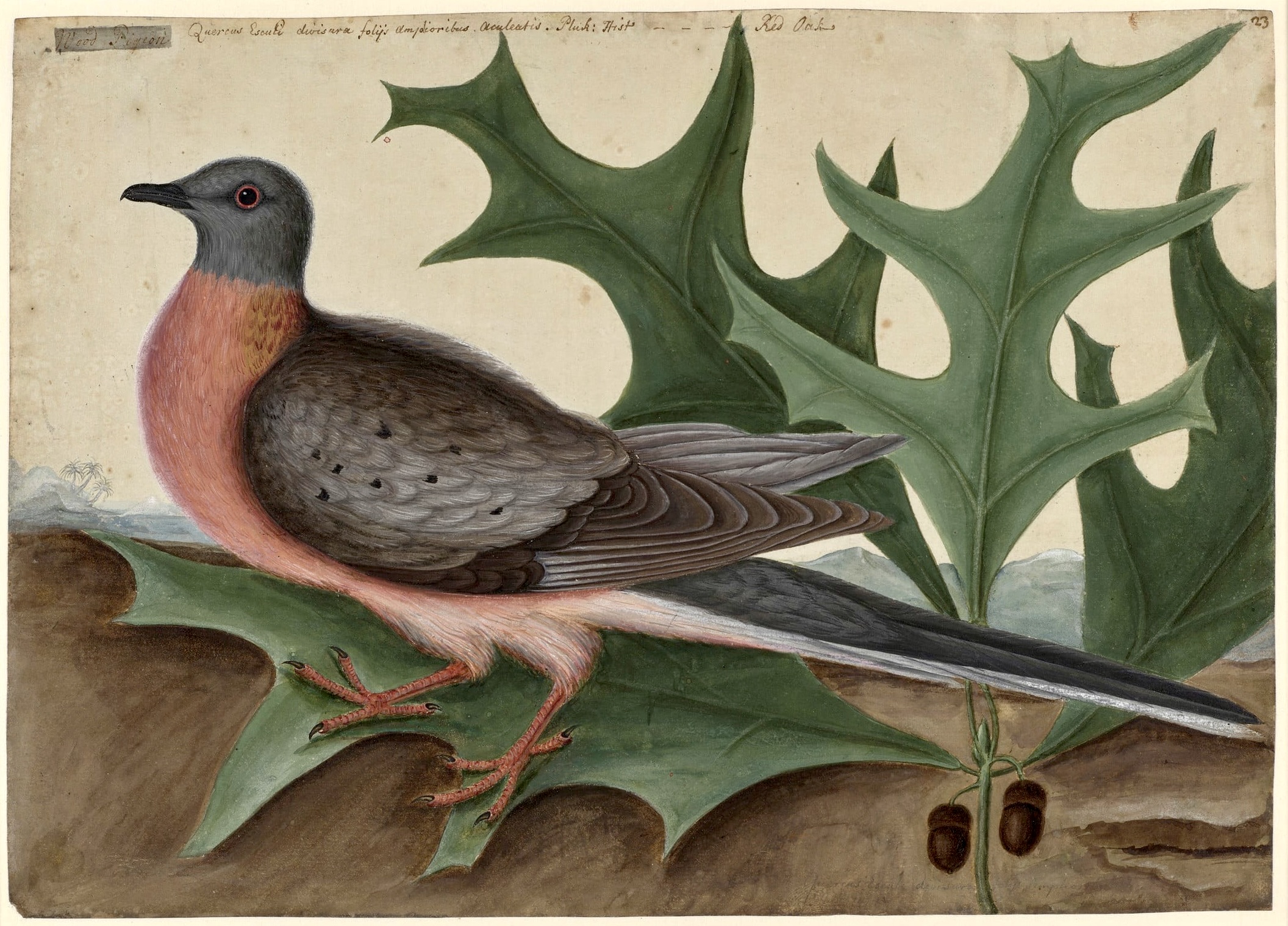
The English naturalist Mark Catesby provided the first artistic representation of the passenger pigeon nearly two centuries before the species’ extinction in 1914. During the 1720s, Catesby observed the birds within their natural forest habitats in Virginia, where massive flocks nested and subsisted on mast such as oak acorns. He also noted the pigeons were hunted in incredible numbers and were a major food source for colonists. His watercolour “Pigeon of Passage and the Red Oak,” is described by him as depicting a bird seen in Virginia during winter; the inclusion of oak leaves and acorns provides critical ecological context regarding its habitat. Linnaeus later relied on Catesby’s work in the field to formally classify the species in 1768. While Catesby’s illustration was acquired by George III and safely resides in the UK Royal Collection, the subject of his illustration has been extinct since 1914. Today about 1,532 preserved specimens are thought to remain in museum collections worldwide.
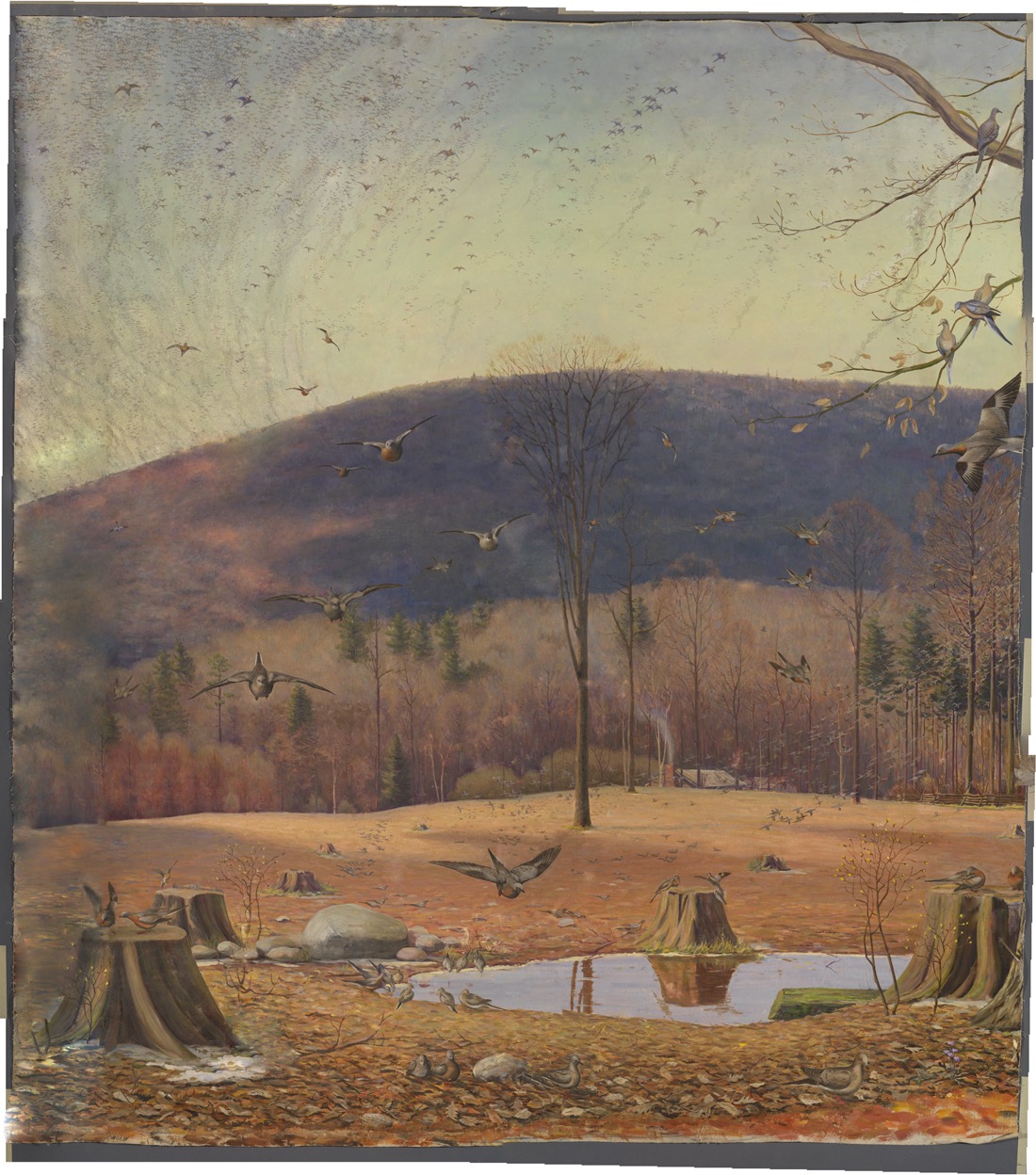
One Passenger Pigeon diorama that did not survive was at the Royal Ontario Museum, where it was dismantled in 1981. When it opened to the public in 1935, it was considered one of the finest in the world. Today all that remains of the diorama is a section of the background painting, showing many soaring Passenger Pigeons descending into a clearing marked with the stumps of a logged beech and maple forest habitat. The scene depicts an April morning in the 1860s near Forks of the Credit, Ontario. Other pigeons are scattered in the foreground foraging on acorns. The diorama was conceived by curator Lester L. Snyder and the background was painted by E.B.S. Logier (1886 – 1979), a distinguished Canadian natural history illustrator, herpetologist, and author who served as associate curator of ichthyology and herpetology at the Royal Ontario Museum.
With only about 1500 specimens of Passenger Pigeons preserved worldwide, the large collection at the Royal Ontario Museum is exceptional. This is due to a local businessman, Paul Hahn, who decided after the species was declared extinct in 1914, to collect as many skins and mounted specimens of the bird as he could find and donate them to the museum “to ensure that future generations would know at least how handsome a bird it was.” He presented the first specimen to the museum in 1918 and by the time he died in 1962, he had donated 70 more, making the collection the largest in the world, with 124 Passenger Pigeon skins and mounts.
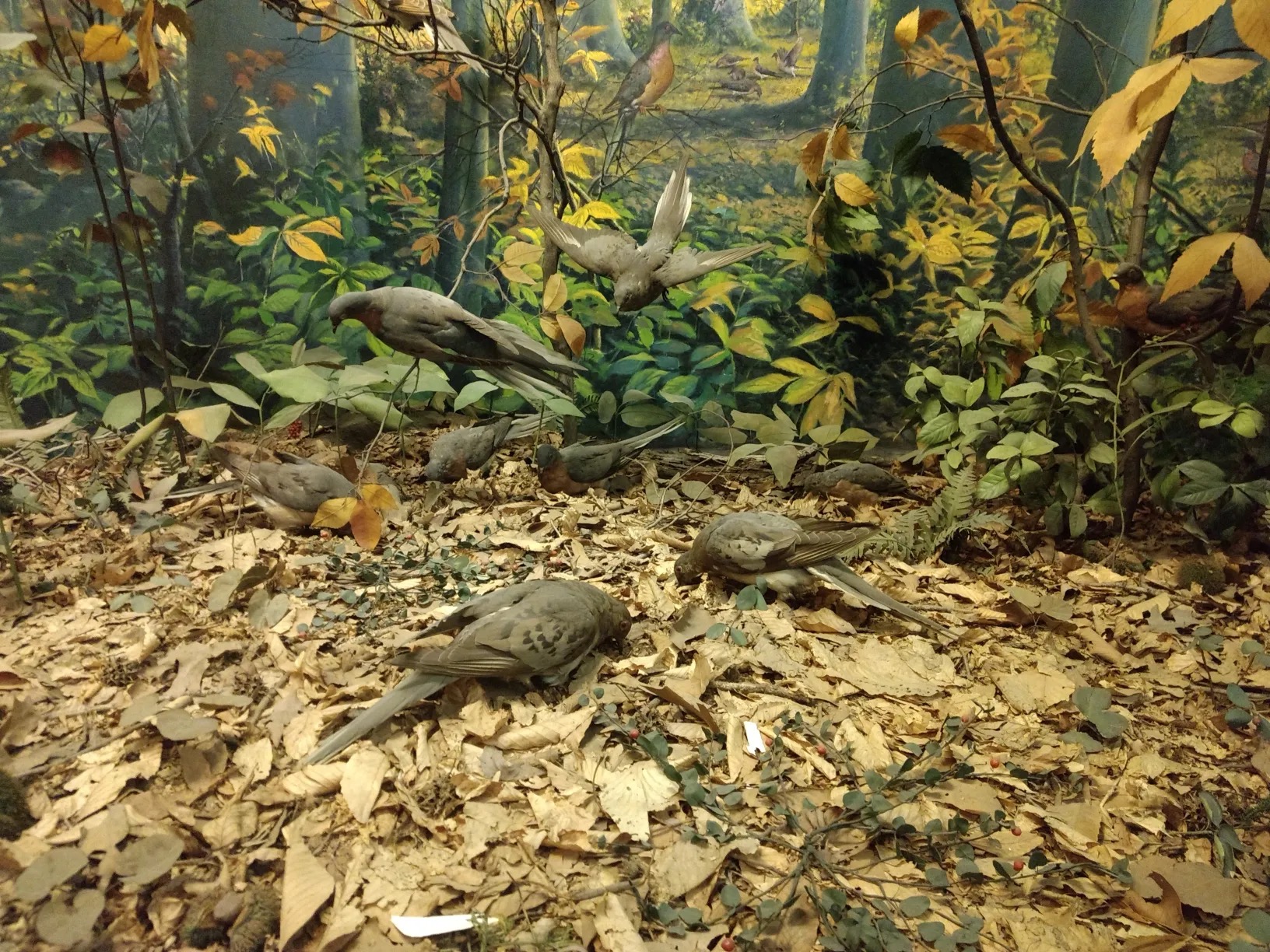
Another habitat diorama featuring the Passenger Pigeon is located at the Academy of Natural Sciences in Philadelphia. Completed in 1947, the background landscape was painted by Belmore Browne (1880 – 1954), an explorer and artist known especially for his diorama backgrounds in museums across the US. The diorama contains four birds foraging on the floor of an Eastern deciduous forest. One specimen is posed in flight revealing the bird’s special adaptive physiology as a migratory species. Harold T. Green, the curator of exhibits, was an advocate of the diorama form of display. Starting in the late 1920s, he instigated a number of dioramas that were made possible in part by artists working under the Works Progress Administration. The foreground accessories, including the botanical replicas, were produced by the exhibits staff at the Academy. By the time this “memorial” diorama had been created in 1947, the reasons for the extinction of the Passenger Pigeon were well understood.
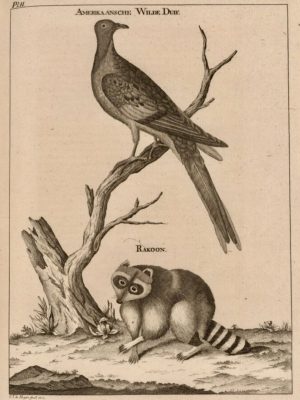
Illustrations of the Passenger Pigeon frequently appeared in early travelogues, such as Travels Into North America (1772) by Pehr Kalm. In the Dutch edition, the engraving is titled “Amerikaansche Wilde Duie.” As an Linnaean “apostle,” Kalm returned to Uppsala, Sweden with natural history specimens that may have included the skin of a Passenger Pigeon. Linnaeus is thought to have utilized this skin to establish the binomial nomenclature of the species along with Catesby’s illustration and description. Another significant early engraving of the bird was published in Thomas Pennant’s classic text, Arctic Zoology (1784). By the mid 19th century, representations of the Passenger Pigeon had shifted to popular print media. A widely reproduced example is the wood engraving titled “Wandertaube” by German illustrator Robert Kretschmer, published in the seminal zoological encyclopedia Brehms Tierleben (1860).
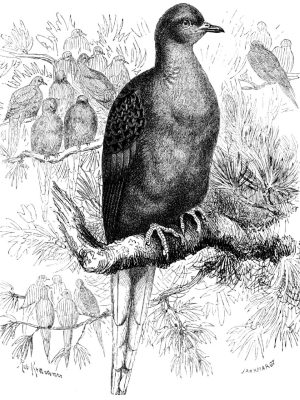
As with the representation of plants, the depiction of birds in scientific illustration developed through a distinct history of pictorial conventions that ultimately shaped the emergence of the habitat concept. During the 19th century, zoological imagery underwent a shift when animals increasingly came to be understood not as isolated specimens defined by morphology, but as living organisms embedded within ecological relations.
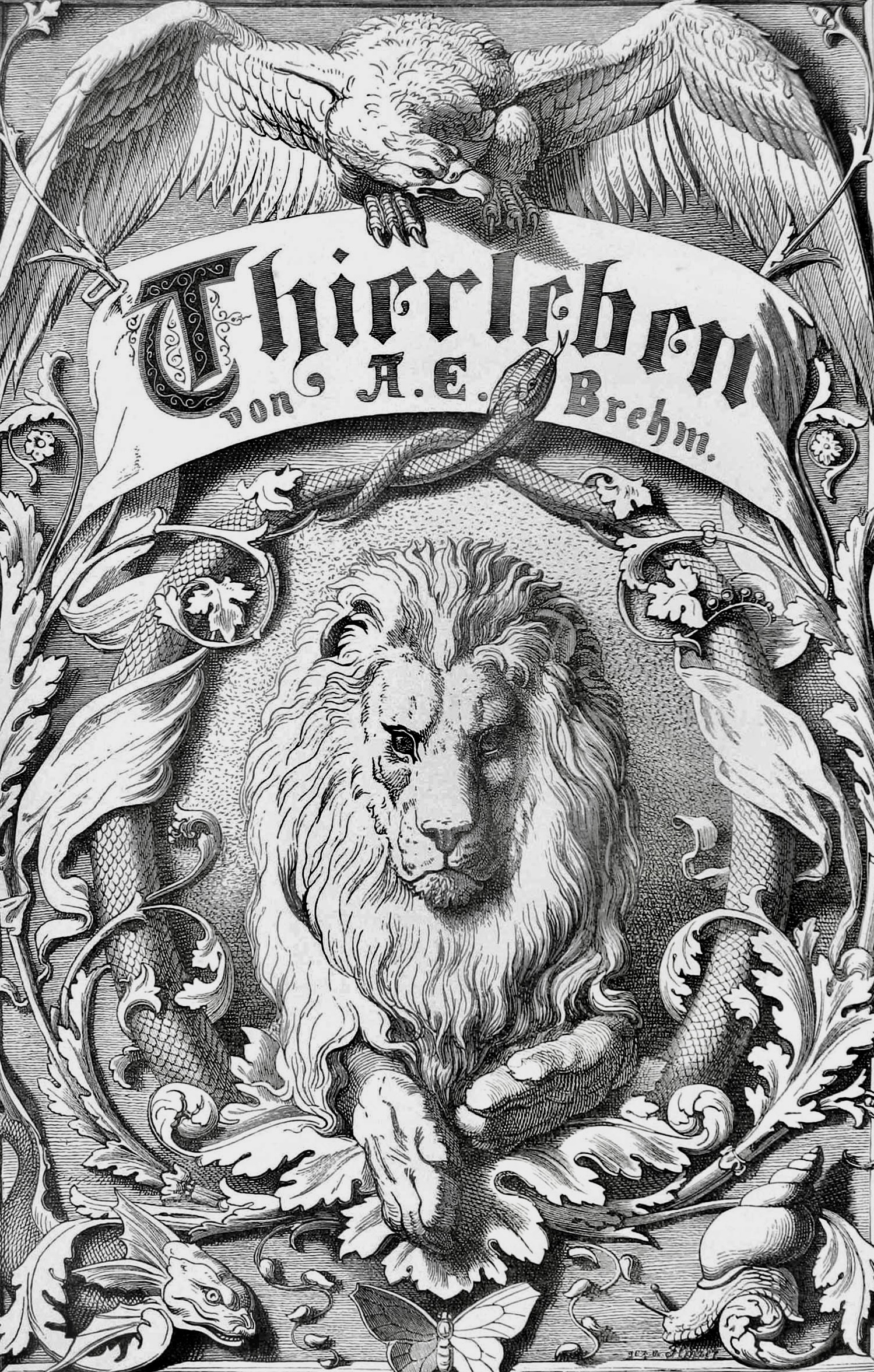
A major catalyst for this transformation was the illustrated encyclopedia of the animal world, Brehms Thierleben (Animal Life) by Alfred Edmund Brehm (1829 – 1884), which set the standard for how animals were perceived and displayed. First published in six volumes between 1864 and 1869, it was expanded in several new editions and reprinted hundreds of times. The main contributor of the c. 1,500 wood engravings in the first edition was artist Robert Kretschmer (1818 – 1872). Illustrations by artists Gustav Mützel, and August and Friedrich Specht were added to the expanded 10 volume second edition of Thierleben, which had a frontispiece by Fedor Flinzer featuring a majestic lion and powerful eagle, the two sovereign rulers of the animal kingdom. The popularizing effect of Brehm’s work is analogous to wildlife films such as Life on Earth by David Attenborough, bringing vivid representations of wildlife around the globe to a mass audience.
Brehm maintained throughout his life that “among all animals birds have always possessed the greatest attraction for me.” For Brehm, birds were not merely zoological specimens but the most aesthetically compelling organisms in which he could blend firsthand, systematic natural history observations with comprehensive anatomical accuracy. Brehm’s work was influential in Sweden, where it was translated as Djurens lif and published between 1882 and 1888. The aim of the biological museum in Stockholm to show the “levnadssätt” (way of living) of the animals on display has a direct parallel with the illustrations in Thierleben.
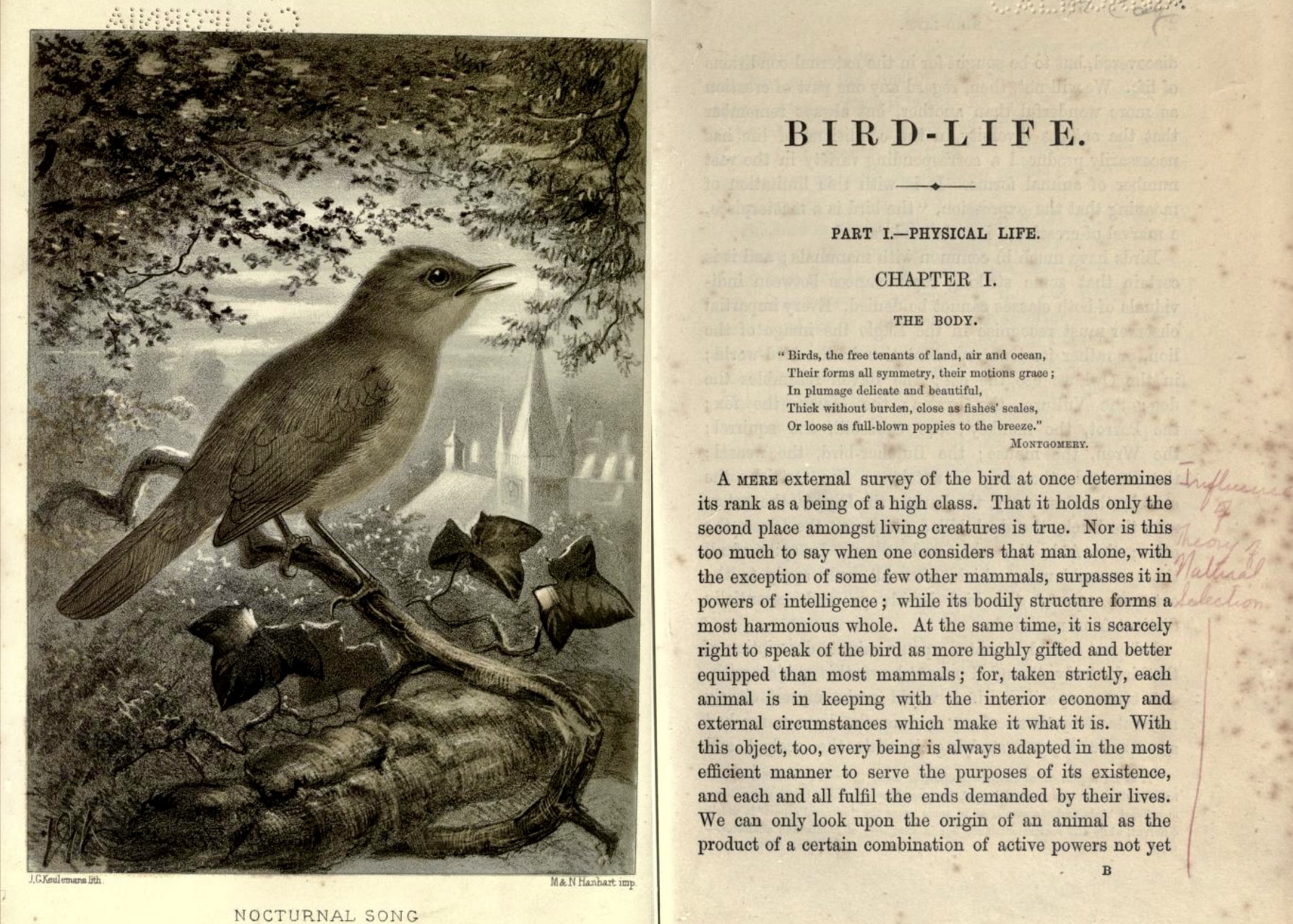
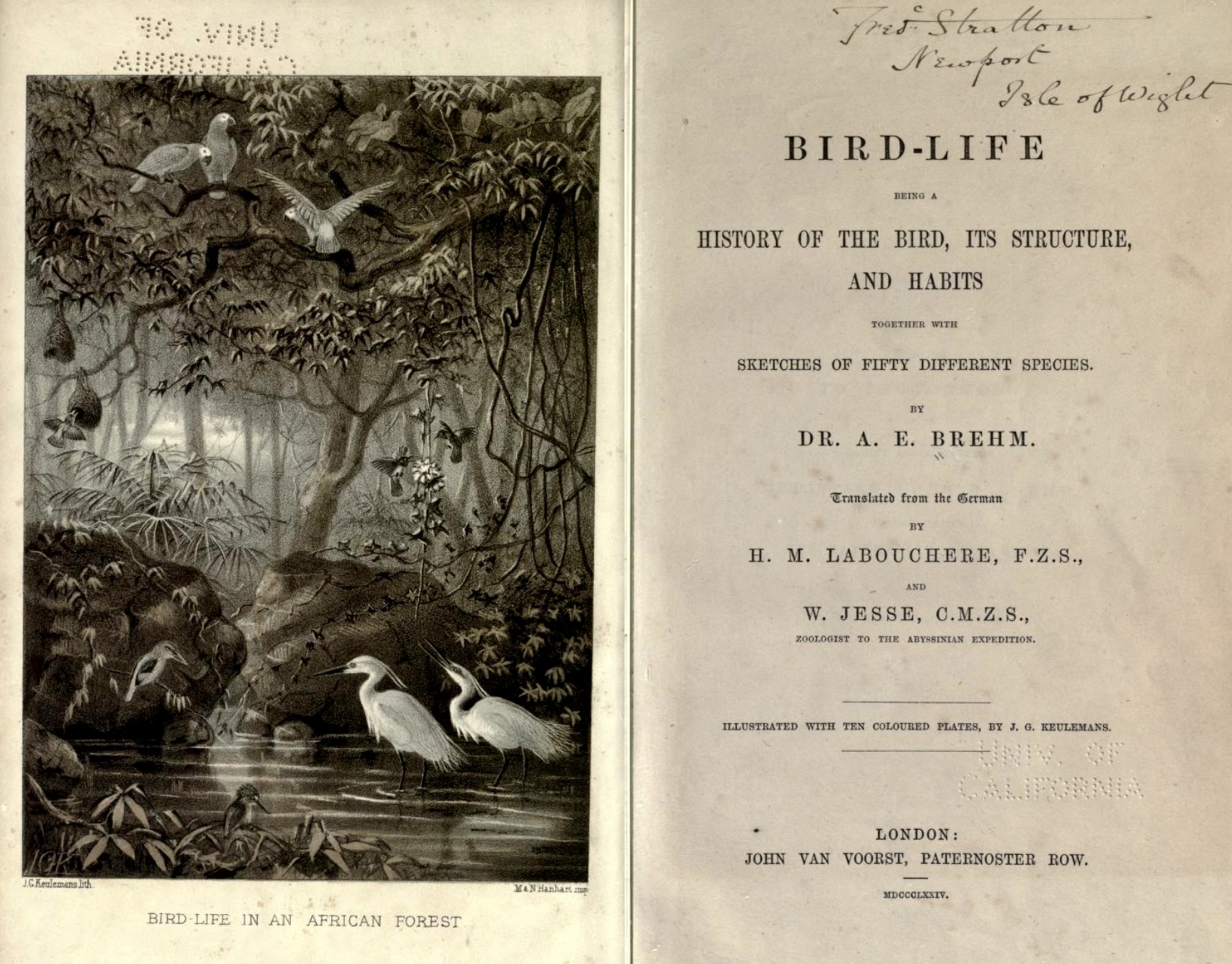
Brehm’s book Das Leben der Vögel (“The Life of Birds”), was first published in 1861. It was a detailed overview of bird behavior, structure, and habits. With sketches of fifty different species, it featured eleven hand tinted lithographic plates by the Dutch ornithological artist J. G. Keulemans (1842 – 1912), known for illustrating many of the seminal 19th century books on birds. The book is dedicated to Brehm’s father, Christian, a pastor and noted ornithologist. A second edition was published in English in 1874. The frontispiece is entitled “Bird Life in the African Forest,” and the first chapter is preceded by an illustration entitled “Nocturnal Birds.” These illustrations are notable for depicting the birds in their native habitats. As Brehm explained the biological reason for this in his foreword: ‘every being is always adapted in the most efficient manner to serve the purposes of its existence, and each and all fulfil the ends demanded by their lives.
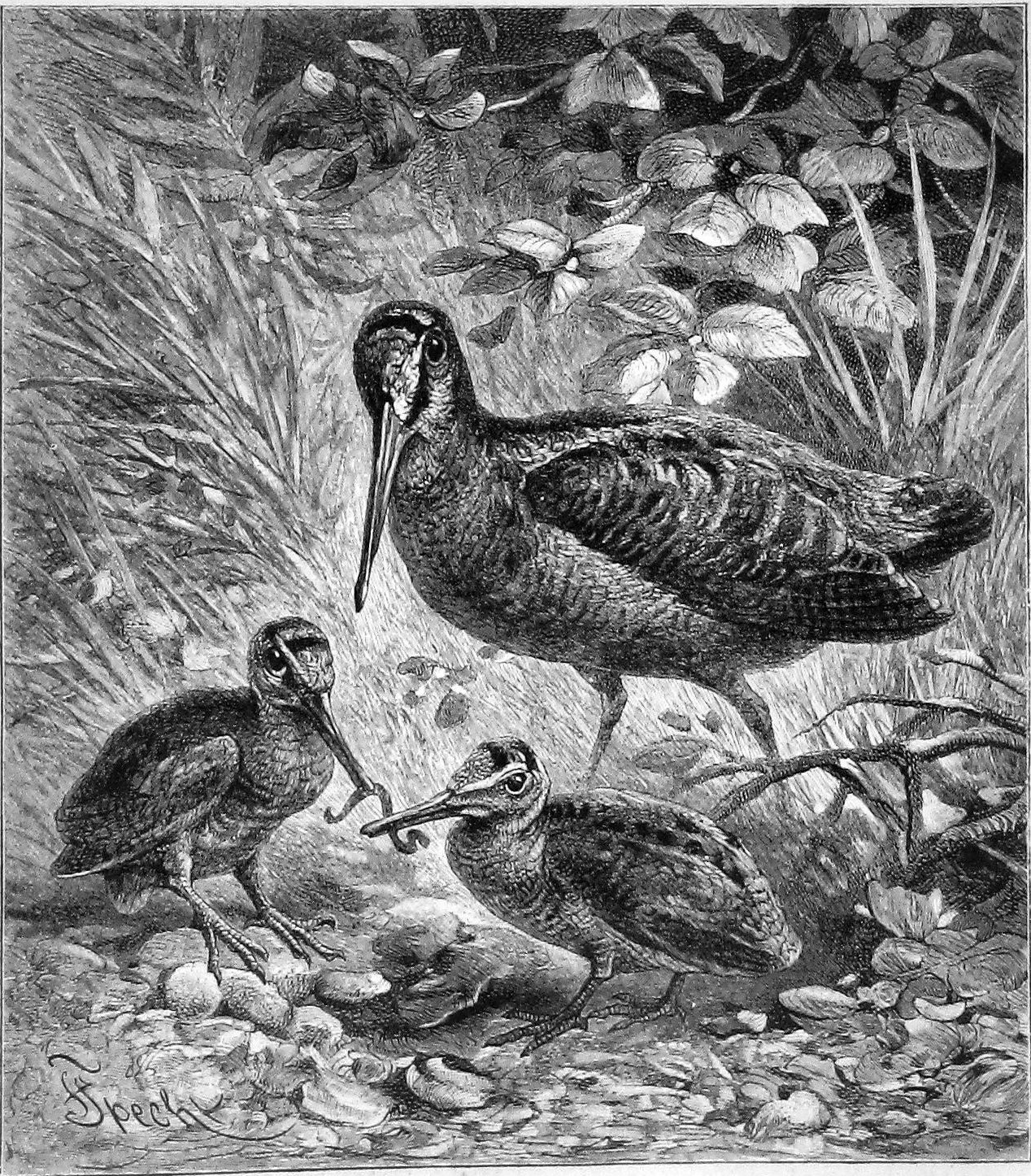
Scientists praised the high quality illustrations in Thierleben; even the illustrious Charles Darwin described them as “admirable” in an 1881 letter to Brehm. The edition refered to by Darwin included more than 2,000 illustrations, a mix of woodcuts, black and white illustrations, and colored plates. One of the artists who most contributed to Brehm’s work was Friedrich Specht (1839 – 1909), a renowned animal illustrator. His 1890 woodcut of a nesting Woodcock “Waldschnepfe” with her chicks is a forerunner of the concept of the habitat group.
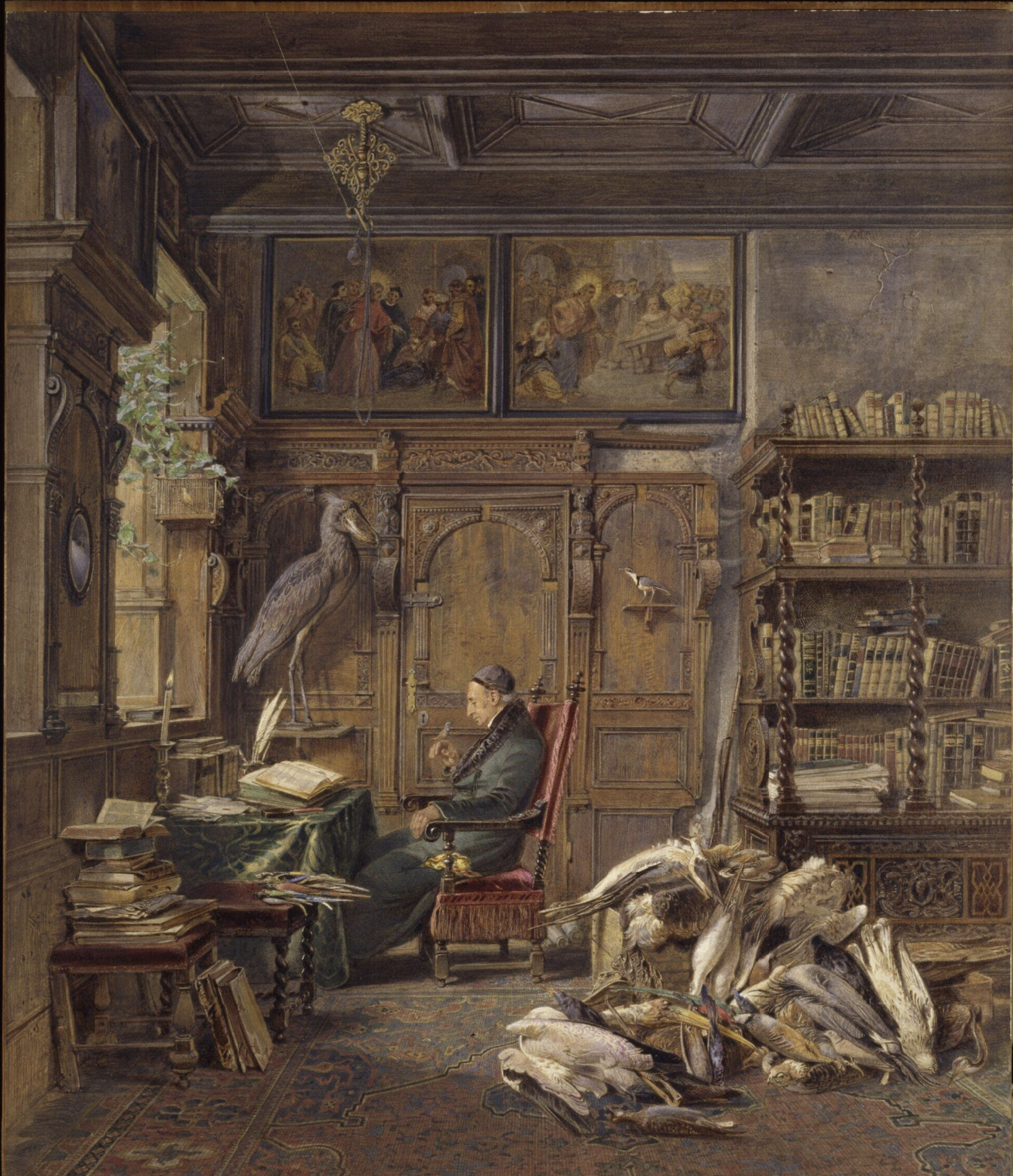
A portrait by Karl Werner painted c. 1860 shows the father of Alfred Brehm, the respected German ornithologist and pastor, Christian Ludwig Brehm (1787 – 1864), in the study of his rectory. Titled “Der Schatzmeister der Wissenschaft” (Treasure Keeper of Science), the scene emphasizes Brehm’s life as a naturalist, collector and pastor, surrounded by his collections of natural history books and bird skins. An avid bird collector, Brehm shot and preserved the specimens.
Most prominent among his “treasures” of science is the large and imposing mounted bird standing over Brehm. This is a Shoebill stork (Balaeniceps rex), a species that was a biological sensation in Europe during the mid 19th century due to its rarity. It had only been identified in the early 1850s and presented a taxonomic puzzle; naturalists could not determine if it was a stork, a heron, or a pelican. Its prominence in the painting reveals Brehm’s identity as a systematist, dedicated to classifying nature through physical comparison.
When Alfred Brehm undertook scientific collecting expeditions to Sudan and the Blue Nile in the late 1840s and early 1850s, it is likely that he returned with the Shoebill treasure for his father. The prehistoric and statuesque appearance of the Shoebill made it a coveted prize: owning a Shoebill specimen was a mark of prestige and signified that the Brehms, father and son, were at the centre of a global exchange network of skins and data. It also reinforced the status of Brehm senior as the “Vogelpastor” (Bird Pastor), whose private rectory held rare specimens that rivalled major national museums.
While Christian Brehm’s life revolved around compiling a large, 15,000 specimen bird collection to catalog God’s creation, his son aimed to describe and represent animals in a context of living nature. The two Brehms represent the convergence that was a crucial bridge between early 19th century natural history to modern biology. In his work, Alfred Brehm moved from classifying species to observing their appearance and behavior in relationship to their natural habitats. Natural history was thus no longer a static inventory of creation but dynamic understanding of life communicated by Brehm’s reliance on extensive visual representation, thus creating a popular understanding of the biology of the animal world.
Unlike his father, Alfred Brehm was critical of the widespread destruction of animal life he witnessed and as early as 1858 he published a passionate plea for the protection of birds, “Schutz den Vögeln!” In this conservation landmark, he wrote: “The stupidity and malice of humankind are clearly demonstrated by the senseless persecution and destruction of many animals. . . Has he who indifferently destroys a thousand lives, who annihilates a joyful heart in its very bud, never considered what a bird truly is? Has it never become clear and understandable to him that the bird is a poetic image, a magnificent poem by the great poet Nature?
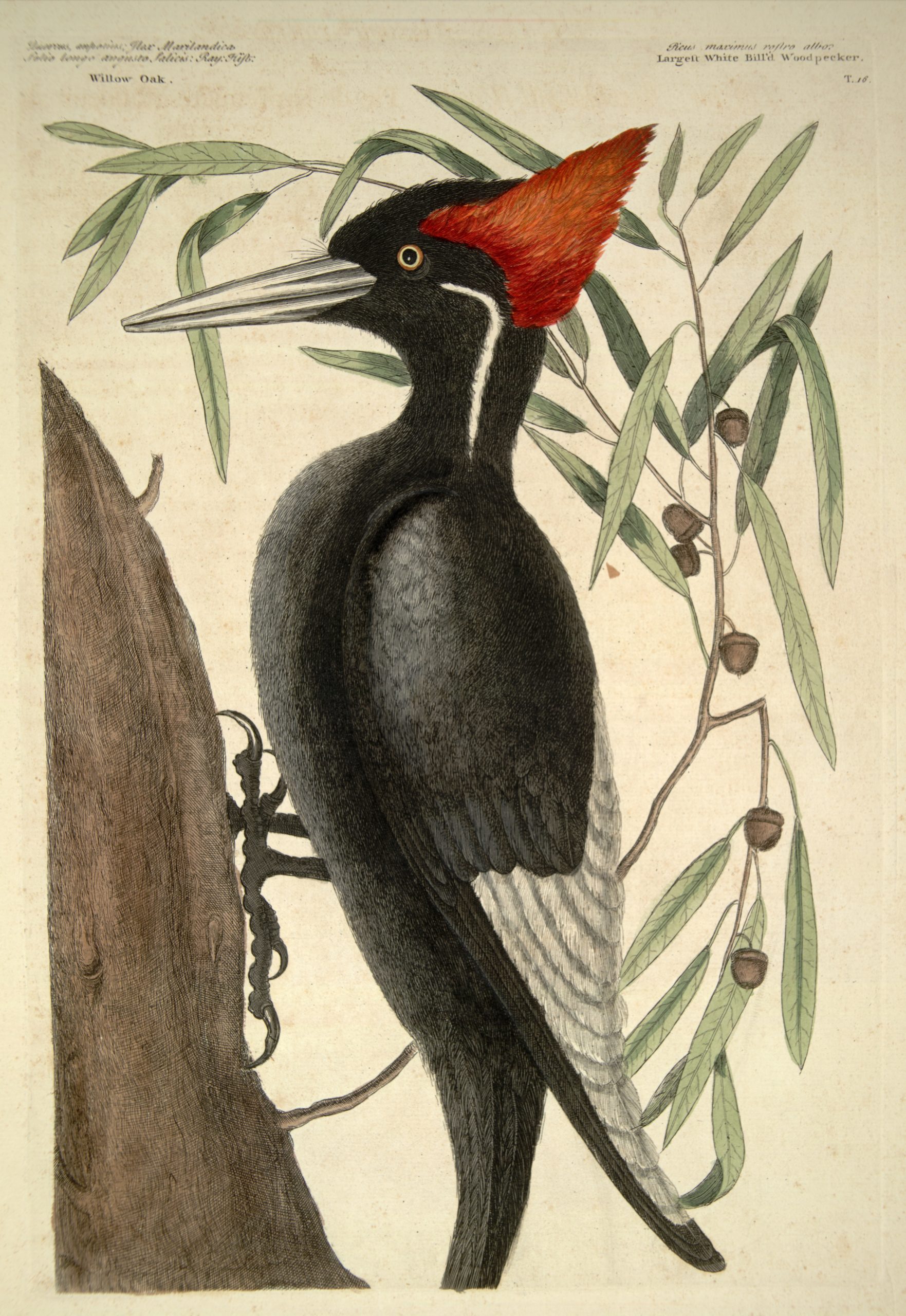
One of the tragedies of animal extinction is the American species, the Ivory billed Woodpecker. First to describe seeing the remarkable species in its native habitat was the English naturalist Mark Catesby (1683 – 1749). His portrait of a male bird is inscribed in Latin as Picus maximus rostro albo (the largest white bill Woodpecker). It is pictured foraging on the trunk of a tree alongside a branch of Willow Oak. Catesby’s description and engraving was published in his book, Natural History of Carolina, Florida, and the Bahama Islands (1731) which enabled Linnaeus to classify the species as Picus principalis in his 1758 Systema Naturae.
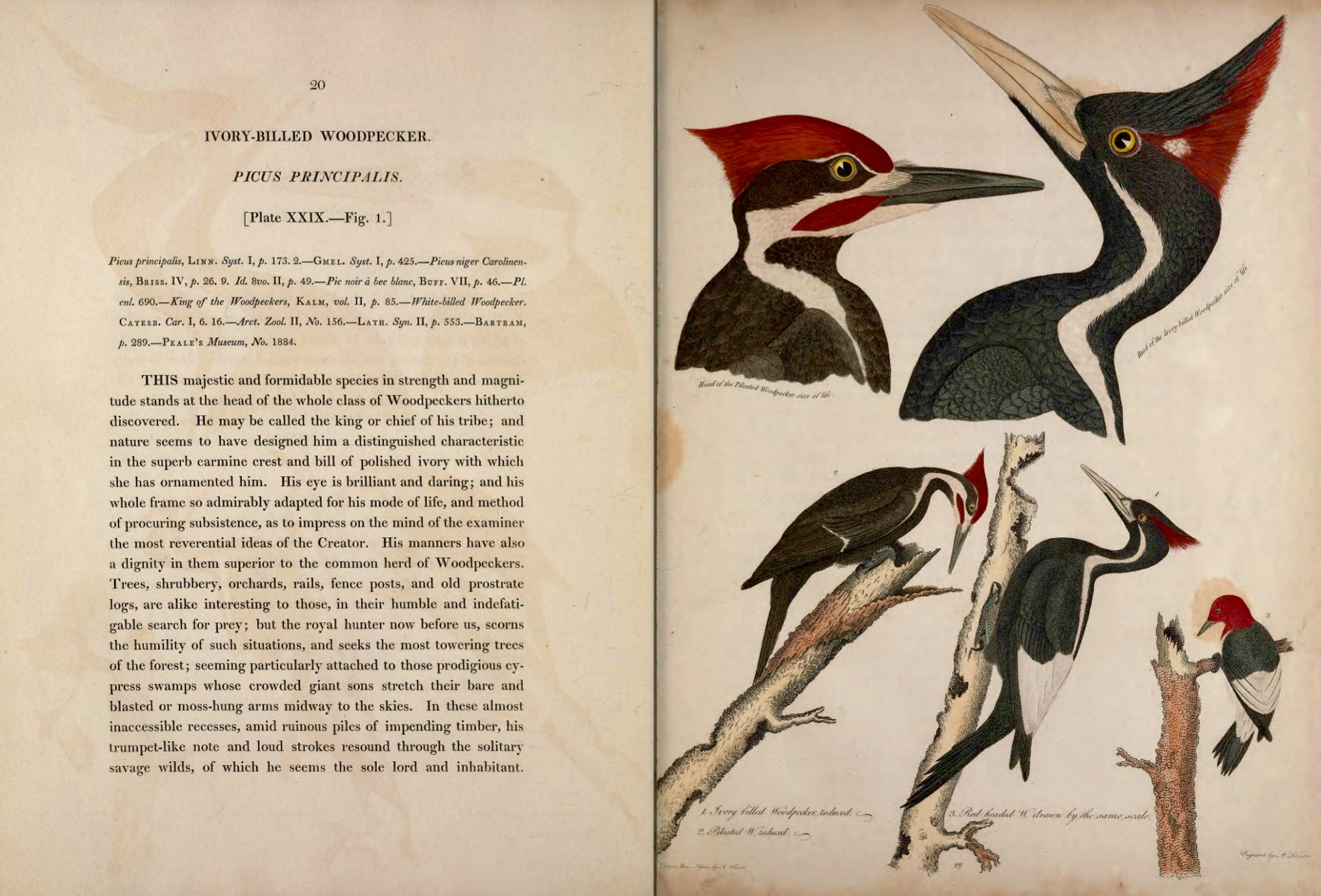
Another naturalist to illustrate the Ivory billed Woodpecker was Alexander Wilson (1766 – 1813). A hand engraved plate was published in his American Ornithology (1811). Wilson’s portrait of the Woodpecker’s head was done from a live bird that he had wounded after shooting it. The bird fought his captor for days before dying from his injuries. Wilson wrote a reverential memorial for the bird that had been sacrificed for science: “This majestic and formidable species in strength and magnitude stands at the head of the whole class of Woodpeckers hitherto discovered. He may be called the king or chief of his tribe; and nature seems to have designed him a distinguished characteristic in the superb carmine crest and bill of polished ivory with which she has ornamented him. His eye is brilliant and daring; and his whole frame so admirably adapted for his mode of life, and method of procuring subsistence, as to impress on the mind of the examiner the most reverential ideas of the Creator.”
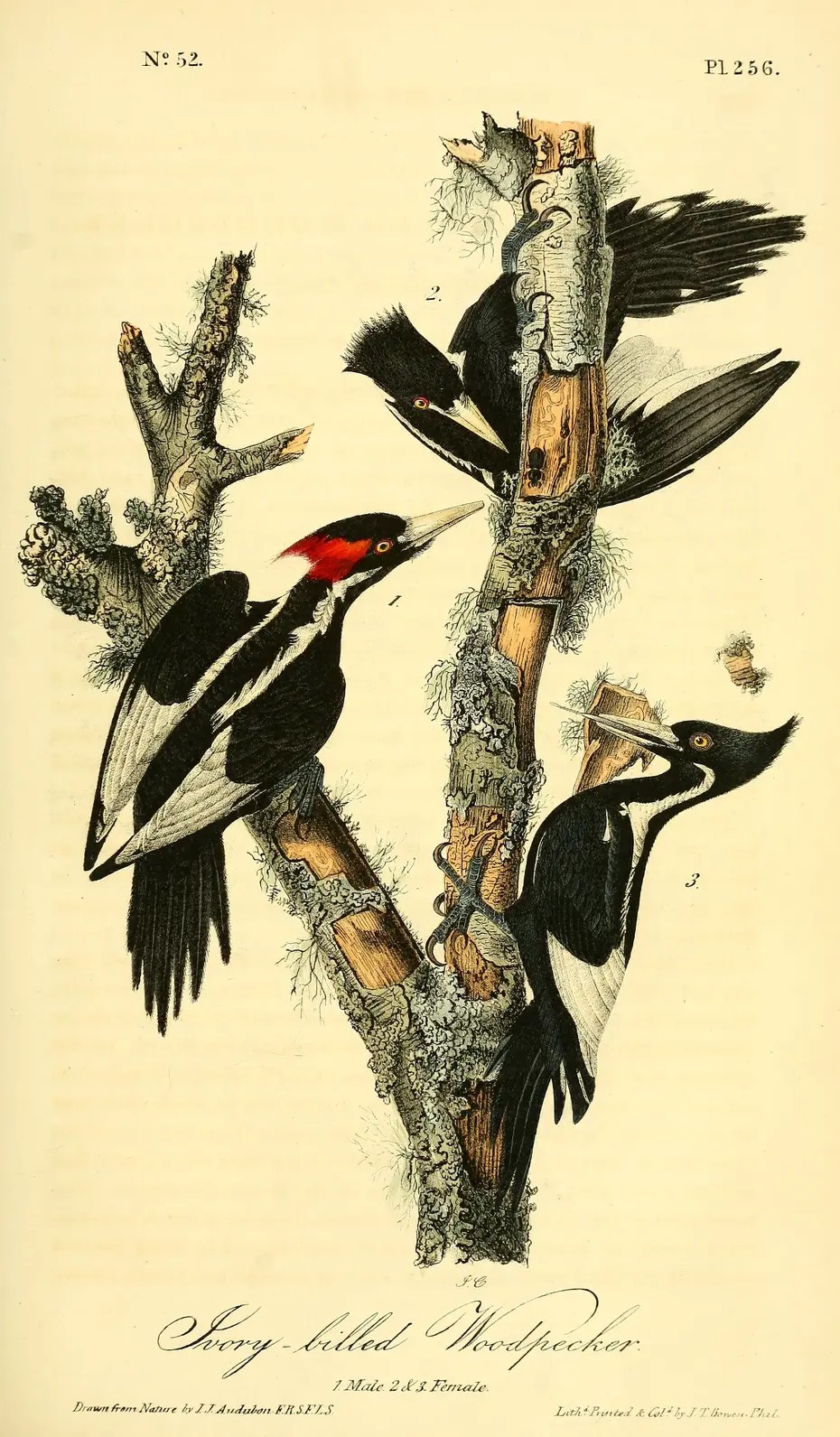
A mysterious species that inhabited the impenetrable old growth forests of southern swamps, Wilson described the bird’s “noble and unconquerable spirit” with its “trumpet like note and loud strokes [that] resound through the solitary savage wilds, of which he seems the sole lord and inhabitant.” He wrote in detail about the individual male bird that he had shot and wounded in a North Carolina swamp; its rage at captivity and anguished human sounding cries led the naturalist to conclude: “I witnessed his death with regret.”
The naturalist and artist, John James Audubon (1785 – 1851), also portrayed the Ivory Billed Woodpecker in his ambitious folio book The Birds of America (1827 – 1838). It was said to be his favourite bird species and he devoted many pages to its description, comparing its beautiful plumage to the colouring of the Dutch master Van Dyke: “The broad extent of its dark glossy body and tail, the large and well defined white markings of its wings, neck, and bill, relieved by the rich carmine of the pendent crest of the male, and the brilliant yellow of its eye, have never failed to remind me of some of the boldest and noblest productions of that inimitable artist’s pencil.” Audubon observed that the birds moved in pairs, stating “Their mutual attachment is, I believe, continued through life.” Perhaps this explains the grief of Wilson’s captive bird who would have left behind his mate.
Like Wilson, Audubon observed the elegant swooping motions of the bird and the distinctive sounds that it made in the depths of the dark primeval forest where it lived on insects, larvae and grubs procured by ripping off the bark from the damaged wood of mature rotting trees. Yet despite his adulation, Audubon remarked on the difficulty of procuring specimens of the bird, saying that even after being shot, it would retreat for days to the top of trees until falling to after its death. Naturalists only shot birds with fine pellets so as not to disturb the scientific value of their skins which resulted in a slow and painful death for the bird. Audubon declared the Woodpecker to be abundant in the southeastern areas but complained that because of its beauty, the male was the object of trophy hunters.
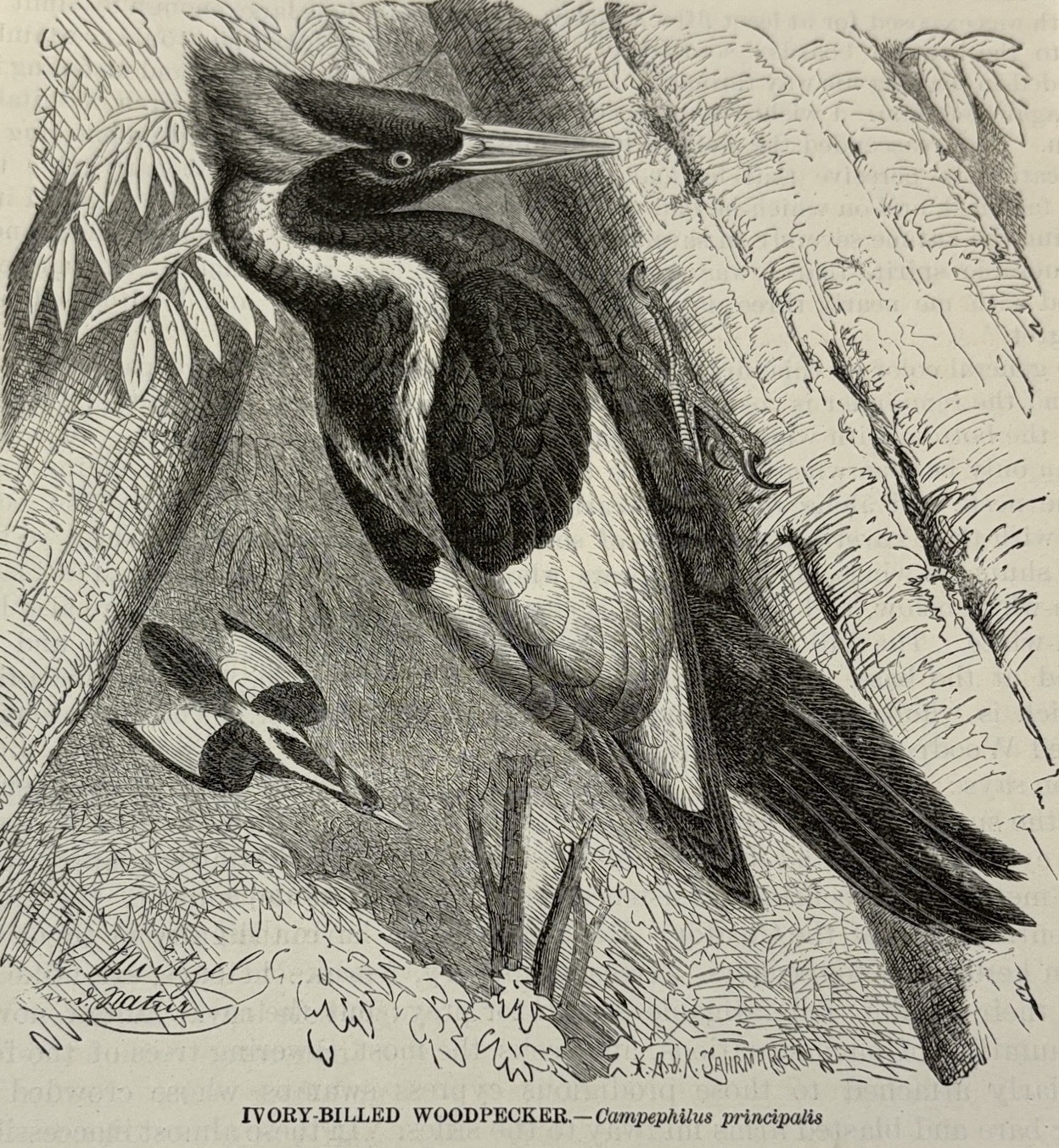
As more specimens of the rare Ivory billed Woodpecker were collected, sold and distributed, representations of the species appeared in popular books. The second edition of the 10 volume Brehm’s Thierleben (1876 – 1879) included such an illustration by Gustav Mützel (1839 – 1893). Although trained as an artist at the Berlin Academy of Art, Mützel did not have expertise as an ornithologist and his woodcut illustration, which is signed by him in the lower left corner, relied on the depiction by Catesby and others. In turn the Mützel woodcut was published in the 1903 5th edition of the Key to North American Birds by the American ornithologist Elliott Coues.
In the days before photography, ornithological books often utilized existing images from renowned European sources like Brehm as an economical way to provide high quality imagery without the expense of creating new engravings for every species. In the case of the Ivory billed Woodpecker, this practice shows how incorrect anatomical observations could be presented as scientific over centuries. Catesby’s 1731 depiction of the species tail feathers was incorrect, for example, and this mistake continued through to the woodcut by Mützel. Few zoological illustrators were able to make visual studies of the living animals in nature, so they utilized the images by other artists. Without living models, the primary references for artists were bird skins, skeletons and mounted birds.
One reason for the lack of knowledge about the morphology of the wings structure of the woodpecker was caused by specimens that were preserved as lifelike mounts. There were commonly positioned with closed wings, perched on the side of a tree to illustrate their position while foraging, with their wing characteristics obscured. This is also the position of most of the visual representations of the species.
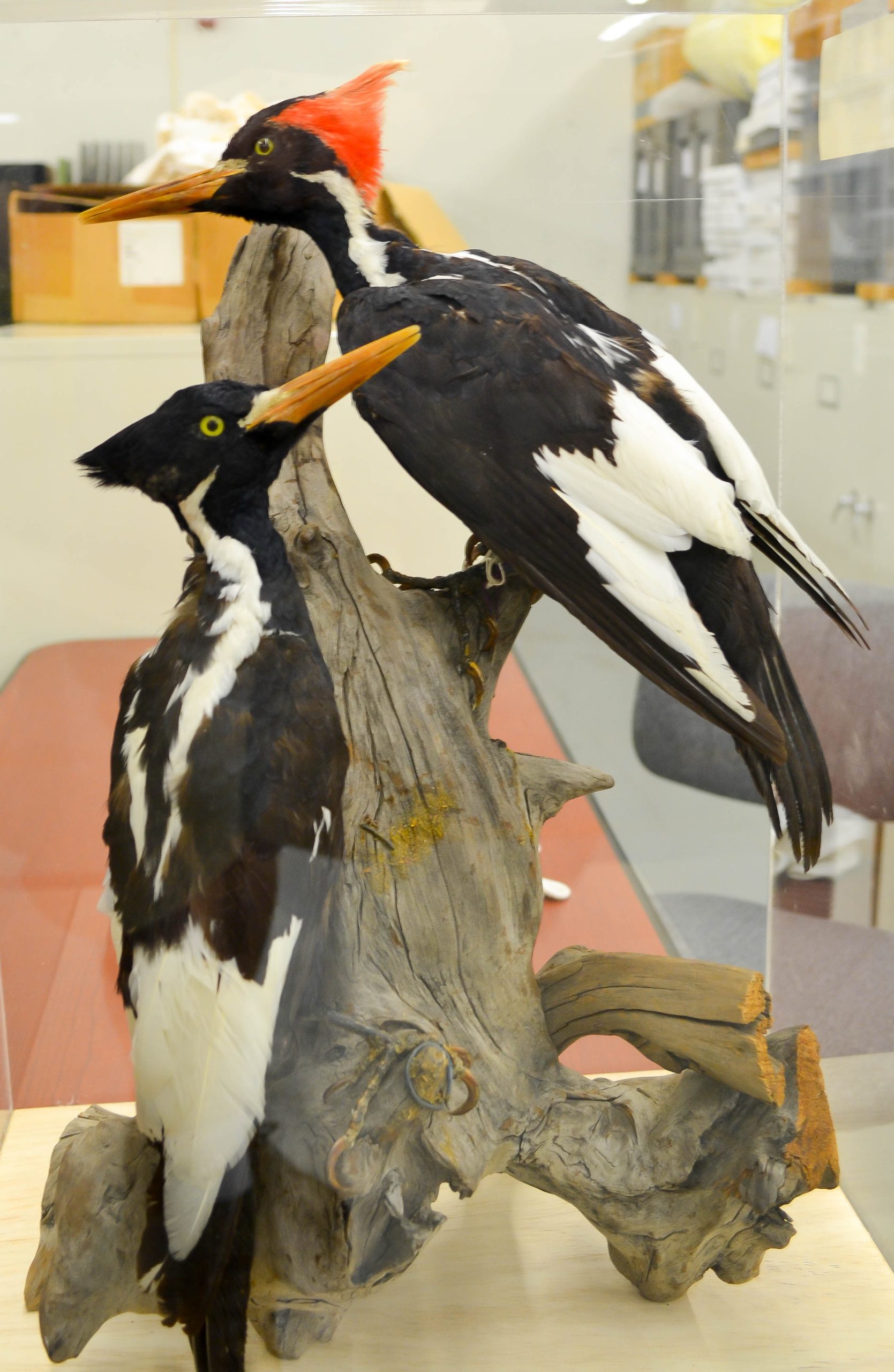
Today there are 413 reported Ivory billed Woodpecker specimens housed among collections of 90 institutions in North America and Europe. Of these, only four are extended wing specimens. The Harvard Museum of Comparative Zoology has the world’s largest (along with one of three nesting cavities in existence), acquired between 1860 and 1907. The American Museum of Natural History has 41 specimens. Two specimens are on public display at the Florida Museum of Natural History. A rare family group of three Ivory billed Woodpeckers mounted on the section of tree that housed their nest cavity is in the collection of the Louisiana State University Museum of Natural Science, and so on.
The Ivory billed Woodpecker was a treasure of nature, a large and magnificent native American bird species that was highly sought after by private collectors and museums around the world. Notably museum “acquisitions” largely occurred during the period of its extirpation. From the 1880s, the old growth swamp forests in the coastal southeast were subject to rampant industrial logging which destroyed the habitat of the species and accelerated its decline. The last stand in which the birds were found was the Singer Tract in northeastern Louisiana, which was clearcut in the late 1930s. The only photographs of the bird were taken here in 1935, along with the single recording of the birds’ distinctive double knock drum and nasal tooting calls. The last sighting was of a female bird in 1944. Finally in 2021, the iconic species known as the “Lord God Bird” was declared dead. Note that any colour photographs of this remarkable bird have been taken of mounted museum specimens.
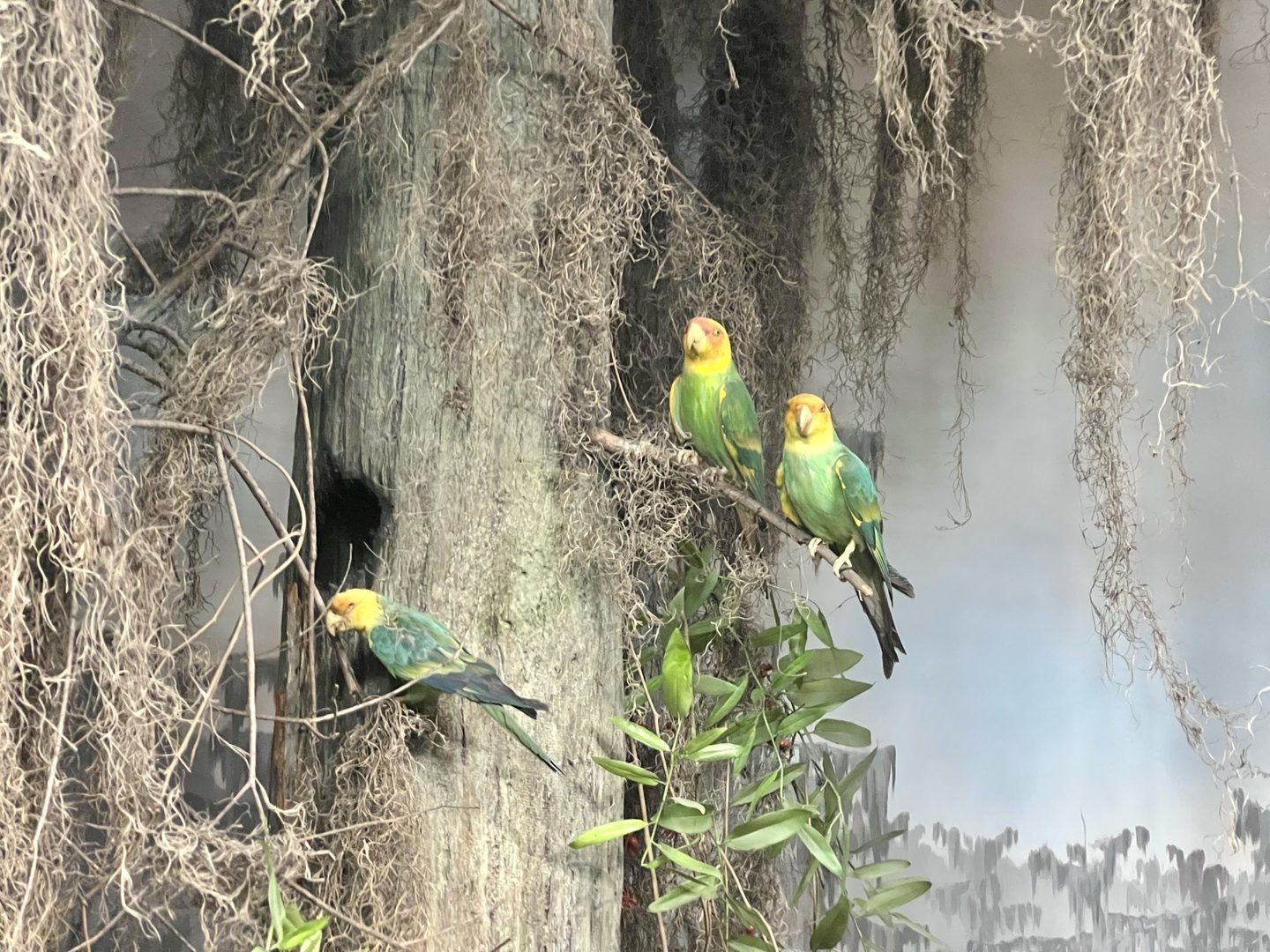
The Avery Island Diorama at the Denver Museum of Nature & Science features two species that are extinct: the Ivory billed Woodpecker and the Carolina Parakeet. Both birds were inhabitants of the deep old growth swamp canopy, nesting in ancient hollow cypresses and sycamores. The diorama is part of a historic series of displays that features the rare, endangered, or extinct birds of the Americas. Constructed between 1919 and 1923, they are regarded by the museum as historically significant legacy exhibits. In 1922, museum director Jesse D. Figgins instigated a trip to Avery Island in Louisiana to conduct research and collect specimens for a diorama that recreated a subtropical swamp habitat, famed for its salt dome geography and its historical status as a private avian sanctuary established by Edward Avery (E.A.) McIlhenny in 1895 to protect the Snowy Egret from the plume trade.
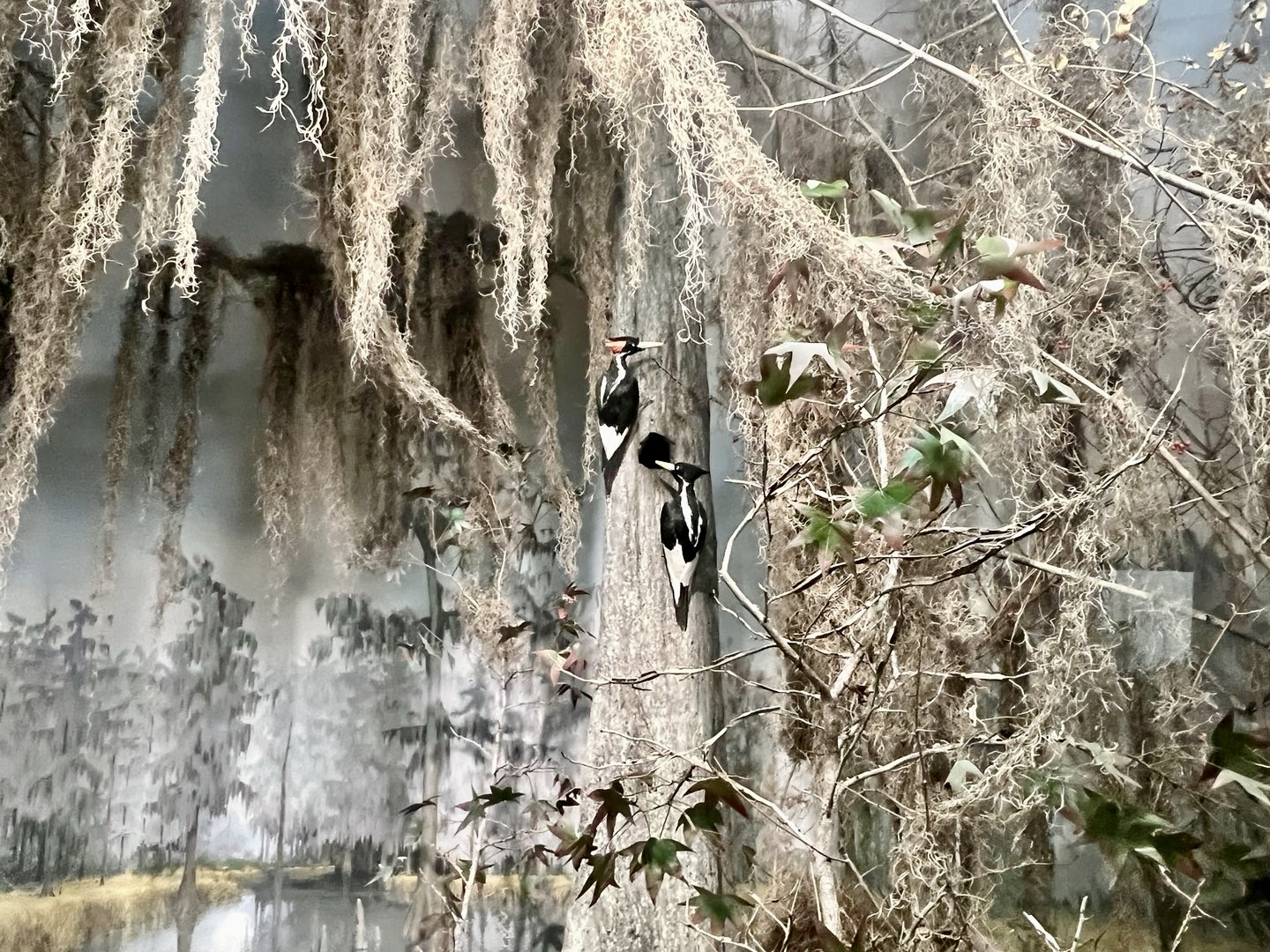
McIhnenny was a donator to the Avery Island Diorama, which was installed in 1922 in the Standley Memorial Wing of the Denver Museum. The hall featured North American birds and was funded by Ellen M. Standley. In 1941 McIhenny expressed his regret over the passing of the Ivory billed Woodpecker, laying the blame squarely on the destruction of the forests by the logging industry.
Seen in the Avery Island Diorama are replicas of the massive ancient trees that developed large hollow cavities as they aged. These trees were essential to flocks of Carolina Parakeets for communal roosting and colonial nesting and the loss of the old growth forests in the swamplands was a major factor in the demise of the species. As their forests were cut down and replaced with agricultural land, the farmers shot entire flocks of parakeets feeding on the crops. Flocks were also shot in huge numbers to supply the millenary industry with colourful plumes. By 1904 the parakeet was gone from the wild, and in 1918 the last bird died in captivity at the Cincinnati Zoo.
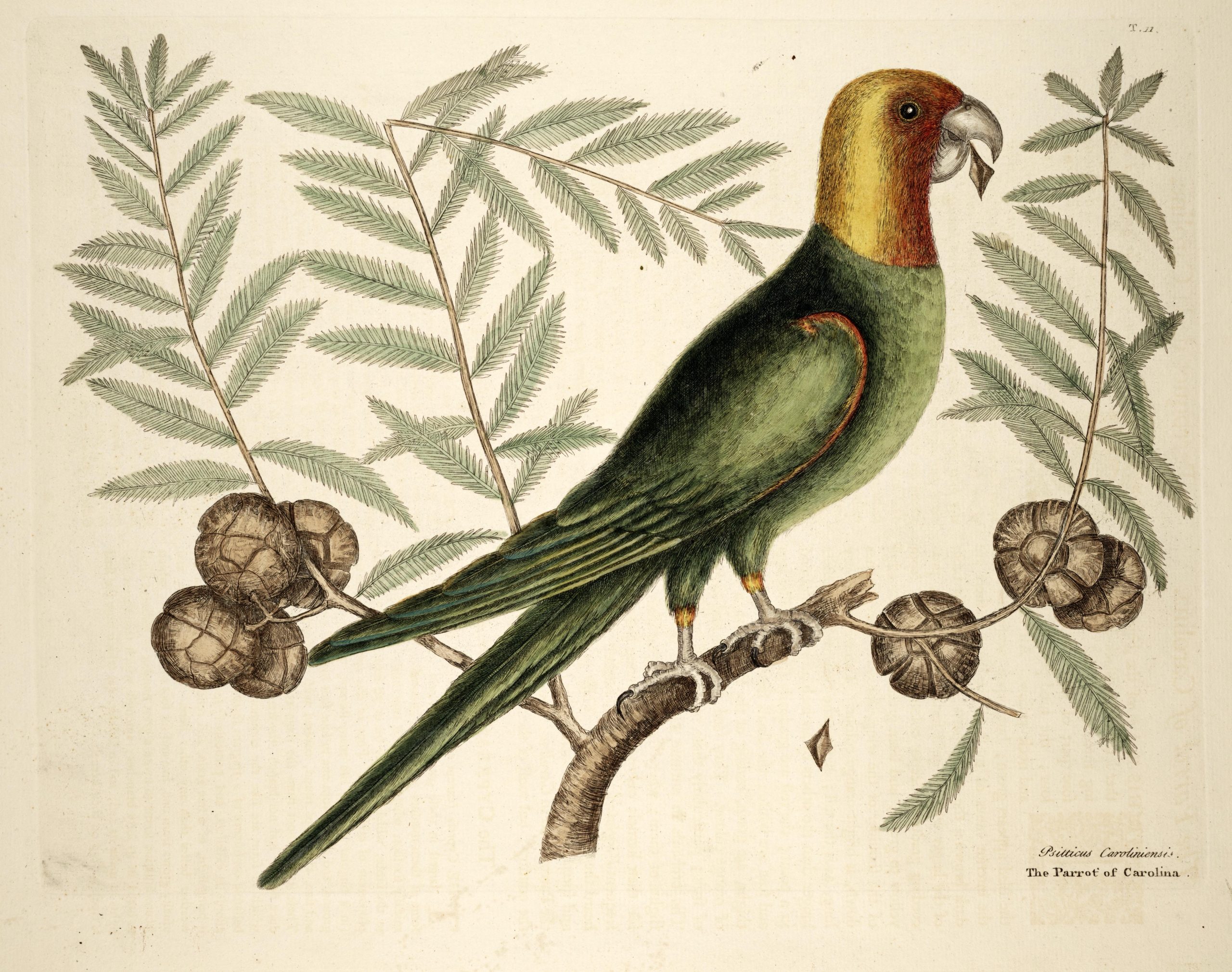
Published in 1731, the etched plate titled “The Parrot of Carolina” (Psittacus Caroliniensis) appears as Plate 11 in Volume I of Mark Catesby’s seminal work, The Natural History of Carolina, Florida, and the Bahama Islands (issued in parts between 1729 and 1743). Although Catesby’s illustration serves as the holotype (the visual basis for the original description), Linnaeus received official credit for the scientific name: Conuropsis carolinensis (Linnaeus, 1758). In 1891, Italian ornithologist Tommaso Salvadori assigned the species its own genus, Conuropsis, just three decades before its extinction. Catesby identified the tree in his illustration as the American Cypress (Taxodium distichum). The woody cones depicted on its branches were a primary food source for the Carolina Parakeet; the seasonal ripening of this cypress mast dictated the flocking and migratory movements of the bird across the old growth hardwood forests and dense river swamps of the American Southeast. It was thus known for well over a century that the destruction of the bird’s habitat would ultimately lead to the extermination of the species yet commercial greed persisted.
Like Mark Catesby, the American naturalist and artist Alexander Wilson illustrated the Carolina Parakeet in his opus, American Ornithology (1811). While traveling through the Ohio and Mississippi River valleys, he observed their vast and noisy flocks, noting that they are a nuisance to farmers who commit “great slaughter among them.” At Big Bone Lick in Kentucky, he described the vibrant beauty of a flock that appeared as a “carpet of the richest green, orange, and yellow.” Wilson’s writing reveals his fondness of the intelligence and sociability of the parakeets. After he wounded one bird while shooting into a flock to collect specimens, he adopted it as a traveling companion and pet which he called Pol; “He creeps into my pocket when I ride, and when I alight he comes out to amuse the people where I stop.”
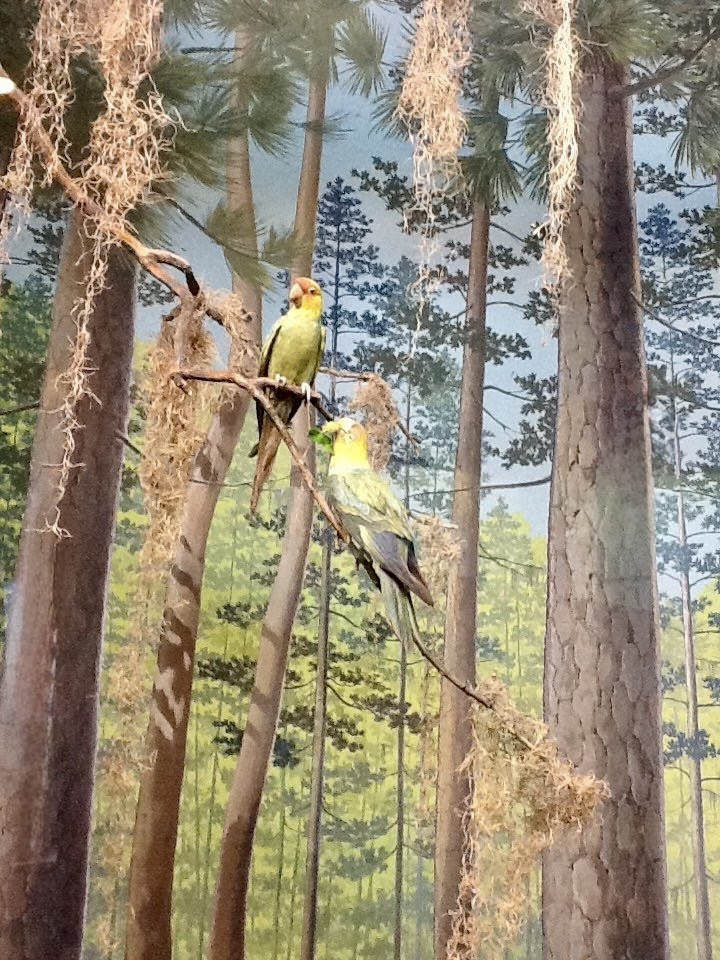
A pair of Carolina Parakeets are shown perched on high branches of the forest canopy in the Wild Turkey Diorama at the Milwaukee Public Museum. The 1962 diorama recreates a scene in the late autumn deciduous woods of Georgia, the light filtering down through the trees. The background was painted by the museum staff artist Robert G. Frankowiak (1933 – 2017), who began working at the museum in the 1950s and over a long career, painted more than 47 murals and diorama backgrounds. His mentor was Owen J. Gromme (1896 – 1991), who served as the museum’s chief taxidermist, curator of birds and mammals, and master artist. As a passionate conservationist, Grome shaped the philosophy of how wildlife was presented to the public during his over four decade career. When the museum moves to a new location in 2027, this diorama and others will become part of a “reimagined” approach that will necessitate the destruction of the original displays with their immovable background landscapes.
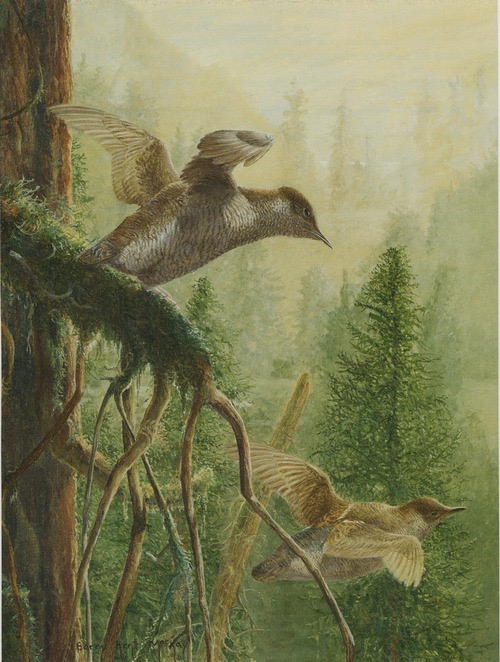
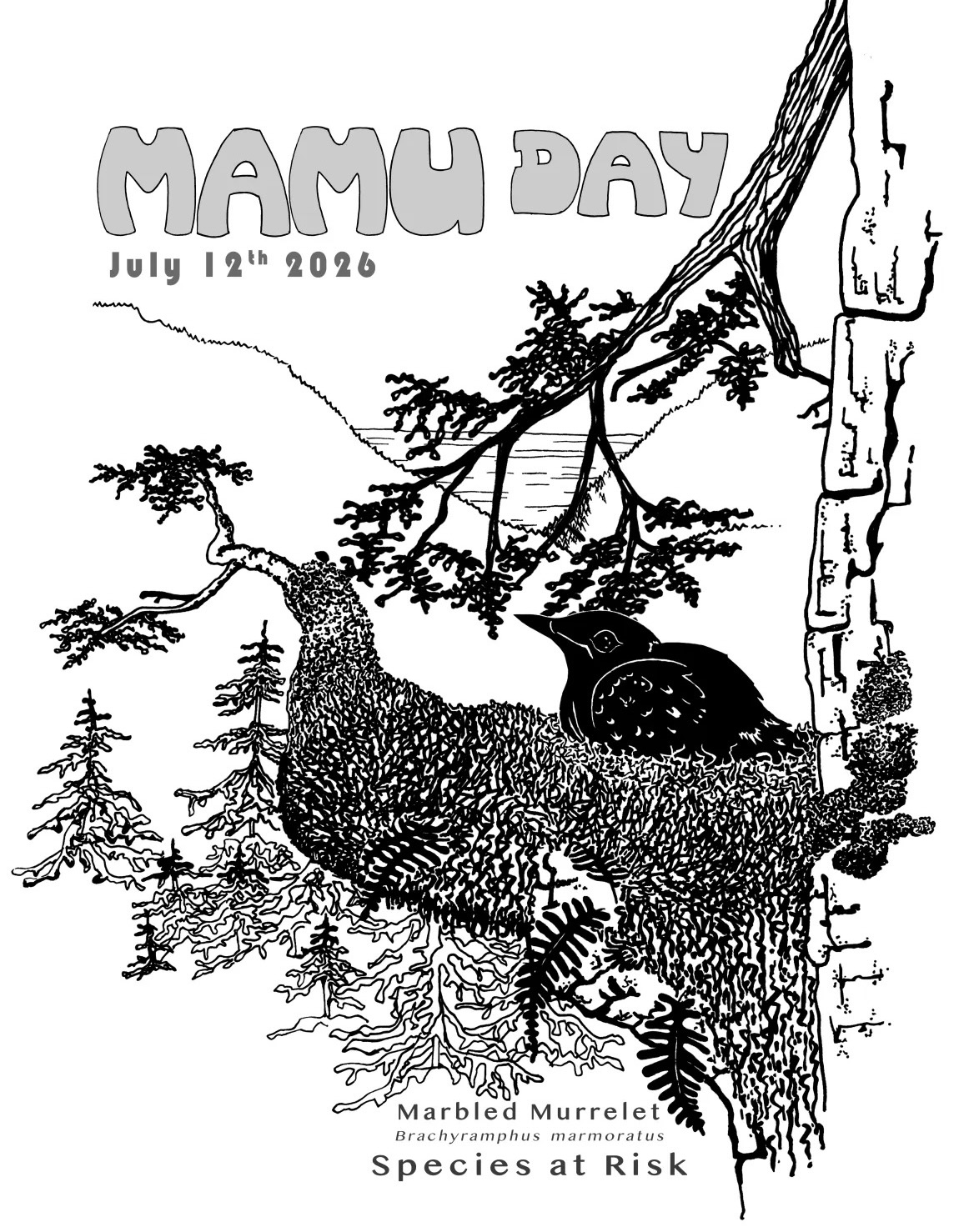
A species currently at risk due to the destruction of its old growth forest habitat is the remarkable Marbled Murrelet (Brachyramphus marmoratus) , a small North Pacific seabird. An alcid (a web footed seabird that includes Auklets, Guillemots, Murres and Puffins), it nests high in the branches of giant old trees. Since the industrial logging of its nest trees began in the past century, the numbers of the Marbled Murrelet have drastically declined.
The Marbled Murrelet was formally described in 1789 by the German naturalist Johann Friedrich Gmelin in his revised edition of Systema Naturae by Linnaeus. He placed it with the Grebes and Loons and gave it the binomial name Colymbus marmoratus. Gmelin based his description on the specimen that had been described and illustrated in 1785 by both the English ornithologist John Latham and by the Welsh naturalist Thomas Pennant. Both authors examined the two specimens in the Leverian Museum that had been collected in Prince William Sound during James Cook’s third voyage to the Pacific Ocean. Cook also described the Marbled Murrelet in his published travel account.
Despite the early discovery and scientific classification of the Marbled Murrelet, there was no knowledge of where the bird nested until 1974, when a nest was accidentally discovered by a tree climber on the upper branch of an ancient redwood tree in California’s Big Basin Redwoods State Park. This was long after the nests of all other North American breeding birds had been discovered. The painting by the Canadian wildlife artist Barry Kent Mackay marks one of the first occasions that a pair of nesting Marbled Murrelets are represented in their old growth forest habitat, hidden in the canopy of an ancient redwood grove.
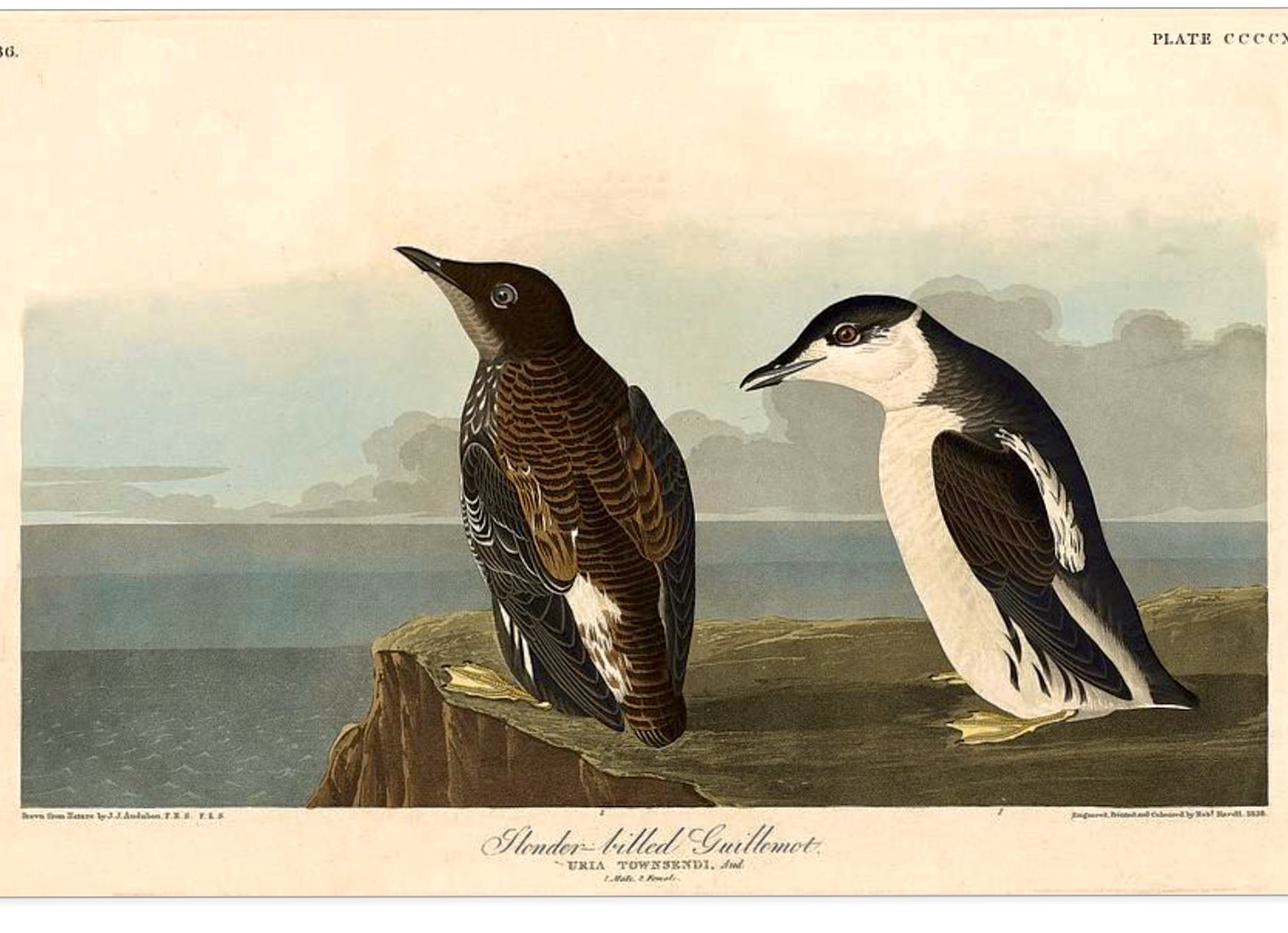
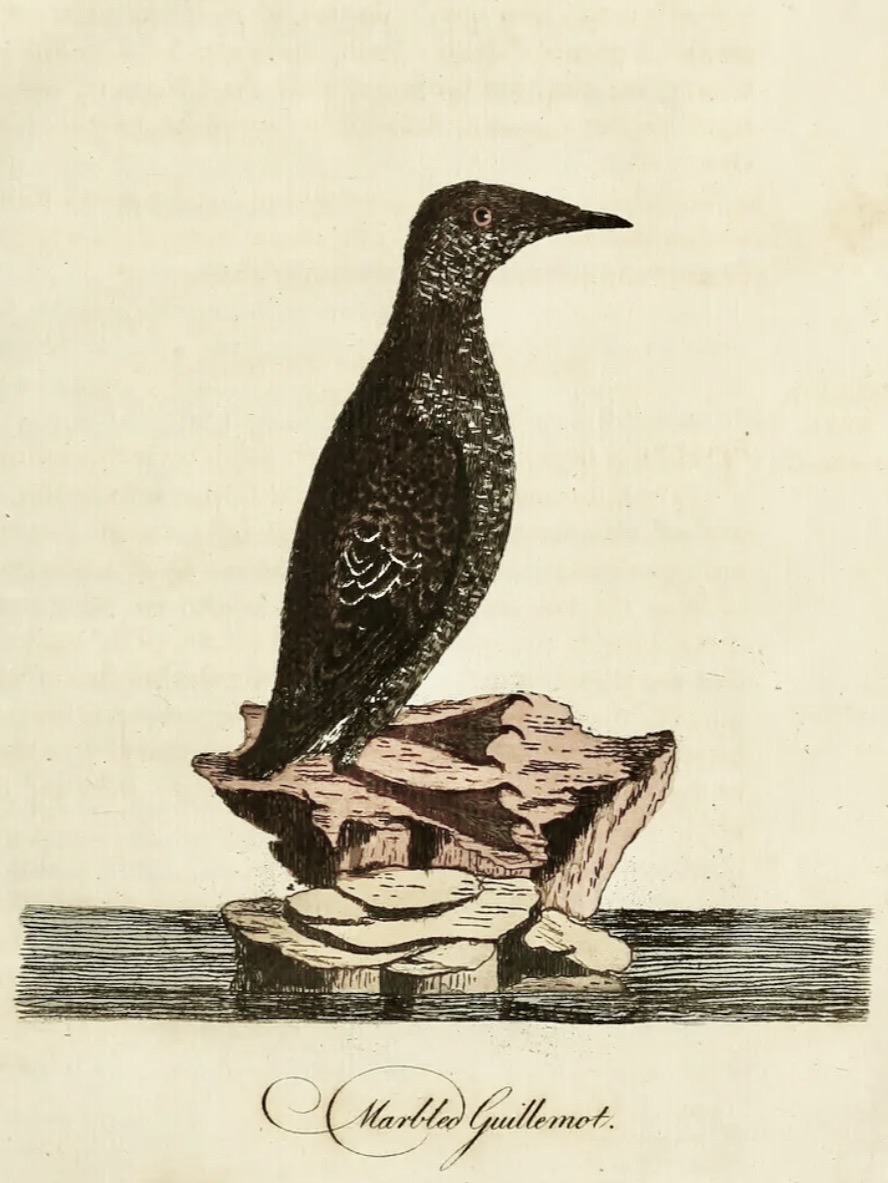
The copper plate titled “Marbled Guillemot” by John Latham appeared in his multi volume work, A General Synopsis of Birds, published in London between 1781 and 1785. The species also appears in Audbon’s The Birds of America (titled the “Slender billed Guillemot”). The original watercolour was painted by Audubon and engraved by Robert Havell in the 1838. The illustration depicts two Marbled Murrelets with their distinctive marbled feathers, the bird at left is in summer “bark brown” breeding plumage, the bird at right in winter plumage. Like Penguins, the Murrelets are incorrectly shown sitting on the ground at the edge of the coastal bluff where they do not nest. Audubon had never seen the living bird and like Latham, relied on skins that had been collected the Pacific Coast.
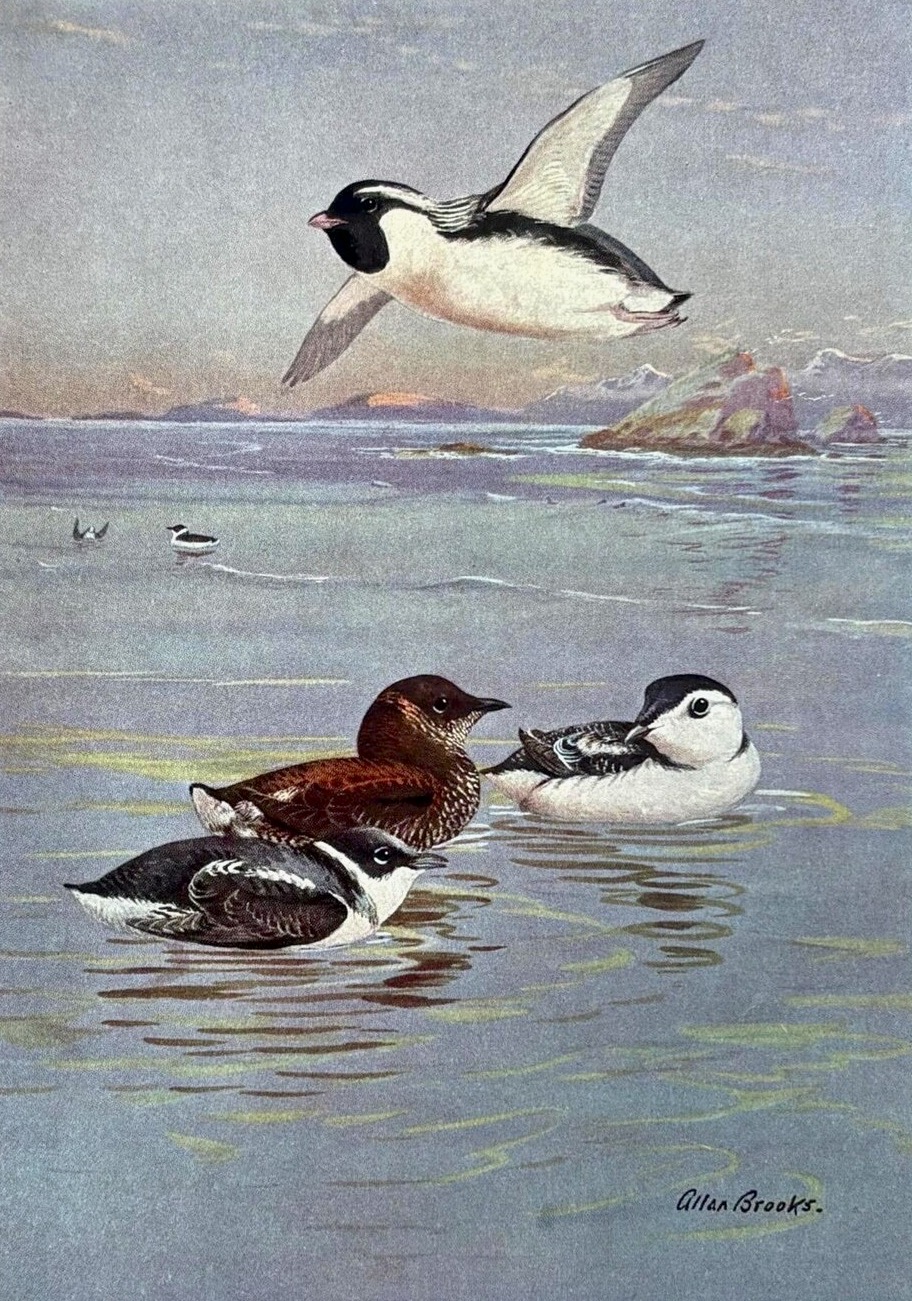
A Canadian ornithologist and artist who did see the Marbled Murrelet in its native habitat was Allan Cyril Brooks (1869 – 1946). In 1885, he met the prominent naturalist Thomas McIlwraith, who taught him how to collect and skin bird specimens. In 1887 Brooks moved to British Columbia and began his career as a specimen collector and hunter naturalist, providing specimens to the Victoria Memorial Museum in Ottawa and a few private collectors. Self trained as a bird artist, the illustrations by Brooks were widely published in some of the landmark ornithological works of the 1920s including Birds of California (1923) by William Leon Dawson; and Birds of Western Canada (1926) by Percy A. Taverner.
The highly regarded illustration of the Marbled Murrelet by Brooks depicts both its brown summer breeding coat and its crisp black and white winter plumage against a misty Pacific Ocean backdrop. This composite image became the definitive visual reference for the species in Canada for a generation. It shows the white head markings of one bird in flight and other three birds in various seasonal plumage. The landscape represented by Brooks is the coastal Northwest, at this time, the only habitat that was associated with the species.
Today some scientists consider the species to be functionally extinct due to the destruction by clearcut logging of its irreplaceable old growth forest nesting habitats. The Marbled Murrelet is small bird, the size of a plump robin. Like a penguin, it uses its wings to navigate underwater to catch fish, to depths as great as 27 metres. Unlike penguins, it can fly at great speed in the air, a remarkable 180 kph has been recorded. The motivation of life and death that lies behind such speed is the need for the bird to traverse quickly from the sea to the forest, during which time it can be attacked by raptors.
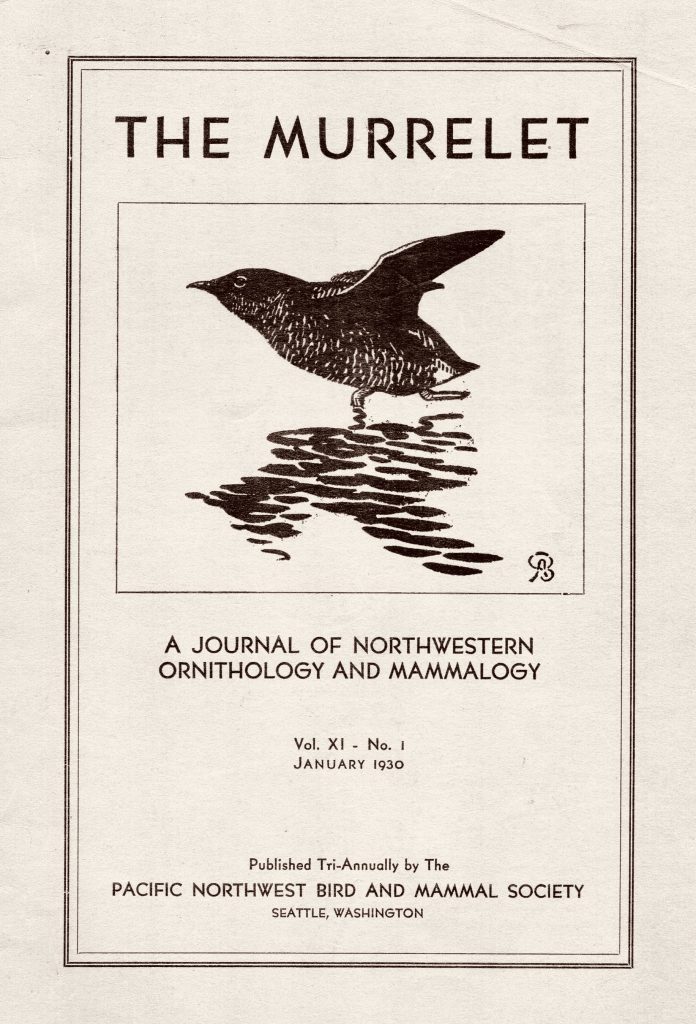
The Murrelet was the founding title of an ornithological journal published by the Pacific Northwest Bird and Mammal Society. Established in 1920, it was named in honour of the unique diving seabirds of the North Pacific, highlighting the region’s rich coastal ecology. Allan Brooks often contributed to the journal, including its cover vignette. The scientific attention given to the Marbled Murrelet, ever since Captain Cook collected its skins in the 18th century, has not saved it from extermination.
There is no legislation to protect the species in British Columbia, where one of the last documented sites of the Marbled Murrelet nesting was the Fairy Creek watershed on Vancouver Island. In 2020 a movement to protect this area from industrial logging erupted into Canada’s largest act of civil disobedience with the arrests of over 1,100 activists. Today, 2026, there still remains no protection of Fairy Creek and a “Mamu Day” has been declared in the ongoing battle to save the species and its habitat.