
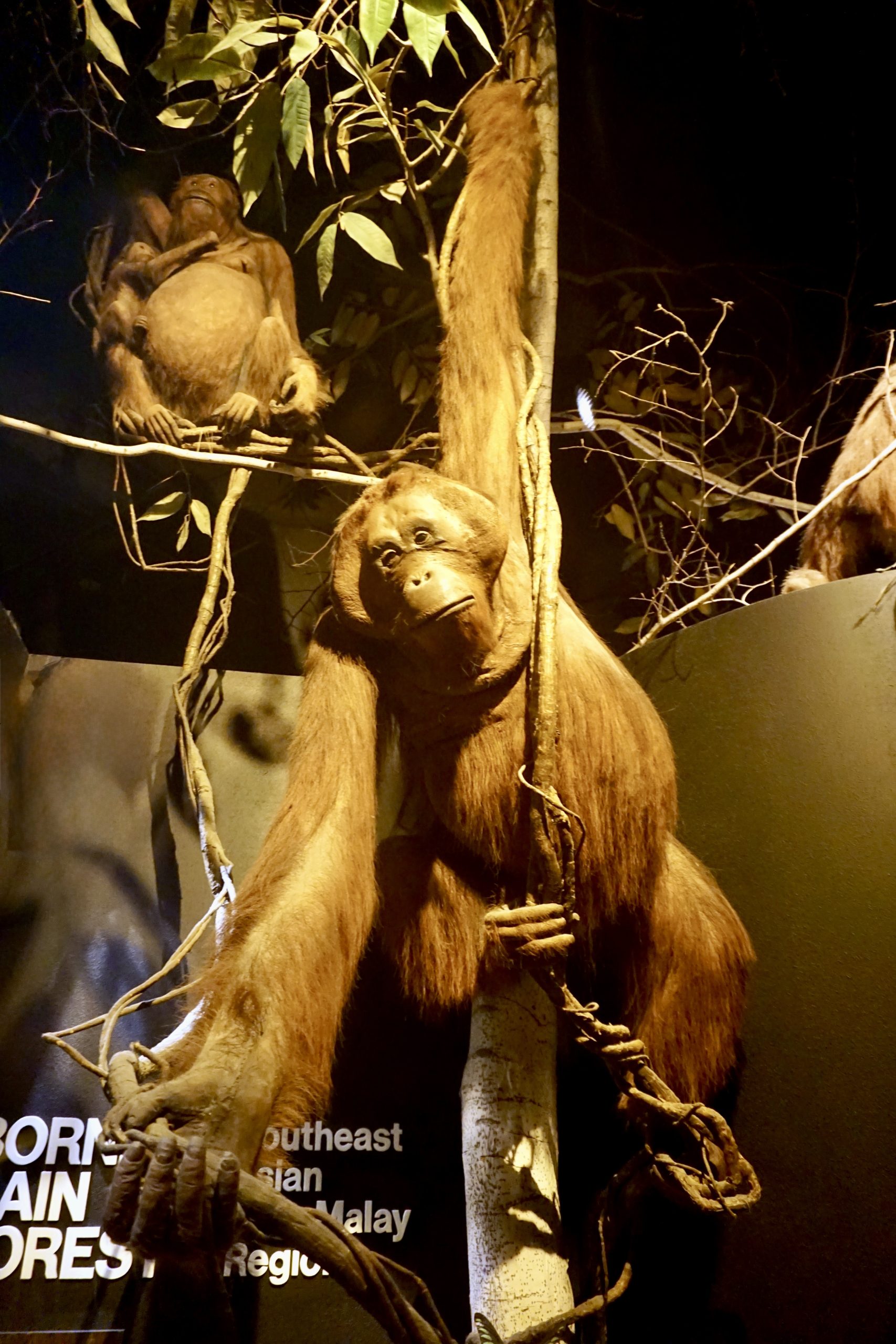
The Orangutan (Pongo pygmaeus) specimens on display at the Milwaukee Public Museum were mounted by Carl Ethan Akeley (1864 – 1926), a taxidermist who worked at the museum from 1886 to 1892. During this period, he created a muskrat group often cited as an early example of a habitat diorama. Akeley later became known for his innovations, the “Akeley Method,” in mounting and displaying large mammals at the Field Museum and American Museum of Natural History. The four orangutans on display in Milwaukee were most likely obtained as skins and skeletons from commercial suppliers of natural history specimens, at a time when the species had become popular both among scientists studying primates and a public fascinated by these humanlike apes. Dead orangutans were also obtained from zoos, which were often unable to keep them alive for long after their importation from Borneo and Sumatra. The Milwaukee display depicts the Borneo rainforest in the Southeast Asian Malay Region. Three adult specimens are shown: the most prominent hangs from a vine covered tree, grasping the vines with both hands and feet; another sits to the side, while above, a female in her nest holds a baby clinging to her chest.
The representation of orangutans and gorillas in museum displays forms part of a continuum shaped by new modes of published visual imagery, advances in taxidermy, scientific discourse, and the presence of living animals in zoos. As knowledge of primates increased, ideological debates about the place of humans in nature intensified, revealing how museums visually historicized humankind in relation to our closest living relatives. Now that all great ape species are threatened with extinction, largely through habitat loss and human activities, understanding how perceptions of these species have shifted since their encounter with Western science takes on new urgency.
An analysis of the iconography of orangutans and gorillas in museum displays reveals the cultural associations and historical perceptions of the human ape interface. Because of the disturbing similitude of these apes with humans, there are complex interconnections that have influenced the way we look at them. The first orangutan specimens to be brought to the US were collected by the American taxidermist William Temple Hornaday (1854 – 1937).
Hornaday spent two years collecting in the East Indies in 1878 and 1879 while working for Ward’s Natural Science Establishment, the largest supplier of natural history specimens in the United States. After several months on the island of Borneo, where he hunted orangutans along the Simujan River, Hornaday’s trophy bag included the skeletons and skins of 43 orangutans. At the time, these animal remains were highly sought after curiosities for both for scientific research and public display.
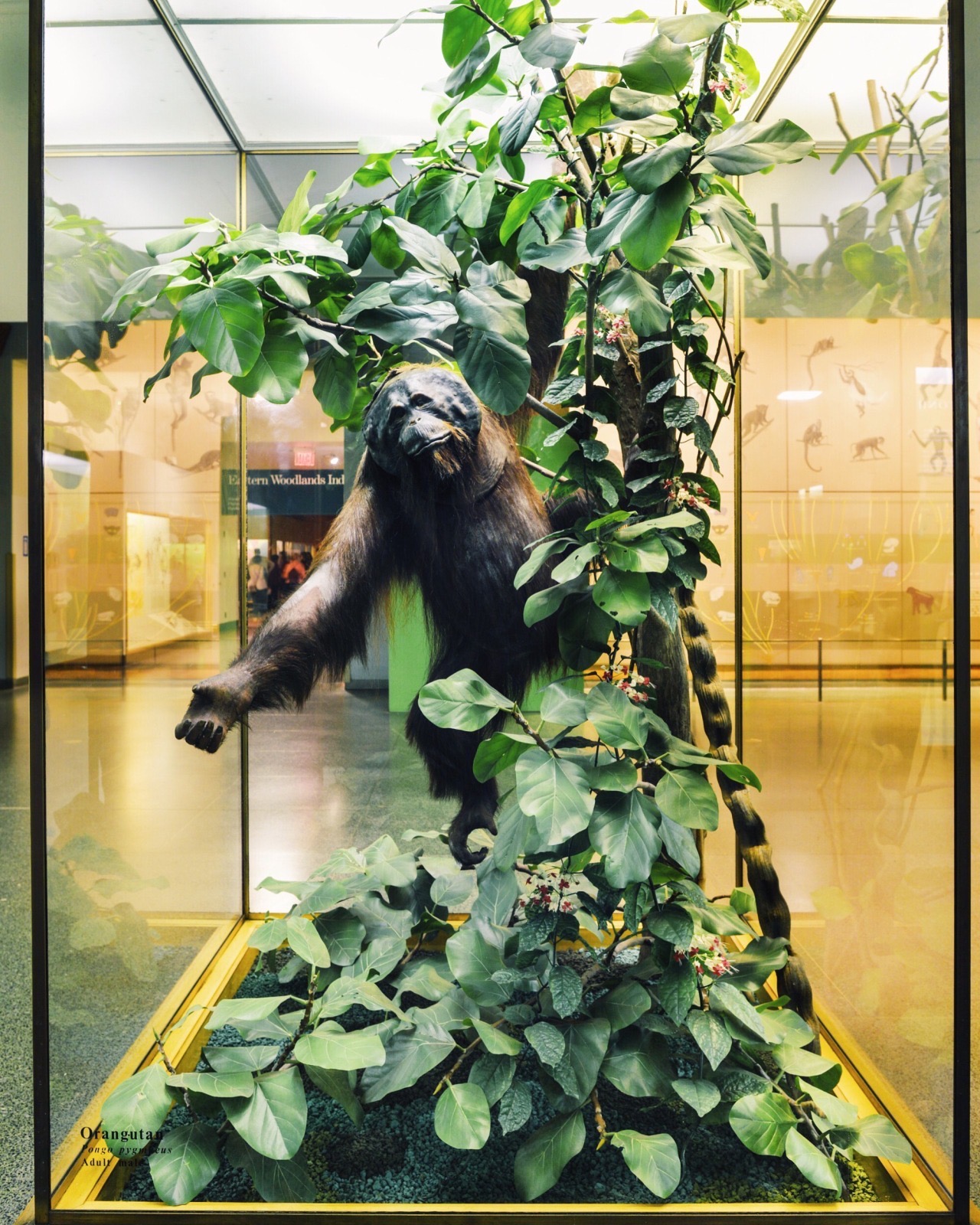
Today there remains only one of Hornaday’s historic orangutan specimens displayed in a glass case at the American Museum of Natural History. Posed swinging from a vine in a lush leafy tropical jungle habitat, the style of taxidermic representation is one of a ferocious beast, ready to attack with an open mouth and sharp teeth grimacing in an aggressive and threatening manner. As they deteriorate with age and become antiquated, with no scientific value and no longer convincing as realistic recreations, it is rare that museums preserve old taxidermic mounts such as this one.
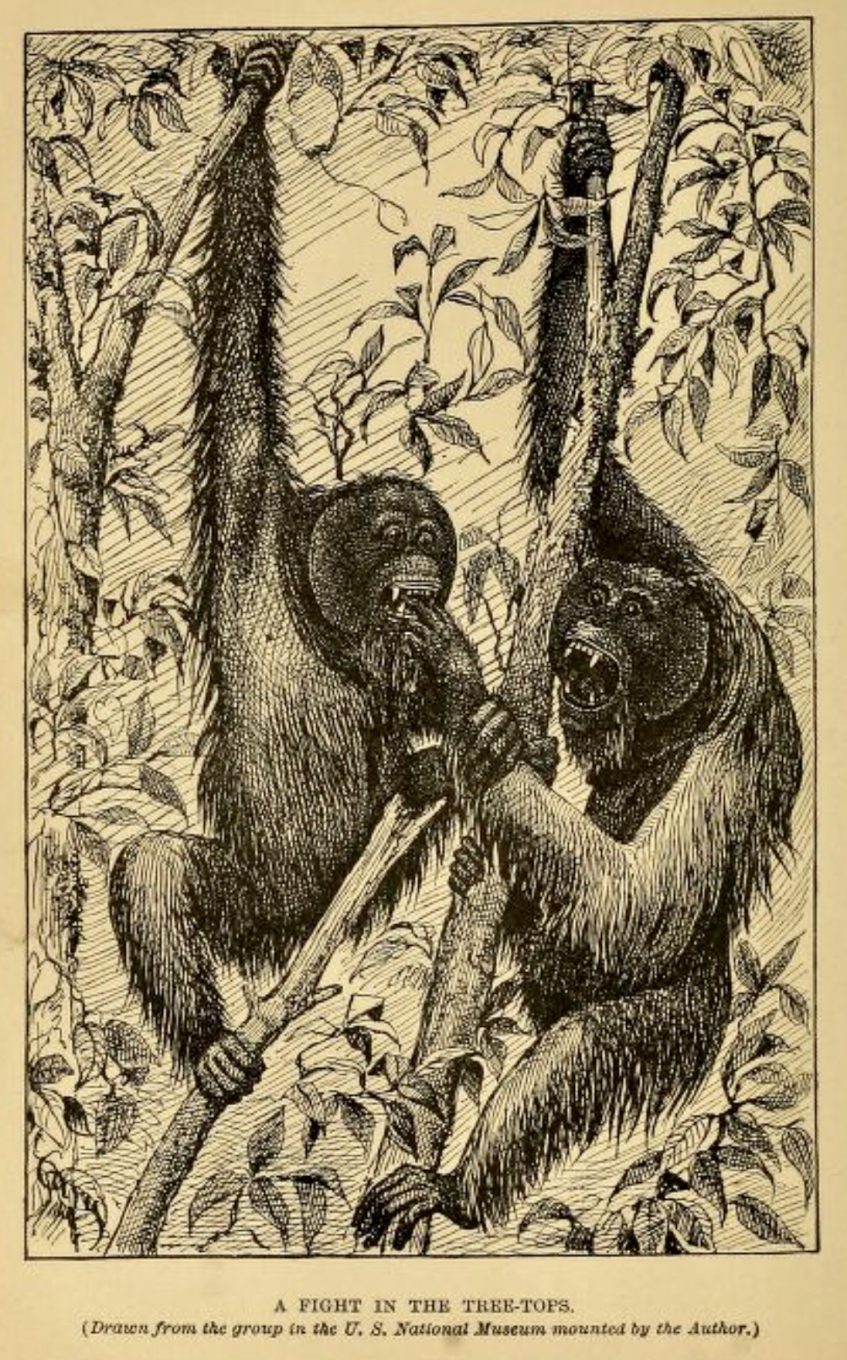
On his return to the US in 1879, Hornaday created a group of mounted orangutans that he planed to be “a trifle sensational” in that it represented “a pair of immense and hideously ugly male orangutans fighting furiously while they hung suspended in the tree tops.” The accessories for the group represented an actual section of the top of a Bornean forest, thirty feet from the ground and included trees, leaves, orchids, pepper vines and moss. The group, called “A Fight in the Tree Tops,” is an early example of the habitat concept of exhibiting animals which evolved into the habitat diorama with its painted background. First exhibited in 1879 at a meeting of the American Association for the Advancement of Science, it attracted much attention as an innovative form of museum taxidermy for large mammals. Hornaday used the group to illustrate the scientific paper he presented on “The Species of Bornean Orangs.” One scientist, G. Brown Goode, assistant director of the US National Museum, was so impressed that he acquired it for the museum in 1883 where it remained for at least 40 years. In 1880, Hornaday displayed his group at the first meeting of the Society of American Taxidermists where it was awarded a medal for the best piece in the exhibition.
Hornaday published an illustration of “A Fight in the Tree Tops” in the the narrative he wrote about his collecting expedition: Two Years in the Jungle: The Experiences of an Hunter and Naturalist in India, Ceylon, the Malay Peninsula and Borneo (1885). The woodcut is described as having been “Drawn from the group in the U.S. National Museum mounted by the Author.” In one passage, Hornaday described one of the orangutans that he killed and later stuffed for his “sanguinary” group: “I can never forget the strange and even awful sensation with which I regarded the face of the dying animal. There was nothing in it in the least suggestive of anything human, but I felt as if I had shot some grim and terrible gnome or river god, a satyr.” Named the Rajah, Hornaday claimed it was the largest ever shot by a naturalist, a perfect giant in size: “his head, body and limbs were simply immense.”
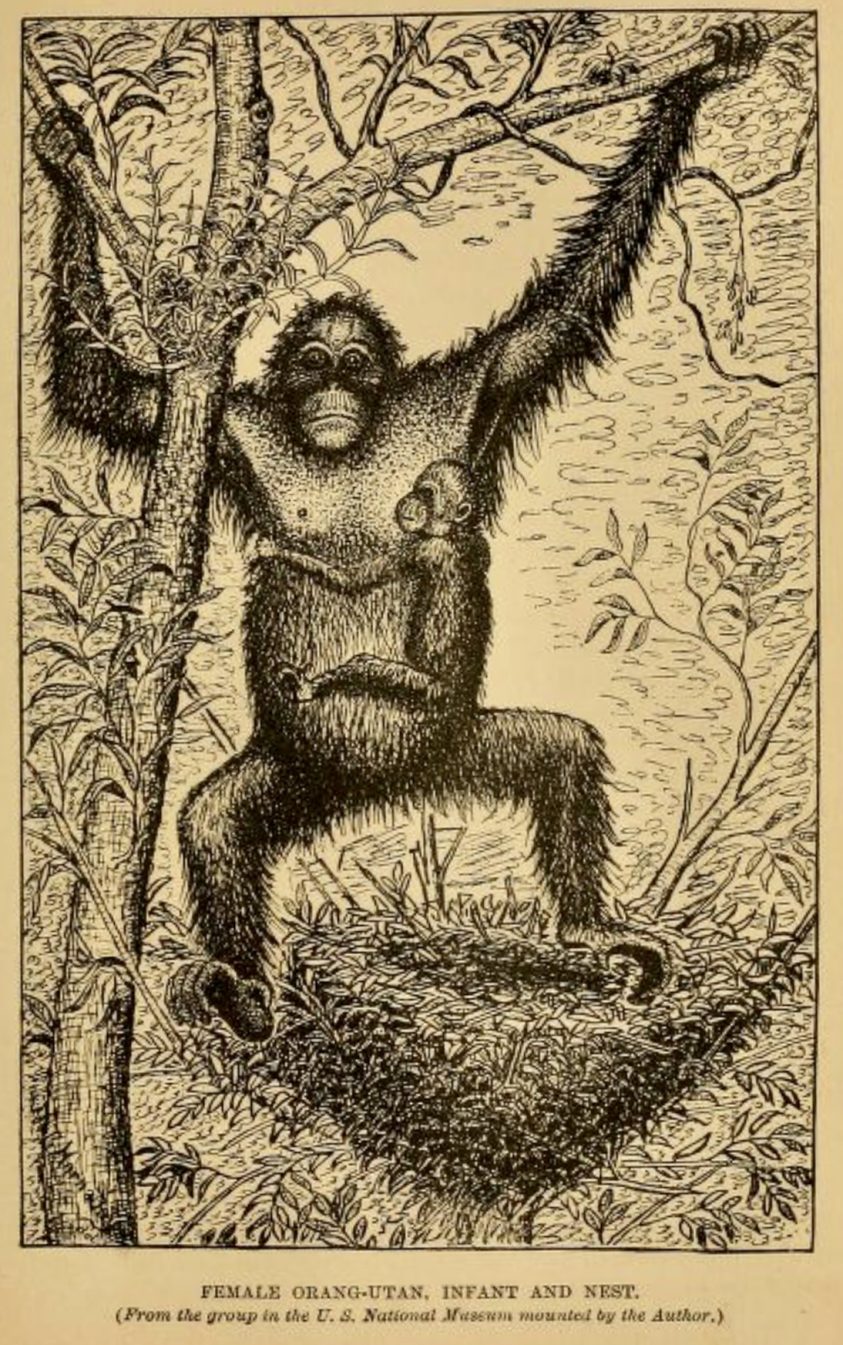
“A Fight in the Tree Tops” included three orangutans that were not illustrated in the woodcut. According to Hornaday’s description of the taxidermic scenario he created, the furious fight was caused when the father of an Orangutan family had been attacked by a rival for the affection of the female orangutan who had an infant clinging to her breast. She hastily left her nest to retreat to higher branches where a fourth young orangutan was fearfully watching the jungle fracas below. A second woodcut, titled. “Female Orang-Utan, Infant and Nest,” was included in Hornaday’s book, also drawn from Hornaday’s group at the National Museum. The theatrical combat between two aggressive male rivals seeking to win over a helpless mother was designed to evoke human emotions and empathy. Yet Hornaday challenged any scientist to find fault with its “naturalness,” arguing that the orangutans were represented in natural attitudes that were the result of his field studies of the life and habits of the species.
Hornaday’s description of killing the mother orangutan and her infant makes clear his collecting zeal: “As soon as I fired at her, she climbed with all haste up to her little one, which quickly clasped her round the body, holding on by grasping her hair, and, with the little one clinging to her, the mother started to climb rapidly away. . . She was resting on a couple of branches, badly wounded, with her baby still clinging to her body in great fright.” After finishing her off, Hornaday scrambled to collect her infant who had fallen to the ground. Young living orangutans had high value in the wild animal trade of the time. But according to Hornaday, the distressed eleven pound six month old baby seemed possessed of a little devil and had the temper of a tiger. “Two hours later,” he wrote “the little baby orang relieved me of all anxiety on its account by dying.” Hornaday was then able to get to work to skin and skeletonize the seven dead orangutans, big and little, that he had killed that day. Due to their rarity, both skins and skeletons were equally valuable and it was essential to preserve them properly for transport.
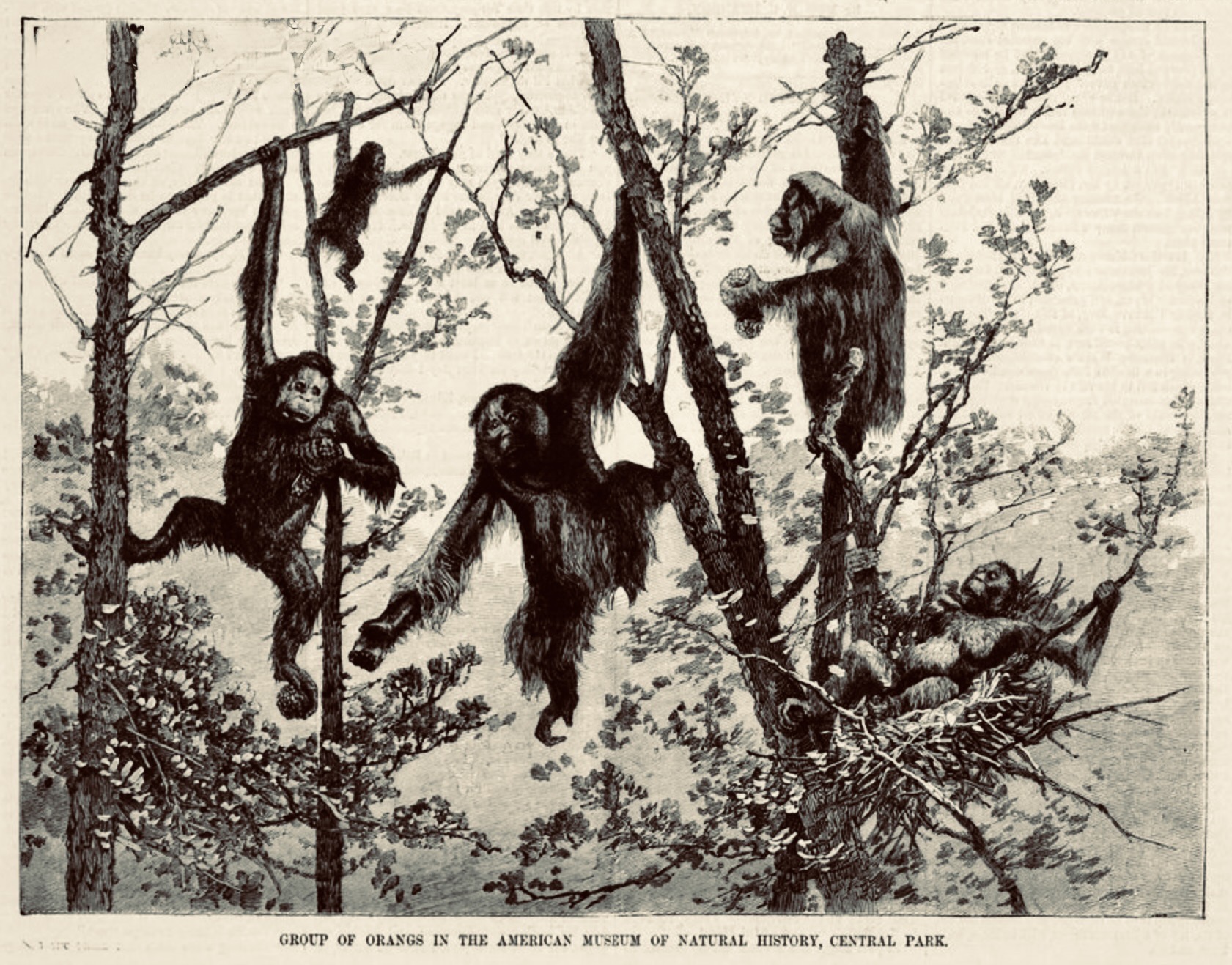
In 1880, the American Museum of Natural History commissioned from Hornaday another group of five orangutans entitled “The Orang Utan at Home.” It depicted the home of the orangutan high in a Borneo forest and featured five specimens “of varying sizes and ages, feeding on durians, sleeping in a nest, climbing, sitting, and swinging.” A woodcut of the group by Dan Beard, a noted American illustrator, was widely published, including in Harpers Weekly (1880), Scientific American Supplement (1883), and Scribners (1896). In his narrative, Hornaday described one of the featured specimens in his group as being in prime fighting condition though disfigured by injuries: “He bore the scars of many a hard fought battle” including pieces bitten out of both lips, missing fingers and toes, misshapen joints, shattered teeth and so on. Despite his diminished value as a trophy specimen, Hornaday killed the old veteran, stating “But, alas! for him, his fighting days are over, and he now peacefully sits on the branch of a tree in the American Museum of Natural History, quietly eating a wax durian.”
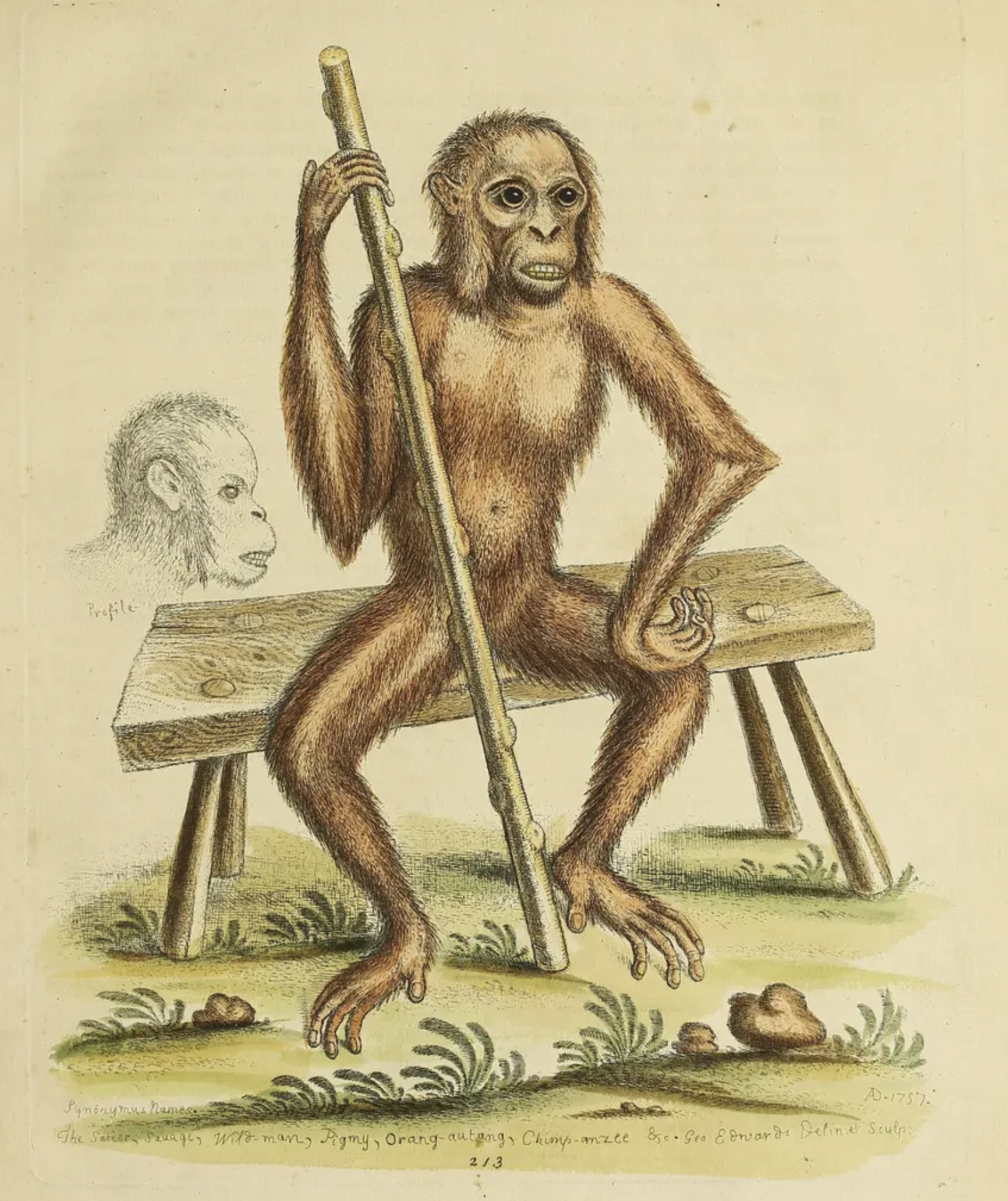
The 1885 Visitors’ Guide to the American Museum of Natural History devoted a couple of pages to “A Fight in the Tree Tops,” describing the group and reproducing part of an interview Hornaday had given to the Washington Post about his collecting adventures in Borneo. Almost 50 years later, a photograph of the same group by Hornaday, now referred to as a “habitat group,” was used in a book titled The Brain From Ape to Man (1928), by Frederick Tilney. Much of Tilney’s comparative evolutionary research for this landmark work was done in collaboration with the American Museum of Natural History and the museum’s president, Henry Fairfield Osborn, wrote the introduction to the book. A paleontologist, Osborn was the first scientist to take the position as president, which he held from 1908 to 1933. He supported the popularizing of science through visual means and instigated many of the great halls of habitat dioramas at the museum. In addition to Hornaday’s orangutan group, Tilney used photographs of other habitat groups of apes in his book to illustrate the physical posture, environmental context and anatomy of the higher primates. Tilney’s central thesis was that environment and behavior dictate brain evolution. He argued that a primate’s physical surroundings, such as living in trees versus walking on the ground, forced adaptations in posture, locomotion and hand usage. This research was the modern continuation of a scientific inquiry that began in the 19th century, when non human primate anatomy was used to investigate the evolutionary relationship between apes and humans, popularized as the “missing link,” which catapulted the collection, dissection and display of great apes into scientific and popular prominence.
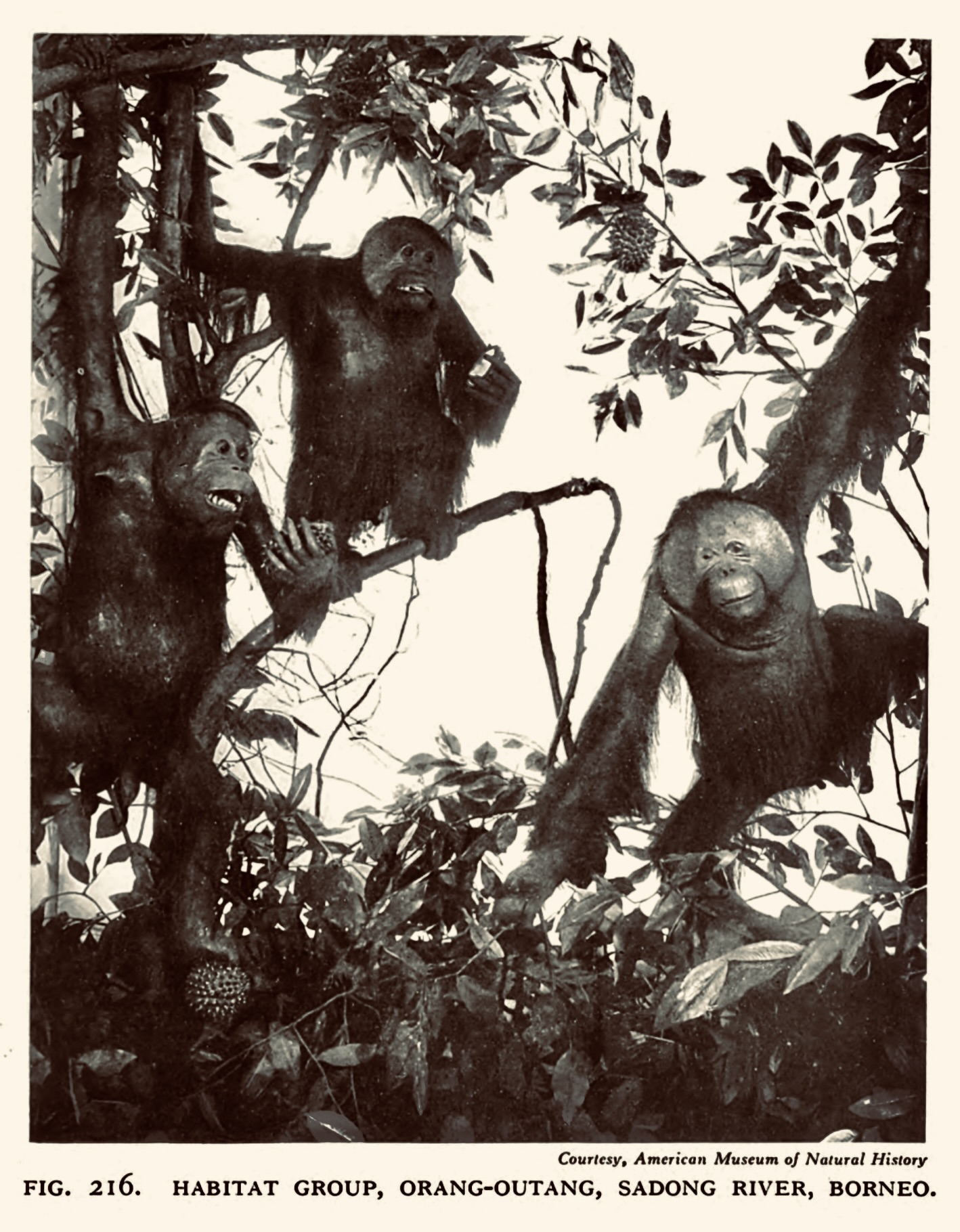
One of the first representations of the Orangutan was an engraving published in Gleanings of Natural History (1757) by the English naturalist and ornithologist George Edwards. Titled “The Satier, Savage, Wild man, Pigmy, Orang autang, Chimp anzee,” Edwards had sketched a real orangutan that had died at a young age and was in the British Museum. He explained that the animal had been soaked in wine to preserve it, then dried and set up in the position from which he drew it, sitting on a bench and holding onto a walking stick. Edwards used the term “Orang Outang” (a Malay phrase meaning “Man of the Woods”) which was used by Europeans in the 1700s as a blanket term for all large tailless apes, thus conflating African chimpanzees with Asian orangutans.
Edwards compared his sketch of the orangutan with other illustrations such as the one by Captain Daniel Beeckman, published in his book A Voyage to Borneo (1718). Beeckman claimed that the apes “have no hair but on those parts where it grows on human bodies.” But Edwards was skeptical: “if this be true, it is nearer the human species than what is here figured.” The specimen that Edwards had drawn was covered in hair as seen in the profile head which “gives the manner of the growth of the hair.” He wrote that the orangutan “had two nipples, situated as in man: the face and naked parts of the paws were of a swarthy flesh colour: the body and limbs were covered with a loose, shaggy, reddish brown hair, thicker on the hinder parts, and thinner before: the hair from the hand to the elbow inclined towards the elbows.”
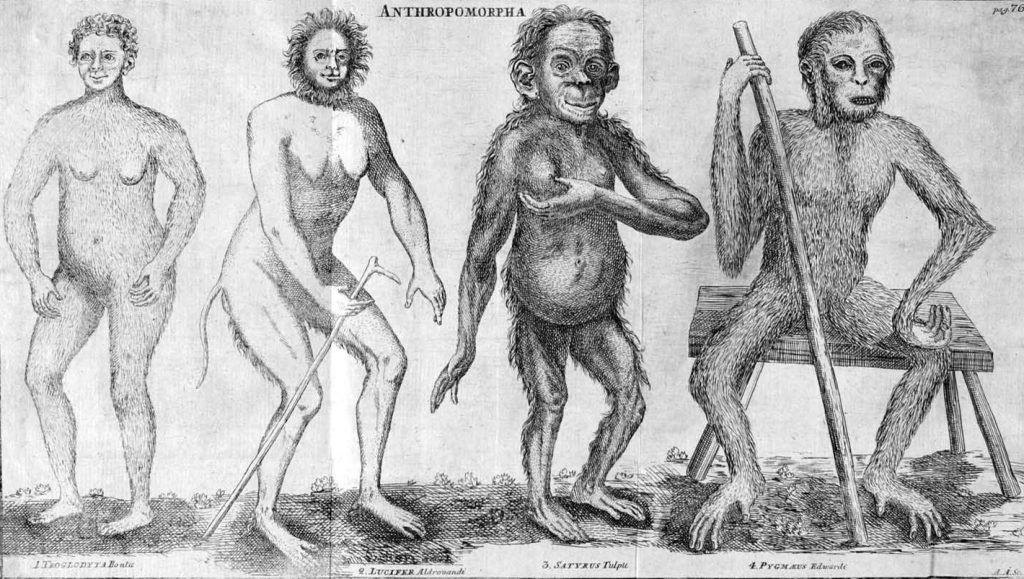
In his 1760 dissertation, Anthropomorpha, C. E. Hoppius featured an illustration of four “apemen:” Troglodyta bontii, Lucifer aldrovandi, Satyrus tulpii, and Pygmaeus edwardi, the last of which was copied from Edward’s 1758 Orangutan engraving. Antropomorpha was the original ordinal name used by Linnaeus in his Systema Naturae (1735) to group humans (Homo), apes and monkeys (Simia), and sloths (Bradypus), marking the first time humans and non human primates were classified in the same taxon. Linnaeus introduced the new term “Primates” in his 10th edition in 1758, and grouped the orangutan into the genus Homo. As he had never seen an orangutan, Linnaeus classified it as Homo troglodytes (a hairy cave dwelling man that walked on two legs) based on myths and traveller’s tales.
Two years later, the orangutan was given the name Simia pygmaeus, which was chaged again in 1766 by Linnaeus when he recombined the great apes, using the name Simia satyrus. In 1799, the French naturalist Lacépède assigned the generic name Pongo to the orangutan which is still used today. The original holotype specimen for the species was collected in 1704 but later was destroyed in around 1850 in London. (Apparently its skull survives and is preserved in the zoological collections of Uppsala University.) The mystery and confusion around the existence and appearance of the orangutan, made the species into a mythological cryptid for a long period. This began to change gradually as more orangutans were hunted and collected in Borneo and Sumantra and sent back to Europe either as skins and skeletons to museums or alive to menageries.
Due to the Dutch coloniation of the East Indies, Dutch naturalists had the earliest first hand experience with orangutans. In 1770 the Dutch anatomist Petrus Camper became the first to dissect an orangutan and began to campaign against the ape’s supposed abilities to breed with humans, walk like humans and speak like humans. Camper’s anatomical conclusion that the orangutan’s hands and feet were built to grasp on to tree branches like birds and he pointed out the absurdity of illustrating the animal upright with a walking stick.
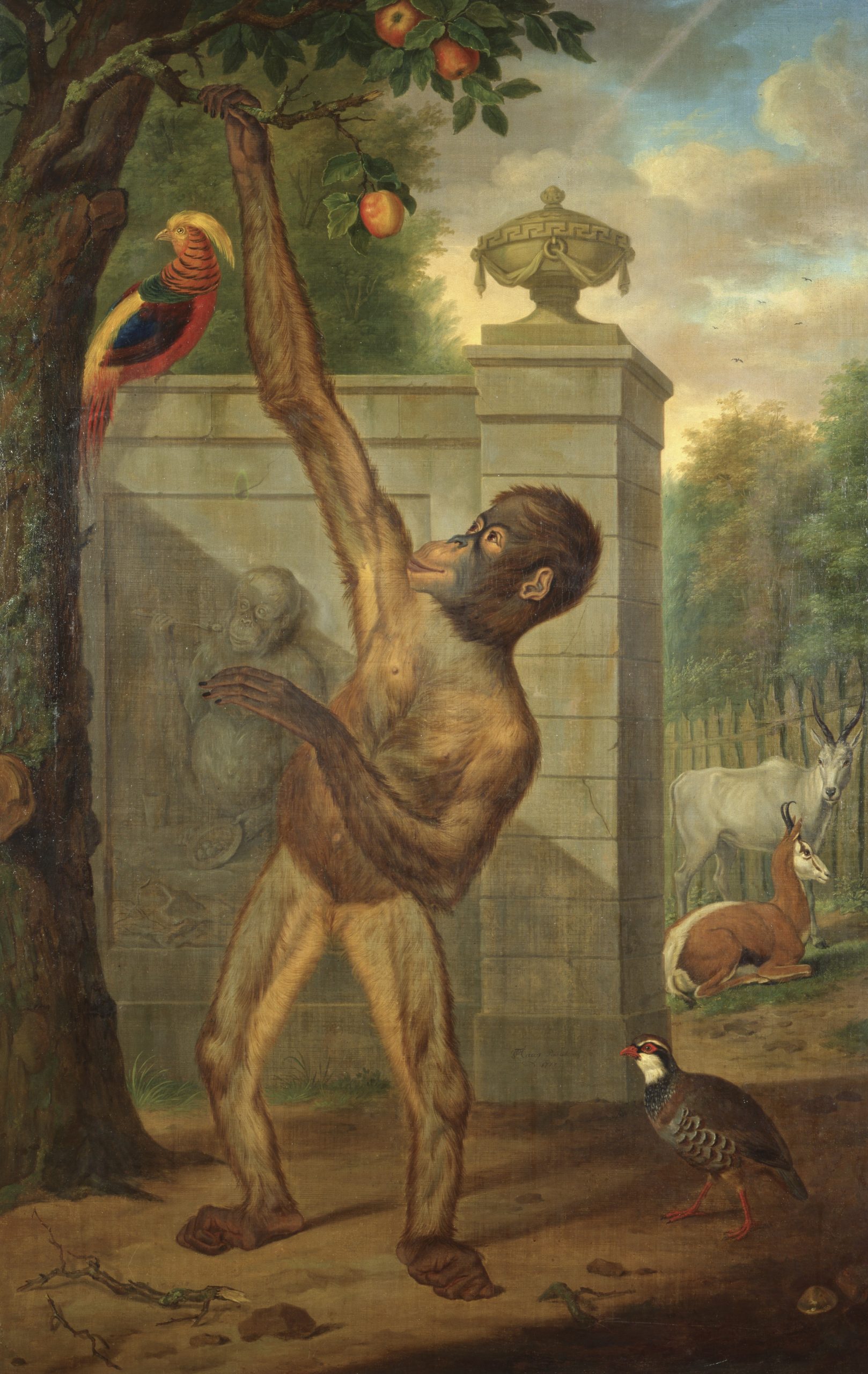
One of the first orangutans to arrive alive in Europe was sent to the menagerie of Willem V, Prince of Orange in 1776. The young animal survived the cold for only a few months but attracted much attention and was painted from life by the court painter T. P. C. Haag in 1777. Shown standing on two legs, the orangutan was given human like qualities. Also the court naturalist Arnout Vosmaer described the animal in detail in a scientific paper published in 1778 that included an illustration of the orangutan by Haag depicting the animal standing on two legs and holding a walking stick. The continuation of the same anthropomorphized iconography in both scientific and artistic representations shows how difficult it was to relinquish.
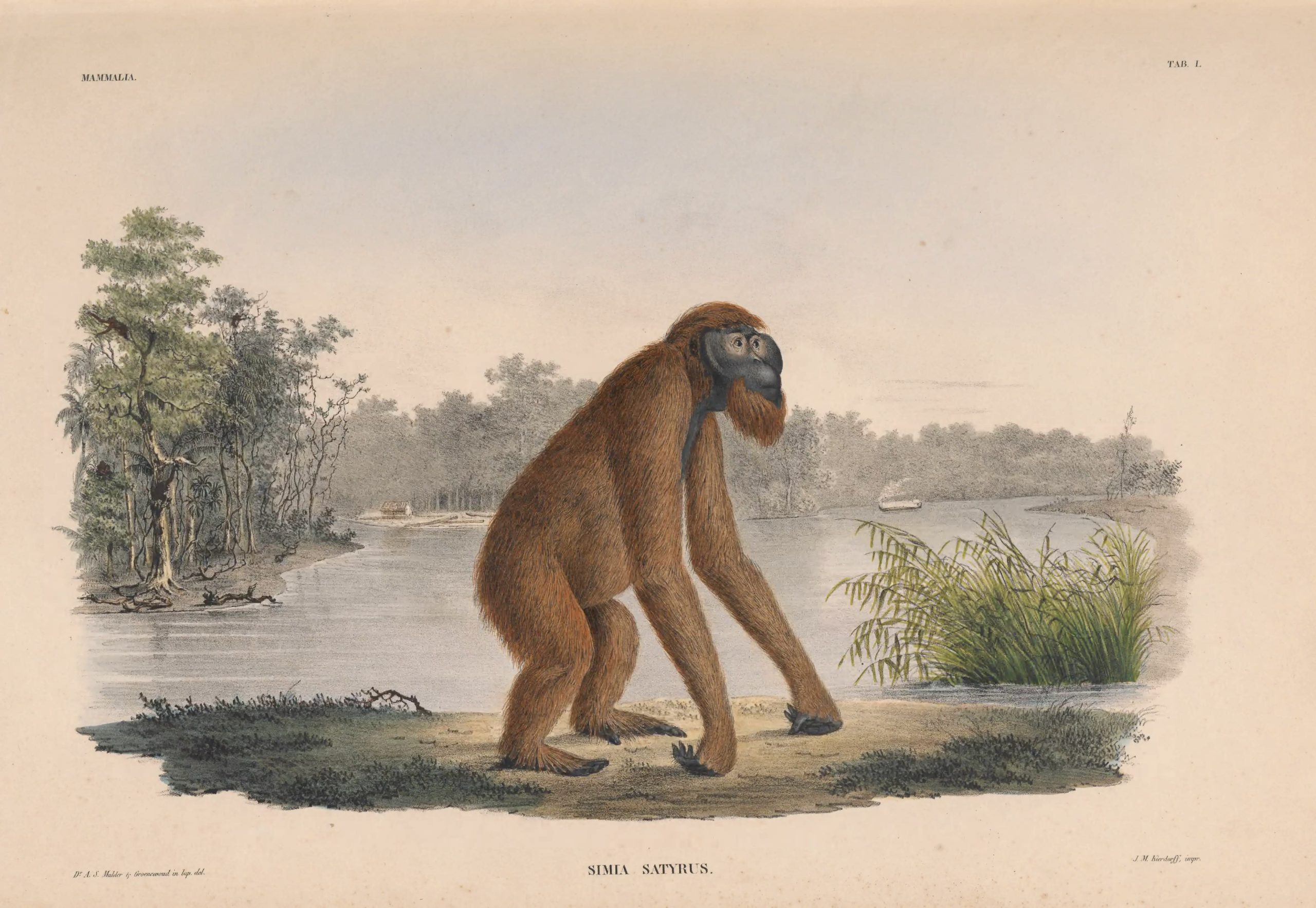
The monumental report Treatises on the Natural History of the Dutch Overseas Possessions (1839 – 1842), edited by the Dutch zoologist Coenraad Jacob Temminck, included a monograph by the German biologist Hermann Schlegel and Dutch naturalist Salomon Müller, published in 1838. The latter had spent years in the East Indies and personally observed the orangutans in their native habitat and made field sketches of them. The plate depicts an old male in a landscape at the river Doeson, in the southern interior of Borneo. This was the earliest trustworthy scientific account of the orangutan, referred to as “Simia Satyrus,” and the iconic plate is one of the earliest naturalistic portrayals of a great ape. It was often reproduced and reprinted in various forms including in the book Man’s Place in Nature (1863) by the English biologist Thomas Henry Huxley which was a groundbreaking work in the history of evolutionary biology, arguing for the first time that humans and apes share a common ancestor.
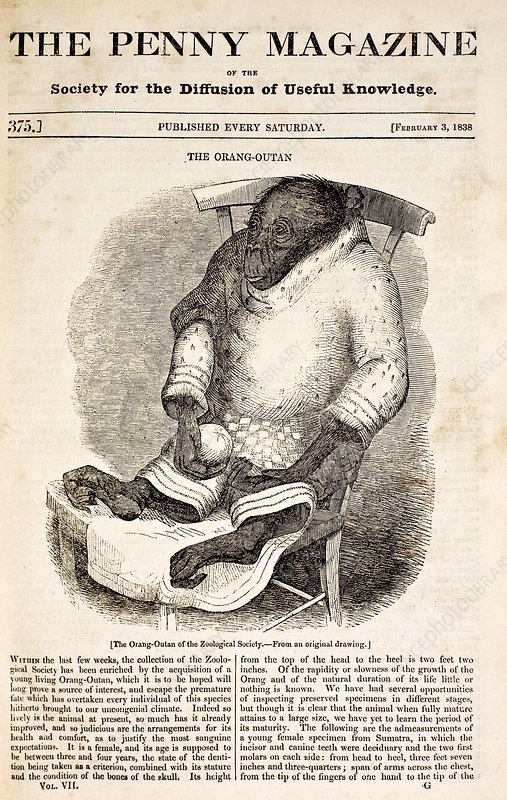
The same year that the Schlegel and Müller engraving of the orangutan was published, a woodcut of the species appeared on the front page of The Penny Magazine (3 February 1838). Described as being drawn from life, it showed the first orangutan to be acquired by the zoo in London. Opened in 1828, this was the world’s oldest scientific zoo, founded by the Zoological Society of London for strictly scientific study. Yet to entertain her viewers, Jenny was dressed in children’s clothes and taught how to perform tricks and drink tea. On 28 March 1838, Charles Darwin (1809 – 1882) came to visit Jenny and was profoundly moved by her, writing in his notebook: “Let man visit Ouranoutang in domestication, hear expressive whine, see its intelligence when spoken [to]; as if it understands every word said – see its affection – to those it knew – see its passion & rage, sulkiness, & very actions of despair . . . and then let him boast of his proud preeminence . . . Man in his arrogance thinks himself a great work, worthy the interposition of a deity. More humble and I believe true to consider him created from animals.” Jenny died soon after Darwom’s visit but was replaced by another young female visited by Queen Victoria who recorded in her diary that the creature was “frightful and painfully and disagreeably human.”
The orangutan was the first non human great ape seen firsthand by Darwin and his co founder of the theory of evolution, Alfred Russel Wallace (1823 – 1913). Although both scientists had strong reactions to their observations of the orangutan, the circumstances were radically different. Darwin met the orangutans in the Zoological Gardens in London while Wallace observed them in the wild in Borneo. In different ways, these experiences are likely to have influenced their understanding of natural selection and the human place in nature.
In the 19th century the organutan increasingly became an object of scientific scrutiny as specimens were acquired in greater numbers by natural history museums. As valuable and rare objects, they were sought after hunters and collectors who also supplied the emerging commercial market in the global trade of wildlife specimens both dead and alive. Sir James Brooke (the first white Rajah of Sarawak), collected 25 skulls and 17 skeletons in 1841 for the Natural History Museum in London. In 1854, Wallace financed an expedition to the Malay Archipelago by collecting natural history specimens. He arrived in Sarawak, Borneo as a guest of Rajah Brooke who provided him with access to the jungles of Bukit Peninjau and Mount Serembu. During his 14 months there, Wallace collected adult orangutans of both sexes, as well as infants, using indigenous hunters and by shooting ten of them himself. In total he collected 29 orangutans which were later sold to European museums.
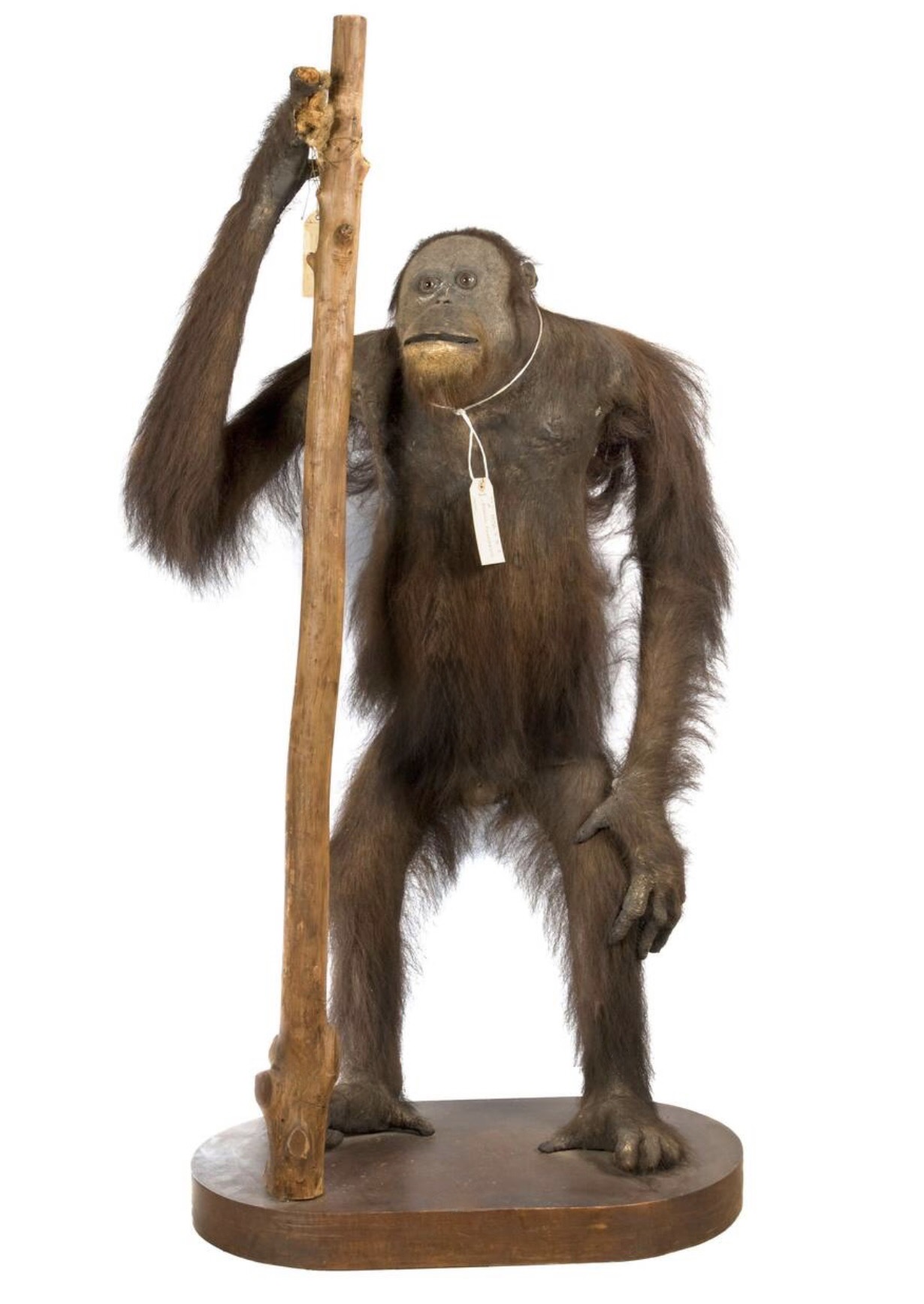
A Bornean orangutan specimen collected by Wallace and held in the Natural HIstory Museum is often featured in discussions regarding the history of evolutionary theory and Wallace’s work in the Malay Archipelago. Surprisingly the taxidermist mounted the skin according to the outdated iconography of a biped ape, standing on two legs with a walking stick, a posture that had originated in the early mythology of the creature as a satyr; a savage, red haired, human like creatures inhabiting remote islands and mountains in Africa. These classical myths fused with European lore about “wild men” who lived deep in the forests and possessed unrestrained appetites. When the first great apes reached Europe in the 17th century, Dutch anatomist Nicolaes Tulp examined a primate and classified it as a satyrus indicus. The enduring nature of this myth is embedded in the orangutan’s initial scientific classification by Linnaeus who gave the it the binomial name Simia satyrus, which translates literally to “satyr monkey.”
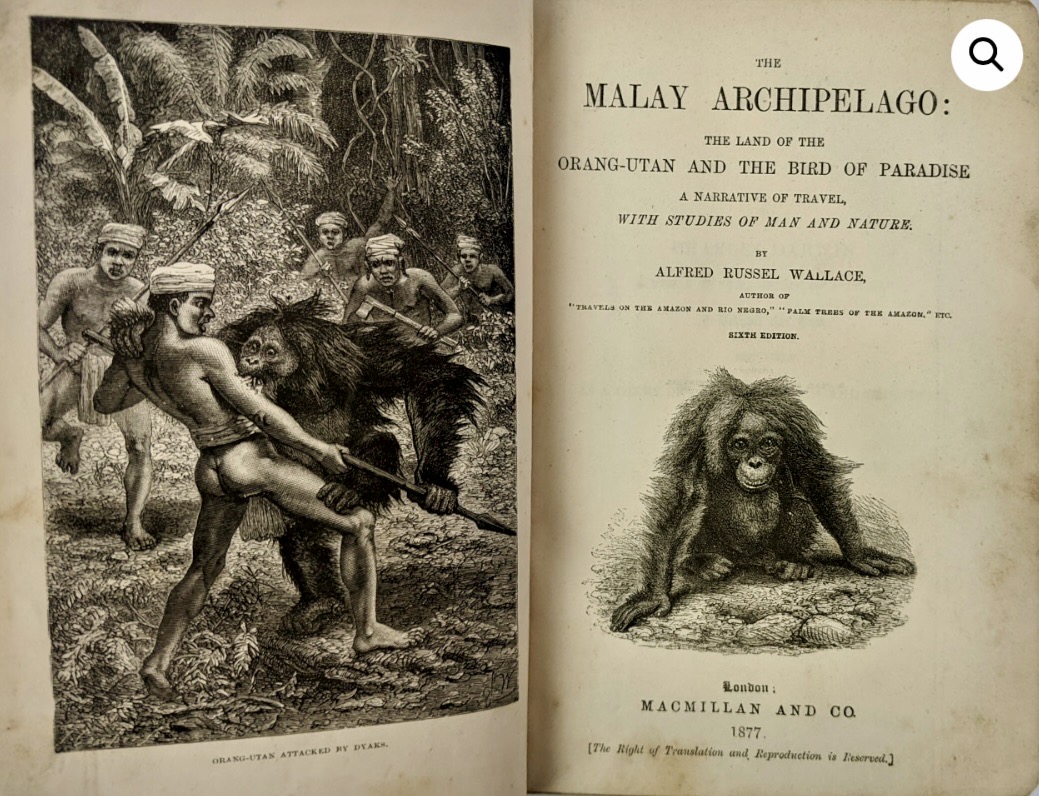
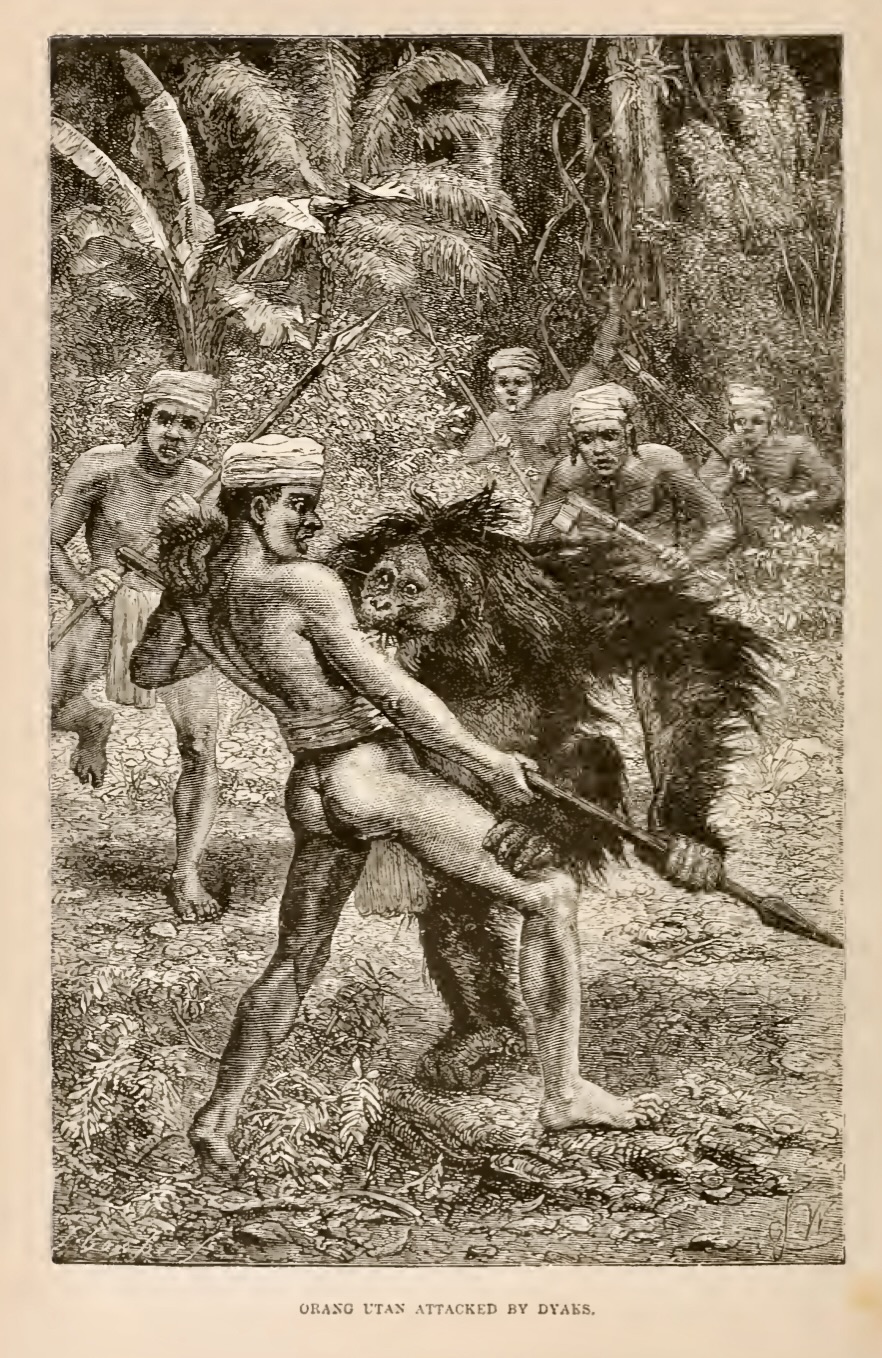
During his eight year expedition, from 1854 to 1862, Wallace travelled over 14,000 miles and collected 125,000 specimens. In 1869, he published a widely popular two volume narrative of his travels: The Malay Archipelago: The Land of the Orang Utan, and the Bird of Paradise. In it he explained that one of his chief objects “was to see the Orang utan (or great man like ape of Borneo) in his native haunts, to study his habitats, and obtain good specimens of the different varieties and species of both sexes, and of the adult and young animals. In all these objects I succeeded beyond my expectations.” The frontispiece to his book shows a ferocious battle between an orangutan and native hunter and a submissive looking female orangutan is depicted on the title page. Wallace, he referred to the first full grown specimen he obtained as a giant male with a perfectly preserved skeleton. In total, five of his orangutan trophies ended up in Liverpool on the 18th March 1857, purchased through Wallace’s London agent.
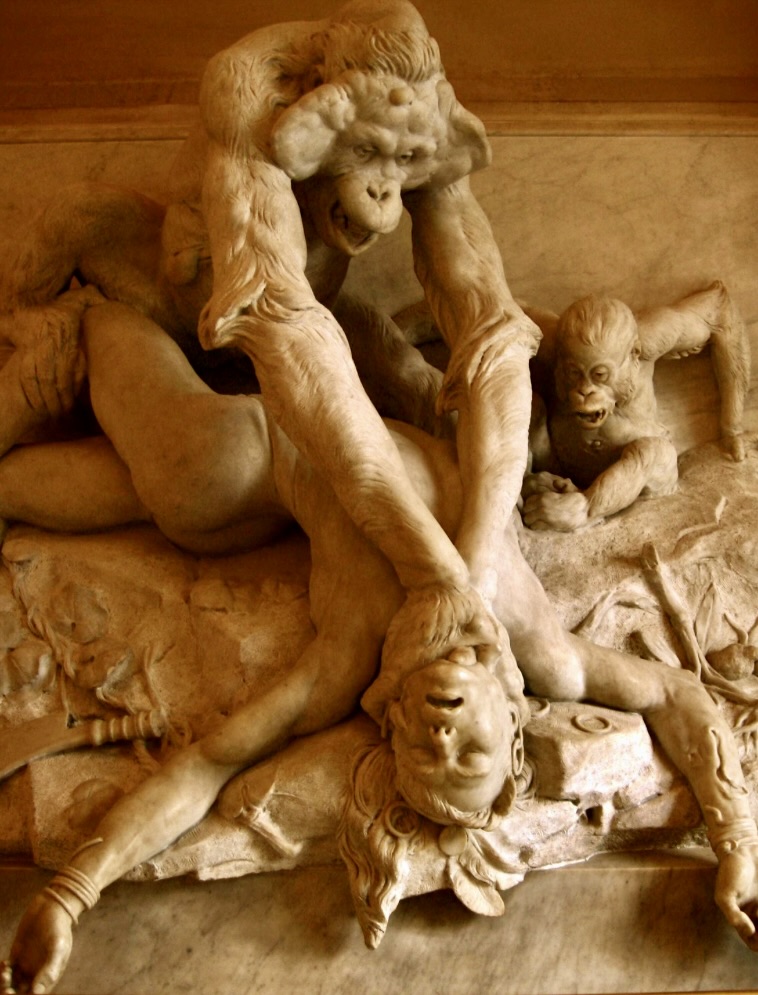
The same ferocious portrayal of an attacking orangutan was the subect of a scupture commissioned in 1898 by the Paris Museum of Natural History (Muséum National d’Histoire Naturelle). The artist was Emmanuel Frémiet (1824 –1910), a distinguished professor of Animal Drawing and Modelling at the Jardin des Plantes where he studied and sketched live animals, using his scientific knowledge to model his lifelike and dramatic sculptures. The sculpture, titled “Ourang outang etranglant un sauvage de Borneo,” depicts a violent and sanguinary animal strangling a helpless and naked indigenous person while a young orangutan watches the horrifying scene. Frémiet carved his sculpture using as a visual reference the dead body of an orangutan called Maurice who had been captured in Borneo and brought to Paris in 1893, but who died 24 days after his arrival (orangutans did not survive for long in captivity). Sensationalist stories about the aggressive behaviour of Maurice enthralled the public imagination and were emphasized to maximum effect by Frémiet. The sculpture still remains in place today, at the entrance to the Jardin des Plantes.
European observers of orangutans associated the animal with the satyr archetype based on three primary traits. The “Man of the Forest” (the original Malay name for the ape) was identified as the literal realization of the classical myth. Second was the unrestrained temperament of the satyr defined by its uncontrollable physical and sexual desires. Tales by early travelers often projected such traits onto the orangutan, describing males as aggressively lascivious toward human women and even impregnating them. Third was the physicality of the ape with its shaggy red hair and menacing mouth and face.
Wallace’s 1869 travel narrative went through many printings and inspired other hunter naturalists to participate in the sport of killing large and exotic animals from distant parts of the world for the purportedly worthy scientific purpose of adding specimens to natural history museum collections. William Hornaday was one such aspiring collector, and his 1885 travel narrative, Two Years in the Jungle, included similarly entertaining adventure stories, maps, and illustrations. While both men made scientific contributions to the study of these species, their lurid descriptions of killing animals reveal deeply ingrained cultural and gendered stereotypes about hunting. Wallace describes how one orangutan he had shot five times was “howling and hooting with rage,” throwing down branches and refusing to die. The masculinity of the hunter and the great size and danger of his prey are emphasized in the frontispieces of both books: Hornaday depicts himself confronting a menacing, growling tiger, while Wallace shows a native engaged in a life threatening battle with a ferocious attacking Orangutan. The latter illustration was by Joseph Wolf (1820 – 1899), a highly acclaimed German natural history artist.
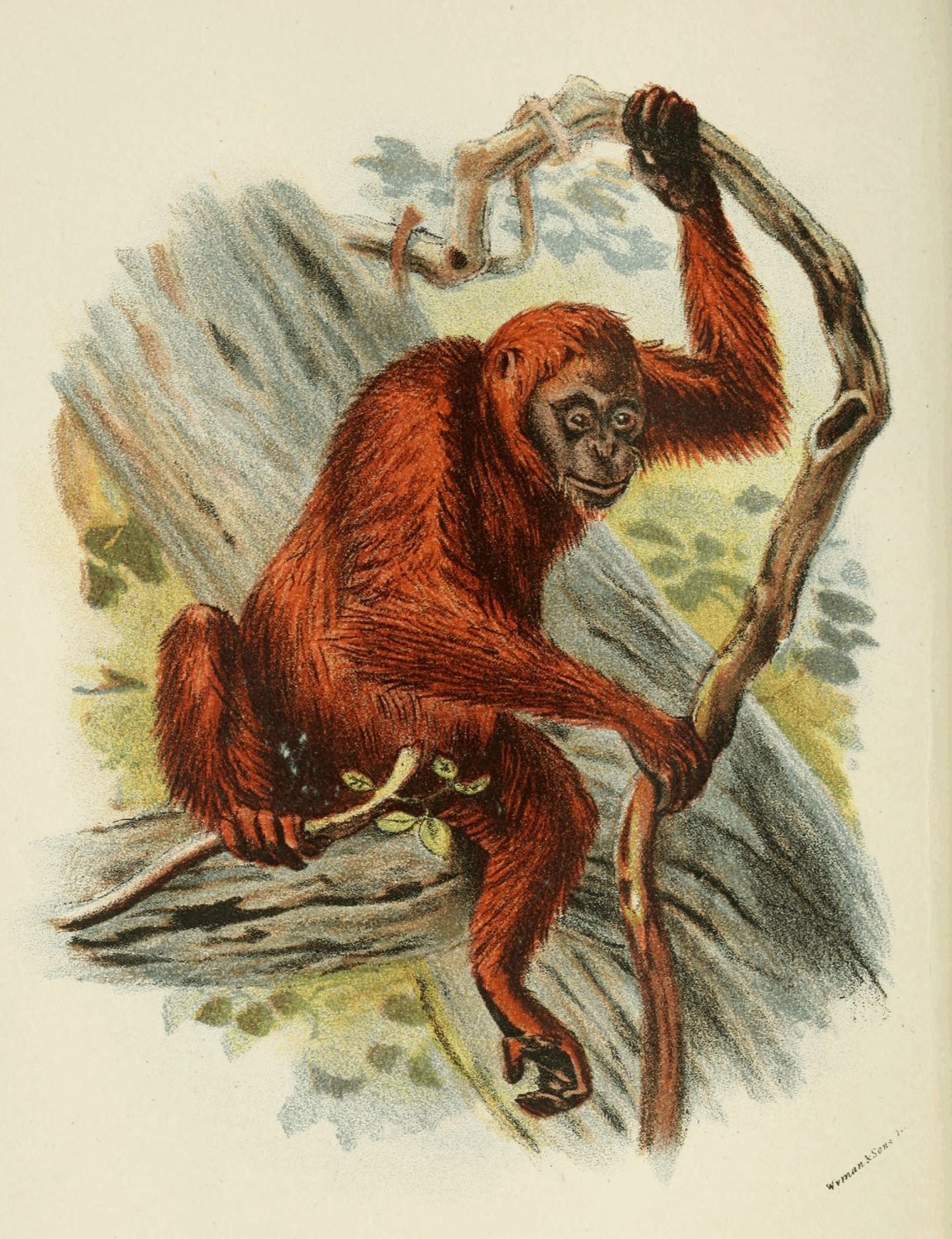
The illustrations in Hornaday’s book, drawn from the taxidermic groups he had created in 1879, are among the earliest to show orangutans swinging from vines in their native jungle habitat. The Dutch natural history illustrator John Gerrard Keulemans (1842 – 1912) similarly depicted an orangutan hanging from vines in a plate for Henry Ogg Forbes’s 1896 Handbook to the Primates. Yet the orangutan was still described by the outdated and derogatory Linnaean name Simia satyrus.